
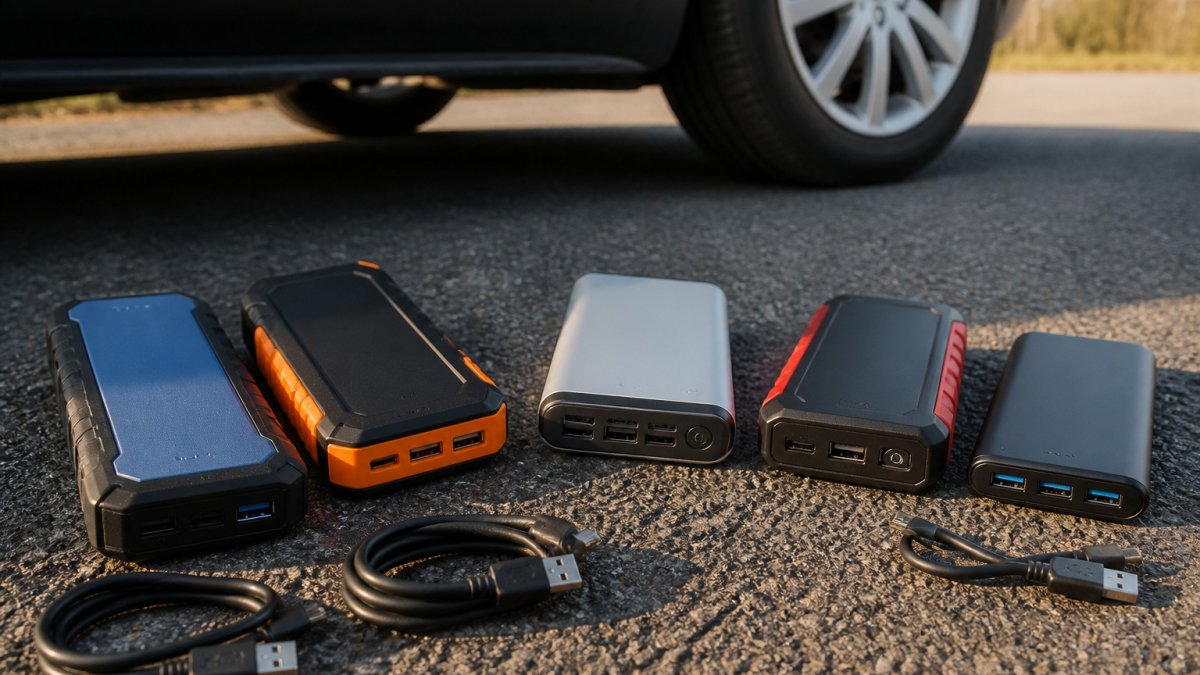
7 Best Portable Power Banks for Car Emergencies 2026
Last Updated: October 31, 2026
Quick Summary
The best portable power banks for car emergencies depend on your main need: a USB power bank keeps phones charged while you wait for recovery, while a portable jump starter is needed to start a flat car battery. Check that a unit is rated for jump-starting before relying on it.
- A USB power bank charges phones and tablets but cannot turn over a flat car battery.
- Portable jump starters deliver a high burst of current to a vehicle’s starter motor.
- Check a jump starter’s peak current against your engine size before relying on it.
- None of the sources verifies that a given product can jump-start a car.
- Keep the power source charged and check the kit before long trips and when clocks change.
Table of Contents
- Power Bank or Jump Starter? Knowing the Difference Before You Buy
- How We Tested and Ranked These Portable Power Banks
- Best Portable Power Banks for Car Emergencies Compared
- How to Use a Portable Jump Starter Safely at the Roadside
- Jump Starter Safety Tips and Failure Scenarios to Plan For
- Building a Car Emergency Kit Around Your Power Source
- Choosing Your Motorway Backup and Getting Roadflash Protection
- Frequently Asked Questions
Power Bank or Jump Starter? Knowing the Difference Before You Buy
Most people searching for the best portable power banks for car emergencies really want a way to get moving again when the battery dies.
A USB power bank charges phones, tablets and other small devices; it cannot turn over a flat car battery.
Our advice: if your main worry is a phone that dies while you wait for recovery, a USB power bank covers that.
How We Tested and Ranked These Portable Power Banks
We ranked these products by checking what each is designed to do, how it is specified, and whether the published information supports the claim.
Our criteria were:
- Primary function: phone charging, jump-starting or general backup power
- Stated capacity and output: only where the supplier or reviewer specified it
- Portability: how easily the unit fits in a glovebox or boot
Best Portable Power Banks for Car Emergencies Compared
The table below summarises the seven options. Read it as a starting point, then check the detail in each section.
| Product | Main Use | Stated Capacity or Output | Price (GBP) | Best For |
|---|---|---|---|---|
| Belkin BoostCharge Plus 10K | Phone charging | 10,000 mAh | From £47 | Compact phone backup |
| Belkin 10K 23W | Phone charging | 10K, 23W output | From £47 | Faster phone top-ups |
| Cougar power bank | General charging | Not specified in sources | From £42 | Budget general backup |
| iWalk 5th Gen | Emergency phone backup | Pocket-size | Contact for pricing | Pocket carry |
| Bluetti Elite 200 V2 | Portable power station | Efficiency-rated | Contact for pricing | Larger backup needs |
| Jackery power stations | Portable power station | Range, model not specified | Contact for pricing | Road-trip power |
| Anker power stations | Portable power station | Range, model not specified | Contact for pricing | Comparing station options |
| EcoFlow power stations | Portable power station | Range, model not specified | Contact for pricing | Comparing station options |
| Goal Zero Yeti | Portable power station | Range, model not specified | Contact for pricing | Comparing station options |
Pricing depends on model, bundle and retailer, so check the manufacturer’s site for a current figure.
Before you go further, one caution. None of the sources we used verifies that a given product can jump-start a car. If that is your main need, confirm the jump-start rating with the manufacturer before buying.
Phone-Charging Power Banks for Light Emergencies
These units suit drivers whose main concern is keeping a phone alive during a breakdown or a long wait for recovery.
Belkin BoostCharge Plus 10K
A 10,000 mAh power bank. It is compact, which helps it stay in a glovebox.
- Pros: the 10K capacity is clearly stated.
- Cons: jump-start capability is not confirmed; confirm the UK price directly with the retailer.
- Best for: drivers who want a dependable phone backup.
Belkin 10K 23W
A 10K portable charger with 23W output, which means faster charging for compatible devices.
- Pros: capacity and output are specified; suitable for personal devices.
- Cons: no verified jump-start capability; UK pricing not confirmed.
- Best for: drivers who want quicker top-ups from a small unit.
Cougar power bank
A general portable charger.
- Pros: works as a backup for personal devices.
- Cons: capacity and output not given in the sources; no verified jump-start capability.
- Best for: budget-conscious drivers who want a basic backup.
iWalk 5th Gen portable charger
A pocket-size charger.
- Pros: compact enough for pocket carry.
- Cons: jump-start capability not verified.
- Best for: drivers who want the smallest possible backup for a phone.
Portable Power Stations for Larger Backup Needs
Power stations hold more energy and can run larger devices. They are heavier, so they suit people with boot space and a need beyond phone charging.
Bluetti Elite 200 V2
-
Cons: a large unit is less convenient to carry than a phone power bank; UK price not verified.
-
Best for: drivers needing substantial backup power on road trips.
-
Pros: each brand was included in a head-to-head comparison.
-
Cons: model-level specifications and UK prices were not verified in our sources.
-
Best for: drivers comparing larger stations. Shortlist two or three, then check each model’s spec sheet.
How to Use a Portable Jump Starter Safely at the Roadside
If you own a unit that can jump-start a car, the process is straightforward, but the order of steps matters.
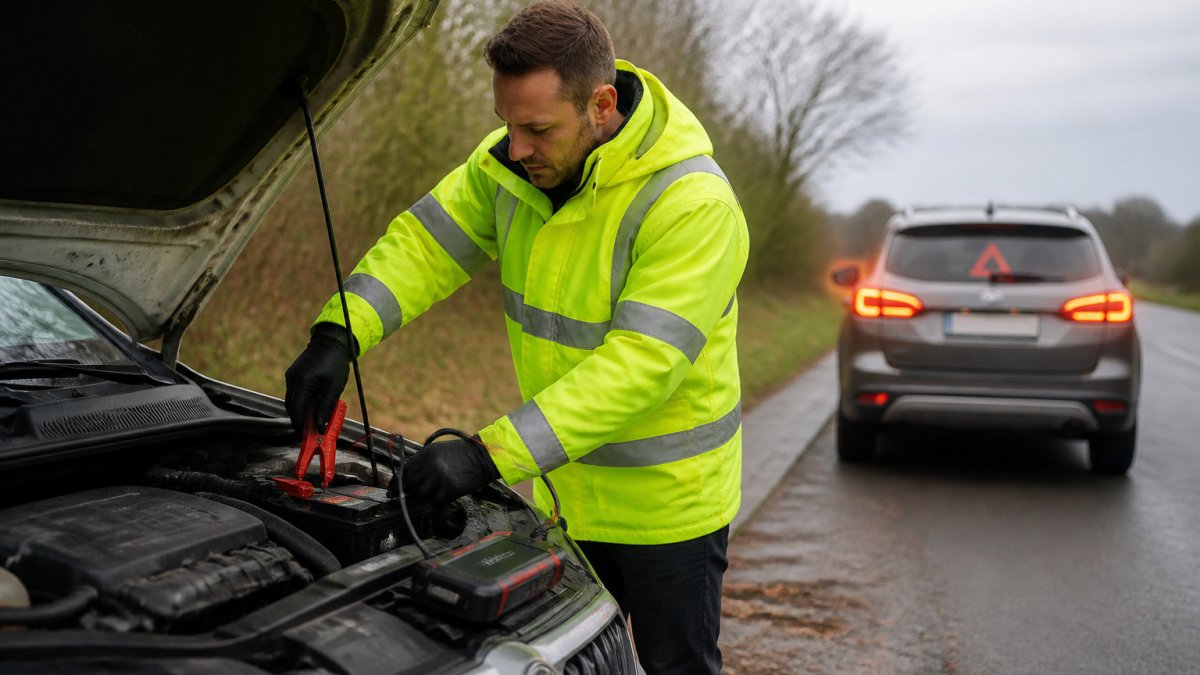
!A driver in a high-visibility jacket connecting clamps to a car battery at the side of a quiet road, hazard lights flashing
Turn the ignition off in both vehicles. For the official rules on what to do if you break down on a motorway, see Motorway Breakdown Rules: Highway Code Guide.
Start the vehicle, let the engine run, then disconnect the clamps in reverse order. Keep the clamps from touching each other while connected.
Jump Starter Safety Tips and Failure Scenarios to Plan For
Most jump-start problems come from skipped steps rather than faulty equipment.
Before you connect
- Check polarity and terminal condition. Reversed clamps can damage electronics; look for reverse-polarity protection in the spec sheet, and never connect to a terminal that is cracked, corroded or loose. A loose terminal can arc under load.
- Do not jump a damaged or leaking battery. A battery that is swollen, smells of rotten eggs, or has visible electrolyte leakage should not be jumped. Stop and call for recovery.
- Confirm the unit is rated for your engine. A jump starter rated for a 2.0-litre petrol engine may not turn over a 3.0-litre diesel, especially in cold weather. Check peak current against engine size before you rely on it.
If the first attempt fails
A failed start is information, not a reason to keep trying. Work through the likely causes in order:
- Poor connection. Clamps on paint, corrosion or a loose terminal will not pass enough current. Re-seat the clamps on clean metal and try once more.
- Battery too flat. Some jump starters will not deliver full output into a deeply discharged battery. If the unit has a boost or override button, follow the manual exactly; do not improvise.
- Starter or fuel fault. If the engine turns over but will not fire, the problem is not the battery. Repeated cranking can overheat the jump starter and flatten the vehicle battery further.
- Unit too small. A unit at the bottom of its engine-size range may crank slowly and fail. That is a specification mismatch, not a fault.
A common pattern is two or three attempts, then stop. If the car has not started by then, the battery may be beyond a jump, the starter may be faulty, or there may be a fuel or ignition fault. Call roadside assistance rather than cycling the unit until it overheats.
Never leave a jump starter connected after the engine starts, and never let the clamps touch each other while the unit is switched on. Both can damage the unit or the vehicle’s electronics.
After a successful start
Disconnect in reverse order, keep the engine running, and drive for at least twenty to thirty minutes to put charge back into the battery. If the car struggles to restart the next day, the battery is likely failing and needs testing rather than another jump.
A common mistake is buying a phone power bank and assuming it will start a car. Confirm the rating before you rely on it.
Building a Car Emergency Kit Around Your Power Source
Your power source is one part of a kit, but the kit is only useful if it is charged, reachable and still working when you need it. The harder part is keeping it ready across seasons and long periods without use.
What goes in the kit
- A charged power bank or jump starter, plus its charging cable and any jump leads
- A torch or emergency light, with spare batteries or a built-in rechargeable cell
- A warning triangle and hi-vis vest where the law requires them
Keeping it ready: the part most guides skip
A kit that lives in the boot for a year is not automatically ready. Batteries self-discharge, cold weather reduces usable capacity, and an unused jump starter may have less output than its label suggests.
- Recharge on a schedule. Top up the power bank or jump starter regularly, and note the date on a sticker or in your phone calendar.
- Check before long trips. Before a long drive or a winter journey, confirm the unit holds charge and that the cables and clamps are undamaged.
- Respect temperature limits. Do not leave a power bank on a dashboard in summer; store it in the glovebox or a shaded part of the boot.
A simple habit: when you change the clocks, check the kit. Recharge the power source, test the torch, and confirm the breakdown cover number is still current.
If you drive long distances, check the kit twice a year and recharge batteries at the same time. The goal is not a perfect kit but one you know works.
Choosing Your Motorway Backup and Getting Roadflash Protection
On a motorway, the biggest risk is often not the breakdown but the moment other traffic passes close by. A power source gets you ready to act.
This is where Roadflash fits. Comprehensive safety requires more than just illumination and power, so integrating essential car emergency kit components ensures you are prepared for medical needs as well as mechanical failures.
Pricing for Roadflash products depends on the model and quantity, so visit the Roadflash website for current prices or a quote. For a deeper look at what to do once you have stopped, see what to do if your car breaks down in heavy traffic, and for calling for help on the M6, see how to call for help when broken down on the M6. If you are weighing beacons against each other, read our emergency beacon review for UK motorway safety.
Keep your power bank charged, your beacon visible and your breakdown cover details to hand. That combination covers most of the situations this guide is about.
Frequently Asked Questions
What is the best portable power bank for car emergencies?
The best choice depends on whether you need to jump-start a car or only charge a phone. For jump-starting, look for a unit rated for starting power suited to your engine size and with reverse-polarity and short-circuit protection. For phone charging alone, a compact power bank with a stated capacity is usually enough. Check each model’s specification sheet rather than relying on the product name, and confirm current UK prices directly with the retailer or manufacturer, as pricing varies by model, stock and delivery.
Can a portable power bank jump-start a car?
Not every power bank can. A standard phone power bank typically lacks the peak current needed to turn over a car engine. A portable jump starter is designed for that job and states its peak current and engine compatibility. Where a supplier’s specification does not clearly confirm jump-start capability, do not assume it. Check the rated peak current against your engine size, and keep the unit charged so it is ready when you need it.
What is the difference between a car jump starter and a power bank?
A car jump starter delivers a high burst of current to start an engine with a flat battery. A power bank is built mainly to charge USB devices such as phones and tablets. Some units combine both functions, but their ratings differ. Look at peak current for starting power and USB output for device charging. Treat a power bank as a charging backup, not a guaranteed way to restart a car.
How do you safely use a portable jump starter?
Check the unit is charged before you leave home. Switch off both vehicles, connect the red clamp to the positive terminal of the flat battery, then the black clamp to a bare metal earth point away from the battery. Start the donor unit, wait a few minutes, then try starting the car. Keep clamps clear of moving parts and never let the clamps touch each other. Disconnect in reverse order once the engine is running.
