
How to Call for Help When Broken Down on M6: 2026 Guide
Table of Contents
- Motorway Breakdown Safety Procedure: Your First Actions
- How to Use Emergency Roadside Telephones
- Calling for Help When Broken Down on M6: Mobile, Apps and What to Say
- High Visibility Roadside Safety Equipment That Saves Lives
- EV Breakdowns, Accessibility and Night-Time: What Most Guides Miss
- Warning Other Traffic: Hazard Lights, Triangles and Smart Motorway Rules
- Frequently Asked Questions
Last Updated: September 24, 2026
Motorway Breakdown Safety Procedure: Your First Actions
Knowing how to call for help when broken down on M6 starts with one rule: get yourself and your passengers to safety before you think about the phone. Every year, drivers are injured on the hard shoulder while waiting for recovery, so your first actions matter more than anything else you do.
This guide from Roadflash walks through the full breakdown procedure, from the moment your car loses power to the moment help arrives. You will learn where to stand, who to call, what to say, and which kit actually protects you at the roadside.
The sequence below is the one to follow. It takes less than a minute once you have practised it.
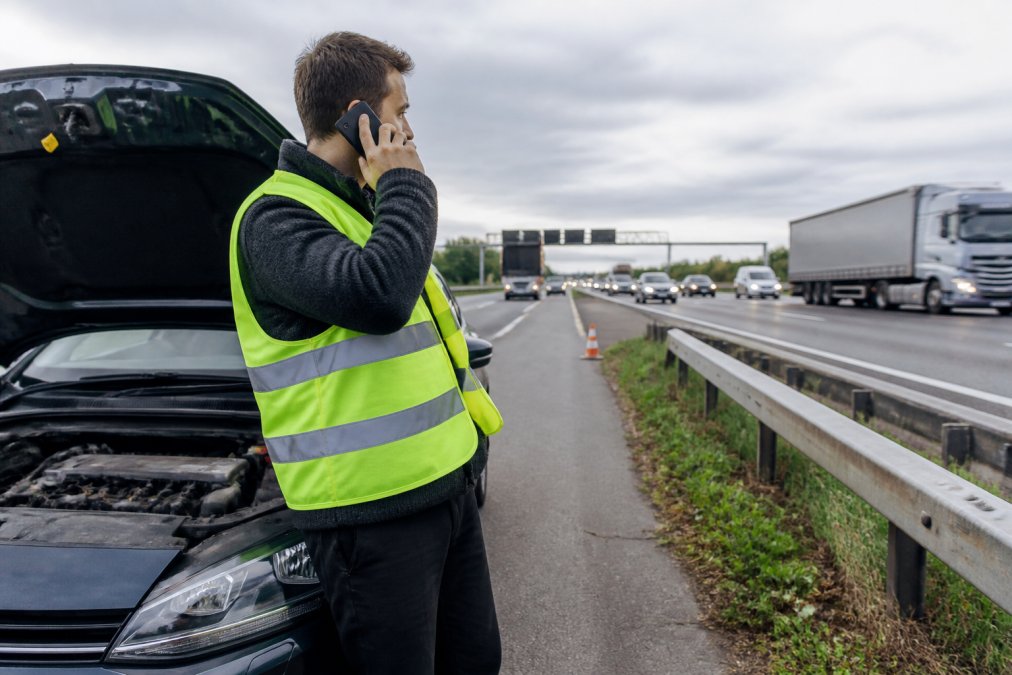
- Pull as far left as you can onto the hard shoulder or into an emergency refuge area.
- Switch on your hazard warning lights immediately.
- Leave the vehicle by the left-hand doors, never the traffic side.
- Take passengers and, if safe, your warning equipment with you.
- Stand behind the safety barrier, up the embankment, away from the vehicle.
- Call for help once you are in a place of relative safety.
National Highways publishes guidance on [motorway breakdown safety(/best-highway-breakdown-safety-equipment-2026/) | nationalhighways.co.uk], and the core message is simple: people first, vehicle second. A car can be replaced. You cannot.
Never attempt repairs on the hard shoulder or in a live lane. Standing between your vehicle and passing traffic is one of the most dangerous positions on the road network, and recovery patrols are trained and equipped to do that work safely.
How to Use Emergency Roadside Telephones
Emergency roadside telephones are free, connect directly to the regional control room, and identify your location automatically. The handler sees which phone has been lifted, so you do not need to describe where you are, the system already knows.
You will find these phones on the hard shoulder at roughly one-mile intervals, marked by a blue and white sign with a telephone symbol and an arrow. On smart motorways they sit inside emergency refuge areas, usually at the same spacing. Each phone is linked to a specific marker post number, which is how the control room dispatches the right recovery unit to the right stretch of carriageway.
Here is how to use one:
- Face oncoming traffic while you walk to the phone, so you can see vehicles approaching.
- Press the button and wait for the control room to answer, do not hang up if there is a pause.
- State the nature of your breakdown: flat tyre, engine failure, collision or obstruction.
- Confirm how many people are with you and whether anyone is injured or vulnerable.
- Follow the handler’s instructions and return to a safe spot behind the barrier.
The phone is the most reliable option when your mobile has no signal. Dead zones still exist on parts of the network, particularly in cuttings and rural stretches, which is why the emergency phone network remains in place even in the mobile era.
If you cannot reach a phone safely, for example, you are in a live lane, have limited mobility, or are travelling with someone who cannot walk to the phone, stay in the vehicle with your seatbelt on and hazard lights running, and call 999 from your mobile. Tell the handler you cannot reach an emergency phone. Control rooms can close lanes remotely and coordinate recovery without you leaving the car.
If you are unsure which direction to walk, look for the nearest marker post. The number on it tells the control room exactly where you are, and it is often quicker to read that out than to describe landmarks.
A common pattern is for drivers to walk the wrong way along the hard shoulder looking for a phone that is behind them. The blue and white signs are placed so that the arrow points to the nearest phone in either direction, read the arrow before you set off.
Calling for Help When Broken Down on M6: Mobile, Apps and What to Say
Calling for help when broken down on M6 by mobile means dialling your breakdown provider first, or 999 if anyone is injured or you are stuck in a live lane. On a smart motorway, the control room may already have spotted you on camera and set the overhead signs to close the lane.
If you are a member of a recovery service, call its breakdown line. If you are not, you can still call and join at the roadside in most cases, though it costs more than joining in advance. For genuine emergencies, 999 is the right number.
What you say matters. Give the handler these details in order:
- The motorway and direction of travel
- The junction number you passed last, or the nearest marker post
- Your vehicle make, model, colour and registration
- Whether you are in a live lane, on the hard shoulder or in a refuge area
- How many people are with you, and whether anyone is vulnerable or injured
Marker posts along the hard shoulder carry small numbers that identify your exact position. Reading one out cuts the time it takes recovery to reach you.
If you use a connected warning beacon with GPS, the location is transmitted automatically when it activates. That removes the guesswork from describing where you are, which matters most at night or in poor visibility.
High Visibility Roadside Safety Equipment That Saves Lives
High visibility roadside safety equipment is the difference between being seen and being hit. At 70mph, a driver covers around 31 metres every second, so anything that buys a following driver an extra moment to react is worth carrying.
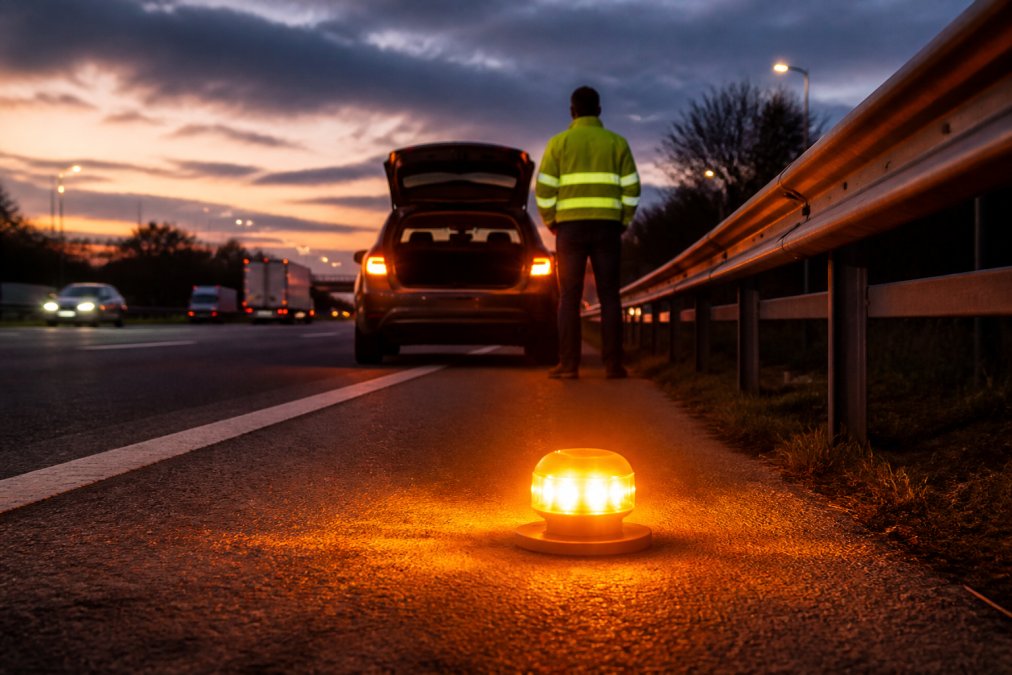
The essentials fit in a small bag in the boot:
- A reflective jacket for every occupant, stored in the cabin, not the boot
- A warning triangle for use on ordinary roads only, never on a motorway
- A rechargeable LED warning beacon with a strong flash pattern
- A torch with fresh batteries
- A charged power bank for your phone
Roadflash builds multi-award-winning early warning systems for exactly this scenario.
EV Breakdowns, Accessibility and Night-Time: What Most Guides Miss
Electric vehicle breakdowns add two complications that standard advice ignores: a discharged battery gives almost no warning, and an EV cannot simply be towed. It needs a flatbed or a specialist recovery vehicle, so tell the handler it is electric when you call.
- Reflective jacket within reach of the driver’s seat
- Beacon charged and working
- Torch in the glovebox
- Phone charged above 50%
- Breakdown cover number saved in your contacts
The two details most drivers forget are the ones that matter most at night: a jacket stored in the cabin rather than the boot, and a beacon that runs on its own power rather than relying on the car’s battery.
Warning Other Traffic: Hazard Lights, Triangles and Smart Motorway Rules
Hazard warning lights are your first and most important signal, and you should switch them on the moment you realise you are stopping. They tell every driver behind you that your vehicle is an obstruction, not moving traffic. On a smart motorway, they also help the control room spot you on camera and set the overhead signs.
| Situation | Warning action | Where to wait |
|---|---|---|
| Hard shoulder | Hazard lights on, beacon behind vehicle if safe | Behind the safety barrier |
| Emergency refuge area | Hazard lights on, beacon if you have one | Inside the refuge area |
| Live lane on smart motorway | Hazard lights on, call 999, do not exit if unsafe | Stay belted in unless you can exit left safely |
| Ordinary road | Hazard lights, then warning triangle | Away from the carriageway |
The single most useful warning action on a smart motorway is the one you cannot perform yourself: the lane closure. Call early so the control room can set it, and treat the red X as your protection.
Frequently Asked Questions
What are the rules for breaking down on a motorway?
Rule 43 of The Highway Code requires you to pull onto the hard shoulder or into an emergency refuge area if possible, switch on hazard warning lights, and exit the vehicle through the left-hand door. Wait behind the safety barrier, away from traffic. On smart motorways without a hard shoulder, use an emergency refuge area or stop in a live lane only if your vehicle cannot move. Call for help using an emergency roadside telephone or your mobile.
How do you use emergency roadside telephones?
Emergency roadside telephones are free and connect directly to the control centre. They are located at intervals along the hard shoulder and in emergency refuge areas, marked by orange SOS signs. When you pick up, the operator knows your exact location automatically. Tell them what happened, whether anyone is injured, and the direction you were travelling. Wait behind the barrier until help arrives.
Is it safer to stay in the car or get out during a breakdown?
The Highway Code advises exiting the vehicle through the left-hand door and waiting behind the safety barrier, away from traffic. Staying inside is dangerous because a stationary vehicle on a motorway can be struck from behind. If you cannot exit safely, keep your seatbelt on and call 999. Once out, move passengers and any pets to a safe place, never stand between your vehicle and oncoming traffic.
What should I do if I have no mobile phone signal?
If your mobile has no signal, walk to the nearest emergency roadside telephone. These are positioned regularly along motorway hard shoulders and inside emergency refuge areas. If you cannot reach one safely, stay behind the safety barrier and wait for a traffic officer or recovery vehicle. Do not attempt to cross carriageways. If another motorist stops, ask them to call 999 on your behalf.
Breaking down is stressful, and the hardest part is often knowing whether you have done enough to stay safe. Roadflash exists to close that gap. Our multi-award-winning early warning systems are built for stationary vehicles on busy motorways, with high-visibility lighting that increases hazard awareness and GPS geolocation that helps emergency services reach you fast. If you want kit that works the moment you need it, browse the range at Roadflash and add to basket with confidence.