
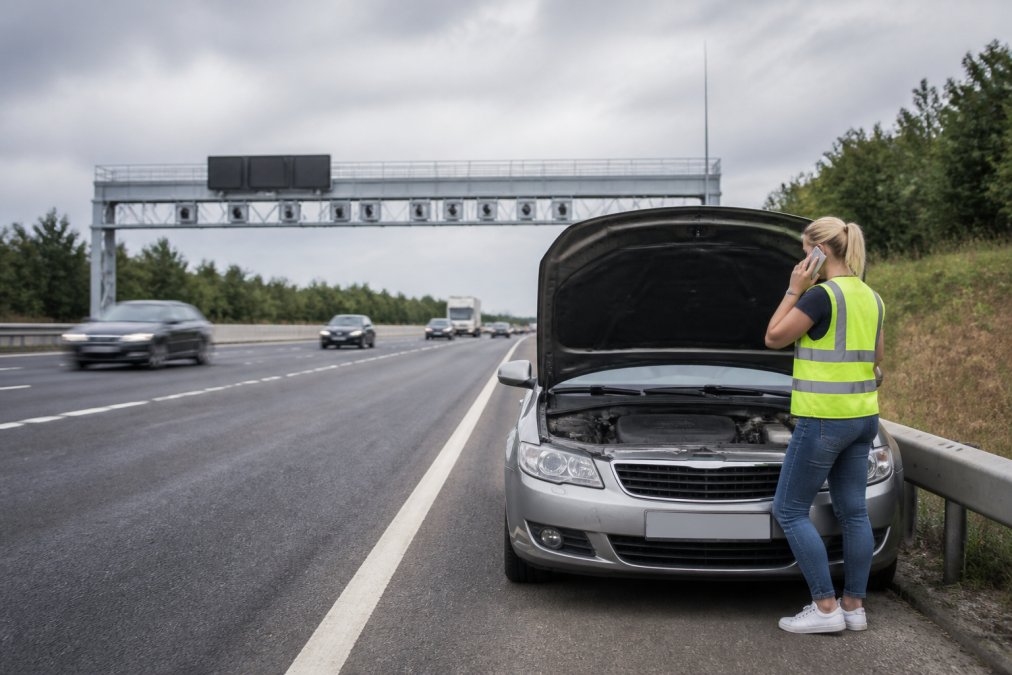
Car Broke Down on a Smart Motorway: What to Do
Table of Contents
- The Immediate Reaction: What to Do in the First 30 Seconds
- Smart Motorway Breakdown: Reaching an Emergency Refuge Area
- If You Can’t Reach an Emergency Refuge Area: Stopping in a Live Lane
- How to Identify Emergency Refuge Area Locations and Stay Safe
- What to Do If Your Car Won’t Start on the Motorway
- Calling for Help: When to Use 999 and Motorway Phones
- Staying Safe While You Wait: Using High Visibility Roadside Safety Equipment
- The Legal and Insurance Steps After a Smart Motorway Breakdown
- Frequently Asked Questions
Last Updated: September 7, 2026
Breaking down on a smart motorway is one of the most dangerous situations a driver can face, and knowing what to do if car breaks down on smart motorway could save your life. Unlike traditional motorways, smart motorways often have no hard shoulder, meaning a stationary vehicle sits directly next to live traffic travelling at speed. The golden rule: get out of the live lane and into a place of safety as quickly as you can.
The Immediate Reaction: What to Do in the First 30 Seconds
The first 30 seconds after you realise something is wrong determine how safe you will be. Stay calm, keep both hands on the wheel, and resist the urge to brake suddenly, which can cause the vehicles behind you to collide with your car.
Your immediate sequence: switch on hazard lights, check mirrors and look over your shoulder for a gap, signal and move left towards the hard shoulder or an emergency area, coast to a stop rather than braking hard, and once stopped, keep your seatbelt on until you decide whether to exit.
Panic is your biggest enemy. A common mistake is freezing or braking without checking mirrors, which removes your ability to react to following traffic. Focus on your exit strategy first, then worry about the cause.
Smart Motorway Breakdown: Reaching an Emergency Refuge Area
A smart motorway breakdown is handled differently depending on where your car stops. If you can keep moving, your priority is reaching an emergency refuge area, marked by orange posts with a blue emergency telephone symbol.
Drive slowly on the hard shoulder if one exists, or use the next emergency area if you are in a live lane. Do not stop on the carriageway to “wait for a gap”, keep moving at a reduced speed until you reach safety. The National Highways guidance on smart motorway breakdowns confirms that emergency refuge areas are spaced roughly every 1.5 miles on most smart motorway sections.
Never reverse along the hard shoulder or carriageway to reach an emergency area you have just passed. This is illegal and extremely dangerous, as traffic behind you will not expect a vehicle moving against the flow.
If You Can’t Reach an Emergency Refuge Area: Stopping in a Live Lane
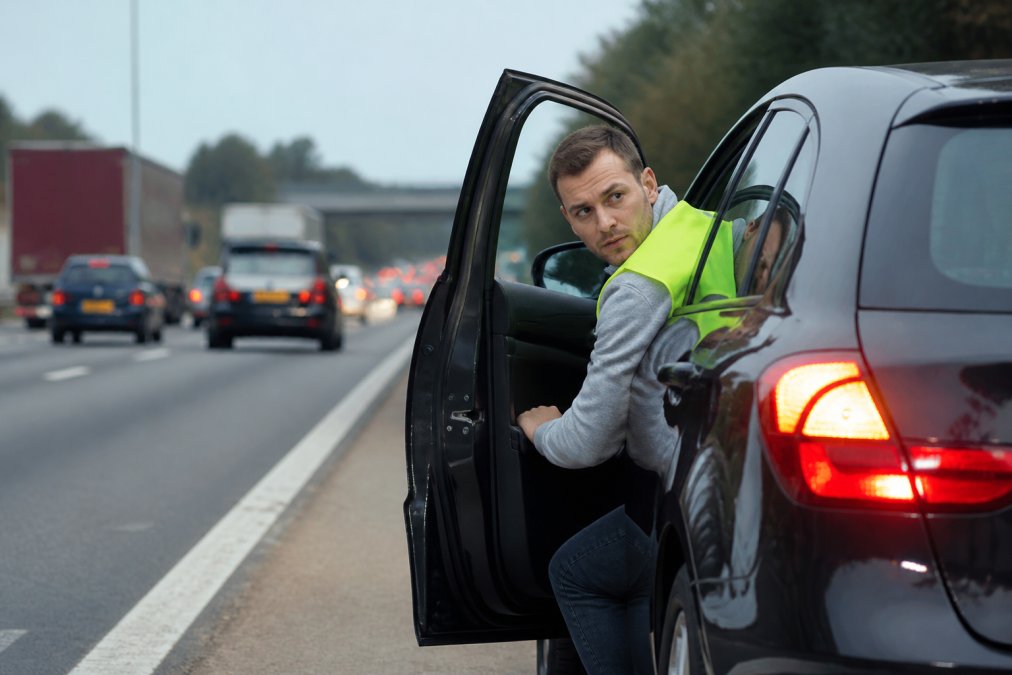
Sometimes you have no choice but to stop in a live lane, such as when your vehicle loses power suddenly or you have a tyre blowout. If this happens, your actions must be immediate and deliberate, and they differ depending on your vehicle type.
Internal Combustion Engine (ICE) Vehicles: The Immediate Priorities
Move as far left as possible, even against the nearside barrier. Keep your hazard lights on and, if visibility is poor, switch on your rear fog lights. Do not open your door or get out unless you are certain it is safe, as passing vehicles may clip your door or hit you.
If you smell fuel or see smoke, do not attempt to restart the engine. Turn the ignition off completely to stop any electrical spark, and only retrieve a fire extinguisher if you can do so without stepping into the live lane. Resist the urge to exit and inspect the engine bay, a common pattern in secondary collisions.
Electric Vehicles (EVs): Battery Safety in a Collision Risk Zone
If you drive an electric vehicle, a live-lane stop introduces a specific hazard: high-voltage battery damage. Modern EVs are designed to isolate the battery in a crash, but a hard impact from following traffic can compromise the casing, leading to thermal runaway, a chemical reaction that causes the battery to heat uncontrollably and catch fire.
Signs of battery compromise include:
- A burning or acrid smell, often described as similar to nail polish remover
- Visible smoke, especially white or grey, coming from under the vehicle
- Unusual hissing or popping sounds from the battery pack
- Dashboard warnings about the electrical system or battery temperature
If you observe any of these, your priority shifts to evacuating to a safe distance behind the barrier, but only if you can do so without stepping into traffic. Do not attempt to extinguish an EV battery fire with a standard extinguisher; it requires specialised foam and large volumes of water that only the fire and rescue service can provide.
If your EV is involved in a collision on a smart motorway, assume the battery is damaged even if the car appears drivable. Call 999 immediately and tell the operator you are in an electric vehicle, as this changes how the fire service approaches the scene.
The Safest Position: Stay Belted Unless You Must Evacuate
The safest position is to stay in your vehicle with your seatbelt fastened until help arrives, unless you can see a clear route to a safer location behind a barrier. This holds for both ICE and EV drivers, but if you suspect battery damage in an EV, the risk of fire makes evacuation behind the barrier, if a safe path exists, the lesser risk.
Traffic officers from National Highways patrol smart motorways and will usually reach you within minutes, closing lanes behind you to protect the scene. When they arrive, follow their hand signals exactly; they are trained to manage live-lane incidents and will direct you to the safest exit point.
How to Identify Emergency Refuge Area Locations and Stay Safe
Most drivers only learn to spot an Emergency Refuge Area (ERA) when they are already broken down in a live lane, exactly the wrong time to be scanning the roadside. Train your eye to identify ERAs during every motorway journey, long before you need one.
The Visual Signature: What an ERA Actually Looks Like
Each ERA has an orange backing board with a blue telephone symbol, and the entry point is marked with road studs and lane markings guiding you in from the left-hand lane.
From a distance, the most distinctive feature is the orange backing board, the only large orange roadside sign on a smart motorway, positioned at the rear of the ERA so you see it as you approach. The blue telephone symbol is the same design used on traditional motorway emergency phones.
A Pre-Journey Checklist: Train Your Eye Before You Drive
Before you set off on any smart motorway journey, run through this mental checklist so the visual cues are fresh in your mind:
- Orange is the trigger colour. Any large orange roadside structure on a motorway is almost certainly an ERA. Train yourself to notice orange before any other colour.
- Count the gantry signs between ERAs. On most smart motorway sections, ERAs are spaced roughly every 1.5 miles. If you pass a gantry with a red X or speed limit display, start counting down the distance to the next ERA.
- Look for the left-hand lane taper. The entry point to an ERA is marked with a painted hatch pattern that narrows from the left-hand lane. This taper is visible from about 200 metres away if you are scanning the road surface.
- Note the stud colour. The road studs leading into an ERA are white, matching the lane markings, but the ERA itself is bordered by red studs on the left and white on the right. Spotting this colour combination helps you confirm you are entering a safe area, not a hard shoulder remnant.
What to Do When You Reach an ERA: The 60-Second Protocol
Once inside an ERA, you are in a relatively safe space, but still close to live traffic. Exit through the left-hand door, away from the carriageway, and stand behind the barrier if one exists. Use the emergency telephone to contact National Highways, who will confirm your location and send assistance.
The emergency telephone is your fastest route to help. When you lift the handset, you are connected directly to the National Highways regional control centre, and the system automatically identifies which ERA you are in, you do not need to describe your location. This is faster than calling your breakdown provider, who may not have real-time visibility of motorway infrastructure.
If you are driving a route you do not know well, set a mental reminder to note the location of the next ERA every time you pass a gantry. This habit takes two seconds and means you always know how far you are from a safe stopping point.
The Limits of an ERA: What They Are Not For
These areas are for emergencies only, and you should leave as soon as your vehicle is safe to drive or recovery arrives. If you have a warning light showing or suspect a mechanical fault, do not rejoin the motorway until a professional has checked your vehicle.
ERAs are typically around 30-40 metres long, sufficient for a car or van but may not accommodate a large goods vehicle towing a trailer. If you are driving a longer vehicle, check the ERA entry signage for length restrictions before committing to enter.
What to Do If Your Car Won’t Start on the Motorway
If your car won’t start on the motorway, the cause is often secondary to the immediate safety problem. Ensure you are in a safe location, then attempt a restart only if you are stationary and out of the live lane.
Try these steps in order: check the gear selector is in Park or Neutral, press the brake pedal fully before turning the key or pressing the start button, look for dashboard warning lights indicating a battery or fuel issue, and if the engine turns over but won’t catch, avoid repeated attempts that drain the battery.
If the car still will not start, do not keep trying. Call for breakdown recovery and wait for professional assistance. Repeated restarts can flood the engine or drain your battery completely, leaving you with no power for hazard lights, a critical safety risk.
Calling for Help: When to Use 999 and Motorway Phones
Call 999 immediately if you are stopped in a live lane, if someone is injured, or if you believe there is a danger to life, including situations where your vehicle is obstructing traffic and you cannot move it to safety.
For non-emergency breakdowns where you are safely in an emergency refuge area or on the hard shoulder, use the emergency phone or call your breakdown recovery provider. The emergency phone connects directly to the National Highways regional control centre, which can pinpoint your exact location.
When calling 999, state clearly that you are on a smart motorway, give the direction of travel, and describe any nearby landmarks or gantry signals. The operator can close lanes behind you while you wait, which significantly reduces your risk. According to the official guidance from National Highways on motorway incidents, traffic officers aim to reach live lane incidents quickly to manage traffic flow and protect stranded drivers.
Staying Safe While You Wait: Using High Visibility Roadside Safety Equipment
While you wait for help, your visibility to approaching traffic is your primary defence. Hazard lights warn drivers, but they are not always enough in bright daylight or poor weather, which is why high visibility roadside safety equipment makes a real difference.
Wearing a high-visibility vest before you exit ensures other drivers and traffic officers can see you clearly. Placing a warning beacon on your vehicle roof increases its visibility from a distance, giving approaching traffic more time to slow down. Roadflash’s multi-award-winning early warning systems excel here: products like their DGT 3.0 compliant emergency beacons with GPS/Geolocation not only flash brightly to warn traffic, but also transmit your precise location, helping emergency services find you faster.
Position any warning light on the roof of your vehicle rather than at ground level. A roof-mounted beacon is visible over the crest of a hill or around a bend, while a ground-level triangle is hidden until traffic is almost upon you.
A reflective warning triangle is a legal requirement in many countries, but it has a serious limitation: you must walk back along the carriageway to place it, which puts you in danger. Modern alternatives like LED beacons can be activated from inside the vehicle or placed on the roof without stepping into the traffic lane.
The Legal and Insurance Steps After a Smart Motorway Breakdown
Once you are safe and recovery is arranged, you still have legal and insurance obligations. Under UK law, you must not leave a vehicle in a position that endangers other road users, and you are required to make every reasonable effort to move it to a safe place.
Report the breakdown to your insurance provider as soon as possible, even if you do not intend to claim. Many policies require notification of any incident that could lead to a claim, and failing to report could invalidate your cover. If your vehicle or motorway infrastructure was damaged, you must also report this to National Highways.
Document the scene thoroughly: take photos of your vehicle’s position, any warning lights on the dashboard, and the surrounding area. This evidence helps your insurer process any claim and protects you if another driver disputes what happened. Keep your breakdown recovery receipt, as some insurance policies will reimburse the cost. For more on your obligations, the Highway Code rules on breakdowns and obstructions provides the definitive legal framework for motorway incidents.
The single most important rule of a smart motorway breakdown: never remain in a live lane. Reach an emergency refuge area or the hard shoulder if possible, and if you cannot, stay belted in your vehicle with hazard lights on until traffic officers close the lane behind you.
Breaking down on a smart motorway is stressful, but a clear plan removes the panic and keeps you safe. The steps above cover your immediate reaction, reaching safety, calling for help, and handling the legal aftermath. Roadflash builds multi-award-winning early warning systems, including DGT 3.0 compliant emergency beacons with GPS/Geolocation, that dramatically increase your vehicle’s visibility and help emergency services locate you quickly. Add to basket today.
Frequently Asked Questions
What should I do if my car breaks down in a live lane on a smart motorway?
If you stop in a live lane, your first priority is to protect yourself. Put your hazard lights on immediately. If you can safely do so, exit the vehicle on the side furthest from traffic and move behind the barrier. If you cannot exit safely, stay in your car with your seatbelt on and call 999 immediately. Traffic officers will close the lane to protect you.
How do I identify an emergency refuge area on a smart motorway?
Emergency refuge areas are marked by orange posts with a blue emergency telephone symbol. They are typically spaced every 1.5 miles on smart motorways without a hard shoulder. The areas are clearly signposted with large blue panels showing the distance to the next one. If you see the sign, indicate and move into the area as soon as it is safe to do so.
Is it safer to stay in my car or get out after a smart motorway breakdown?
It depends on your location. If you have reached an emergency refuge area, exit the vehicle using the left-hand door and wait behind the barrier. If you are stopped in a live lane and cannot reach a refuge area, staying in your car with your seatbelt on is often safer than getting out, as you are protected by the vehicle’s structure. Call 999 immediately for assistance.
What equipment should I keep in my car for a motorway breakdown?
Carrying high visibility roadside safety equipment is essential. A high-visibility vest should be worn before you exit the vehicle. A warning triangle can be placed 45 metres behind your car, though you should never use one on a motorway. A mobile phone is your most critical tool, along with a charger. Consider a dedicated emergency beacon with GPS to alert approaching traffic and help emergency services locate you quickly.