
LED Warning Light vs Reflective Triangle: Which Is Safer?
Table of Contents
- LED Warning Light vs Reflective Triangle: The Core Difference
- Visibility and Detection Range: Why Distance Matters
- Performance in Adverse Weather and Night-Time Conditions
- Deployment Speed and Safety: Staying Out of Traffic
- Legal Requirements and Compliance for Roadside Breakdowns
- Battery Life, Durability, and Maintenance Considerations
- Best LED Road Safety Beacons 2026: What to Look For
- Building Your Roadside Emergency Kit Essentials
- Frequently Asked Questions
Last Updated: September 5, 2026
LED Warning Light vs Reflective Triangle: The Core Difference
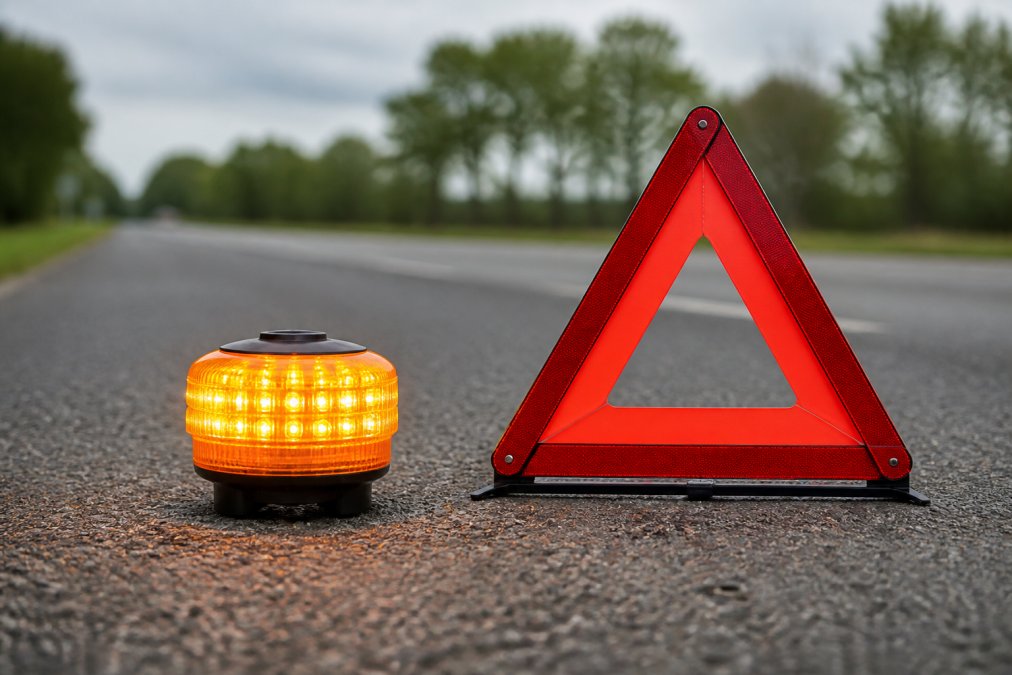
A led warning light is an active safety device that emits its own illumination to signal danger, whereas a reflective triangle is a passive device that only becomes visible when headlights strike its reflective surface. That single distinction decides which technology protects you better in a real breakdown scenario, particularly on high-speed roads where every second of reaction time counts.
The difference matters because passive triangles have a fundamental limitation: they are invisible until a driver’s headlights hit them at close range. Active LED beacons, by contrast, broadcast a warning signal continuously, regardless of ambient light or approaching vehicle direction. For UK Highway Code guidance on breakdowns, the emphasis is on warning other road users effectively, and modern active technology achieves this far more reliably than reflective surfaces alone.
The core safety principle is simple: active illumination warns drivers earlier than passive reflection, and earlier warning means more time to react and avoid a collision.
Visibility and Detection Range: Why Distance Matters
Detection range determines how much time approaching drivers have to slow down or change lanes. A passive triangle relies on retro-reflective material to bounce light back toward its source, which works well in daylight but creates a narrow visibility cone at night that only illuminates when headlights are perfectly aligned.
How Retro-Reflective Triangles Work
Retro-reflective triangles use thousands of microscopic corner cubes or glass beads to return light directly to its source. The triangle only “activates” when a vehicle’s headlights are already pointed at it. On a curved motorway or in multi-lane traffic, that alignment may happen late, leaving drivers with minimal reaction time.
Active Illumination from LED Beacons
LED beacons generate their own high-intensity light output, measured in lumens, making them visible from significantly greater distances than passive markers. High-intensity flashing patterns at night improve driver awareness because flashing light captures peripheral vision more effectively than a static reflective surface. Active illumination works in every direction, not just toward headlight beams, which is critical for warning traffic approaching from multiple lanes.
Performance in Adverse Weather and Night-Time Conditions
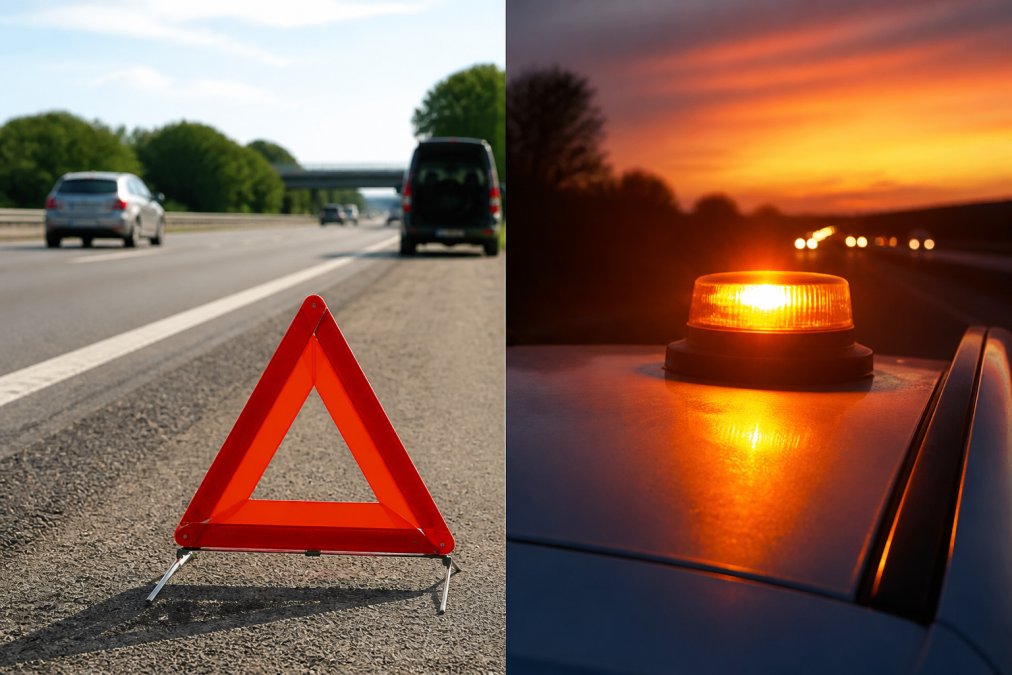
Rain, fog, and spray coat reflective surfaces with moisture, scattering light and dramatically reducing visibility range. Fog penetration is particularly poor for reflective materials because water droplets diffuse the light before it can return to the driver’s eye.
A bright led warning light cuts through rain and fog because it emits direct light energy rather than relying on reflected beams. The amber wavelength commonly used in warning beacons offers strong fog penetration while remaining distinct from red tail lights and white headlights, reducing confusion for approaching drivers.
A reflective triangle is only as visible as the headlights aimed at it, meaning a vehicle in the wrong lane or a driver with dipped beams may not see it until dangerously close. An active beacon maintains consistent optical performance regardless of what other road users are doing, providing reliable conspicuity throughout the hours of darkness.
Deployment Speed and Safety: Staying Out of Traffic
The most dangerous moment of any breakdown is when you step out of your vehicle to place warning equipment. Traditional triangles require walking 45 metres behind your car on the hard shoulder, exposing you to high-speed traffic. This is where active LED technology offers a safety advantage that passive equipment cannot match.
A magnetic mounting beacon can be attached to your vehicle’s roof within seconds, without leaving the safety of the passenger side. Many modern units also feature a foldable design for compact storage, but the key difference is deployment speed: seconds rather than minutes, and zero time spent walking in live traffic lanes. Vancle LED Road Flares, for example, use magnetic bases precisely so drivers can place them without bending down on the carriageway.
The Royal Society for the Prevention of Accidents guidance on motorway breakdowns stresses that the priority is getting yourself to a safe location behind a barrier. Every second you spend placing equipment on the road is time spent at risk, and active beacons minimise that exposure dramatically.
Legal Requirements and Compliance for Roadside Breakdowns
Legal requirements for warning equipment vary by region. In the UK, carrying a warning triangle is not mandatory for private vehicles, though many European countries require one by law. However, the legal landscape is shifting toward active technology in several markets.
Spain has introduced DGT 3.0 regulations that require emergency beacons with GPS and geolocation capabilities instead of traditional triangles for vehicles registered after specific dates. These V16 beacons must be placed on the vehicle roof and transmit location data to emergency services automatically. Roadflash produces DGT 3.0 compliant emergency beacons with GPS and geolocation, meaning the device not only warns approaching traffic but also tells emergency responders exactly where you are.
Using a non-compliant triangle in regions that mandate active beacons can result in fines, and worse, it leaves you without the automatic emergency notification that modern regulations are designed to provide.
For UK motorists driving in Europe, checking the specific requirements of each country before travel is essential. A device that satisfies UK guidance may not meet the legal standards of Spain, France, or Germany. Compliance is not just about avoiding penalties; it is about ensuring your equipment performs when you need it most.
Battery Life, Durability, and Maintenance Considerations
Battery life separates equipment that protects you for years from equipment that fails at the worst possible moment. Passive triangles have no power requirements, which is their main advantage, but they also degrade over time. Reflective surfaces lose their optical performance through UV exposure, scratches, and contamination, and a triangle left in a hot boot for years may reflect far less light than when new.
Active LED beacons depend on battery management, but modern units are designed for extended standby and operational life. Weather resistance is critical for outdoor deployment, and quality units feature waterproof housings that withstand rain, snow, and temperature extremes. The trade-off is straightforward: you must check and maintain batteries periodically, but you gain active illumination that works in conditions where passive reflectors fail.
The maintenance burden is modest. Check battery status before long journeys, replace cells on a schedule rather than waiting for failure, and store the unit in an accessible location, not buried under luggage. A led warning light with proper care will provide years of reliable service, and the peace of mind during night-time motorway driving is worth the occasional battery change.
Best LED Road Safety Beacons 2026: What to Look For
Choosing a beacon on lumens alone is a mistake. The specification that matters most is not raw brightness but the interaction between flash pattern, wavelength, and human visual perception. Understanding the underlying science separates a device that genuinely reduces collision risk from one that merely looks bright in a product photo.
The Science of Flash Patterns and Reaction Time
Research into visual perception consistently shows that the human visual system is exquisitely sensitive to temporal change. Peripheral vision, the part of the retina responsible for detecting threats while you focus on the road ahead, contains a higher proportion of rod cells, which respond more strongly to flicker than to steady light. A flashing beacon exploits this biological bias: a strobe pattern at 1-2 Hz (one to two flashes per second) captures peripheral attention more reliably than a steady light of equal intensity. This is why emergency vehicles use flashing lights rather than continuous illumination.
Rapid strobe patterns (above 4 Hz) can induce a sense of urgency but risk being mistaken for a vehicle already braking hard. Slower, rhythmic patterns (around 1 Hz) are more easily distinguished from brake lights and tend to produce earlier, more measured driver responses. Most practitioners recommend a beacon with at least two modes: a high-frequency strobe for motorway use where you need maximum attention capture, and a slower pulse for urban or low-speed scenarios where you want to signal hazard without causing panic braking.
Wavelength and Colour Selection
Amber (approximately 590 nm wavelength) is the dominant choice for roadside warning because it sits in the most sensitive region of photopic (daylight) vision and is not confused with the red of tail lights or the white of headlights. Red beacons risk being mistaken for brake lights, which can cause approaching drivers to brake unnecessarily or, worse, fail to recognise the difference until too late. White beacons can be confused with oncoming headlights, particularly on undivided roads. Blue is reserved for emergency services in the UK and is illegal for civilian roadside use. For UK motorists, amber is the only wavelength that offers both legal compliance and optimal visual distinctiveness.
Regulatory Compliance: The UK and EU Landscape
Before purchasing any beacon, verify its compliance status for the regions where you drive. In the UK, there is no specific British Standard mandating the use of active beacons for private breakdowns, the Highway Code requires that you warn other road users, and a reflective triangle satisfies this guidance. However, the regulatory picture across Europe is changing rapidly.
Spain has taken the most decisive step. Its DGT 3.0 regulation requires vehicles registered after 1 January 2026 to carry a V16 connected beacon instead of a physical triangle. These beacons must be placed on the vehicle roof, emit a 360-degree amber light visible from at least 1 kilometre, and transmit GPS coordinates to the DGT’s traffic management platform automatically. The regulation is being phased in, with a transition period running until 2028, after which physical triangles will no longer be accepted for new vehicles in Spain. France, Germany, and Italy continue to require a physical triangle by law, and none currently accept an LED beacon as a substitute, so a motorist carrying only a beacon would be non-compliant in those countries.
If you drive in Europe, check the specific requirements of each country before travelling. A beacon that satisfies Spanish DGT 3.0 rules does not replace the triangle required in France or Germany. Carry both to remain compliant across borders.
Practical Specification Checklist for 2026
When evaluating a beacon for UK use, focus on these concrete specifications rather than marketing language:
- Luminous intensity: Look for a rating of at least 25 candela in flashing mode, which provides visibility at the 1-kilometre distance recommended for motorway use. Lumens measure total output, but candela measures intensity in a specific direction, the metric that matters for warning visibility.
- Beam angle: A true 360-degree horizontal beam is essential. Some budget units claim 360 degrees but actually have a 270-degree pattern with a dead zone where the battery compartment sits. Test this by rotating the unit while viewing it from a fixed point.
- Flash rate: Confirm the unit offers at least two distinct patterns, with one in the 1-2 Hz range for optimal peripheral detection.
- IP rating: Look for IP65 or higher, which guarantees protection against dust and low-pressure water jets. IP54 units may survive light rain but can fail in a motorway spray.
- Mounting mechanism: Magnetic mounts should have a holding force of at least 10 kg to resist wind blast from passing HGVs. Suction or clip mounts are less reliable on uneven vehicle surfaces.
- Battery indication: A clear low-battery warning light is non-negotiable. Units that simply dim when depleted give no advance warning of failure.
- GPS connectivity: For future-proofing, consider a unit with GPS capability. While not yet required in the UK, the Spanish DGT 3.0 precedent suggests that connected beacons will become the norm across Europe within the decade.
The market for 2026 is moving toward connected, multi-function devices that combine high-intensity LED output with automatic emergency notification. For UK motorists who drive regularly on motorways or travel to Europe, investing in a beacon with these specifications provides both immediate safety benefits and future regulatory compliance.
Building Your Roadside Emergency Kit Essentials
A roadside emergency kit essentials checklist should prioritise equipment that keeps you safe without requiring you to spend unnecessary time in traffic. Your kit should include a warning device as the primary element, but several supporting items make the difference between a controlled response and a hazardous one.
Start with a high-visibility warning beacon that can be deployed from inside the vehicle. Add a reflective warning triangle as a secondary measure for daylight use or as backup if the beacon battery fails. A hi-visibility vest is essential; wear it before exiting the vehicle, and store it within arm’s reach, not in the boot under luggage. A torch with spare batteries helps you assess the situation without relying on your phone screen.
Include a first-aid kit, warning triangle, and basic tools, but the most important item is a charged phone with emergency numbers saved. For breakdowns on motorways, knowing your location is critical, which is why GPS-enabled beacons provide such a significant advantage. The National Highways guidance on what to do in a breakdown recommends getting behind a barrier and calling for help rather than attempting repairs in live traffic.
Your emergency kit is only useful if it is accessible. Store it in the passenger footwell or under a seat, not in the boot where you must exit the vehicle to retrieve it. A few minutes of preparation before your next journey could prevent a serious accident, and choosing the right warning technology is the foundation of that preparation.
Choosing between a led warning light and a reflective triangle ultimately comes down to how much time you want between an approaching driver seeing you and impact. Passive triangles remain useful as a budget option, but active LED technology provides superior visibility, faster deployment, and increasingly, the legal compliance that modern regulations demand. At Roadflash, we build multi-award-winning early warning systems, including DGT 3.0 compliant beacons with GPS and geolocation, designed to keep you visible and protected on busy highways. Explore our range of high-visibility safety lighting and equip yourself with technology that works when you need it most.
Frequently Asked Questions
Is it a legal requirement to carry a reflective triangle in the UK?
No, carrying a reflective warning triangle is not a legal requirement for private vehicles in the UK. The Highway Code recommends them for vehicles over 2,250 kg, but for cars they remain optional. However, if you do use one, you must place it at least 45 metres behind your vehicle on the same side of the road, and never on a motorway. LED warning lights are also not mandated for private cars, but they are increasingly recommended by road safety organisations for their superior visibility.
Why are LED warning lights more visible than reflective triangles?
Reflective triangles are passive devices; they only bounce back light from oncoming headlights, making them effective in daylight but less so in fog, heavy rain, or on unlit roads. LED warning lights are active: they emit high-intensity light in flashing modes that draw the eye. High-quality beacons can be visible from significantly greater distances compared to reflective triangles under headlights, giving drivers significantly more time to react and slow down.
Can LED warning lights be used as a replacement for reflective triangles?
Yes, in most circumstances an LED warning light can replace a reflective triangle. The key advantage is safety: a beacon with a magnetic mount can be placed on your car roof from the driver’s seat, eliminating the need to walk along the hard shoulder to set up a triangle 45 metres behind. If you drive in Spain, a DGT 3.0 compliant beacon is now the required standard, replacing the traditional triangle for vehicles registered after specific dates.
What should I include in my roadside emergency kit essentials?
Beyond a warning device, your kit should include a hi-visibility vest, a torch, warning triangle or LED beacon, first-aid kit, phone charger or power bank, and bottled water. If you carry an LED beacon, choose one with a magnetic mount and a long battery life. A foldable design makes storage easier. For frequent motorway drivers, a GPS-enabled beacon that alerts emergency services to your exact location is a worthwhile addition for breakdown safety.
How do I choose the best LED road safety beacon for my vehicle?
Look for high light intensity, a flashing mode for daytime visibility, and a 360-degree light output. Check the battery life; a beacon should last at least a few hours on a full charge. A magnetic base is crucial for quick deployment without leaving the car. Consider weather resistance for use in rain and fog. Finally, if you travel in Europe, verify whether the beacon meets the relevant standards, such as DGT 3.0 compliance for Spain.
This article was written using GrandRanker