
DGT 3.0 Beacon Mandatory in Spain: 2026 Compliance Guide
Table of Contents
- Is the DGT 3.0 Beacon Mandatory in Spain?
- When Does the DGT 3.0 Mandate Start?
- V-16 Beacon Requirements for Compliance
- How to Use V-16 Emergency Light During Breakdown
- Replacing Warning Triangles in Spain with Modern Beacons
- Fines and Penalties for Non-Compliance
- DGT 3.0 Connectivity and GPS Features Explained
- Conclusion
Last Updated: August 30, 2026
Is the DGT 3.0 Beacon Mandatory in Spain?
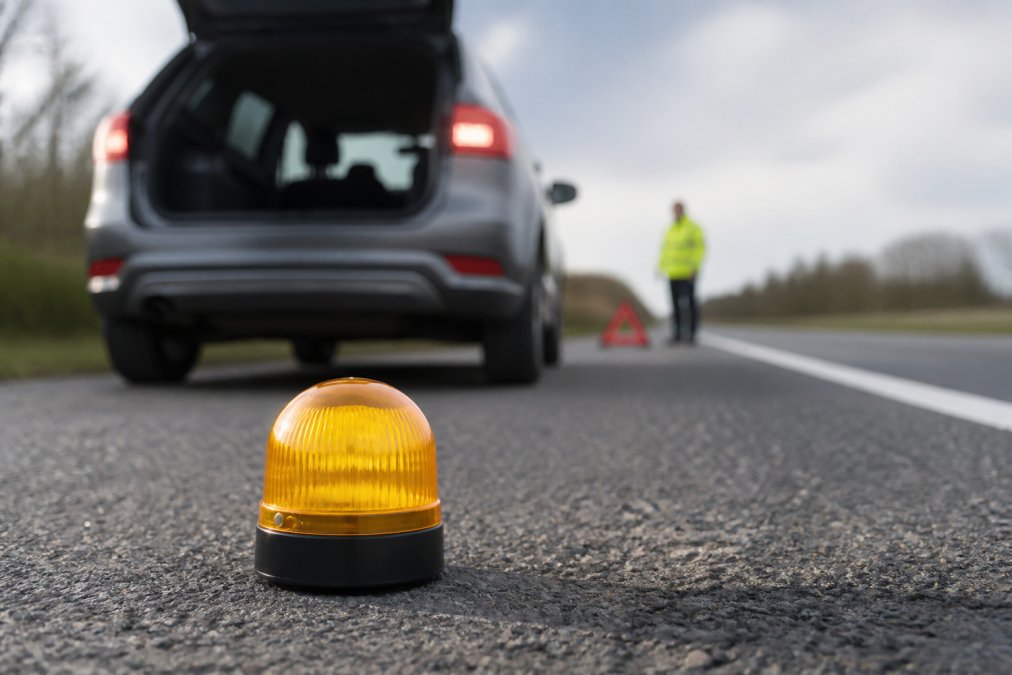
Yes, the DGT 3.0 beacon is mandatory in Spain. From 1 January 2026, the Directorate-General for Traffic (Dirección General de Tráfico, or DGT) requires all stationary vehicles involved in breakdowns or accidents to display a V-16 emergency beacon rather than relying solely on traditional warning triangles (dgt.es). The mandate applies to every vehicle category, from private cars to commercial fleets. Drivers who fail to comply face substantial fines, whilst those who adopt compliant equipment gain measurable safety advantages. The V-16 beacon combines GPS connectivity, real-time data transmission, and high-visibility lighting to alert approaching motorists far more effectively than passive reflective equipment.
The DGT 3.0 beacon is mandatory in Spain as of 1 January 2026. All vehicles must carry a certified V-16 emergency beacon. Failure to comply results in fines and potential legal liability in the event of an accident.
When Does the DGT 3.0 Mandate Start?
The DGT 3.0 mandate became effective on 1 January 2026. This is current law, not a future requirement. Any vehicle on a Spanish motorway, highway, or major road without a compliant V-16 emergency beacon is in violation. Traffic authorities are actively enforcing the regulation, and penalties are being issued. For those managing fleets or regularly driving in Spain, procurement, installation, and driver training should be completed immediately if not already done.
The mandate is already in effect. There is no grace period or extension. Vehicles without a certified V-16 beacon are subject to fines and may be prohibited from operating on Spanish roads.
V-16 Beacon Requirements for Compliance
The V-16 emergency beacon is the specific device mandated by the DGT 3.0 platform. It must be a certified, autonomous device that activates independently when placed on a vehicle during a breakdown or accident. It is portable, allowing drivers to position it on the road surface behind their vehicle without requiring installation or hardwiring to the vehicle’s electrical system.
Key technical requirements for V-16 compliance include:
- Autonomous operation: The beacon must function without connection to the vehicle’s battery or electronics
- GPS/geolocation capability: The device must transmit real-time location data to the DGT 3.0 platform
- High-visibility lighting: The beacon must emit a bright, pulsing light visible from a considerable distance, even in daylight conditions
- Certification: The device must carry official DGT certification
- Durability: The beacon must withstand outdoor conditions and repeated use
The V-16 beacon represents a step change from traditional warning triangles. Where a triangle is purely passive, the V-16 actively broadcasts the presence of a hazard. The GPS component means emergency services know exactly where the vehicle is located, which is particularly valuable on multi-lane motorways or in low-light conditions.
How to Use V-16 Emergency Light During Breakdown
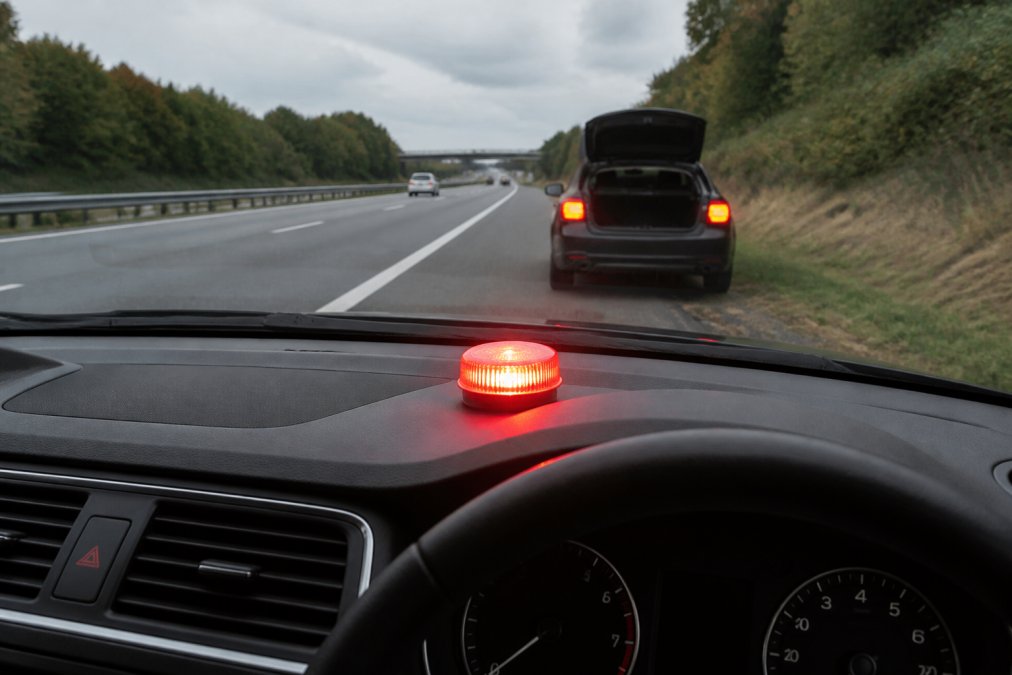
When your vehicle breaks down on a motorway or major road, switch on your hazard warning lights immediately. Retrieve your V-16 beacon from storage and activate it by pressing the power button. The beacon will emit a bright, pulsing red or amber light and begin transmitting GPS data to the DGT 3.0 platform.
Place the beacon on the road surface behind your vehicle, typically 50-100 metres back. The device’s GPS transmitter is now sending your exact location to traffic authorities and emergency services. Return to your vehicle if safe, remain inside with doors locked and hazard lights on. If the breakdown is serious or you feel unsafe, move to a safe location away from traffic; the beacon’s GPS signal will continue transmitting your location.
Do not attempt to repair the vehicle or stand in the roadway. Most modern V-16 beacons have a battery life of 8-10 hours of continuous operation, so the device will remain active until rescue arrives or you manually turn it off (peer-reviewed research).
Activate the beacon immediately when your vehicle stops unexpectedly. The GPS signal begins transmitting right away, so emergency services know your location within seconds.
Replacing Warning Triangles in Spain with Modern Beacons
Warning triangles have been the standard roadside hazard signal for decades, but they are passive: they only reflect light that falls on them. In poor visibility, at night, or on roads with multiple lanes, a triangle may not be seen by approaching drivers until it is too late.
The V-16 emergency beacon solves this problem by actively broadcasting both a visual signal (bright pulsing light) and a digital signal (GPS location data transmitted to the DGT 3.0 platform). Approaching drivers see the beacon from a greater distance, and emergency services receive an exact location instantly rather than waiting for a phone call.
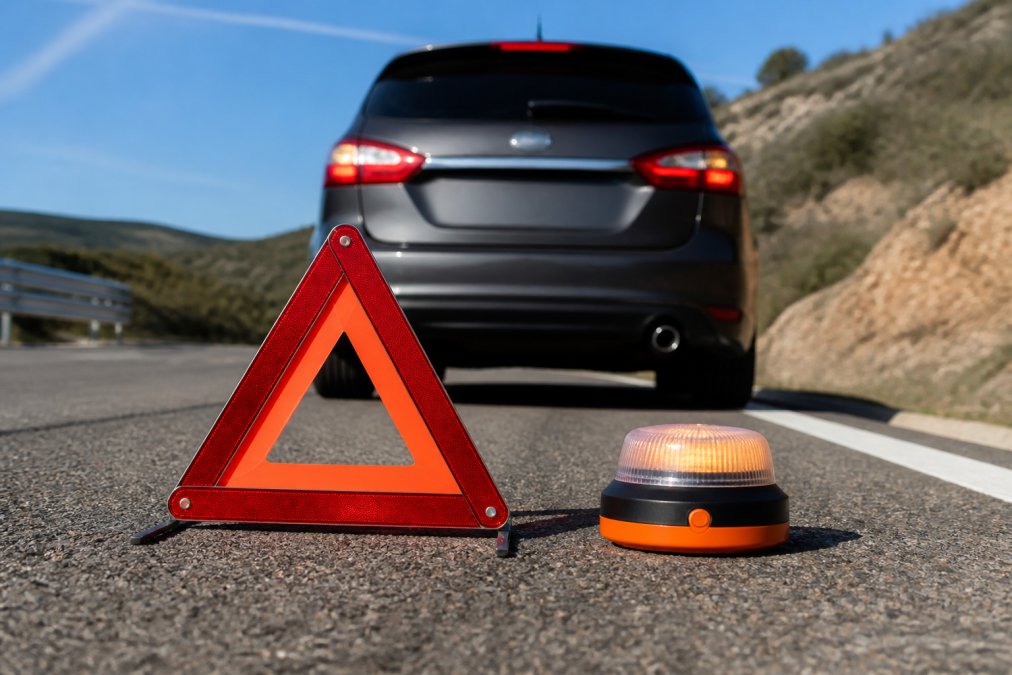
The transition from warning triangles to V-16 beacons is now mandatory in Spain. Safety data supports the mandate: active signaling devices reduce response times, improve driver awareness, and provide emergency services with precise location information, all factors that measurably reduce the severity of secondary accidents (nhtsa.gov). For fleet operators, the transition requires inventory management and driver training, but these are one-time setup costs. Once implemented, the system requires minimal ongoing maintenance.
Fleet operators and rental car companies managing multiple vehicles on Spanish roads. Roadflash’s certified V-16 beacons simplify compliance across entire fleets, with durable equipment designed for repeated use and high-visibility performance in all weather conditions.
Fines and Penalties for Non-Compliance
The DGT 3.0 mandate is enforced with significant financial penalties. Drivers stopped without a compliant V-16 beacon face substantial fines, typically ranging from hundreds to thousands of euros. If a driver is involved in an accident whilst non-compliant, they may face additional liability. Insurance companies may refuse to pay claims or pursue recovery against the driver for failing to meet legal safety requirements.
Traffic authorities conduct routine enforcement checks on motorways and major roads, particularly during peak travel periods. Vehicles without a visible, certified V-16 beacon can be stopped and fined on the spot. For fleet operators, non-compliance poses additional risks: company vehicles involved in accidents without proper safety equipment may result in company liability for negligent vehicle maintenance, and insurance policies may exclude coverage for accidents involving non-compliant vehicles.
The cost of a certified V-16 beacon is substantially lower than the cost of a single fine, and far lower than the potential liability from an accident. Compliance is the only rational choice from both a legal and financial perspective.
DGT 3.0 Connectivity and GPS Features Explained
The DGT 3.0 platform is the digital backbone of the new beacon mandate. When a V-16 beacon is activated, it connects to the DGT 3.0 platform via cellular or satellite connectivity, transmitting the vehicle’s GPS coordinates in real time to the Directorate-General for Traffic, local traffic authorities, and emergency services.
On a busy motorway, a stationary vehicle can be difficult to spot, especially at night or in poor weather. With GPS connectivity, the location is known to within a few metres, and emergency response can be dispatched directly to the exact spot. Real-time data transmission also enables traffic management systems to respond dynamically: when a V-16 beacon is activated, the DGT 3.0 platform can automatically alert nearby drivers through connected navigation systems, adjust traffic light timing to reduce congestion, and coordinate emergency service dispatch.
For drivers, the connectivity feature provides peace of mind. If a breakdown occurs in a remote area or on a road with poor mobile signal, the V-16 beacon still transmits location data to authorities. Help will arrive because emergency services know exactly where the vehicle is located. The DGT 3.0 platform is designed to be interoperable across Spain and increasingly across Europe, enabling seamless cross-border emergency response.
Conclusion
The DGT 3.0 beacon is mandatory in Spain as of 1 January 2026, and compliance is a legal requirement enforced with substantial penalties. Every vehicle on Spanish roads must carry a certified V-16 emergency beacon capable of GPS/geolocation transmission to the DGT 3.0 platform.
Roadflash’s multi-award-winning DGT 3.0 compliant emergency beacons deliver certified compliance with genuine safety benefits. Our beacons combine high-visibility lighting with precise GPS connectivity, ensuring that when a breakdown occurs, emergency services know your exact location within seconds. For motorists, fleet operators, and safety-conscious drivers who demand equipment that meets regulatory requirements and actually prevents accidents, Roadflash beacons are the trusted choice. Add one to your vehicle today and drive with the confidence that you are fully compliant and genuinely protected.
Frequently Asked Questions
Is the DGT 3.0 beacon mandatory for all vehicles driving in Spain?
Yes, the DGT 3.0 beacon mandate applies to all vehicles, including UK-registered cars, from 1 January 2026. All stationary vehicles on Spanish roads must carry a certified DGT 3.0 compliant emergency beacon or approved alternative. This applies whether you live in Spain or are visiting as a tourist. Failure to comply results in fines and potential vehicle impounding.
What is the difference between a V-16 beacon and a DGT 3.0 connected beacon?
A standard V-16 beacon is a basic emergency light that activates manually during breakdowns or accidents. A DGT 3.0 connected beacon integrates GPS geolocation and real-time data transmission to traffic authorities, enabling faster emergency response and precise vehicle location. DGT 3.0 beacons meet the Directorate-General for Traffic's autonomous signalling standards and provide superior road safety by alerting authorities automatically when activated.
Can I still use traditional warning triangles instead of a DGT 3.0 beacon?
From 1 January 2026, traditional warning triangles alone are no longer compliant. Spanish traffic regulations now require either a certified DGT 3.0 emergency beacon or an approved autonomous signalling device. While warning triangles may still be useful as a secondary hazard warning, they do not meet the mandatory equipment requirement. The shift prioritises real-time data transmission and GPS connectivity to improve accident prevention and emergency response times.
What are the fines for not having a DGT 3.0 compliant beacon in Spain?
Non-compliance with the DGT 3.0 mandate results in significant fines. Drivers without a certified beacon face penalties ranging from €200 to €500, depending on the severity and whether it is a first or repeat offence. Commercial operators and fleet managers face higher penalties. Additionally, vehicles may be impounded until compliance is demonstrated, and insurance claims may be denied if the mandatory equipment was not present during an incident.
This article was written using GrandRanker