
GPS Beacons for Safety: Benefits & How They Work
Table of Contents
- What GPS Beacons Do for Motorist Safety
- How GPS Beacons Improve Hazard Awareness on Stationary Vehicles
- DGT 3.0 Compliant Emergency Beacons: Legal Safety Requirements
- Emergency Roadside Safety Equipment: GPS vs. Traditional Hazard Warnings
- Real-Time Tracking and Emergency Response Integration
- Device Reliability, Maintenance and Testing Protocols
- Choosing the Right GPS Beacon for Your Needs
- Conclusion
Last Updated: August 28, 2026
What GPS Beacons Do for Motorist Safety
GPS beacons transform how drivers respond to roadside emergencies by combining real-time location tracking with high-visibility warning systems to alert emergency services and nearby motorists. Unlike traditional hazard triangles or basic hazard lights, these systems provide precise geolocation data that emergency responders can act on immediately.
When you activate a GPS beacon during a breakdown, you broadcast your exact coordinates to the people who can help you fastest. The core benefit is protection: stationary vehicles on high-speed roads face collision risks from distracted or fatigued drivers. A GPS beacon with two-way communication means you can alert emergency responders without relying on mobile signal strength or your ability to describe your location, particularly valuable in poor visibility, at night, or in remote areas.
Roadflash has designed GPS beacons specifically for this purpose, combining DGT 3.0 compliant emergency beacons with geolocation technology to ensure motorists have reliable, legally compliant protection during roadside incidents.
The real value of a GPS beacon isn’t just visibility, it’s the certainty that emergency services know exactly where you are, even if you’re injured, disoriented, or unable to communicate clearly.
How GPS Beacons Improve Hazard Awareness on Stationary Vehicles
Hazard awareness on motorways depends on giving other drivers enough time and clarity to react. GPS beacons address this by combining multiple warning layers: immediate visual signals through high-visibility lighting, real-time tracking that updates emergency services, and in some cases, active collision avoidance alerts sent to nearby connected vehicles.
When a GPS beacon activates, it broadcasts your location to emergency response networks and flags hazardous locations to traffic management centres automatically. They can dispatch help before you’ve made a phone call and coordinate traffic flow to create a safer environment around your vehicle.
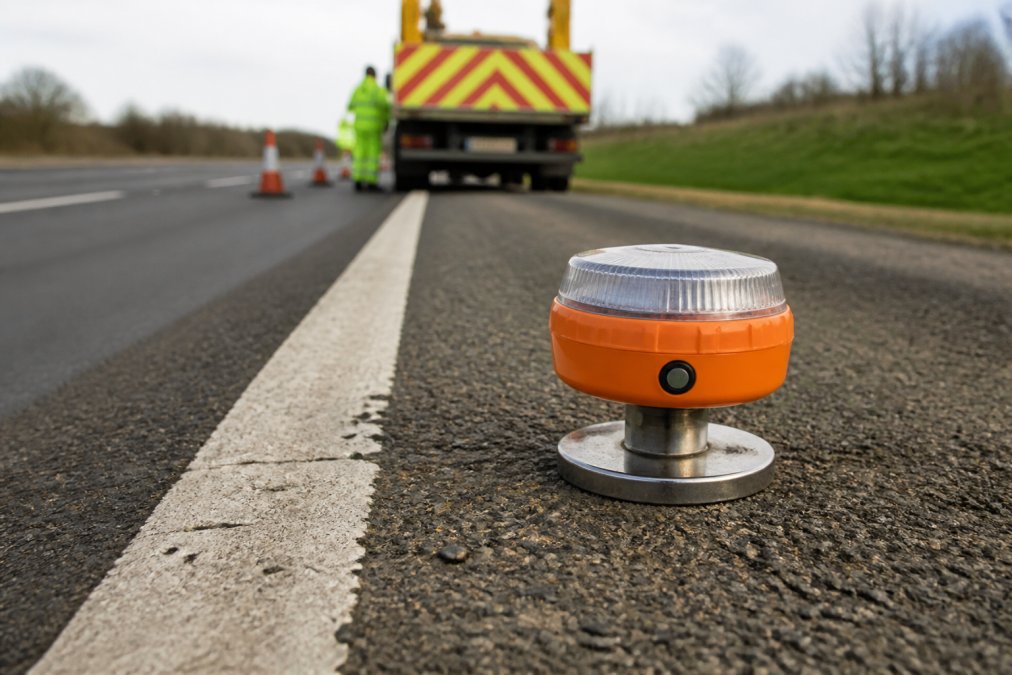
The visibility component works through ruggedized, waterproof warning lights engineered for high-intensity visibility in daylight, fog, rain, and darkness. A driver approaching at 70 mph needs to see the hazard clearly enough to begin braking well before reaching your vehicle (nhtsa.dot.gov). GPS beacons with dual-layer warning systems, bright LED lights combined with satellite signal transmission, ensure detection by both human drivers and automated traffic systems.
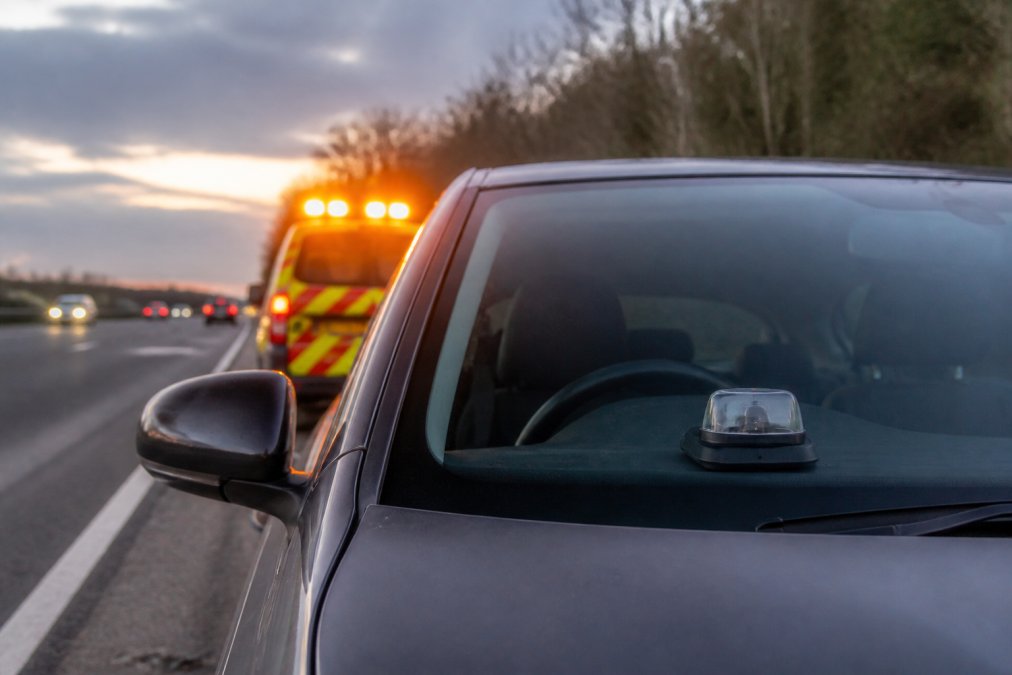
Device reliability matters enormously. A GPS beacon that fails during an emergency creates false confidence. The best systems include battery redundancy, self-testing protocols, and waterproof construction that withstands rain, spray, and temperature extremes. Roadflash beacons maintain signal transmission and lighting functionality in conditions that would disable cheaper alternatives.
The difference between a visible hazard and a protected one is whether emergency services know your location. GPS beacons ensure they do.
DGT 3.0 Compliant Emergency Beacons: Legal Safety Requirements
In Spain and several other jurisdictions, emergency beacons must meet DGT 3.0 specifications. This standard defines technical requirements for GPS-enabled warning systems used on motorways and highways. Compliance isn’t optional, it’s a legal requirement for roadside safety equipment in regulated markets.
DGT 3.0 compliance ensures your GPS beacon meets specific standards for signal transmission, device durability, and integration with emergency response infrastructure. The standard guarantees that beacons transmit location data in formats emergency services can immediately process, reducing response times and eliminating compatibility issues.
The technical requirements include:
- Satellite technology capable of global positioning system accuracy within specified tolerances
- Two-way communication protocols allowing emergency services to confirm receipt and coordinate response
- Ruggedized construction withstanding motorway conditions
- Battery life sufficient for extended roadside waits
- Integration with regional emergency response networks and traffic management systems
Roadflash’s DGT 3.0 compliant emergency beacons meet these specifications, ensuring seamless integration with local emergency infrastructure. This compliance determines whether your equipment will actually function in an emergency.
Using non-compliant emergency beacons in regulated jurisdictions can result in fines and confiscation. Always verify DGT 3.0 certification before purchasing, especially if you operate in Spain or cross borders regularly.
Emergency Roadside Safety Equipment: GPS vs. Traditional Hazard Warnings
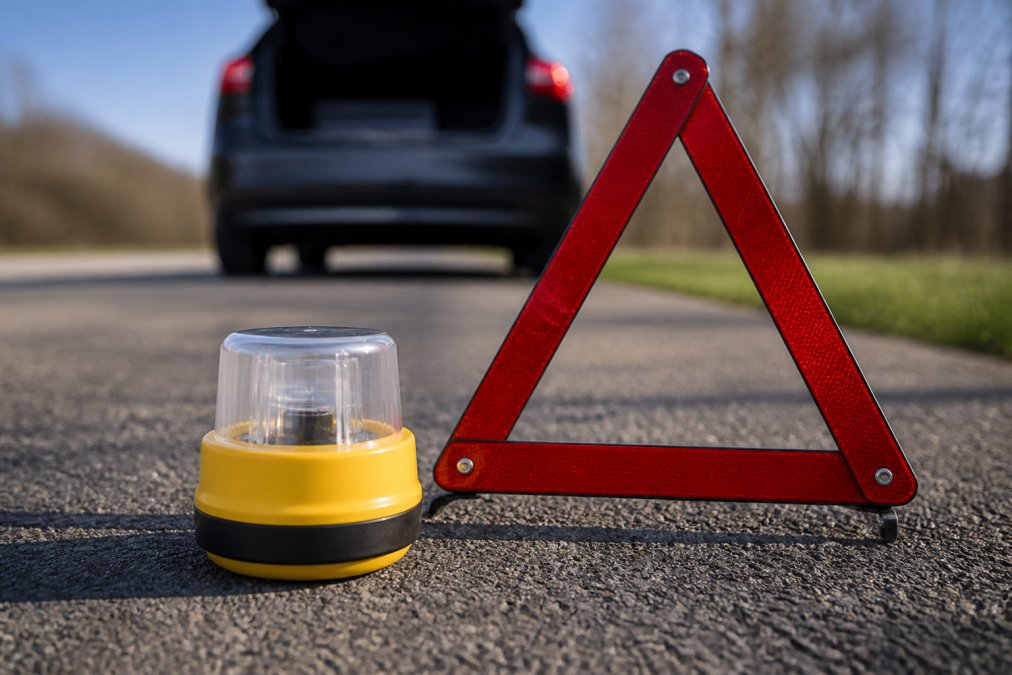
Traditional roadside safety equipment, reflective triangles, basic hazard lights, and warning vests, makes a stationary vehicle visible to approaching drivers. A reflective triangle placed 50 metres behind your vehicle gives oncoming traffic a visual warning. This approach is simple, reliable, and requires no batteries or connectivity.
GPS beacons add critical capabilities that traditional equipment cannot provide. Where a reflective triangle only works if a driver is paying attention and can see it, a GPS beacon actively communicates your location to emergency services and, in networked systems, to nearby vehicles. Help can be dispatched even if visibility is poor, if you’re injured and unable to activate manual warnings, or if your vehicle is partially obscured.
| Capability | Reflective Triangle | Hazard Lights | GPS Beacon |
|---|---|---|---|
| Visible in daylight | Yes | Moderate | High (lights + tracking) |
| Works in fog or rain | Limited | Moderate | Yes (satellite signal) |
| Communicates location to emergency services | No | No | Yes |
| Requires driver action | Yes | Yes | Automatic or manual |
| Works if driver is injured | No | No | Yes |
| Battery-dependent | No | Yes | Yes |
| Compliance in regulated markets | Yes | Yes | Yes (if DGT 3.0 certified) |
Traditional equipment remains valuable as a backup. But the most effective roadside safety strategy combines both: high-visibility passive warnings for immediate driver awareness, plus active GPS transmission to ensure emergency services are alerted and can locate you precisely.
Roadflash integrates these layers, providing satellite-based location transmission and two-way communication alongside integrated high-visibility lighting to address both immediate collision risk and emergency response coordination.
Real-Time Tracking and Emergency Response Integration
Real-time tracking transforms how emergency services respond to roadside incidents. When a GPS beacon transmits your location continuously, emergency responders receive updated position data as they approach, eliminating the common problem where drivers give inaccurate directions or emergency services struggle to locate them.
Integration with emergency response networks means your GPS beacon data flows directly into systems that dispatch ambulances, fire services, and police. Traffic management can be alerted to create a safe corridor, emergency services can prepare for the specific incident type, and other motorists can be warned to reduce speed or change lanes.
Two-way communication is critical: you’re not just broadcasting your location, you’re receiving confirmation that emergency services have received your signal and are responding. This link also allows responders to send you information about estimated arrival time or instructions while you wait.
Data transmission happens through satellite technology, meaning your location reaches emergency services even in areas with no mobile network coverage, particularly valuable on remote motorway stretches or during network outages.
The difference between a location transmitted and a location acted upon is real-time integration. Ensure any GPS beacon connects directly to emergency response networks in your region, not just to a private app.
Device Reliability, Maintenance and Testing Protocols
A GPS beacon that fails during an emergency creates false confidence. Device reliability depends on rigorous maintenance and testing protocols.
Start with regular self-testing. Most modern GPS beacons include built-in diagnostics that verify battery charge, signal transmission, and light functionality. Use these tests monthly or before long motorway journeys. A beacon that fails self-testing should be serviced or replaced immediately.
Battery management is critical. GPS beacons typically use rechargeable batteries that degrade over time. Check the battery status indicator regularly and recharge after any activation. Pay attention to low-battery warnings.
Waterproofing requires inspection too. If your beacon has been exposed to salt spray, extreme heat, or physical impact, examine seals and housing for damage. Cracks allow moisture ingress, which corrodes internal components and degrades signal transmission.
Storage conditions matter. GPS beacons should be stored in cool, dry environments, not in vehicle glove boxes where temperatures swing wildly. If storing long-term, charge fully and keep in a climate-controlled space.
Testing protocols should include:
- Monthly self-test using built-in diagnostics
- Battery charge verification before long journeys
- Visual inspection for cracks, corrosion, or seal damage
- Annual professional service or replacement of wear items
Roadflash beacons are engineered for reliability, but no device performs well without maintenance. Building testing into your routine ensures your GPS beacon will work when you need it.
Choosing the Right GPS Beacon for Your Needs
Selecting a GPS beacon depends on how often you drive on motorways, whether you operate in regulated markets, and what level of emergency services integration matters most.
For occasional motorway drivers, a GPS beacon with basic location transmission and high-visibility lighting is sufficient. You need reliable, DGT 3.0 compliant equipment that activates easily and communicates your location to emergency services. Battery life should exceed 48 hours in standby mode, and the device should be waterproof and ruggedized.
For professional drivers and fleet operators, compliance is non-negotiable. Your beacons must be DGT 3.0 certified if you operate in regulated jurisdictions. Fleet management integration allows real-time vehicle tracking and verification that all vehicles have functioning beacons. Two-way communication becomes more valuable for receiving status updates and coordinating multi-vehicle incidents.
For drivers in remote areas or those traveling frequently on poorly-served roads, satellite technology is critical. Mobile network coverage is unreliable in many rural areas, so a GPS beacon transmitting independently via satellite ensures you can call for help regardless of phone signal.
Key evaluation criteria:
- Compliance: Is it DGT 3.0 certified if you operate in regulated markets?
- Coverage: Does it use satellite technology or depend on mobile networks?
- Reliability: What’s the battery life, and how easy is maintenance?
- Integration: Does it connect directly to emergency response networks?
- Activation: Is it manual, automatic, or both?
- Durability: What’s the waterproof rating and temperature tolerance?
Roadflash GPS beacons are designed for motorists who prioritize safety and compliance. The multi-award-winning approach combines DGT 3.0 compliance, satellite-based location transmission, high-visibility lighting, and integration with emergency response infrastructure.
Drivers who commute regularly on motorways and want guaranteed DGT 3.0 compliance, reliable satellite-based location transmission, and integration with emergency response networks.
Conclusion
GPS beacons represent a fundamental shift in how motorists respond to roadside emergencies. They combine real-time location tracking, high-visibility warning systems, and integration with emergency response infrastructure to ensure help finds you quickly and other drivers see you clearly.
The benefits are concrete: reduced collision risk through immediate hazard awareness, faster emergency response through precise geolocation, and peace of mind knowing your location is actively transmitted to those who can help. In regulated markets, DGT 3.0 compliance ensures seamless integration with local emergency infrastructure.
Roadflash has engineered GPS beacons specifically for motorists who refuse to compromise on safety. Add a Roadflash GPS beacon to your vehicle and gain the certainty that emergency services will know exactly where you are. Get started with Roadflash and transform how you handle roadside incidents.
Ready to protect yourself on the motorway? Roadflash GPS beacons combine DGT 3.0 compliance, satellite-based location transmission, and high-visibility warning systems to ensure you’re protected during breakdowns. Explore our award-winning emergency beacons and add one to your vehicle today. Learn more about motorway safety standards and Emergency services guidance on roadside assistance to understand why real-time location transmission matters in emergencies.
Frequently Asked Questions
Q: What are the primary safety benefits of using a GPS beacon?
A: GPS beacons provide real-time location data to emergency services, reducing response times during breakdowns or accidents. They transmit your exact position via satellite technology, ensuring search and rescue teams locate you quickly even in remote areas with poor mobile coverage. Combined with high-visibility lighting and SOS alert capabilities, GPS beacons significantly increase hazard awareness among other road users, reducing collision risk for stationary vehicles on busy motorways and highways.
Q: How do GPS beacons improve hazard awareness compared to reflective triangles?
A: Reflective triangles rely on driver visibility and manual placement, offering limited protection in poor weather or darkness. GPS beacons combine active lighting, real-time tracking, and automatic distress signal transmission. They alert emergency services to your exact location instantly, whereas triangles require drivers to notice them. For motorway breakdowns, this difference can be critical, GPS beacons provide situational awareness to both nearby traffic and emergency responders simultaneously.
Q: Are GPS beacons effective for vehicle breakdown safety on motorways?
A: Yes. GPS beacons are specifically designed for stationary vehicle protection on high-speed roads. They transmit your location, activate high-visibility lighting, and send SOS alerts to emergency services and nearby vehicles. For motorway commuters, GPS beacons address the greatest risk period: the minutes between breakdown and emergency service arrival.
Q: Do GPS beacons require a subscription to work for emergency safety?
A: Subscription requirements vary by device type. Some GPS beacons operate via satellite technology and require a subscription for two-way communication and continuous tracking. Others offer basic SOS functionality with one-time activation. Before purchasing, clarify the subscription model and coverage area with your supplier. Many professional road safety products, including DGT 3.0 compliant emergency beacons, bundle subscription costs into their service offering, so check what's included in your purchase.
This article was written using GrandRanker