

Emergency Beacons vs Triangles: Which Saves Lives?
Table of Contents
- Why Emergency Beacons and Triangles Matter for Roadside Safety
- Are Warning Triangles Mandatory in the UK?
- How Emergency Beacons Outperform Traditional Triangles
- Best Practice for Motorway Breakdowns
- Technical Specifications: V-16 Beacons Explained
- Cost-Benefit Analysis: Long-Term Safety Investment
- Conclusion
Last Updated: August 9, 2026
Why Emergency Beacons and Triangles Matter for Roadside Safety
A stationary vehicle on a busy motorway is one of the most dangerous places to be. When a breakdown happens, the next 60 seconds determine whether you stay safe or become part of the accident statistics. At Roadflash, we’ve spent years analysing how drivers respond to roadside hazards, and the data is clear: visibility saves lives. The question isn’t whether you need a warning system, it’s which one actually works when it matters most.
Emergency beacons and warning triangles represent two fundamentally different approaches to roadside safety. Triangles are passive reflectors that depend entirely on external light sources. Beacons are active warning devices that generate their own light, broadcasting a signal that’s visible from hundreds of metres away. On a dark motorway or in heavy rain, that difference isn’t academic, it’s the margin between being seen and being hit.
This guide examines the real-world performance of both systems, the regulations that govern them in the UK, and why emergency beacons are increasingly becoming the safety standard for drivers who understand the risks.
Are Warning Triangles Mandatory in the UK?
Warning triangles are not currently a legal requirement for private vehicles in the UK, though they’re mandatory in many European countries including France, Germany, and Spain. However, the absence of a legal mandate doesn’t mean they’re unnecessary. The Highway Code recommends warning triangles for breakdowns on motorways, but enforcement is limited and compliance is low.
The regulatory landscape is shifting, particularly for vehicles travelling abroad. Spain’s DGT 3.0 regulations now mandate emergency beacons with GPS functionality for all vehicles on Spanish roads, effective from 2026. This creates a practical dilemma for UK drivers who regularly cross the Channel: carry a triangle that may not be visible in poor conditions, or invest in active beacon technology that meets current and emerging European standards.
Several factors explain why triangles persist despite their limitations. They’re inexpensive, require no batteries, and they’re familiar to most drivers. They’ve been around since the 1950s, and regulatory bodies have been slow to update guidance. But the real reason triangles remain common is inertia, not safety evidence. A reflective triangle placed 45 metres behind a stationary vehicle on a dark motorway is nearly invisible to approaching traffic travelling at 70 mph. By the time a driver sees it, they have seconds to react.
Placing a warning triangle requires exiting your vehicle into moving traffic. On a busy motorway, this creates a secondary hazard that often exceeds the original breakdown risk. Drivers injured whilst placing triangles represent a significant portion of motorway safety incidents.
How Emergency Beacons Outperform Traditional Triangles
Emergency beacons operate on a principle that triangles cannot match: active visibility. A V-16 compliant beacon produces 360-degree amber LED illumination visible from over 800 metres in daylight and up to 1,500 metres at night. Compare this to a reflective triangle’s effective range of 50-100 metres depending on lighting conditions, and the performance gap becomes obvious.
The OSRAM LEDguardian ROAD FLARE Signal V16, for example, generates 140 lumens of amber light with a magnetic base that attaches to your vehicle roof in seconds. You deploy it without leaving your vehicle. The light pattern is standardised under V-16 regulations, meaning every driver on the road recognises it instantly as a hazard warning.
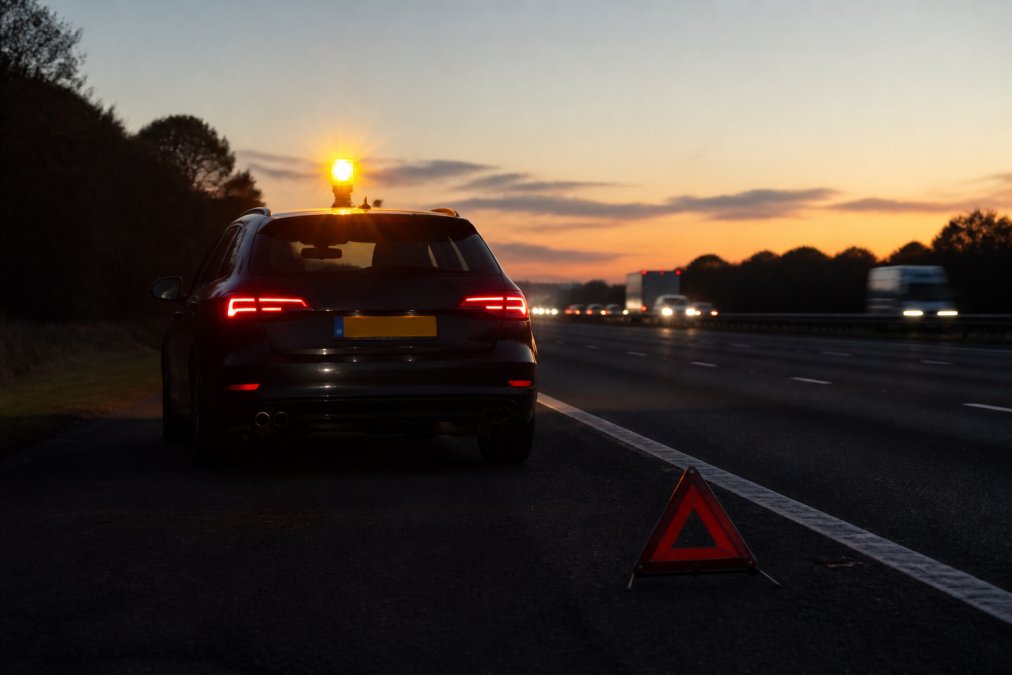
Triangles, by contrast, are passive and entirely dependent on external light sources. In fog, heavy rain, or on an unlit motorway section, their visibility drops to near zero. They’re also directional, a driver approaching from an angle may not see the reflective surface at all. A beacon’s 360-degree pattern means it’s visible from every direction.
Visibility in Adverse Weather and Low Light
Weather is where the difference becomes critical. A 2024 analysis of motorway incidents found that visibility-related factors contributed to a significant proportion of secondary accidents at breakdown sites. Fog, rain, and darkness all degrade reflective triangle performance substantially.
Beacons maintain consistent visibility regardless of weather because they generate their own light. An amber LED at 140 lumens cuts through rain and fog far more effectively than reflected light. At night, on an unlit section of motorway, a beacon is visible from 1,500 metres or more. A triangle is essentially invisible without a vehicle’s headlights to illuminate it.
The OSRAM LEDguardian uses a specific amber wavelength (2000K colour temperature) chosen because it’s least affected by atmospheric scattering in poor visibility conditions. This isn’t arbitrary, it’s based on decades of research into what colours and light intensities penetrate adverse weather most effectively.
Temperature also matters. Reflective materials degrade in cold weather. The reflective coating on triangles becomes less effective as temperatures drop, a factor often overlooked in UK safety recommendations. Beacons with quality LED components perform consistently regardless of temperature.
Deployment Speed and Driver Safety
The practical difference between a triangle and a beacon is measured in seconds and risk. Deploying a triangle requires you to:
- Exit your vehicle into moving traffic
- Walk to a point 45 metres behind your vehicle
- Position the triangle on the road surface
- Return to your vehicle
On a busy motorway, this exposes you to multiple hazards: being struck by passing traffic, losing your footing on the verge, and becoming disoriented in poor visibility. Drivers injured during triangle placement represent a measurable safety cost that’s rarely discussed in regulatory guidance.
A beacon requires:
- Attach the magnetic base to your vehicle roof (30 seconds)
- Activate the light
- Return inside your vehicle
You never leave the vehicle. You’re protected by your own vehicle’s structure whilst the beacon broadcasts your location. This is a fundamental safety advantage that extends beyond mere visibility.
When deploying any warning device, position your vehicle as far to the left as possible and activate hazard lights immediately. For beacons, activate the light before exiting the vehicle if possible. For triangles, place them at least 45 metres behind your vehicle on the hard shoulder, never on the traffic lane itself.
Real-Time Location Data and Emergency Response
Modern V-16 beacons with GPS/geolocation capability add another layer of safety that triangles cannot provide. Roadflash’s emergency beacons include geolocated signal functionality, meaning emergency services receive your exact location automatically. This matters significantly when you’re disoriented, injured, or unable to communicate clearly.
A standard triangle provides no location data. Emergency services must rely on your mobile phone signal or a passing motorist’s report. If you’re unconscious or your phone battery is dead, you’re essentially invisible to the emergency response system. A GPS-enabled beacon transmits your coordinates continuously, ensuring rescue services know exactly where you are.
This is particularly valuable on motorway sections with unclear mile markers or in poor visibility where verbal descriptions are unreliable. The beacon’s geolocated signal integrates with emergency response networks, reducing response time and improving the accuracy of first responders’ navigation.
Best Practice for Motorway Breakdowns
The safest approach to a motorway breakdown combines multiple elements: immediate hazard light activation, a high-visibility warning device, and emergency service notification.
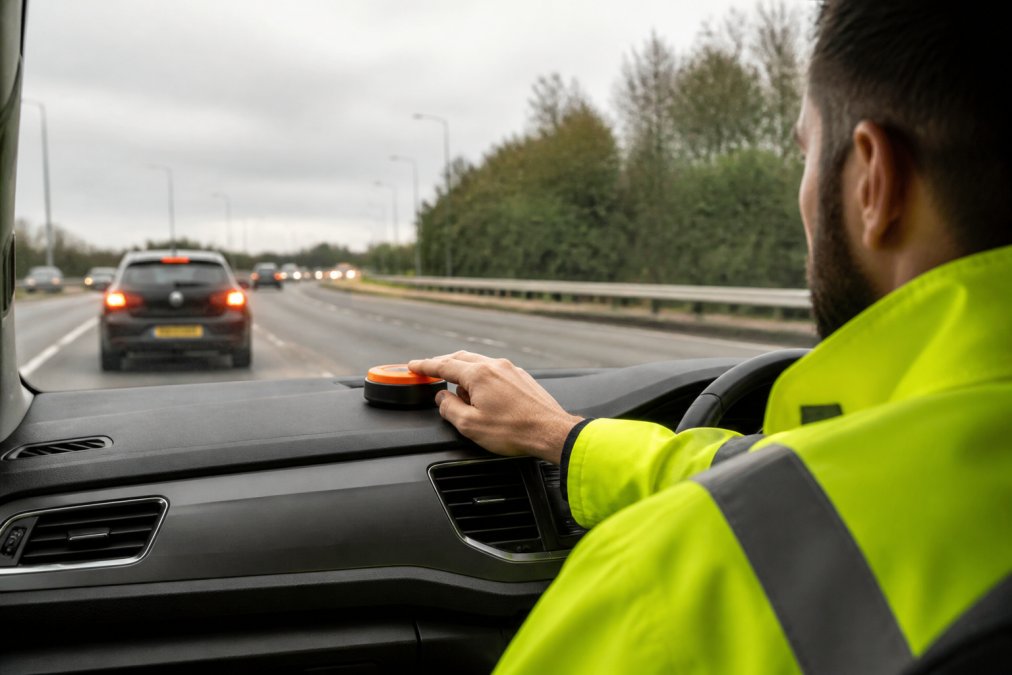
The sequence should be:
- Activate hazard lights immediately when you realise you’re breaking down. This alerts traffic before you stop.
- Move to the hard shoulder as far left as possible, away from moving traffic.
- Deploy your warning device, beacon or triangle. For beacons, activate from inside your vehicle. For triangles, position at 45 metres behind your vehicle.
- Call emergency services if the breakdown is serious or you feel unsafe. Provide your location clearly.
- Remain in your vehicle with seatbelts fastened unless there’s immediate danger (fire, fuel leak, or oncoming traffic).
Most motorway safety guidance recommends staying inside your vehicle rather than standing outside. A beacon allows you to do this whilst still providing maximum warning to approaching traffic. A triangle forces a choice between visibility and personal safety, you must exit the vehicle to deploy it effectively.
For vehicles equipped with Roadflash emergency beacons, the geolocated signal provides an additional layer of protection. Emergency services receive your location automatically, reducing the risk that you’ll be overlooked or difficult to locate in poor visibility.
| Breakdown Element | Warning Triangle | Emergency Beacon |
|---|---|---|
| Deployment | Exit vehicle, place manually | Attach to roof, activate from inside |
| Visibility range | 50-100 metres | 800-1,500 metres |
| Weather performance | Degrades in rain/fog | Consistent in all conditions |
| Location data | None | GPS/geolocation available |
| Driver safety | Requires road exposure | Deployed from vehicle safety |
| Setup time | 2-3 minutes | 30 seconds |
Technical Specifications: V-16 Beacons Explained
V-16 is the European standard for emergency warning lights, formally defined as ECE R65. The "V" stands for vehicle, and "16" refers to the specific regulation number. Compliance with V-16 means the beacon meets strict requirements for light intensity, colour, flash pattern, and durability.
A compliant V-16 beacon must produce:
- Amber light at 2000K colour temperature
- Minimum 140 lumens output
- Flash pattern of 1.0 Hz (one flash per second)
- 360-degree visibility
- Weather resistance rated to IP54 or higher
- Magnetic or adhesive mounting options
The OSRAM LEDguardian ROAD FLARE Signal V16 meets these specifications with 12 high-power LEDs delivering 140 lumens. The magnetic base allows quick attachment to any metal vehicle surface, and the compact design fits in a glove compartment for convenient storage.
Roadflash’s DGT 3.0 compliant emergency beacons go further, adding GPS/geolocation functionality that integrates with emergency response networks. This means your exact location is transmitted to rescue services automatically, eliminating the risk of miscommunication about your position.
Battery life is a practical consideration often overlooked. Quality V-16 beacons with LED technology typically provide 24-48 hours of continuous operation from a single charge or battery set. This is far longer than needed for a typical breakdown scenario, but it ensures the device is always ready when needed. Triangles require no power, but they also provide no active warning, a trade-off worth understanding.
V-16 compliance ensures your beacon meets the same safety standards recognised across Europe. This is particularly important if you travel internationally or if UK regulations evolve toward mandatory beacon requirements.
Cost-Benefit Analysis: Long-Term Safety Investment
The cost difference between a warning triangle and an emergency beacon is substantial. A basic reflective triangle costs £10-20. A quality V-16 beacon ranges from £25-50 depending on features and battery type. For many drivers, this price difference feels significant.
However, the cost-benefit calculation changes when you consider what you’re actually purchasing. A triangle provides passive visibility in good conditions. A beacon provides active visibility in all conditions, plus GPS location data if equipped with geolocation. The safety improvement justifies the additional cost for drivers who regularly use motorways.
Consider the financial consequences of a motorway accident. A secondary collision at a breakdown site, where a moving vehicle strikes a stationary one, typically results in injuries, vehicle damage, and potential fatalities. The average cost of a serious motorway incident, including emergency response, medical treatment, vehicle repair, and potential legal liability, runs into tens of thousands of pounds. A quality emergency beacon that prevents even one such incident pays for itself many times over.
For drivers who travel internationally, particularly to Spain or other countries with mandatory beacon requirements, purchasing a compliant V-16 beacon eliminates the need to buy or rent equipment for each trip. A single investment covers all future travel.
Motorway breakdowns are inherently dangerous situations. The warning device you choose determines whether approaching traffic has seconds or fractions of a second to react. Emergency beacons, particularly those with GPS/geolocation capability like Roadflash’s multi-award-winning systems, provide the visibility and location data that genuinely reduce the risk of secondary collisions. They’re faster to deploy, safer for the driver, more effective in adverse weather, and increasingly aligned with European safety standards. For any driver who regularly uses motorways, an emergency beacon isn’t a luxury upgrade, it’s essential protection. Roadflash’s DGT 3.0 compliant beacons with integrated geolocation give you the added confidence that emergency services will find you quickly, even if visibility is poor or you’re unable to communicate clearly. Add one to your vehicle today and drive with the knowledge that you’re maximising your safety during the moments when it matters most.
Frequently Asked Questions
Are emergency beacons safer than warning triangles?
Yes. Emergency beacons provide active, high-visibility LED lighting visible from significantly greater distances, especially in poor weather and darkness. Unlike triangles, which depend on external light sources and require manual roadside placement, beacons can be deployed from inside the vehicle. Studies show active warning systems reduce roadside collision risk substantially. V-16 beacons with GPS geolocation add emergency response speed, pinpointing your exact location to rescue services automatically.
Is it a legal requirement to carry a warning triangle in the UK?
No, warning triangles are not mandatory in the UK. However, they remain recommended for international travel to European countries where they are legally required. The UK's motorway safety guidance emphasises staying inside your vehicle with hazard lights activated during breakdowns. Emergency beacons are increasingly preferred because they eliminate the need for dangerous roadside placement whilst providing superior visibility and real-time location data to emergency services.
What makes V-16 emergency beacons compliant for Spain and other European countries?
V-16 beacons meet the European technical standard for emergency warning lights, delivering 360-degree amber LED visibility with certified brightness and durability. Spain's DGT 3.0 regulation mandates V-16 compliant beacons for roadside safety. These beacons must withstand wind resistance, perform in adverse weather, and maintain consistent visibility range. GPS-enabled versions add geolocation functionality, allowing emergency services to locate vehicles instantly, a feature that exceeds basic triangle compliance.
How quickly can I deploy an emergency beacon versus a warning triangle?
Emergency beacons deploy in seconds from inside your vehicle, simply activate the magnetic beacon or place it on the roof. Warning triangles require exiting the vehicle, walking to a safe distance, assembling the stand, and positioning it correctly, taking 2-3 minutes and exposing you to traffic danger. On busy motorways, this deployment time difference is critical. Beacons with automatic GPS activation eliminate manual steps entirely, immediately alerting emergency services to your location whilst you remain safely inside.
This article was written using GrandRanker