
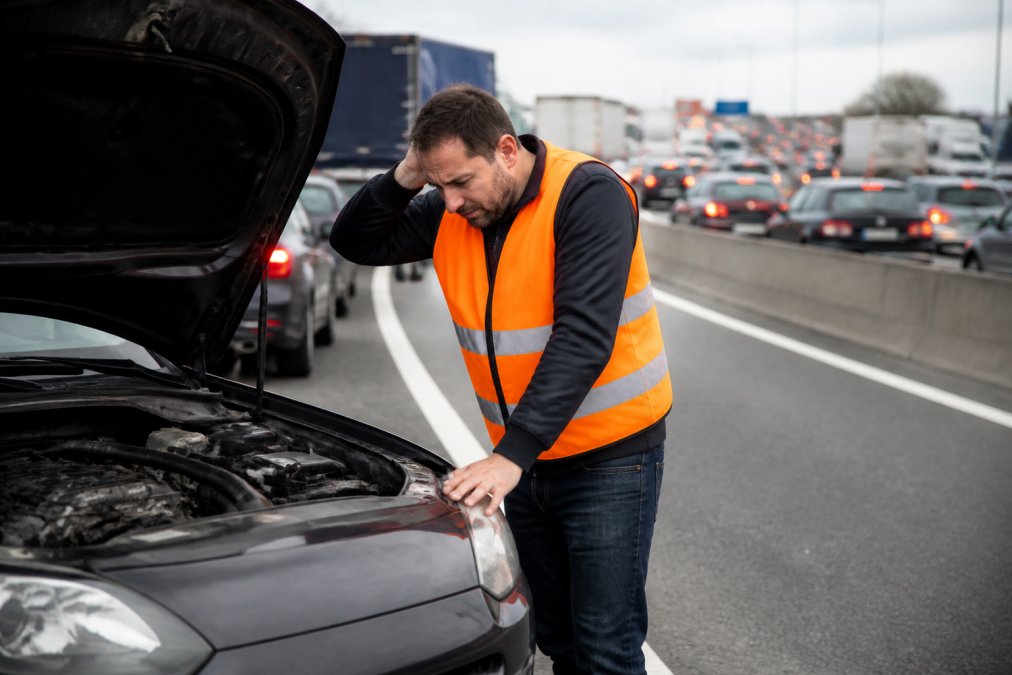
What to Do If Your Car Breaks Down in Heavy Traffic
Table of Contents
- Immediate Safety Actions When Your Car Breaks Down in Heavy Traffic
- Activating Hazard Lights and Warning Beacons
- Moving to a Safe Location
- How to Use Hazard Warning Lights Correctly
- Motorway Breakdown Safety Rules You Need to Know
- Staying Visible: Vehicle Visibility Safety Products That Work
- Managing Panic and Communicating with Emergency Services
- Preventing Breakdowns in Traffic: Pre-Trip Checks and Safe Driving
- Conclusion: Staying Calm and Safe When Your Car Breaks Down
- Frequently Asked Questions
Last Updated: September 26, 2026
Immediate Safety Actions When Your Car Breaks Down in Heavy Traffic
Knowing what to do if your car breaks down in heavy traffic can mean the difference between a stressful delay and a serious collision. At Roadflash, we build early warning systems for exactly this scenario.
- Switch on your hazard lights immediately.
- Keep both hands on the wheel and steer steadily. Do not brake hard.
- Move to the left if a hard shoulder or lay-by is close.
- Stop as far left as you safely can, away from live lanes.
- Turn your wheels away from traffic so the car cannot roll back into the lane.
Never stop in a live lane if you can possibly avoid it. A stationary car in flowing traffic is one of the most dangerous places on the road network, and drivers behind you may have less than two seconds to react.
Activating Hazard Lights and Warning Beacons
Hazard lights are your first and fastest signal that something is wrong. Use them the moment you feel a problem, do not wait until you have fully stopped.
- Flashing hazards: press the triangle button on your dashboard.
- Warning beacons: place a high-visibility beacon behind your car once you are safely out.
- Brake lights: keep your foot on the brake while slowing, so drivers behind see red.
Moving to a Safe Location
The safest place for a broken-down car is off the carriageway, a hard shoulder, emergency area, lay-by, or the left verge.
Once stopped, follow this order:
- Switch on hazard lights.
- Apply the handbrake.
- Turn the wheels away from traffic.
- Leave the car through the door facing away from traffic.
- Take passengers and pets with you.
- Move behind the barrier or up the embankment.
How to Use Hazard Warning Lights Correctly
Hazard warning lights flash all four indicators at once. Used correctly, they buy you time and space; used wrongly, they confuse the people you most need to understand you.
The rules are simple:
- Use them when broken down, when slowing suddenly on a fast road, or when you are a temporary hazard.
- Do not use them to park illegally or to thank another driver.
- Switch them off once you are safely off the road and no longer a hazard.
Motorway Breakdown Safety Rules You Need to Know
Motorway breakdown safety rules exist because motorways are the most dangerous place to stop: speeds are high, reaction times short, and there is often nowhere to go.
Legal Obligations and Liability
Drivers have a legal duty to keep their vehicle roadworthy. Under the Road Traffic Act 1988, it is an offence to use a vehicle in a dangerous condition, bald tyres, faulty brakes, defective lights.
What to Do on Different Road Types
The right move changes with the road you are on.
| Road type | First action | Where to stop | Who to call |
|---|---|---|---|
| Motorway | Hazards on, drift left | Hard shoulder or emergency area | 999 if in a live lane, otherwise recovery |
| Dual carriageway | Hazards on, keep left | Left verge or lay-by | Recovery service |
| Urban high street | Hazards on, pull in | Side street or car park | Recovery service |
| Rural A-road | Hazards on, slow early | Verge or field gate | Recovery service |
| Tunnel | Hazards on, keep moving if possible | Emergency bay only | Use the emergency phone |
Staying Visible: Vehicle Visibility Safety Products That Work
Visibility is what keeps you alive on the shoulder. On an unlit motorway at night, a driver at 70 mph may have under two seconds to react to a stationary vehicle.
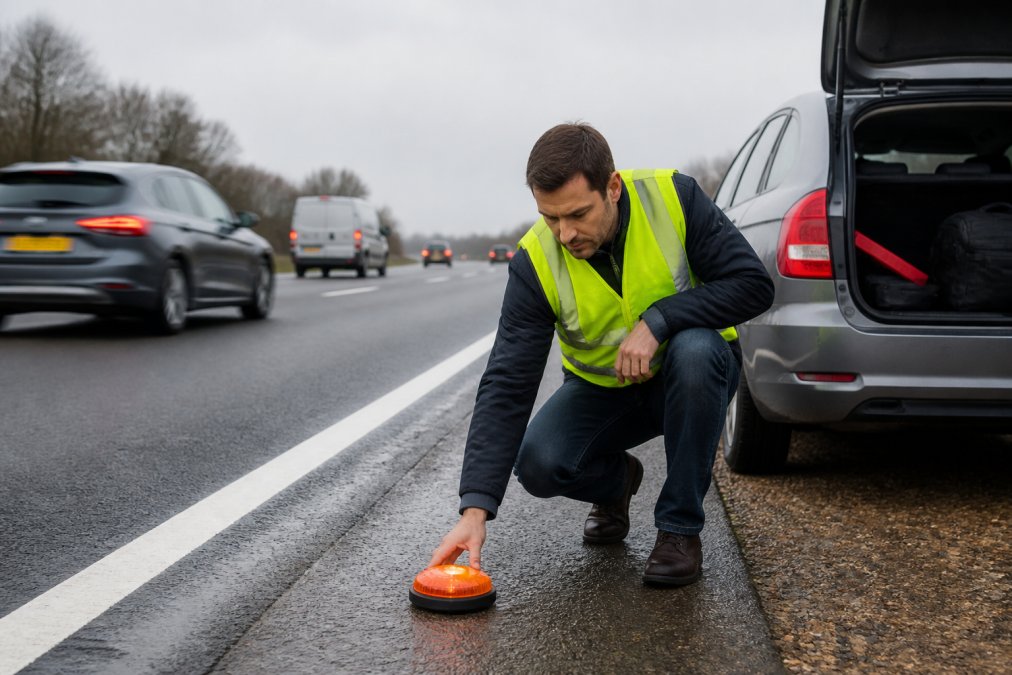
What actually works, in order of impact
- Hazard lights. Free, instant, and your primary signal, day and night.
- High-visibility vest. One per occupant, stored in the cabin, not the boot, which is useless when it faces a live lane.
- Warning beacon or flashing light. A self-powered beacon on the shoulder dramatically increases how far back you are seen; magnetic or suction versions attach without stepping into traffic.
- Reflective triangle. Effective on quiet roads, but many safety bodies advise against using one on a motorway, walking back up a live lane puts you in serious danger.
- GPS-enabled beacons. These combine high-visibility lighting with location sharing, so responders find you faster.
Placement: where and when
Placement matters as much as owning the kit.
- Place the beacon behind the car, on the shoulder, not in a live lane, and not so far back that you must walk in traffic to retrieve it.
- On a hard shoulder, aim a few metres behind the rear, angled slightly toward the carriageway so approaching drivers see it early.
- In an emergency area, place it at the entrance to the bay so drivers know it is occupied.
- At night or in poor visibility, switch on every light you have, hazards, beacon, and interior light if you are staying inside.
- In fog or heavy rain, leave the beacon running even after you have called for help.
Never walk back up a live lane to place or retrieve equipment. If you cannot place a beacon safely from the shoulder, do not place one at all, your hazard lights and vest are enough.
What to keep in the car, and where
The most common mistake is storing safety kit in the boot, if it faces traffic, you cannot reach it safely. Keep essentials in the cabin:
- High-visibility vest for every occupant, within arm’s reach of each seat.
- A self-powered warning beacon, charged and tested monthly.
- A torch, ideally a head torch so your hands are free.
- A charged phone and a cable.
- A foil blanket if you may be waiting in cold weather.
Trade-offs to be aware of
- Brightness vs. battery life. The brightest beacons drain fastest, check the charge before long journeys, especially in winter.
- Magnetic vs. suction mounts. Magnetic mounts are quicker but only work on steel bodywork; suction mounts work on glass and plastic but can fail in cold, wet conditions.
- Fixed vs. portable. A wired beacon is always ready but only helps the vehicle it is fitted to; a portable one moves between cars.
A note on being seen when you cannot get out
If you are trapped in a live lane and cannot safely exit, keep hazards on, keep your seatbelt on, and if a beacon is within reach, switch it on and place it on the dashboard or rear parcel shelf. Do not open a door into traffic.
Managing Panic and Communicating with Emergency Services
Panic is the hidden hazard in a breakdown. It makes people step into traffic, forget the handbrake, or freeze in a live lane. Drivers who survive a live-lane breakdown usually got their breathing under control before touching the door handle.
Why panic hijacks your decision-making
When you are suddenly stationary in fast-moving traffic, your body dumps adrenaline: heart rate climbs, peripheral vision narrows, and your brain shifts to reflex decisions. That reflex is often to open the door and step out, the single most dangerous thing you can do in a live lane.
- Take three slow breaths, in through the nose, out through the mouth. This lowers heart rate enough to think.
- Name the first action out loud, “hazards on”, and do it. Speaking engages the planning part of the brain.
- Do one thing at a time. Do not try to solve the whole situation at once.
- If you have passengers, give one of them a single job: call for help while you manage the vehicle.
If you feel yourself freezing, grip the wheel and press your feet flat on the floor. Physical grounding interrupts the freeze response long enough to act.
Panic looks different on different roads
On a busy high street, the pressure is social, horns, impatient drivers, the urge to wave apologies. Ignore it; your safety outranks anyone’s journey time.
Communication scripts for emergency services
“I’ve broken down on the [motorway/road name] heading [direction]. I’m near [junction number, marker post, or What3Words location]. My car is [colour, make, model], registration [number]. I am [in a live lane / on the hard shoulder / in an emergency area]. There are [number] people in the car, including [children/pets]. I am [injured / not injured].”
A few specifics that make a real difference:
- Marker posts. On motorways, verge posts show a letter and number, for example, M6 A 145.0, giving control rooms an exact location.
- What3Words. A three-word address pinpoints you to a three-metre square, and emergency services across the UK accept these.
- Direction of travel. Always state which way you were heading.
- Live lane or not. This single fact changes the response priority, say it early.
Who to call, and when
- 999, if you are in a live lane, if anyone is injured, if there is a fire risk, or if you are in a tunnel and cannot reach an emergency bay.
- National Highways, for motorway and major A-road breakdowns where you are safely on the hard shoulder or in an emergency area. Their traffic officers provide free recovery from live lanes.
- Your breakdown provider, once you are in a safe position and no one is at immediate risk.
- 101, for non-urgent reporting, such as debris left on the carriageway.
Do not call your breakdown provider before 999 if you are in a live lane. Recovery can take time to reach you; the emergency services can protect the scene immediately.
What not to say
Avoid vague phrases like “somewhere on the M25” or “near London”, operators cannot dispatch to a feeling. Give a junction, marker post, or What3Words location. If you do not know where you are, describe the last sign you passed; the operator can work backwards from that.
Preventing Breakdowns in Traffic: Pre-Trip Checks and Safe Driving
Most breakdowns are preventable. A five-minute check before a long drive catches the faults behind most call-outs.
- Tyre pressure and tread: check when cold, including the spare.
- Coolant levels: top up between the min and max marks.
- Brake fluid: check the reservoir is above the minimum.
- Engine oil: check with the dipstick on level ground.
- Battery health: look for slow starts or dim lights.
- Lights: test all bulbs, including hazards and brake lights.
- Emergency kit: vest, warning beacon, torch, water, phone charger.
Phantom traffic jams, the ones with no obvious cause, are usually triggered by one driver braking hard and the wave rippling backwards. Keeping a steady gap and avoiding sudden braking helps break that wave before it forms.
Conclusion: Staying Calm and Safe When Your Car Breaks Down
A breakdown in heavy traffic is frightening, but survivable if you follow a clear order: hazards on, get left, get out, get behind the barrier, then call for help.
Frequently Asked Questions
Do I need to call the police if my car breaks down on the motorway?
You should call 999 only if you are in immediate danger or blocking a live lane. For non-emergency breakdowns on the hard shoulder, contact your breakdown provider or National Highways on 0300 123 5000. If you cannot reach a safe location and your vehicle is stranded in a live lane, call 999 immediately. Emergency services need to know your location, direction of travel, and whether anyone is injured. Always prioritise getting yourself and passengers to safety behind the barrier before making any calls.
How can I make my stationary vehicle more visible to other drivers?
Switch on your hazard warning lights immediately. If you carry a warning triangle, place it at least 45 metres behind your vehicle on the same side of the road, but never use one on a motorway hard shoulder. High-visibility warning beacons with flashing lights and GPS, such as those from Roadflash, significantly increase hazard awareness. Wear a high-visibility jacket if you have one. Keep your sidelights on if it is dark or visibility is poor. These steps help alert other drivers and reduce the risk of a collision.
What is the safest way to exit a vehicle in heavy traffic?
Exit through the door furthest from moving traffic, usually the left side. Check for approaching vehicles before opening any door. Move immediately to a safe area behind the barrier or on the verge, never stand between your car and oncoming traffic. Keep passengers, especially children, together and away from the carriageway. If you cannot exit safely, stay inside with seatbelts on and call 999. The goal is to put a physical barrier between you and live traffic as quickly as possible.
What should I do if my car breaks down in the middle of a busy road?
If your car breaks down in a live lane, switch on hazard lights immediately. If the vehicle still moves, steer it onto the hard shoulder or as far left as possible. If it cannot move, stay inside with seatbelts fastened and call 999. Do not attempt to push your car in moving traffic. Once police or traffic officers arrive, follow their instructions. If you can exit safely, move behind the barrier and wait for recovery. Never attempt repairs in a live lane.