
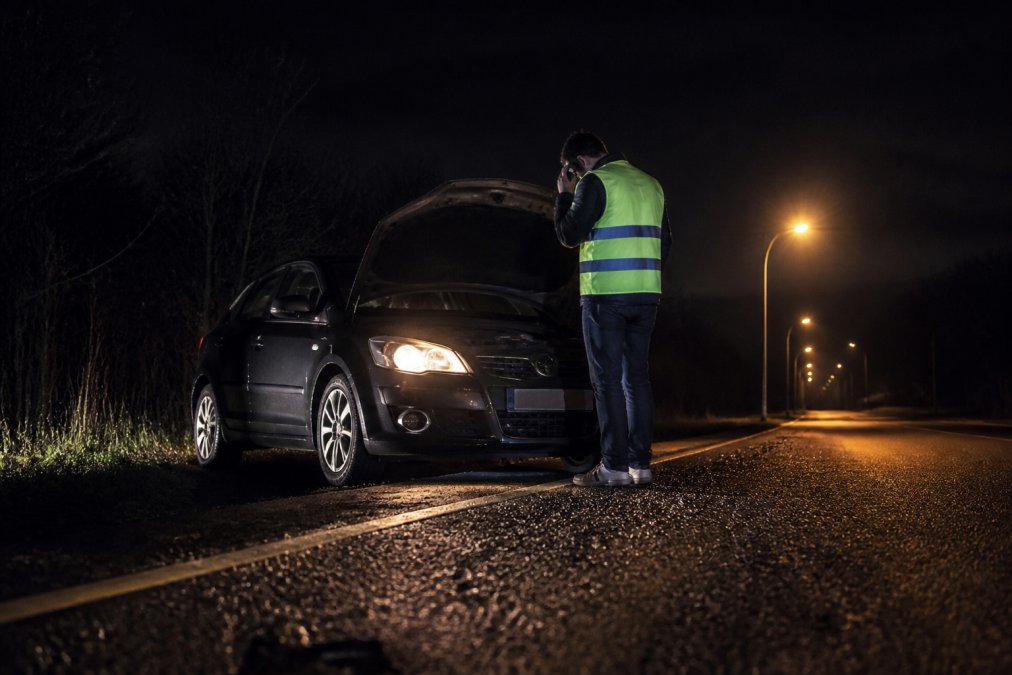
What to Do If Your Car Breaks Down at Night
Table of Contents
- What to Do If Your Car Breaks Down at Night: First Steps
- Motorway Breakdown Safety Rules Every Driver Should Know
- Emergency Breakdown Kit Essentials for Night Driving
- Visibility Aids for Stationary Vehicles: How to Be Seen in Low Light
- Rural vs Urban Night Breakdowns: What Changes
- Managing Panic and Sharing Your Location Digitally
- Frequently Asked Questions
Last Updated: September 25, 2026
What to Do If Your Car Breaks Down at Night: First Steps
Breaking down at night is one of the most stressful things a driver can face. Knowing what to do if your car breaks down at night starts with one rule: get safe before you get answers. This guide from Roadflash covers the exact steps to take, in order, so you can protect yourself and your passengers.
The first minute matters most. Your priority is not the engine, the warning light, or the recovery cost. It is making sure other drivers can see you.
Here is the sequence to follow:
- Keep both hands on the wheel and steer to the left.
- Switch on your hazard lights straight away.
- Pull as far left as you can.
- Stop the engine and leave your sidelights on.
Do those four things and you have already cut the biggest risk.
The most dangerous part of a night breakdown is the first few minutes, before other drivers register that your car is stationary. Hazard lights and a safe position do more for you than any phone call.
Motorway Breakdown Safety Rules Every Driver Should Know
Motorway breakdown safety rules exist because speed changes everything. Traffic can close on a stationary car in seconds.
If you can coast to a National Highways breakdown guidance emergency area or the hard shoulder, do it. Then follow this protocol:
- Stop on the hard shoulder, as far left as possible.
- Turn your wheels to the left, away from traffic.
- Switch on hazard lights. Leave sidelights on if light is poor.
- Exit through the left-hand doors only.
- Wait behind the barrier, never in the car.
- Call for help once you are safely behind it. National Highways recommends using the emergency roadside phones on the motorway, which connect directly to their control room and identify your exact location automatically.
If you cannot reach the hard shoulder, stay in the car with your seatbelt on and call 999. Moving into live lanes is far more dangerous than waiting.
Never stand between your car and oncoming traffic, and never try to repair a vehicle on the hard shoulder. Passing drivers misjudge the gap constantly, and the hard shoulder is not a safe place to work.
Emergency Breakdown Kit Essentials for Night Driving
Emergency breakdown kit essentials differ at night. A daytime kit keeps you fed and watered. A night kit keeps you seen, warm, and reachable. The difference is not the list, it is where each item lives and what it is for after dark.
The single most important item is a high-visibility jacket or vest. Under the Road Vehicles (Construction and Use) Regulations 1986, you are not legally required to carry one in a private car, but if you have to step onto the carriageway, being seen is the difference between a near miss and a collision. Buy one per occupant, not one per car, and store them in the cabin, under the seat, in the door pocket, or in the glovebox. A jacket in the boot is useless if the boot is against a live lane.
Build the rest of the kit around three night-specific jobs:
Being seen
- A high-visibility vest for every person in the car, stored in the cabin
- A torch with fresh batteries, or a wind-up model that cannot run flat
- A warning triangle, legal to carry, but never deploy it on a motorway, where it puts you in live traffic
- A reflective armband or clip-on light as a backup if a vest is missing
Staying warm and safe while you wait
- Foil blankets and warm layers. A breakdown on an unlit road in January can mean a long, cold wait, and hypothermia is a real risk if you are outside the car
- Water and any essential medication, kept where the driver can reach them
- A charged power bank as well as a phone cable, because a 12V socket may not work if the battery is flat
Being found
- A fully charged phone and a charging cable
- A note of your insurer’s or breakdown provider’s number, written down in case your phone dies
- A paper map or offline map download for rural areas with no signal
Check the kit before every long trip, and replace torch batteries at the same time you change your smoke alarm batteries. A kit you have not opened in two years is a kit you cannot rely on.
Store the high-visibility vest on the back of the driver’s seat or in the door pocket, not in the boot. If you have to open the boot while parked on a hard shoulder, you are standing in the most dangerous place on the road.
Visibility Aids for Stationary Vehicles: How to Be Seen in Low Light
Visibility aids for stationary vehicles work by giving approaching drivers more time to react. At night, a dark car on a dark road is nearly invisible until it is too late.
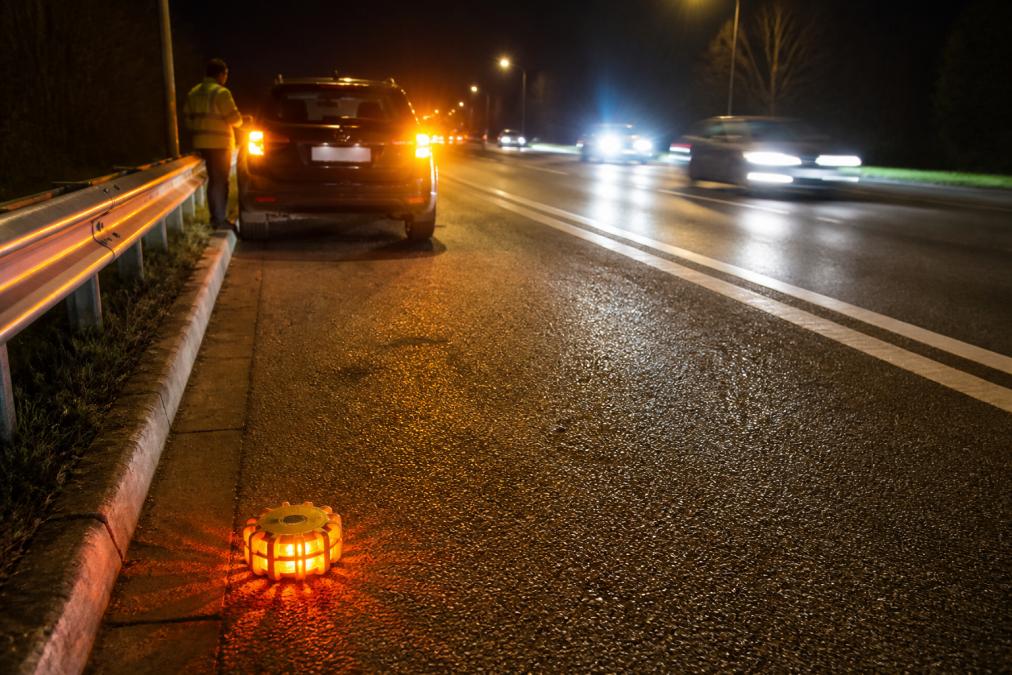
Hazard lights help, but they are not enough on their own. They sit low, they are small, and they do not stand out against a sea of other lights. A warning beacon placed behind the car, at a height and brightness designed to be seen from a distance, gives drivers far more warning.
Roadflash builds multi-award-winning early warning systems for exactly this situation. The beacons use high-visibility lighting and GPS geolocation, so the vehicle is easier to spot and easier to find. For anyone who drives motorways regularly, that extra warning distance is the difference between a near miss and a collision.
Place any warning beacon on the road surface behind your car, not on the roof or bonnet. That keeps it at the height approaching drivers expect and keeps you out of the traffic lane while you set it.
Rural vs Urban Night Breakdowns: What Changes
Rural and urban night breakdowns call for different decisions, and most guides treat them as the same event. They are not. The setting should decide the plan, because the risks, the wait times, and the way you get found are all different.
In an urban area at night
Street lighting does most of the visibility work for you. Passing traffic is slower and more frequent, so a stationary car is registered sooner. Recovery services are usually close, and a typical wait is measured in tens of minutes rather than hours. Mobile signal is strong, so a live location share or a call to your provider connects first time.
The main urban risk is not darkness, it is other drivers assuming you are parked, not broken down.
On a rural road at night
The decision framework
- Lit street, help close, signal strong: stay in the car, hazards on, call for recovery.
- Unlit road, help far, signal weak: stay in the car, hazards on, share location, expect a long wait.
- Motorway or dual carriageway: get behind the barrier, never stay in the car.
On an unlit rural road, do not walk to the nearest house or village for help unless you can do so entirely off the carriageway. Pedestrians on unlit country roads are among the most vulnerable road users after dark, and drivers simply do not see them.
Managing Panic and Sharing Your Location Digitally
Panic is the quiet risk in a night breakdown. It pushes people to step into traffic, forget the barrier, or leave the hazard lights off. Managing it starts with a simple breathing pattern and a fixed checklist.
- Send a live location to one trusted contact.
- Note the nearest marker post or junction number.
- Tell the operator your direction of travel.
- Stay on the line until help confirms your position.
Frequently Asked Questions
What should I do if my car breaks down on a motorway at night?
Pull onto the hard shoulder, switch on your hazard lights and sidelights, then exit through the left-hand door once it is safe. Stand behind the barrier, at least 10 metres from the carriageway, and call your breakdown provider or 999 if you are in danger. Put on a high-visibility jacket before leaving the vehicle. Never attempt repairs on the hard shoulder, and do not stand between your car and oncoming traffic.
Do I need to stay inside my car if it breaks down at night?
On a motorway, you should leave the vehicle and wait behind the barrier. On a quiet rural road where you feel unsafe walking, staying inside with doors locked, hazards on and seatbelt fastened may be the safer option. If you stay inside, keep the engine off to avoid carbon monoxide build-up and call for help immediately. Never sit in a vehicle on a live carriageway.
How can I make my vehicle more visible to other drivers in the dark?
Switch on hazard lights and sidelights, wear a high-visibility jacket when outside the car, and place an emergency warning beacon or triangle behind the vehicle where it is safe to do so. A GPS-enabled warning beacon with high-visibility lighting can be seen from a greater distance than standard hazard lights, giving approaching traffic more time to react. Reflective clothing also helps other drivers spot you on the roadside.
What are the essential items to keep in my car for night-time emergencies?
A high-visibility jacket, a charged mobile phone, a torch with spare batteries, a warning triangle or LED beacon, warm clothing, a blanket, water, and a first-aid kit form the core of an emergency breakdown kit. In winter, add a scraper, de-icer and a fully charged power bank. Check your breakdown cover documents are in the car, and keep a note of your provider’s number saved in your phone.
A night breakdown tests your nerve as much as your car. The drivers who come through it safely are the ones who get seen first, then get help. Roadflash exists to make that first part easier, with multi-award-winning early warning systems, DGT 3.0 compliant beacons with GPS geolocation, and high-visibility lighting built for stationary vehicles on busy roads. Add to basket and give yourself the warning distance that keeps you safe after dark.