
Why Visibility Is Crucial for Stationary Vehicles
Table of Contents
- Why Visibility Is Crucial for Stationary Vehicles on Motorways
- The Science of Perception and Reaction Time
- Secondary Collision Prevention: The Real Risk of a Breakdown
- How to Stay Safe During a Roadside Breakdown
- High Visibility Roadside Safety Equipment That Makes a Difference
- Direct Vision vs Indirect Vision: Blind Spots and Vehicle Size
- Visibility Challenges in Low-Light Conditions and Adverse Weather
- Regulatory Requirements for Vehicle Conspicuity and Safety Compliance
- Conclusion
- Frequently Asked Questions
Last Updated: September 20, 2026
Why Visibility Is Crucial for Stationary Vehicles on Motorways
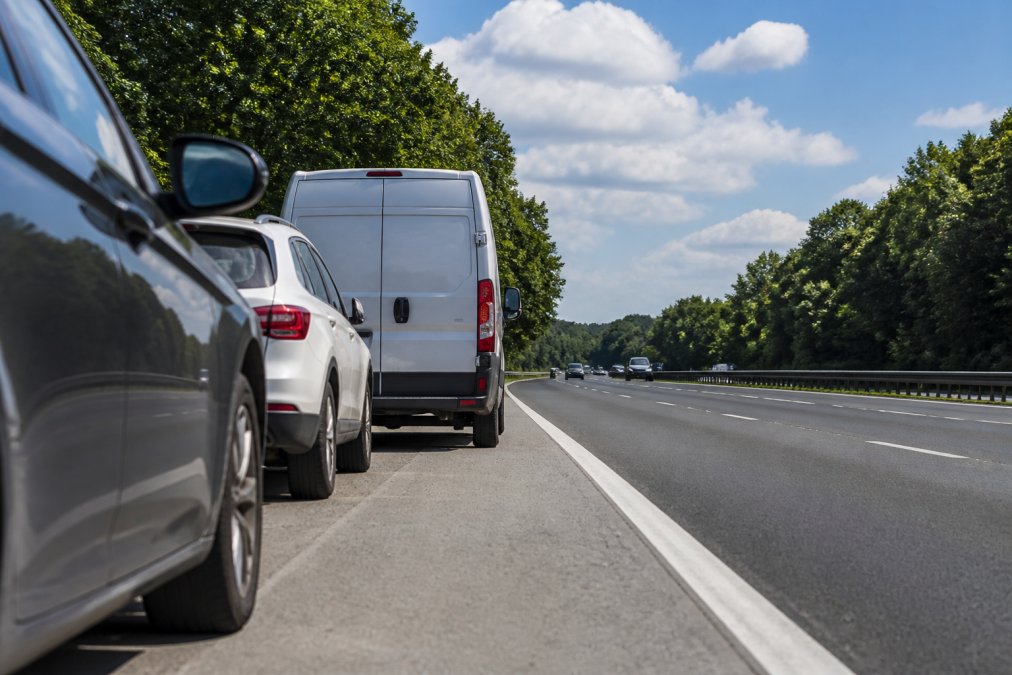
A stationary vehicle on a motorway is one of the most dangerous objects a driver will ever encounter. Why visibility is crucial for stationary vehicles comes down to a simple fact: traffic approaches at motorway speed, and a car that has stopped is no longer moving with the flow. Roadflash builds early warning systems for exactly this scenario, and the physics behind it never changes. Below, we’ll show you how perception, reaction time and conspicuity markings combine to decide whether a breakdown becomes a near-miss or a collision.
Conspicuity is the property that determines how easily a road user detects and recognises a vehicle against its background. A stationary car with no lighting or reflective markings is, from a driver’s perspective, nearly invisible until it is far too late.
That is the core tension in this whole topic. A moving vehicle announces itself through motion, size and speed. A stationary vehicle announces nothing at all unless we deliberately make it visible.
The Science of Perception and Reaction Time
Perception-reaction time is the total interval between a hazard appearing and a driver physically responding to it. At motorway speed, a vehicle covers a large distance in that interval, which is why detection distance matters more than braking distance.
Three factors govern how quickly a driver can act:
- Detection: can the hazard be seen at all against the background?
- Recognition: does the driver interpret it as a stopped vehicle rather than part of the scenery?
- Response: how long before the foot reaches the brake?
Driver fatigue, ambient lighting and environmental factors all stretch that timeline. A tired driver at dusk processes a hazard more slowly than a rested driver in daylight. This is why conspicuity markings and emergency lighting are not accessories. They buy the driver the seconds that perception and reaction demand.
Inattentional Blindness: When Drivers Look But Do Not See
Inattentional blindness is the documented tendency for a person to fail to notice an unexpected object in plain sight while focused on another task (pubmed.ncbi.nlm.nih.gov). A driver scanning for lane position, exit signs and following distance can look straight through a stationary vehicle without registering it.
This is the part most guides get wrong. They assume that if something is visible, it will be seen. In practice, the eye and the brain are not the same instrument, and a hazard that does not demand attention is a hazard that gets filtered out. The practical consequence is blunt: your stationary vehicle must not merely be present, it must interrupt the driver’s attention.
Relying on the driver to notice you is the single most common mistake at the roadside. If your vehicle does not actively interrupt a fatigued driver’s attention, inattentional blindness means it may as well not be there at all.
Secondary Collision Prevention: The Real Risk of a Breakdown
Secondary collision prevention is the practice of protecting a stationary vehicle from being struck by other traffic after the initial breakdown has occurred. The breakdown itself is rarely the fatal event. What follows is.
A vehicle stopped in a live lane, on a hard shoulder or on the verge creates a stationary vehicle hazard that approaching traffic must detect, interpret and avoid. The window for that is short. Every element of roadside safety exists to widen it: hazard warning lights, reflective triangles, high-visibility clothing and, increasingly, active warning beacons.
Why Hazard Warning Lights Alone Are Not Enough
Hazard warning lights are a minimum, not a solution. They flash at a fixed point and rely entirely on a driver already looking in that direction. They do nothing for a driver whose attention is elsewhere, and they compete with every other light source on a busy motorway at night.
In low-light conditions, a pair of indicators can be lost among brake lights, street lighting and reflective road studs. Vehicle signaling alone does not create the depth perception a driver needs to judge closing speed. That is why serious roadside safety equipment adds height, brightness and, in some cases, geolocation on top of the standard hazard lights.
How to Stay Safe During a Roadside Breakdown
Knowing how to stay safe during a roadside breakdown is a sequence, not a single action. The priority order is: get out of the live carriageway if you can, make yourself visible, then get to safety behind the barrier.
Work through it in this order:
- Pull as far left as possible and switch on hazard warning lights immediately.
- Exit the vehicle through the door away from traffic, never the traffic side.
- Put on a high-visibility vest before leaving the vehicle, not after.
- Move behind the safety barrier and stay there, away from the vehicle.
- Deploy warning equipment only if it is safe to do so from behind the barrier.
- Call for assistance and give your location precisely.
The instinct to stand beside the car and wave traffic around is understandable and dangerous. In practice, the safest place is behind the barrier, and the equipment does the signalling job for you.
Post-Breakdown Safety Protocols for Live Lanes and Hard Shoulders
Post-breakdown safety protocols differ sharply between a live lane and a hard shoulder. In a live lane, the only correct action is to exit the vehicle and get behind the barrier as quickly as possible. There is no safe position inside a car stopped in a running lane.
On a hard shoulder, the risk is lower but not gone. A stationary vehicle on the shoulder still sits in the path of any driver who drifts, and hard shoulders are not a designated safe area for occupants. The protocol is the same: barrier first, vehicle second.
If you are injured, disoriented or unsure of your exact position, geolocation-enabled warning equipment that transmits your location to emergency services removes the hardest part of the rescue: finding you. That capability is worth more than any reflective triangle in a genuine emergency.
High Visibility Roadside Safety Equipment That Makes a Difference
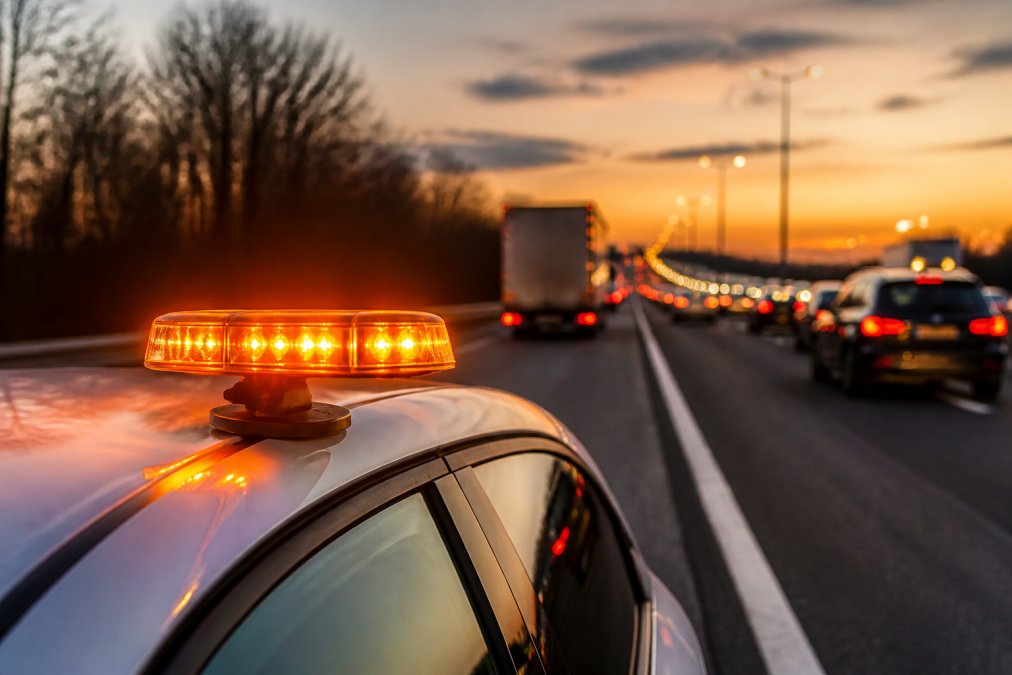
High visibility roadside safety equipment is any device or garment that increases how quickly approaching traffic detects a stationary vehicle and its occupants. The category spans reflective vests, warning triangles, warning beacons and active lighting systems.
A practical comparison of the main options:
| Equipment | Type | Placement | Best For |
|---|---|---|---|
| Hazard warning lights | Passive | Vehicle height | Immediate, first response |
| Reflective triangle | Passive | Ground level | Daylight, low-speed roads |
| High-visibility vest | Passive | Wearer | Occupant visibility |
| LED warning beacon | Active | Roof height | Dusk, dawn, night, motorways |
| GPS-enabled beacon | Active + location | Roof height | Live lanes, remote locations |
Retro-Reflective Materials and Conspicuity Markings
Retro-reflective material returns light back toward its source, which is why it appears to glow when caught in a headlight beam. Conspicuity markings use this principle to outline a vehicle’s shape and dimensions so that approaching drivers can judge its size and position.
Direct Vision vs Indirect Vision: Blind Spots and Vehicle Size
Direct vision is what a driver sees through the windows; indirect vision is what they see through mirrors. The distinction matters because mirrors create blind spots, and blind spots scale with vehicle size.
Visibility Challenges in Low-Light Conditions and Adverse Weather
Low-light conditions and adverse weather are when conspicuity fails most often. Dusk and dawn visibility is the worst case, because ambient lighting is falling while drivers’ eyes have not yet adapted, and contrast between a vehicle and its background is at its lowest.
Regulatory Requirements for Vehicle Conspicuity and Safety Compliance
Legal compliance keeps you within the rules. Conspicuity keeps you alive. Treat the two as separate goals and aim well above the minimum.
For fleet operators and roadside workers, compliance also covers high-visibility clothing and lighting for anyone working near live traffic. Traffic management and emergency lighting requirements vary by situation, so check the current guidance from the relevant authority for your operation.
Conclusion
The gap between a legal warning and an effective one is where collisions happen. A stationary vehicle that meets the minimum standard can still be missed by a fatigued driver at dusk, and that is the scenario early warning systems are built to close.
Frequently Asked Questions
Why is visibility important for stationary vehicles on motorways?
A stationary vehicle on a motorway creates a sudden, unexpected hazard. Drivers travelling at 70 mph need time to perceive the obstruction, decide on a course of action, and react. If your vehicle is not clearly visible, especially in low-light conditions or poor weather, approaching drivers may not see it until it is too late. High-visibility equipment extends the distance at which your vehicle is detected, giving others more time to slow down or change lanes safely.
What are the legal requirements for hazard warning lights in the UK?
The Highway Code requires you to use hazard warning lights when your vehicle is stationary and causing an obstruction, such as after a breakdown. However, hazard lights are only permitted while stationary. They do not replace the need for additional visibility measures. For vehicles carrying dangerous goods, additional conspicuity markings may be legally required. Always check current regulations and ensure your warning equipment meets the relevant standards for your vehicle type and use case.
How can high-visibility beacons prevent secondary collisions?
High-visibility beacons use bright, flashing or rotating lights to draw attention from a greater distance than standard hazard lights. This extended detection range gives approaching drivers more time to perceive the hazard, react, and either slow down or move over. For secondary collision prevention, the goal is to break through driver inattention and make your stationary vehicle impossible to miss, even in low-light conditions or adverse weather.
What should you do if your vehicle breaks down in a live lane?
If your vehicle breaks down in a live lane, put your hazard warning lights on immediately. If you can safely exit the vehicle, move to a safe location behind the barrier or on the verge, away from traffic. Do not stand between your vehicle and oncoming traffic. If you cannot exit safely, stay in your vehicle with your seatbelt on and call emergency services. High-visibility warning equipment placed behind your vehicle can significantly improve your chances of being seen.