
Emergency Beacon Review for UK Motorway Safety 2026
Table of Contents
- Why an Emergency Beacon Review Matters for Motorway Safety
- Quick Comparison: Emergency Beacons and Safety Equipment
- Roadflash: The DGT 3.0 Compliant Emergency Beacon Built for Motorways
- How to Use Emergency Warning Lights on Motorways Safely
- Motorway Breakdown Safety Equipment: What You Actually Need
- Alternative Emergency Beacons and Satellite Communicators
- Legal Requirements and Smart Motorway Safety Protocols
- Verdict: Which Emergency Beacon Is Right for You?
- Frequently Asked Questions
Last Updated: September 16, 2026
Why an Emergency Beacon Review Matters for Motorway Safety
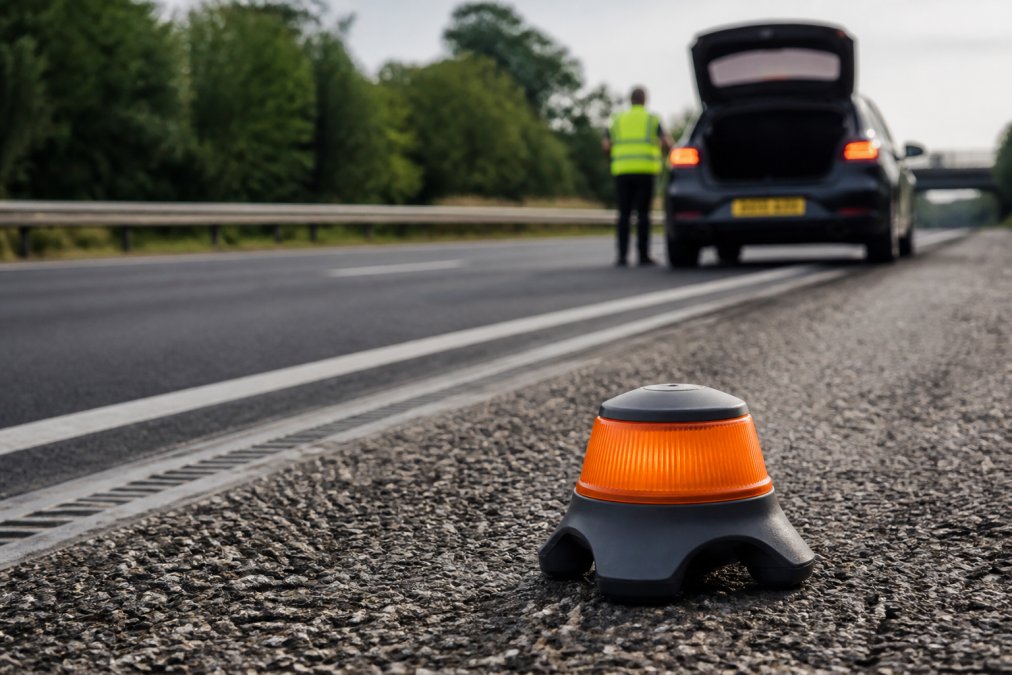
An emergency beacon is a portable, battery-powered warning light that makes a stationary vehicle visible to approaching traffic long before hazard lights alone can. This emergency beacon review for UK motorway safety exists because the stakes on a hard shoulder are higher than most drivers realise. At Roadflash, we build early warning systems for exactly this scenario, and we have seen how quickly a breakdown turns dangerous when a vehicle is not visible soon enough.
The core problem is physics, not carelessness. Hazard lights alone present a small, low light source that a driver at motorway speed may not register in time to change lanes safely. A high-mounted beacon with a magnetic base lifts that light above the roofline, where it enters a driver’s field of view earlier and from further away.
Below, we break down what matters when choosing a beacon, which features earn their place, and how to use one under smart motorway rules.
Quick Comparison: Emergency Beacons and Safety Equipment
The table below summarises the main options. Roadflash pricing is available on request.
| Product | Type | Key Feature | Published Price | Best For |
|---|---|---|---|---|
| Roadflash DGT 3.0 Compliant Beacon | LED beacon with GPS | DGT 3.0 compliance, geolocation | Contact for pricing | Motorway breakdowns |
| Ocean Signal rescueME PLB1 | Personal locator beacon | 7-year battery, SOS function | £240.00 | Remote areas, no signal |
| Garmin inReach Mini 2 | Satellite communicator | Two-way messaging, SOS | £349.99 | Off-grid communication |
| Emergency Beacon B003DTMQ3Y | LED warning light | Magnetic mount, flashing patterns | £15.00 | Budget roadside visibility |
| ZOLEO Satellite Communicator | Satellite messenger | Network switching, SOS button | £199.00 | App-based messaging |
The distinction that matters most: beacons warn other drivers, while satellite communicators call for help. Most motorway drivers need the first. Drivers crossing remote routes need both.
Roadflash: The DGT 3.0 Compliant Emergency Beacon Built for Motorways
Roadflash is a Nottingham-based manufacturer whose multi-award-winning early warning systems are designed specifically for stationary vehicles on busy motorways. This is our own product, so treat the assessment below as a manufacturer’s specification rather than an independent test.
Key Features and Specifications
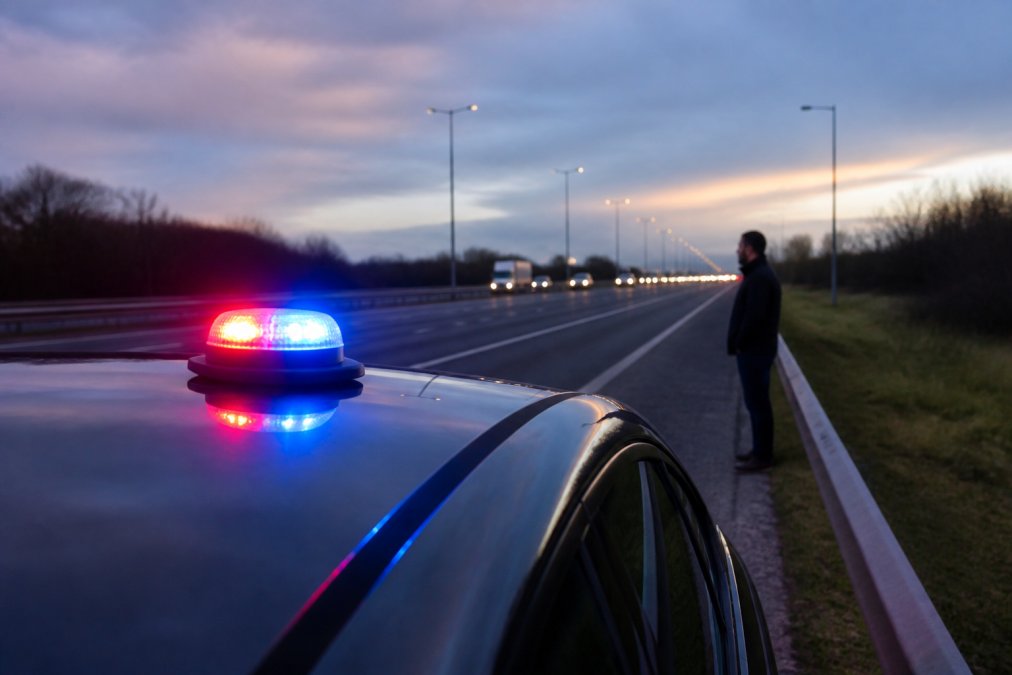
- DGT 3.0 compliance for modern road safety standards
- Integrated GPS and geolocation so emergency services can locate the vehicle
- High-intensity LED lighting for increased visibility at the roadside
- Magnetic base for rapid attachment to a vehicle roof
The magnetic base changes deployment speed: attaching a beacon to the roof takes seconds and keeps you out of the traffic lane far longer than a warning triangle would.
Pros and Cons
Pros:
- Engineered specifically for motorway conditions
- Geolocation features that help emergency services find you
- Multi-award-winning road safety product range
Cons:
- Pricing is not publicly listed, so you need to request a quote
Mount the beacon before you exit the vehicle if you can reach the roof through the window. Every second spent standing beside the car in a live lane is a second of unnecessary exposure.
How to Use Emergency Warning Lights on Motorways Safely
Knowing how to use emergency warning lights on motorways matters more than which unit you buy. This is the sequence we recommend to fleet operators.
- Pull onto the hard shoulder or into an emergency refuge area and switch on your hazard warning lights.
- If you can reach the roof safely from inside, attach the beacon before opening your door.
- Exit through the door furthest from traffic and move behind the barrier.
- Place the beacon on the roof, switch it on, and step back behind the barrier immediately.
- Call for roadside assistance and give the location marker or beacon GPS reference.
- Stay behind the barrier until recovery arrives.
The common mistake is placing the beacon on the ground or boot lid. Both sit below the roofline and reduce visibility range, defeating the purpose.
Never stand between your vehicle and oncoming traffic to position a beacon or triangle. A secondary collision is the single greatest risk in a motorway breakdown, and it happens fastest when a driver is in the carriageway.
Motorway Breakdown Safety Equipment: What You Actually Need
Motorway breakdown safety equipment falls into two categories: equipment that warns other drivers, and equipment that calls for help. Confusing the two is the most frequent error we see.
Warning equipment includes a high-visibility beacon, a reflective jacket, and a torch. Communication equipment includes a charged mobile phone, a charging cable, and, for remote routes, a satellite communicator.
A driver approaching a stationary vehicle with a bright, elevated, flashing light reads it as an active hazard and changes lane earlier; hazard lights alone read as a parked car. That split-second difference in perception is what a beacon buys you.
Alternative Emergency Beacons and Satellite Communicators
Alternatives to a dedicated motorway beacon serve different jobs, and the mounting mechanism often decides whether a unit actually gets used.
Magnetic versus suction mounts
Magnetic mounts are the default for roof deployment: they attach in seconds, hold firm at motorway speed, and can be positioned from inside the vehicle if you can reach the roof through the window. The limitation is that they need a ferrous roof panel, aluminium, composite, and many glass panoramic roofs will not hold a magnet.
Suction mounts work on glass and smooth body panels, useful on vehicles with non-ferrous roofs. But suction cups degrade over time, lose grip in cold weather, and need a clean, flat surface to seal. In a roadside emergency, with cold hands and limited time, a suction mount is slower and less reliable than a magnet.
A third option is a window- or dash-mounted unit that stays inside the vehicle.
Brightness, battery, and weather resistance
Brightness is usually quoted in lumens or candela, and the two are not interchangeable.
The accessibility angle most guides miss
For elderly or mobility-impaired drivers, the calculus shifts toward a beacon that can be deployed without leaving the seat.
Satellite communicators and personal locator beacons
The Ocean Signal rescueME PLB1 is a personal locator beacon with a seven-year battery and dedicated SOS function, best suited to remote areas with no mobile signal.
If you carry a rechargeable beacon, charge it at the same time you check your tyre pressures. A beacon that is flat when you need it is no better than no beacon at all.
Legal Requirements and Smart Motorway Safety Protocols
Legal requirements for breakdown equipment are narrower than many drivers assume, and the gap between what is required and what is sensible is where most of the risk sits.
What the rules actually require
There is no legal requirement to carry a warning triangle or an emergency beacon in this market.
Smart motorway protocols in practice
On a smart motorway the hard shoulder may be a live running lane, permanently or at certain times.
Why GPS-enabled beacons change the recovery equation
Integration with breakdown recovery services is where a GPS-enabled beacon earns its keep.
The law asks you to warn others and stay safe. It does not ask you to stand in a live lane. Every decision at the roadside should be measured against that distinction.
Verdict: Which Emergency Beacon Is Right for You?
For most motorway drivers, the Roadflash DGT 3.0 Compliant Beacon is the strongest choice: built for motorway conditions, DGT 3.0 compliant, with GPS geolocation that helps emergency services find you.
Frequently Asked Questions
Are emergency beacons legal for use on motorways?
Yes, emergency beacons are legal for use on motorways when your vehicle is stationary and posing a hazard. They supplement your hazard warning lights and warning triangle. However, always follow the Highway Code: exit the vehicle on the side away from traffic, stand behind the barrier, and call for roadside assistance. A DGT 3.0 compliant emergency beacon with GPS can also help emergency services locate you faster.
Do I need a V-16 beacon to drive in Spain?
Yes, since 2026, all vehicles in Spain must carry a DGT 3.0 compliant V-16 emergency beacon. It replaces warning triangles and must have GPS connectivity to send your location to traffic authorities. If you drive in Spain, ensure your beacon is certified and meets the latest DGT 3.0 standards. Roadflash offers compliant beacons designed for this purpose.
How do LED safety beacons improve visibility for stationary vehicles?
LED safety beacons produce a high-intensity flashing light that is visible from a greater distance than standard hazard lights, especially in poor weather or at night. They increase hazard awareness and reduce the risk of secondary collisions. Many models have a high visibility range, giving approaching drivers more time to react and change lanes safely.
Do I need an emergency beacon if I have a warning triangle?
A warning triangle is a legal requirement in many countries, but it has limitations: it can be hard to see in bad weather or at night, and deploying it on a busy motorway is dangerous. An emergency beacon offers superior visibility and can be placed on your vehicle’s roof without walking into traffic. For maximum safety, carry both, but prioritise a beacon for motorway breakdowns.
Are magnetic emergency beacons safe for all vehicle types?
Magnetic bases are safe for most steel-bodied vehicles, including cars, vans, and trucks. However, they may not adhere to aluminium or composite panels, and some modern vehicles have non-metallic roofs. Check your vehicle’s roof material before relying on a magnetic mount. If in doubt, choose a beacon with a suction mount or a strap attachment, or place it on a stable surface inside the vehicle.
Breakdowns are unpredictable, but your visibility does not have to be. Roadflash builds multi-award-winning early warning systems designed to prevent collisions involving stationary vehicles, with DGT 3.0 compliant beacons, GPS geolocation, and high-visibility LED lighting that improve how early other drivers see you. If you want equipment that protects you and your passengers during a motorway breakdown, get started with Roadflash and put a proper warning system in your boot before you need it.