

Are Emergency Beacons Worth the Investment?
Table of Contents
- What Are Emergency Beacons and Why Motorists Consider Them
- How Does GPS Emergency Tracking Work
- DGT 3.0 Compliant Emergency Beacons: Legal Requirements and Compliance
- Emergency Beacon Battery Life Expectancy and Operational Readiness
- Cost-Benefit Analysis: Subscription vs Non-Subscription Models
- Real-World Safety Impact and False Alarm Protocols
- Is an Emergency Beacon Right for Your Situation?
Last Updated: August 23, 2026
What Are Emergency Beacons and Why Motorists Consider Them
Emergency beacons are compact, battery-powered devices designed to alert emergency services to your location when a vehicle breaks down on a motorway or remote road. Unlike traditional warning triangles or hazard lights alone, these devices use satellite or cellular networks to transmit your exact position to rescue coordinators, dramatically reducing response times when you’re stranded in dangerous conditions.
The core appeal is straightforward: a breakdown on a busy motorway is a life-threatening situation. You’re vulnerable to high-speed collisions, poor visibility in adverse weather, and the physical and psychological stress of being isolated on a fast-moving road. Many motorists who drive regularly on motorways or venture into remote areas consider emergency beacons worth investigating because they address a genuine gap in road safety infrastructure.
What makes this decision complex is weighing the actual risk against the cost and commitment. A driver who breaks down once every five years faces different mathematics than a fleet operator managing 50 vehicles. The question isn’t whether emergency beacons are useful in theory, they demonstrably are. The question is whether they’re necessary for your specific situation, and whether the subscription or hardware costs align with your actual exposure to risk.
Emergency beacons provide GPS-enabled location tracking and two-way communication capabilities that traditional warning equipment cannot match. The investment question hinges on how often you drive in high-risk conditions and whether you value the peace of mind of guaranteed emergency location verification.
How Does GPS Emergency Tracking Work
GPS emergency tracking in modern beacons operates through a combination of satellite positioning and ground-based communication networks. When you activate an emergency beacon, the device uses Global Positioning System satellites to calculate your precise geographic coordinates, typically accurate to within a few metres (fcc.gov). That location data is then transmitted via satellite network (or in some models, cellular backup) to a monitoring centre staffed by emergency coordinators.
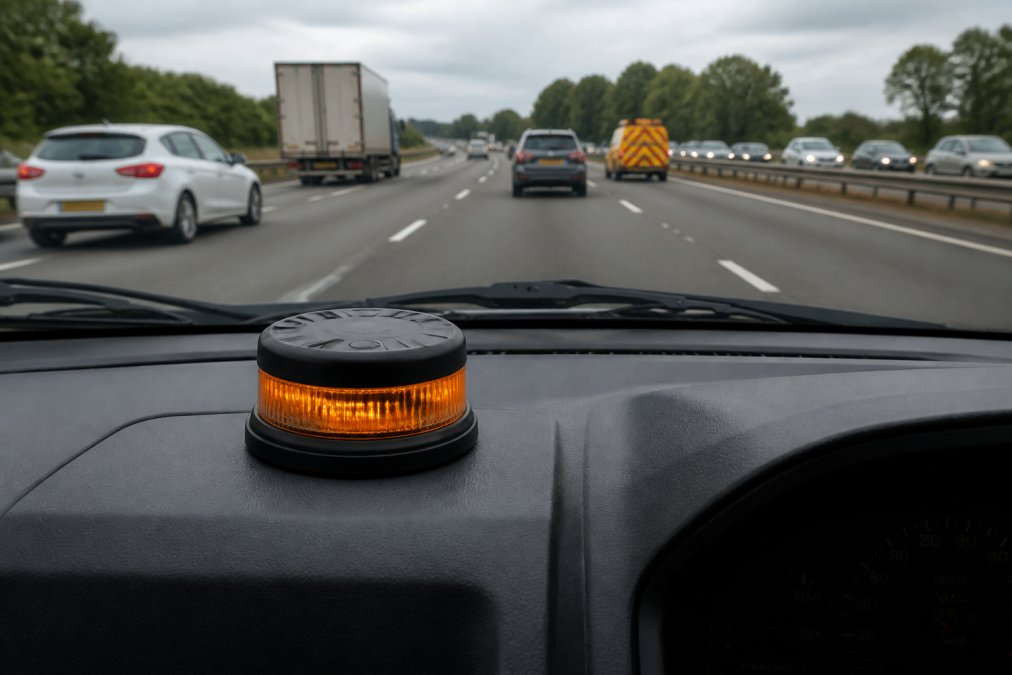
The transmission happens in seconds. Once received, the monitoring centre has your exact coordinates and can immediately dispatch emergency services to your location without you needing to describe where you are or hoping they can find you in poor visibility. This is the critical advantage over relying solely on mobile phone calls, which can fail in areas with poor signal coverage and require you to communicate your location verbally, a challenging task when you’re stressed, injured, or in shock.
Two-way communication is a secondary feature in many models. Beyond just sending your location, some beacons allow you to receive confirmation that help is on the way, or to send pre-programmed messages ("I’m injured," "Vehicle is disabled," "I need medical assistance") without needing voice capability. This is particularly valuable if you’re unable to speak or if background noise from traffic makes voice communication unreliable.
The reliability of GPS emergency tracking depends on three factors: satellite signal availability (which works in most outdoor conditions but can be blocked by heavy cloud cover or dense forest), battery longevity (which determines how long the device can transmit), and the monitoring centre’s response time. Most modern beacons maintain a connection to satellite networks within seconds of activation, making the bottleneck typically the emergency service response time rather than the beacon’s ability to transmit.
Many drivers assume mobile phone coverage and emergency services can always find them. GPS emergency tracking removes that assumption by providing independent confirmation of your location to the emergency centre, regardless of whether your phone has signal. This is especially valuable on motorways where GPS signal is typically clear and unobstructed.
DGT 3.0 Compliant Emergency Beacons: Legal Requirements and Compliance
In Spain, emergency beacons must meet the DGT 3.0 standard, a technical and operational specification set by Spain’s Dirección General de Tráfico (General Traffic Directorate) (dgt.es). This regulation mandates specific performance criteria for warning devices used on Spanish roads, including brightness levels, activation protocols, and GPS accuracy thresholds.
DGT 3.0 compliance is not optional for drivers in Spain. Vehicles without compliant warning equipment face fines and potential vehicle impoundment during traffic stops. For UK-based operators or drivers who regularly cross into Spain, understanding and meeting this requirement is essential to avoiding regulatory penalties.
Roadflash specialises in manufacturing DGT 3.0 compliant emergency beacons specifically designed for the Spanish and broader European market. Their beacons meet the brightness, durability, and GPS accuracy specifications required by Spanish law, eliminating the compliance risk for operators who need to work legally in Spain. This is a material differentiator, not all emergency beacon manufacturers achieve or maintain DGT 3.0 certification, and using non-compliant equipment exposes you to legal and financial liability.
The compliance requirement also reflects a broader point: emergency beacons are not standardised globally. A device legal in one market may not meet another’s requirements. If you operate across borders or plan to use a beacon in multiple countries, verifying compliance with local regulations is non-negotiable before purchase.
Emergency Beacon Battery Life Expectancy and Operational Readiness
Battery longevity is a critical but often overlooked factor in emergency beacon selection. A beacon that cannot reliably transmit your location when activated is worse than useless, it’s a false sense of security.
Most modern emergency beacons use lithium batteries designed for long shelf life and consistent performance in cold conditions (relevant for winter motorway breakdowns). Battery life expectancy typically ranges from three to seven years under normal storage conditions, with some premium models extending to ten years (peer-reviewed research). However, actual operational readiness depends on several factors: how often you activate the device for testing, how you store it (temperature extremes degrade batteries faster), and the beacon’s transmission power requirements.
A common mistake is purchasing a beacon and then ignoring it for years. Many manufacturers recommend periodic testing, typically every 12 months, to ensure the battery remains responsive and the satellite connection functions. Neglecting this maintenance can result in a device that fails when you actually need it. Some beacons include low-battery indicators or automatic alerts, but not all do.
The operational readiness question also extends to activation protocol. Some beacons require a deliberate two-step activation (press and hold, then confirm) to prevent accidental activation. Others activate on a single button press. Understanding your device’s activation sequence and practising it during a calm moment ensures you can deploy it correctly under stress.
A beacon with a dead or degraded battery is indistinguishable from a functional one until you actually need it. If your beacon hasn’t been tested in over 12 months, its battery status is unknown. Always verify battery health before relying on the device for safety, especially before long journeys into remote areas.
Cost-Benefit Analysis: Subscription vs Non-Subscription Models
The investment in emergency beacons breaks into two distinct cost models: non-subscription hardware beacons and subscription-based satellite messaging services.
Non-subscription beacons typically have a higher upfront hardware cost but no ongoing fees. You purchase the device once, maintain it yourself (including battery replacement every few years), and rely on it indefinitely. This model appeals to occasional users and those who want to avoid recurring charges. The trade-off is that you’re entirely responsible for ensuring the device remains operational, missed maintenance can render it unreliable.
Subscription-based models involve lower hardware costs but require monthly or annual fees to maintain active satellite connectivity and monitoring centre access. These services often include additional features: two-way messaging, real-time location tracking accessible via a mobile app, and professional monitoring centre support. The ongoing cost ensures the service remains current with satellite network updates and regulatory changes.
The financial decision depends on your usage pattern. A motorist who drives the motorway twice weekly across a year will spend less on a non-subscription beacon plus occasional battery replacement than on a subscription service. A fleet operator managing 20 vehicles will likely find subscription services more cost-effective because they can negotiate volume pricing and because centralised monitoring provides operational oversight beyond emergency response.
Roadflash offers multi-award-winning beacons. For UK-based operators, their multi-award-winning beacons provide compliance assurance and proven reliability, removing the guesswork from the investment decision.
| Model | Upfront Cost | Ongoing Fees | Best For | Reliability Dependency |
|---|---|---|---|---|
| Non-Subscription Hardware | Higher | None | Occasional drivers, budget-conscious users | User maintenance required |
| Subscription Service | Lower | Monthly/Annual | Frequent drivers, fleet operators | Professional monitoring |
| Hybrid (Hardware + Optional Service) | Medium | Optional | Flexible users, growing fleets | User choice |
Real-World Safety Impact and False Alarm Protocols
The safety impact of emergency beacons is documented in rescue operations across Europe. When a motorist activates a beacon, emergency services receive their exact location within seconds and can dispatch resources accordingly. This eliminates the delay inherent in phone-based reporting, where you must first establish a connection, describe your location (often inaccurately under stress), and hope the dispatcher understands your position correctly.

The real-world impact extends beyond faster response times. Beacons significantly reduce the risk of secondary collisions, when a stranded vehicle is hit by oncoming traffic because it wasn’t visible or its location wasn’t communicated clearly to approaching drivers. A beacon with high-visibility flashing lights serves as both a warning to other road users and a GPS transmitter to emergency services, addressing both aspects of the breakdown safety problem.
False alarm protocols exist to prevent abuse of emergency systems. Accidentally activating a beacon, or activating it during a non-emergency situation, can trigger an expensive emergency response. Most jurisdictions have legal frameworks addressing false alarms, and repeated false activations can result in fines or loss of service. However, accidental activation is rare with modern beacons because they require deliberate two-step activation sequences. The more common issue is users activating beacons for non-emergency situations (e.g., to test the device without notifying the monitoring centre, or to request roadside assistance rather than genuine emergency help).
Understanding your beacon’s activation protocol and communicating with the monitoring centre about planned tests prevents misunderstandings. Many services allow you to schedule test activations so the monitoring centre knows not to dispatch emergency resources.
The safety benefit of emergency beacons is most pronounced in three scenarios: breakdowns on high-speed motorways during poor visibility, situations where you’re injured or unable to communicate clearly, and journeys into remote areas where mobile signal is unreliable. Outside these contexts, the risk reduction is marginal.
Is an Emergency Beacon Right for Your Situation?
Determining whether an emergency beacon is worth the investment requires honest assessment of your actual risk exposure.
If you drive the motorway regularly, more than twice weekly, for work or long-distance travel, the risk of breakdown is material. Motorway breakdowns are genuinely dangerous; you’re vulnerable to high-speed collisions, and poor visibility in rain or fog makes you hard to spot. A beacon adds a layer of protection that traditional warning equipment cannot provide. For this group, the investment is defensible.
If you drive the motorway occasionally, a few times per month or less, the statistical risk of breakdown is lower. However, the consequence of a breakdown when it does occur remains serious. A beacon provides peace of mind that you’re not paying for protection you’ll never use; you’re paying for certainty that if the worst happens, help will find you quickly.
If you operate a fleet of vehicles, the mathematics shift dramatically. Centralised monitoring of multiple beacons, volume pricing on subscriptions, and reduced administrative burden of managing multiple devices make fleet-scale deployment cost-effective. A fleet operator with 15 vehicles faces a different risk profile than a solo commuter, and the investment justifies itself through reduced downtime and improved driver safety.
If you drive primarily on well-maintained roads with reliable mobile coverage and rarely venture into remote areas, a beacon is lower priority. Your mobile phone provides emergency communication, and breakdown services offer recovery support. The additional protection of a beacon is marginal.
The peace of mind factor is real but shouldn’t be the primary driver of the decision. Peace of mind that costs £200 per year is a luxury purchase, not a safety investment. Peace of mind that costs £30 per year becomes a rational decision for anyone who drives motorways regularly.
Roadflash’s multi-award-winning beacons are built specifically for motorists and fleet operators who prioritise safety and compliance. Their DGT 3.0 compliance, GPS accuracy, and proven reliability in real-world conditions make them a credible choice if you’ve decided a beacon aligns with your risk profile.
The core question, are emergency beacons worth the investment?, has no universal answer. They’re worth it if you drive high-risk routes regularly, if you value certainty of emergency location verification, or if regulatory compliance (DGT 3.0 in Spain) is mandatory for your operations. They’re less essential if your motorway driving is infrequent and your mobile coverage is reliable. Assess your actual risk, understand the specific features and compliance status of the device you’re considering, and make the decision based on your circumstances rather than theoretical worst-case scenarios. For drivers and operators who need reliable emergency location transmission, Roadflash delivers the multi-award-winning technology and compliance assurance that transforms a breakdown from a terrifying situation into a manageable one.
Frequently Asked Questions
Q: How does GPS emergency tracking work in emergency beacons?
A: GPS emergency tracking works by pinpointing your exact location using satellite positioning, then transmitting those coordinates to emergency services via satellite or cellular networks. When you activate the SOS signal on your beacon, rescue teams receive your precise geospatial coordinates, eliminating the need to describe your location verbally. This is especially valuable in remote areas where cellular coverage is weak or during medical emergencies when you may be disoriented or unable to communicate clearly. The beacon maintains a continuous signal until help arrives or you cancel the distress alert.
Q: What is DGT 3.0 compliance and do I need it?
A: DGT 3.0 is a Spanish regulatory standard for emergency warning and beacon devices used on roads. If you drive in Spain, DGT 3.0 compliant emergency beacons are legally required for stationary vehicles on motorways and highways. Roadflash's emergency beacons meet this certification, ensuring you comply with local safety regulations. Even if you primarily drive in the UK, having DGT 3.0 compliant equipment means your beacon meets high safety standards and will work across European jurisdictions without legal issues.
Q: How long do emergency beacon batteries last?
A: Emergency beacon battery life expectancy typically ranges from 5 to 10 years in standby mode, depending on the device model and battery type. However, operational readiness depends on regular maintenance checks and avoiding extreme temperatures. Most quality beacons like Roadflash's products are designed to last through multiple activation events without degradation. It's essential to test your beacon annually and replace batteries according to manufacturer guidance to ensure your device functions reliably when needed. Many beacons include battery status indicators to help you monitor power levels.
Q: Are emergency beacons worth the investment for occasional motorway users?
A: Yes, emergency beacons are worth the investment even for drivers who use motorways infrequently. A single breakdown on a busy highway in poor visibility or bad weather can create a life-threatening situation. Emergency beacons provide peace of mind and significantly increase your chances of rapid rescue by alerting emergency services to your exact location. The cost of the device is minimal compared to the potential cost of injuries, medical treatment, or worse. For professional drivers or fleet operators, the safety benefits and legal compliance requirements make them essential equipment.
This article was written using GrandRanker