

Emergency Beacon Pricing for Business Fleets
Table of Contents
- Emergency Beacon Pricing: What Business Fleets Actually Pay
- Types of Emergency Beacons and Their Cost Structures
- Commercial Vehicle Safety Lighting Regulations UK
- Fleet Vehicle Lightbar Installation Costs and Compatibility
- GPS Emergency Beacon Subscription Pricing Models
- Total Cost of Ownership for Fleet Safety Systems
- Conclusion
Last Updated: August 10, 2026
Emergency Beacon Pricing: What Business Fleets Actually Pay
A breakdown of emergency beacon costs reveals a fragmented market where pricing depends entirely on the technology type, communication capability, and subscription model you choose. For fleet managers evaluating emergency beacon pricing for business fleets, the decision isn’t simply about upfront device cost, it’s about total cost of ownership across three to five years of operation.
At Roadflash, we’ve analysed how UK fleets allocate safety budgets and what drives their purchasing decisions. Most businesses underestimate the true expense of emergency beacon systems because they focus only on device purchase price and miss the subscription fees, installation costs, and maintenance requirements that accumulate over time.
The market has fragmented into distinct categories: one-time purchase beacons with no ongoing costs, satellite messengers requiring monthly subscriptions, and integrated fleet telematics systems combining GPS tracking with emergency alerting. Each approach serves different fleet profiles and operational needs.
Below, we’ll break down the actual costs you’ll encounter, compare the major technology types, and show you how to calculate whether an emergency beacon investment makes financial sense for your specific operation.
Types of Emergency Beacons and Their Cost Structures
Emergency beacon pricing varies dramatically based on the underlying technology and communication method. Understanding these categories is essential before comparing specific products.
Personal Locator Beacons (PLBs) vs EPIRBs
Personal Locator Beacons (PLBs) are compact, portable devices designed for individuals or small teams operating in remote areas without mobile coverage. They transmit a distress signal via satellite to rescue coordination centres, with no subscription required for basic operation.
A PLB like the Ocean Signal rescueME PLB1 costs approximately £274-£334 as a one-time purchase. The device operates on the global Cospas-Sarsat rescue system, which is free to use indefinitely. Battery life typically extends seven years, after which replacement is required. For a small fleet of five vehicles, equipping each with a PLB represents an initial investment of roughly £1,370-£1,670, with no ongoing subscription costs.
The trade-off is functionality. PLBs offer one-way communication only, they send a distress signal with your GPS location to rescue services, but you cannot receive confirmation or send additional information. This limitation suits remote workers and adventure teams but may feel restrictive for commercial fleets operating on busy UK motorways where mobile coverage is reliable.
EPIRBs (Emergency Position Indicating Radio Beacons) are larger, more powerful systems designed for vessels and commercial operations. The McMurdo SmartFind G8 PLUS AIS EPIRB costs between £500-£650 per unit. It combines a 406 MHz distress signal with AIS (Automatic Identification System) for localised rescue, plus a 10-year battery life. For a fleet of 20 vehicles, the initial investment reaches £10,000-£13,000, but the extended battery life reduces replacement frequency.
EPIRBs suit larger commercial fleets where the higher upfront cost is justified by enhanced rescue capabilities and longer intervals between maintenance. However, they remain primarily designed for marine use and may be overkill for land-based commercial operations.
Cospas-Sarsat international satellite search and rescue system
Satellite Messengers and Two-Way Systems
Satellite messengers represent a fundamentally different approach: instead of one-way distress alerting, they enable two-way communication via satellite networks. This capability comes at a higher cost, both upfront and ongoing.
The Garmin inReach Messenger costs approximately £250-£300 for the device, plus a subscription starting from £12.99 per month (30-day minimum term), with an annual access fee of around £35. For a fleet of ten vehicles, annual costs total £1,850-£2,100 in subscriptions alone, plus the initial device purchase of £2,500-£3,000. Over three years, this reaches £7,050-£8,100 in subscription costs alone.
The advantage is substantial: two-way messaging allows fleet managers to send instructions, confirm receipt of distress signals, and maintain contact with drivers in areas without mobile coverage. The Garmin system integrates with a smartphone app, enabling interactive SOS messaging to Garmin Response (available 24/7) and group messaging across your fleet.
The SPOT Gen4 Satellite GPS Messenger offers a lower-cost entry point at approximately £140-£150 for the device, with subscriptions from around £16.95 per month on an annual contract. This works out to roughly £203 per year per device. For a ten-vehicle fleet, annual subscription costs are approximately £2,030, making it more affordable than Garmin but with limited two-way messaging capability, primarily one-way SOS alerts with check-in messages.
The Yellowbrick 3 targets organised fleets and expedition teams, offering fleet tracking and messaging via the Iridium satellite network. Pricing is not publicly available and requires direct contact, but comparable fleet-tracking systems typically cost £400-£800 per device plus £30-£60 per month per unit for subscription. For a 20-vehicle fleet, annual costs could reach £7,200-£14,400 in subscriptions, making it suitable only for high-value operations where real-time fleet visibility justifies the expense.
Iridium satellite network coverage and commercial messaging services
Commercial Vehicle Safety Lighting Regulations UK
Commercial vehicle safety lighting regulations in the UK are governed by the Road Vehicles (Construction and Use) Regulations 1986, as amended. These standards specify requirements for hazard warning lights, beacon systems, and high-visibility equipment on commercial and emergency vehicles.
For stationary vehicles on motorways or major A-roads, the regulations require hazard warning lights to be activated immediately. Additionally, vehicles must display warning triangles or other hazard warning devices within specific distances (typically 45 metres on motorways). Modern commercial vehicle safety lighting regulations increasingly permit LED beacon systems as an alternative or supplement to traditional triangles.
The Vehicle and Operator Services Agency (VOSA) enforces compliance during vehicle inspections. Non-compliance can result in fines and vehicle impounding. For fleets operating across the UK and Europe, meeting DGT 3.0 compliance (Spain’s emergency beacon standard) has become increasingly important, as many fleet operators work cross-border and want unified equipment across their entire operation.
Roadflash’s DGT 3.0 compliant emergency beacons meet these regulatory requirements while adding GPS/geolocation capabilities that exceed basic legal minimums. This compliance reduces the risk of regulatory penalties and ensures your fleet meets current and emerging standards across multiple jurisdictions.
UK Road Vehicles Construction and Use Regulations 1986
Fleet Vehicle Lightbar Installation Costs and Compatibility
Installing emergency beacon systems on commercial vehicles involves more than simply purchasing a device. Professional installation, compatibility assessment, and integration with existing vehicle systems add significant costs that many fleet managers overlook.
A professional lightbar installation typically costs between £150-£400 per vehicle, depending on complexity. For a standard commercial van or truck, a technician must assess roof structure, electrical capacity, and integration with the vehicle’s existing warning systems. Some vehicles require reinforced mounting hardware, additional wiring, or modifications to the roof structure, pushing costs toward the higher end.

Compatibility varies significantly across vehicle types. A Transit van, Sprinter van, or similar light commercial vehicle typically accommodates standard lightbar installations without modification. Larger articulated vehicles or specialised service vehicles may require custom mounting solutions, increasing installation costs by 50-100%.
Electrical integration is another consideration. Older vehicles with basic electrical systems may require additional wiring or a dedicated power supply to support modern LED beacon systems. Newer vehicles with integrated telematics platforms can often connect emergency beacons directly to the vehicle’s CAN bus (Controller Area Network), enabling automatic activation and data logging.
For a fleet of 20 vehicles, professional installation costs range from £3,000-£8,000 depending on vehicle types and complexity. This represents a significant capital outlay beyond device purchase price and must be factored into total cost of ownership calculations.
Roadflash products are designed for straightforward installation on standard UK commercial vehicles, with clear compatibility guidance for different vehicle types.
GPS Emergency Beacon Subscription Pricing Models
The subscription model for GPS-enabled emergency beacons creates an ongoing operational cost that varies significantly based on the service provider and feature set.
Most satellite messenger subscriptions fall into two categories: basic plans offering SOS alerting and location sharing, and premium plans adding two-way messaging, tracking, and integration with fleet management systems.
Basic SOS-only plans typically cost £10-£20 per month per device. These allow drivers to send a distress signal with GPS coordinates to emergency services or a designated contact, but offer no two-way communication. For a ten-vehicle fleet, annual costs are £1,200-£2,400.
Premium plans with two-way messaging and active tracking cost £25-£60 per month per device. These plans enable fleet managers to monitor vehicle locations in real-time, send instructions to drivers, and maintain communication even in areas without mobile coverage. Annual costs for a ten-vehicle fleet reach £3,000-£7,200.
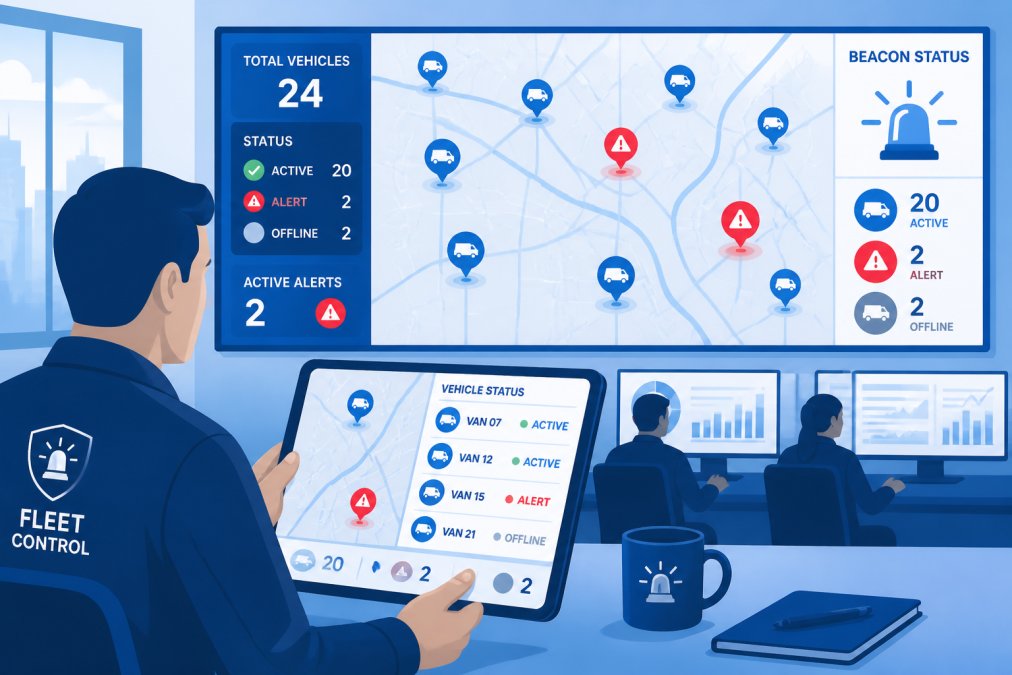
Some providers offer tiered pricing based on fleet size. A fleet of 50+ vehicles may negotiate per-unit costs of £15-£25 per month through volume discounts, whereas a small fleet of five vehicles pays closer to the published per-unit rate.
Annual contracts typically offer better rates than month-to-month plans. Committing to a 12-month subscription often reduces per-unit costs by 10-20% compared to rolling monthly terms. However, this creates cash flow implications and requires confidence in your choice of provider.
The subscription model creates predictable ongoing costs but locks you into a single provider. Switching providers mid-contract often incurs early termination fees of £50-£150 per device, making vendor selection critical at the outset.
Total Cost of Ownership for Fleet Safety Systems
Calculating true emergency beacon pricing requires moving beyond device purchase price to assess total cost of ownership (TCO) across a three to five-year period. This includes device cost, installation, subscriptions, maintenance, and battery replacement.
Five-Year TCO Comparison: Small Fleet (10 vehicles)
One-Time Purchase PLB System (Ocean Signal rescueME PLB1):
- Device cost: £2,740-£3,340 (10 units at £274-£334)
- Installation: £1,500-£4,000 (assuming £150-£400 per unit for mounting and integration)
- Battery replacement (year 4): £2,740-£3,340
- Annual maintenance and testing: £500 (estimated)
- 5-year TCO: £7,980-£11,180
Satellite Messenger System (Garmin inReach Messenger):
- Device cost: £2,500-£3,000 (10 units)
- Installation: £1,500-£4,000
- Annual subscription: £1,850-£2,100 per year × 5 years = £9,250-£10,500
- Device replacement (mid-cycle): £2,500-£3,000 (optional, depending on durability)
- 5-year TCO: £15,250-£20,500
Fleet Telematics with Integrated Emergency Beacon (Yellowbrick 3 or equivalent):
- Device cost: £8,000-£16,000 (10 units at £800-£1,600 per unit)
- Installation: £1,500-£4,000
- Annual subscription: £3,600-£7,200 per year × 5 years = £18,000-£36,000
- 5-year TCO: £27,500-£56,200
The data reveals a clear pattern: one-time purchase systems offer the lowest TCO for small fleets that can accept one-way communication and no real-time tracking. Satellite messengers provide two-way communication at a moderate cost increase. Full fleet telematics systems justify their expense only for larger fleets or operations where real-time asset tracking provides measurable business value.
For a small fleet operating primarily on UK motorways with reliable mobile coverage, a one-time purchase PLB system offers the best value. For fleets operating in remote areas or requiring two-way communication capability, satellite messengers justify their higher ongoing cost.
Roadflash’s approach combines the cost efficiency of hardwired emergency beacon systems with GPS/geolocation capability, avoiding the recurring subscription model of satellite messengers while providing enhanced visibility compared to basic PLBs.
Calculating ROI: When Emergency Beacons Pay for Themselves
An accident prevention mindset reveals the financial logic behind emergency beacon investment. A single high-speed motorway collision involving a stationary vehicle can result in:
- Vehicle damage: £5,000-£50,000 (depending on impact severity)
- Medical costs and liability: £10,000-£500,000+ (catastrophic injury cases)
- Legal fees and compensation: £5,000-£100,000+
- Reputational damage and insurance premium increases: £2,000-£20,000 annually
In contrast, a complete emergency beacon system for a ten-vehicle fleet costs £7,980-£20,500 over five years. Preventing even a single significant collision pays for the system many times over.
Insurance providers increasingly offer premium reductions for fleets using approved safety equipment. A 5-10% reduction on fleet insurance premiums (typical for safety-conscious operators) can offset emergency beacon costs entirely over a five-year period.
Choosing the right emergency beacon pricing strategy requires matching your fleet’s operational profile to the appropriate technology level. One-time purchase systems suit small fleets on well-covered roads. Satellite messengers serve fleets operating in remote areas or requiring two-way communication. Full telematics systems justify their cost only for large operations where real-time visibility creates measurable business value.
The lowest-cost option isn’t always the best choice. Roadflash’s multi-award-winning emergency beacon systems are designed to prevent collisions and protect your drivers during breakdowns, combining regulatory compliance with practical safety features that reduce your actual risk on UK motorways and highways. Get started with Roadflash and ensure your fleet has the visibility and emergency capability needed to keep drivers safe when it matters most.
Frequently Asked Questions
How much does a professional-grade emergency beacon cost for UK commercial fleets?
Emergency beacon costs vary significantly based on technology type and features. Personal Locator Beacons (PLBs) typically range from £275 to £360 for a one-off purchase with no subscription required. Satellite messengers with two-way communication cost £140-£500 upfront, plus monthly subscriptions from £13 to £17. EPIRBs designed for larger fleets range from £500 to £650. For Roadflash solutions, pricing depends on quantity, delivery dates, and specific features required, contact Roadflash directly for current quotes tailored to your fleet size.
Do business fleet emergency beacons require ongoing subscription fees?
It depends on the beacon type. One-way Personal Locator Beacons (PLBs) and basic EPIRBs require no subscription, you pay once and the device works via the global Cospas-Sarsat satellite system. Two-way satellite messengers and GPS emergency beacon systems require monthly or annual subscriptions, typically £13-£17 per month plus annual access fees around £35. Fleet telematics and active tracking platforms also charge recurring fees. Evaluate your operational needs: if you need real-time GPS tracking and two-way communication, expect subscription costs; if one-way distress signalling suffices, opt for a no-subscription PLB.
What factors influence the price of vehicle lightbars and emergency beacons?
Key cost drivers include: beacon technology (PLB vs satellite messenger vs EPIRB), communication capability (one-way vs two-way), GPS accuracy and GNSS support (basic GPS vs multi-constellation), battery life (7 years vs 10 years), additional features (infrared strobe, AIS integration, Return Link Service), professional installation complexity, fleet size (bulk discounts available), and subscription model duration. Regulatory compliance, such as DGT 3.0 certification for Spain or UK commercial vehicle lighting standards, can add certification and testing costs. Roadflash's award-winning systems incorporate these factors; request a detailed breakdown for your specific requirements.
Is it cheaper to buy emergency beacons in bulk for large fleets?
Yes, bulk purchasing typically offers cost savings. Wholesale distributors and larger fleet operators negotiate volume discounts on device costs and subscription fees. A fleet of 15 vehicles qualifies for business pricing structures that smaller operators may not access. Subscription bundling across multiple units can reduce per-unit monthly costs. For accurate bulk pricing and support tailored to your fleet size, contact Roadflash directly, they work with fleet operators of various sizes and can provide competitive quotes based on your specific requirements.
This article was written using GrandRanker