

Do Emergency Beacons Actually Prevent Accidents?
Table of Contents
- What Is an Emergency Beacon and How Do They Work?
- Do Emergency Beacons Actually Prevent Accidents?
- PLB vs Satellite Messenger: Choosing the Right Device
- How to Use a Personal Locator Beacon in an Emergency
- Legal Requirements and Emergency Beacon Registration UK
- Battery Life, Maintenance, and Practical Considerations
- Why Emergency Beacons Matter for Motorway Safety
- Conclusion
Last Updated: August 7, 2026
What Is an Emergency Beacon and How Do They Work?
An emergency beacon is a portable device that alerts other road users and emergency services to a stationary or disabled vehicle using high-intensity flashing lights, GPS geolocation, and real-time transmission capabilities to increase visibility and enable rapid response.
Emergency beacons operate through two complementary mechanisms. A 360-degree amber flashing light creates visual hazard warnings visible from considerable distances, especially in low-light conditions. Advanced models integrate GPS technology that transmits the vehicle’s exact location to emergency services, reducing response time and eliminating the need for drivers to communicate their whereabouts if injured or disoriented.
The effectiveness hinges on addressing both immediate collision risk and rapid emergency response. The visual alert warns approaching drivers to slow down or change lanes, while geolocation ensures emergency services can find the vehicle quickly, even on remote motorway stretches where landmarks are sparse.
Roadflash has engineered multi-award-winning emergency beacons specifically for UK motorway conditions, incorporating DGT 3.0 compliance for international travel and GPS-enabled location tracking for enhanced emergency response coordination. Their systems function reliably in harsh highway conditions where visibility enhancement and precise location data can mean the difference between a minor incident and catastrophic collision.
Emergency beacons work best when activated immediately after a breakdown. The earlier you alert approaching traffic, the more time drivers have to respond safely. Waiting until vehicles are dangerously close reduces the protective benefit significantly.
Do Emergency Beacons Actually Prevent Accidents?
Emergency beacons don’t prevent breakdowns from occurring, but they substantially reduce the collision risk that a stationary vehicle creates on a high-speed roadway. The real question isn’t whether they prevent accidents entirely, but whether they meaningfully reduce harm when a breakdown happens.
Visibility Enhancement and Driver Awareness
A stranded vehicle on a motorway at night or in poor weather becomes nearly invisible to approaching drivers until it’s too late to brake safely. An amber flashing beacon changes this dynamic by creating a moving light source that captures attention far more effectively than static reflectors or hazard lights alone.
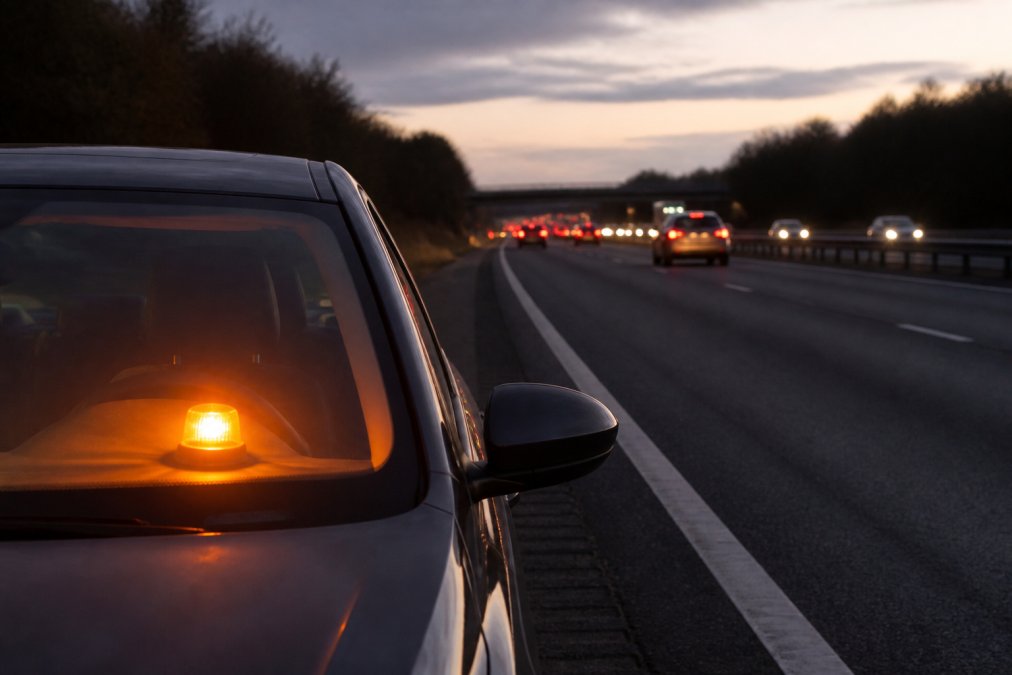
Research into driver behavior shows that flashing lights trigger stronger attentional responses than steady lights. A driver will notice a flashing amber beacon from significantly greater distances than a stationary vehicle, even one with hazard lights activated. That extra distance translates directly into additional reaction time, which at motorway speeds is the difference between slowing down safely and collision.
A beacon signals "something unusual is happening here", a clear warning that requires action. Hazard lights alone can blend into the ambient visual environment, especially at night when other vehicles’ brake lights create visual noise. A dedicated emergency beacon cuts through that noise with a specific, recognizable pattern.
Roadflash’s high-visibility beacon systems are engineered with 360-degree light distribution to ensure visibility from any approach angle. On a motorway where vehicles approach from behind at 70 mph or faster, that comprehensive visibility becomes critical.
Real-World Effectiveness in High-Risk Scenarios
Emergency beacons matter most in scenarios where accidents are most likely: breakdowns during rush hour, in fog, or at night.
Consider a motorway breakdown at dusk. Approaching drivers are transitioning between daylight and artificial lighting, making a stationary vehicle harder to detect. An emergency beacon’s flashing pattern cuts through the sensory confusion and communicates hazard unmistakably.
In fog with visibility reduced to 50 meters or less, a reflective triangle becomes useless because drivers can’t see it until already within the danger zone. A flashing beacon can be spotted through fog at greater distances because the light source is active rather than passive, giving drivers more time to slow down.
Emergency beacons are most effective in scenarios where driver visibility is already compromised, darkness, fog, rain, or heavy traffic. In these conditions, the additional warning time they provide can prevent collisions that would otherwise be inevitable.
PLB vs Satellite Messenger: Choosing the Right Device
Understanding the difference between a Personal Locator Beacon (PLB) and a satellite messenger is essential for choosing the right emergency device for your situation.
A Personal Locator Beacon (PLB) is a one-way device designed to transmit a distress signal and location data to emergency services via satellite. It activates with a single action and requires no subscription because it uses standardized emergency frequencies. Once activated, it tells rescuers where you are and that you need help.
A satellite messenger is a two-way communication device allowing you to send messages to designated contacts or emergency services and receive responses. Satellite messengers typically require a subscription and offer flexibility to communicate specific information about your situation.
For motorway breakdowns, PLBs offer advantages that satellite messengers can’t match. A motorway breakdown doesn’t require two-way conversation; it requires rapid location transmission so emergency services can dispatch recovery and medical response. A PLB activates instantly and begins transmitting without needing message composition.
Roadflash’s approach integrates GPS-enabled location tracking into their beacon systems, ensuring emergency services receive precise coordinates automatically upon activation. This combines the simplicity and reliability of a PLB with the visibility benefits of a high-intensity beacon.
| Device Type | Activation Method | Communication | Subscription | Best For |
|---|---|---|---|---|
| Personal Locator Beacon | Single button/pin | One-way distress signal | No | Motorway breakdowns, rapid emergency dispatch |
| Satellite Messenger | Message composition | Two-way messaging | Yes | Remote travel, detailed situation updates |
| Emergency Beacon with GPS | Button activation | Automatic location transmission | Varies | Stationary vehicles, visibility + location combined |
How to Use a Personal Locator Beacon in an Emergency
Using a PLB correctly in an emergency is straightforward, but the critical steps need to be understood before a crisis situation. Familiarity with your device before activation is essential because panic can impair decision-making.
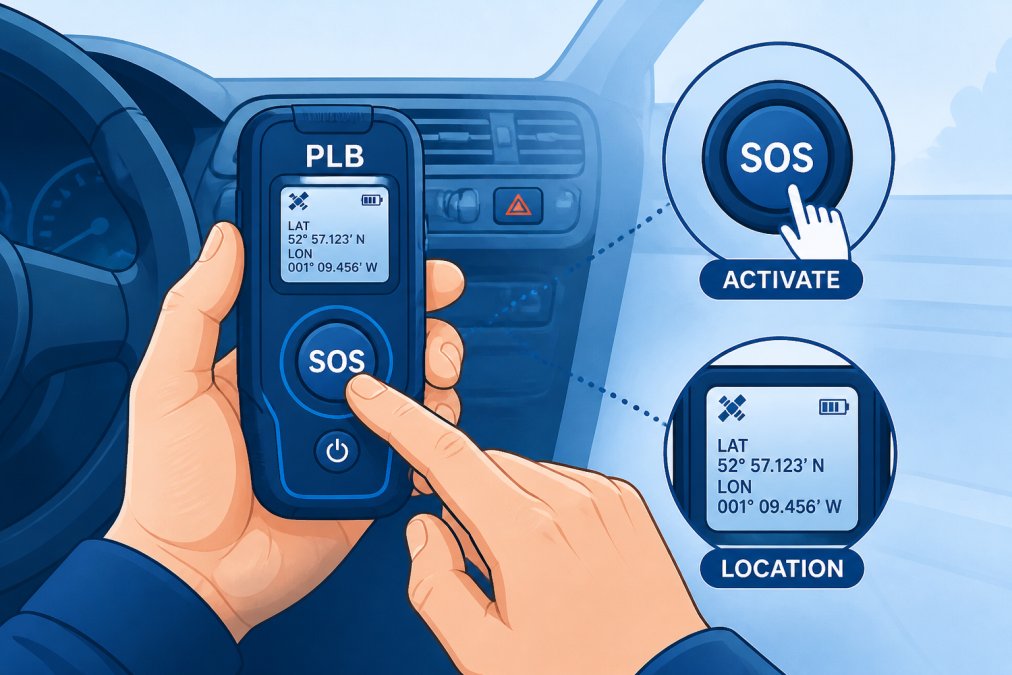
Step 1: Activate the device immediately after stopping. The moment you realize your vehicle is disabled, activate your beacon. Don’t wait to see if another vehicle stops to help. Activate immediately to start location transmission and alert emergency services.
Step 2: Move to a safe location if possible. Once activated, exit the vehicle if safe and move away from the traffic lane. Stand behind a barrier or in the hardstanding area. This protects you from passing vehicles and gives emergency responders a clear view of your location. If you cannot exit safely, remain in the vehicle with hazard lights activated and doors locked.
Step 3: Stay with the device. Don’t leave the beacon behind in the vehicle. Emergency services will use the beacon’s signal to locate you, not just the vehicle. Keep the device with you within its transmission range.
Step 4: Prepare information for emergency responders. While the beacon is transmitting, prepare what you’ll tell emergency services: how many people are in your vehicle, whether anyone is injured, your vehicle’s color and registration, and any hazardous materials present.
Step 5: Monitor your device’s status. Most modern beacons display whether they’re actively transmitting. Watch for confirmation that the device has established contact with emergency services. If transmission fails, try repositioning the device for a clearer line of sight to the sky.
Do not turn off your beacon prematurely. Keep the device active until responders explicitly tell you to deactivate it. Turning it off too early can cause confusion about your actual location if responders are still en route.
Legal Requirements and Emergency Beacon Registration UK
The UK has specific regulations governing emergency beacons and their use on roads. Understanding these requirements is essential for compliance and ensuring your device functions correctly with emergency services.
Emergency beacons used on vehicles must comply with relevant British Standards and European regulations. For drivers who travel to Spain or other EU countries, DGT 3.0 compliance becomes mandatory. Spain’s traffic authority requires emergency beacons to meet specific technical standards including brightness, flash frequency, and geolocation accuracy. Roadflash’s DGT 3.0 compliant beacons meet these international standards, ensuring legal compliance on UK motorways or continental Europe.
Personal Locator Beacons using satellite frequencies must be registered with the appropriate authorities to ensure they’re recognized as legitimate distress signals rather than false alarms. This registration is typically handled by the device manufacturer or supplier. Roadflash provides guidance on registration requirements for their GPS-enabled systems.
Emergency beacons are safety devices, not substitutes for proper vehicle maintenance or safe driving practices. You’re legally required to maintain your vehicle in roadworthy condition and have breakdown cover or roadside assistance. An emergency beacon supplements these requirements.
For professional drivers and fleet operators, additional requirements may apply. Check with your insurer and fleet management provider to ensure you’re meeting all applicable regulations.
Battery Life, Maintenance, and Practical Considerations
Emergency beacons are only effective if they function when needed. Battery life and maintenance are therefore central to whether your device will work during a real breakdown.
Most emergency beacons use lithium batteries designed for extended shelf life and reliable performance in cold conditions. A typical beacon has a battery lifespan of 5-7 years before replacement is recommended, even if unused. If you purchased your beacon more than 5 years ago, check battery status or replace the unit.
Keep your beacon clean and dry. Salt spray, moisture, and dust can corrode contacts and degrade optical components. Wipe it down monthly with a soft, dry cloth. Store it in a dry location within your vehicle, not in a damp boot or exposed to direct sunlight, as heat accelerates battery degradation.
Test your beacon’s functionality annually using test mode to verify the light illuminates brightly and flashes at the correct frequency. If the light is dimmer than expected or the flash pattern seems irregular, battery replacement may be necessary.
For GPS-enabled beacons like Roadflash’s systems, battery life is particularly important because geolocation requires continuous power transmission. A beacon with degraded batteries might illuminate but fail to transmit location data. Check battery status before long motorway journeys.
Keep documentation of your beacon’s specifications, battery replacement dates, and test results. This record helps track maintenance schedules and demonstrates to insurance providers that you’ve maintained your safety equipment properly. Some insurers offer premium discounts for verified safety equipment maintenance.
Set a calendar reminder for your beacon’s annual maintenance check. Make it part of your vehicle’s routine servicing schedule, just like checking oil or rotating tyres.
Why Emergency Beacons Matter for Motorway Safety
Motorways present unique hazards that distinguish them from other road environments. Motorway traffic moves at high speeds, typically 60-70 mph. At these speeds, a driver’s reaction distance extends to hundreds of metres. A vehicle approaching a stationary hazard at 70 mph has only seconds to perceive the danger and brake safely. An emergency beacon visible from 500 metres away rather than 100 metres gives drivers 12 extra seconds to respond, the difference between controlled deceleration and collision.
Motorway breakdowns often occur in darkness or poor weather, precisely the conditions where visibility is already compromised. A breakdown at 2 AM in fog is exponentially more dangerous than a breakdown at midday in clear weather. Emergency beacons are most valuable in exactly these high-risk scenarios.
A driver who knows they have an emergency beacon deployed experiences reduced anxiety during a breakdown, leading to better decision-making. They’re more likely to exit the vehicle safely, move to a protected location, and communicate clearly with emergency responders.
Roadflash’s focus on motorway safety specifically reflects this understanding. Their emergency beacon systems are engineered for the exact conditions that create the highest collision risk: high-speed traffic, poor visibility, and the need for rapid emergency response.
Emergency beacons don’t prevent breakdowns from happening, but they meaningfully reduce the collision risk when a breakdown occurs. The visibility enhancement they provide gives approaching drivers critical reaction time, while geolocation capabilities ensure emergency services can respond rapidly. For motorway drivers in the UK, especially those who travel frequently, an emergency beacon represents a practical investment in safety that addresses a genuine hazard with a proven solution.
Roadflash’s multi-award-winning emergency beacon systems combine high-visibility flashing lights with GPS geolocation and DGT 3.0 compliance, delivering comprehensive hazard warning and emergency response coordination in a single device. Whether you’re a frequent motorway commuter or occasional long-distance traveller, adding an emergency beacon to your vehicle provides peace of mind backed by tangible safety benefits. Add to basket and ensure you’re prepared for the breakdown scenario that most drivers hope won’t happen, but many will.
Frequently Asked Questions
Do emergency beacons prevent accidents or just aid rescue?
Emergency beacons serve both functions. They prevent accidents by significantly increasing hazard visibility through 360-degree amber flashing lights, alerting approaching drivers to stationary vehicles at distances of up to 1,500 metres. Simultaneously, their GPS/geolocation features enable rapid emergency response, reducing the time injured occupants wait for help. On motorways and unsignalized intersections, this dual capability directly reduces collision risk during the critical window when a vehicle is most vulnerable.
What is the difference between a PLB and a satellite messenger?
A personal locator beacon (PLB) transmits a distress signal via 406MHz frequency to search and rescue authorities, primarily designed for remote areas without mobile coverage. A satellite messenger allows two-way communication, enabling you to send and receive messages via satellite networks. For motorway emergencies in the UK, PLBs with GPS geolocation are more practical, as they automatically alert emergency services to your exact location without requiring manual message composition. Satellite messengers suit expedition work where two-way contact is essential.
Is emergency beacon registration required in the UK?
Yes, 406MHz emergency beacons must be registered with the UK Maritime and Coastguard Agency (MCA) to enable rapid identification and response. Registration is free and ensures emergency services can contact you immediately when your beacon activates. For road-specific beacons with GPS geolocation, registration links your vehicle details and emergency contact information to your device's unique identifier, reducing response time significantly. Failure to register delays rescue coordination.
How do I know an emergency beacon will actually work when I need it?
Emergency beacons meet strict vehicle safety standards and undergo rigorous testing for signal transmission, battery reliability, and GPS accuracy. Modern beacons with 360-degree amber lighting are visible in daylight at 1,500+ metres, and their real-time transmission to emergency services is monitored by the Coastguard Agency. Battery life typically exceeds 48 hours in standby mode. Regular maintenance, checking battery charge and ensuring GPS lock, guarantees functionality. Unlike reflective triangles, beacons actively transmit your location, eliminating the risk that emergency services cannot find you.
This article was written using GrandRanker