
Preventing Secondary Collisions After a Vehicle Breakdown
Table of Contents
- What to Do If Your Car Breaks Down on a Motorway
- Why Preventing Secondary Collisions Matters More Than Fixing the Car
- High Visibility Roadside Safety Equipment That Actually Warns Drivers
- Warning Triangle Breakdown Safety: Where and When to Use One
- Emergency Breakdown Kit Essentials for Every Vehicle
- Passengers, Children, Pets and Mobility Needs
- Reducing Risk in Poor Visibility, at Night and in Bad Weather
- Preventing Secondary Collisions: A Step-by-Step Checklist
- Frequently Asked Questions
Last Updated: October 19, 2026
What to Do If Your Car Breaks Down on a Motorway
Preventing secondary collisions after a breakdown starts with one decision in the first few seconds: get left, get off the carriageway, and get behind a barrier.
Early warning systems are crucial for this moment. Here is the sequence to follow.
- Switch on your hazard warning lights immediately.
- Ease off the accelerator and let the car slow naturally.
- Steer left, onto the hard shoulder or into the leftmost lane if there is no shoulder.
- Stop as far left as you can, wheels turned slightly left.
- Leave your sidelights on if visibility is poor.
Do not brake hard or cross lanes to reach a lay-by you have already passed. A sudden stop in a live lane is how rear-end collisions begin.
Move Left and Get Clear of Moving Traffic
Moving left is the single most important action in a motorway breakdown. Every metre between your vehicle and the traffic flow reduces the chance of a secondary collision.
Stop on the hard shoulder where one exists.
Once stopped, put the handbrake on and keep your foot off the brake pedal, brake lights that stay lit can mask your hazard warning lights.
Stay Inside or Exit: A Decision Tree
Stay inside the vehicle if you can safely remain there, and exit only when you can get behind a crash barrier. Here is the decision tree to use:
- Can you stop on the hard shoulder with a barrier beside you? Exit on the passenger side and stand behind the barrier.
- Are you in a live lane? Stay belted in, call 999, and keep hazard lights on. Do not step into traffic.
- Is there no barrier and no safe verge? Stay inside with seatbelts fastened and call for help.
The rule is simple: never stand between your vehicle and oncoming traffic.
Why Preventing Secondary Collisions Matters More Than Fixing the Car
Preventing secondary collisions is the whole point of a breakdown procedure.
The numbers behind this are grim, and official road safety statistics on motorway hard-shoulder incidents are published each year by the Department for Transport road safety statistics.
That is why drivers are advised to treat the car as disposable and themselves as precious. Leave it. Warn others. Get behind the barrier.
Your priority order is: warn, move left, get behind a barrier, then call for recovery. Repairing the vehicle comes last, and often not at all.
High Visibility Roadside Safety Equipment That Actually Warns Drivers
High visibility roadside safety equipment is any gear that makes a stationary vehicle and its occupants easier to see from a distance in poor light. The best options work passively once set up.
Hazard Warning Lights, Beacons and Reflective Clothing
Hazard warning lights are your first warning signal and cost nothing.
But hazard lights have a limit. They are low-mounted and easy to miss over a crest or around a bend.
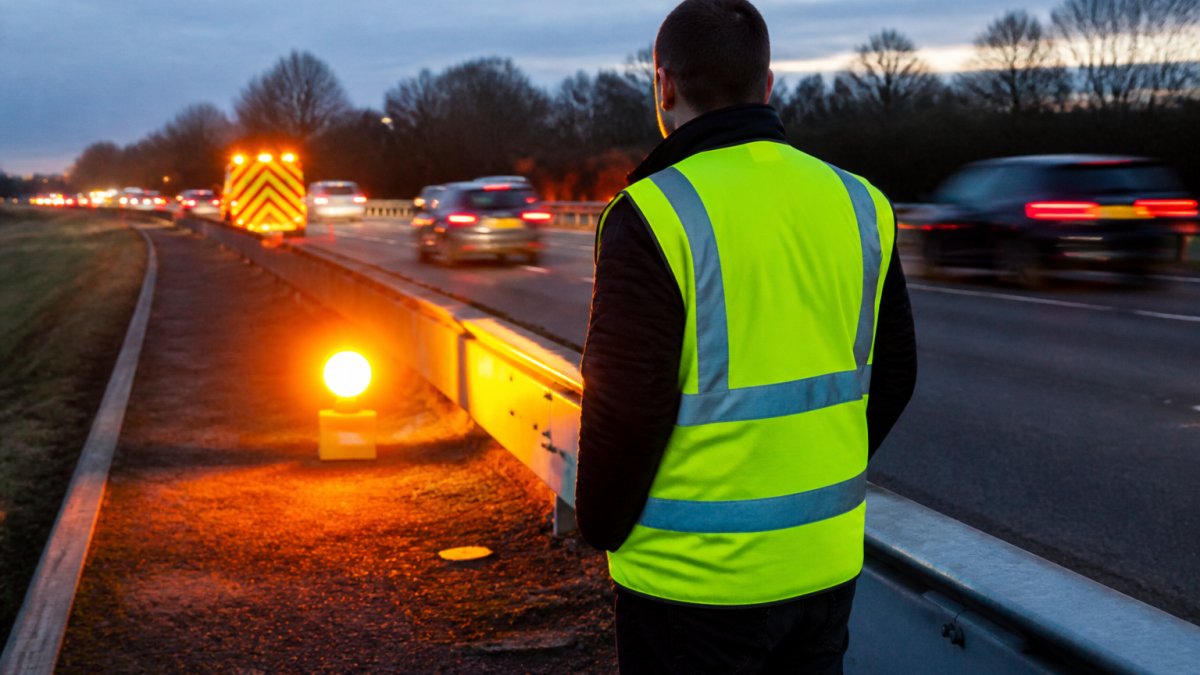
Reflective clothing matters just as much: a high-visibility vest is the difference between being seen and being hit when you step out.
Multi-award-winning warning beacons are built for this exact job.
Switch your hazard lights on before you do anything else, even before you have decided where to stop. The earlier approaching drivers see the flash, the more time they have to reduce speed and change lane.
Warning Triangle Breakdown Safety: Where and When to Use One
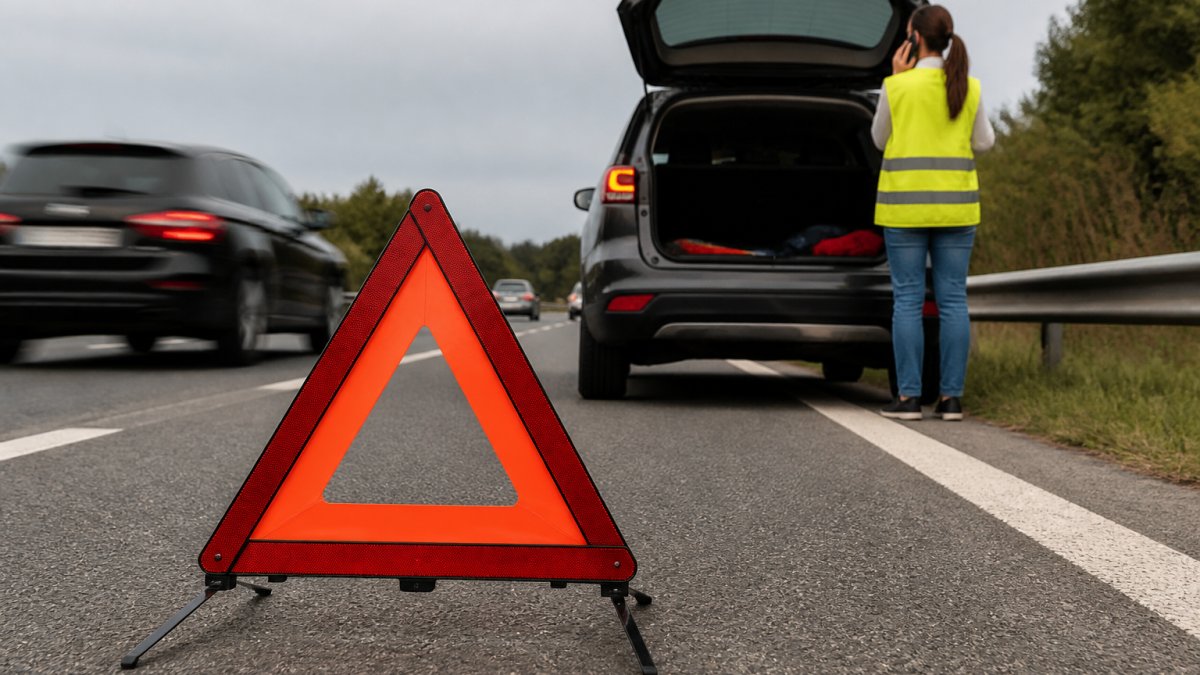
Warning triangle breakdown safety comes down to three questions: is it legal here, can you place it without entering a live lane, and will it be seen in time. A warning triangle is a reflective equilateral triangle placed behind your vehicle to warn approaching traffic. Used well, it buys following drivers several extra seconds; used badly, it puts you in the carriageway for no benefit.
The rule that overrides everything else
Never place a warning triangle on a motorway or on any road where you would have to walk into a live lane to do it. The risk of being struck while placing or retrieving it outweighs the warning it provides.
This reflects the same logic that applies on any high-speed road: the person placing the triangle is the most exposed object at the scene.
Where a triangle is appropriate
On a quieter road with good forward visibility, a rural A-road, a straight section of single carriageway, a lay-by with a clear approach, a triangle can add useful warning.
Place it on the verge or as close to the edge as the road allows. Do not place it in the centre of the lane. Do not place it on a blind crest.
The trade-off most guides skip
A triangle is static: it does not flash, it does not move, and in rain, spray or low sun it can be almost invisible until a driver is close.
Retrieve the triangle only when traffic has cleared and you can walk to it without stepping into a live lane. If that moment never comes, leave it. A triangle is replaceable; you are not.
Do not walk back along a motorway hard shoulder to retrieve a triangle. Leave it and tell your recovery operator where it is. The hard shoulder is a live traffic environment, not a safe working area.
Emergency Breakdown Kit Essentials for Every Vehicle
Emergency breakdown kit essentials are the items you keep in the boot so a breakdown does not become a crisis. Build the kit once and check it each season.
- High-visibility reflective vest for every occupant
- Portable warning beacon or flashing light
- Warning triangle, for use only where safe
A common mistake is keeping the vest buried under luggage. If you cannot reach it in seconds, it is not part of your kit.
Passengers, Children, Pets and Mobility Needs
Passengers change the plan: a driver alone can exit quickly, but a full car needs a clear order of exit.
Children should exit on the side away from traffic and be kept behind the barrier with an adult.
Pets should stay in the vehicle unless there is immediate danger.
For passengers with limited mobility, staying inside with seatbelts on and calling 999 is often the safest route.
Never leave a child or vulnerable passenger alone in a vehicle on the hard shoulder while you walk for help. Call for recovery and stay with them.
Reducing Risk in Poor Visibility, at Night and in Bad Weather
Poor visibility turns a routine breakdown into a secondary collision. The physics is simple: the distance at which an approaching driver can see your stationary vehicle shrinks, but the distance they need to stop does not.
Most breakdown guides treat this as a lighting problem. It is really a positioning and timing problem. Here is how the plan changes by condition.
At night
Darkness removes colour and contrast. A dark car on an unlit verge is effectively invisible until headlights sweep across it. The priorities shift:
- Switch hazard warning lights on before you stop, not after.
- Put your reflective vest on before you open the door, so you are visible the moment you step out.
- Keep sidelights on as well as hazards if the vehicle has them, so the car’s outline is readable.
A high-mounted flashing beacon is worth more at night than at any other time, because it sits above the level of most headlights and is seen over crests and around bends where low-mounted hazard lights are not.
In rain and spray
Heavy rain reduces visibility and throws spray from passing vehicles that can completely hide a stationary car for seconds at a time.
The practical response is to move further from the traffic flow, not just off it. If there is a verge, use all of it. If there is a barrier, get behind it and stay there.
In fog
Fog is the worst case because it removes warning distance evenly and without visual cues, so a driver has no sense of how close the hazard is until it is very close. The same rules apply as for rain, but with less margin: get left sooner, get behind the barrier faster, and do not attempt any roadside repair.
In low sun and on crests
Low sun is an underrated risk: a driver coming over a crest into low sun can be effectively blind for a second or two. If your breakdown happens on or just beyond a crest, treat it as a poor-visibility event even in clear weather: hazards on, vest on, behind the barrier, and call for recovery.
The one rule that does not change
Across every condition, the sequence is the same: warn earlier, move further left, get behind a barrier, and call for help with a precise location. Visibility changes how fast you do each step and how far from traffic you stand, not the order.
If you can see the weather closing in, spray building, fog forming, light fading, treat the breakdown as urgent even if the car is technically repairable. The safest breakdown is the one you are not standing next to when conditions worsen.
Preventing Secondary Collisions: A Step-by-Step Checklist
Preventing secondary collisions comes down to a short, repeatable sequence. Run it every time, in the same order, so it becomes automatic under stress.
| Step | Action | Why It Matters |
|---|---|---|
| 1 | Hazard lights on | Warns approaching traffic early |
| 2 | Move left, off the carriageway | Removes you from the traffic flow |
| 3 | Handbrake on, wheels left | Stops the vehicle rolling into traffic |
| 4 | Reflective vest on | Makes you visible to drivers |
| 5 | Exit on the safe side, behind the barrier | Puts a physical barrier between you and traffic |
| 6 | Call recovery or 999 | Gets help and a precise location |
| 7 | Stay clear until recovery arrives | Avoids standing beside the vehicle |
The thing nobody tells you about a breakdown is how fast traffic closes in. A vehicle that felt safe for thirty seconds becomes terrifying at minute three.
That is the gap warning systems are built to close.
Frequently Asked Questions
Should you stay in your vehicle if it breaks down on a motorway?
If you can stop safely on the hard shoulder or in an emergency area, the general advice is to exit through the left-hand doors, provided it is safe to do so, and wait behind the crash barrier or on the verge. Staying inside is only the better option when exiting would put you in the path of moving traffic, for example if you are stranded in a live lane. In that case keep seatbelts on, switch on hazard warning lights and call emergency services immediately. Preventing secondary collisions depends on getting yourself out of the line of traffic wherever that is genuinely possible.
Is it safe to place a warning triangle on a motorway?
No. Warning triangles should never be placed on a motorway or any high-speed road. Walking along a live carriageway to position a triangle puts you directly in the path of approaching vehicles, and the triangle itself offers little protection against a rear-end collision at motorway speeds. Warning triangle breakdown safety rules apply to ordinary roads where you can place one at least 45 metres behind the vehicle without entering traffic. On a motorway, rely on hazard warning lights, a high-visibility beacon and getting behind the barrier instead.
How can you make a broken-down vehicle more visible to other drivers?
Switch on your hazard warning lights immediately, even in daylight. If you have a portable high-visibility warning beacon, place it on the roof or rear of the vehicle where approaching drivers will see it first. Put on a reflective vest before you exit. At night or in poor visibility, these measures matter even more because vehicle visibility drops sharply. High visibility roadside safety equipment, such as LED beacons with a wide viewing angle, gives drivers further back more time to reduce speed and change lane, which is central to preventing secondary collisions.
What roadside safety equipment should you keep in your vehicle?
A practical emergency breakdown kit essentials list includes a high-visibility reflective vest for every occupant, a portable LED warning beacon, a torch, a charged phone and cable, a warm blanket, and a basic first-aid kit. Warning triangles are useful on ordinary roads but should not be used on motorways. Keep the kit in the boot or under a seat where you can reach it without stepping into traffic. Check batteries and beacon charge every few months so the equipment works when you need it.
A breakdown is stressful enough without wondering whether the traffic behind you has seen you. Roadflash exists to answer that question with multi-award-winning early warning beacons, high-visibility lighting and GPS location sharing that improves vehicle visibility at the side of roads. If you want gear that warns drivers sooner and protects everyone in the car, add a Roadflash beacon to your breakdown kit and give yourself that extra margin of safety.