
High-visibility lighting and driver behaviour: A practical guide
Table of Contents
- How high-visibility lighting affects driver behaviour and hazard detection
- Driver response to flashing lights and warning signals
- Roadside hazard warning lights and visibility in low-light conditions
- Vehicle visibility at night and conspicuity on motorways
- Stationary vehicle safety and collision prevention
- Evidence gaps and practical limitations of high-visibility lighting
- Practical recommendations for safer roads
- Frequently Asked Questions
Last Updated: October 4, 2026
How high-visibility lighting affects driver behaviour and hazard detection
High-visibility lighting driver behavior research shows how dramatically this lighting changes driver perception and response to roadside hazards. When a stationary vehicle or roadside worker is illuminated by high-visibility lighting, detection happens faster and at greater distances compared to reflective markers alone.
The core mechanism is simple: light-emitting sources command attention in ways passive reflectors cannot. A driver scanning the road ahead processes flashing or brightly lit hazards before their brain registers dimly lit obstacles.
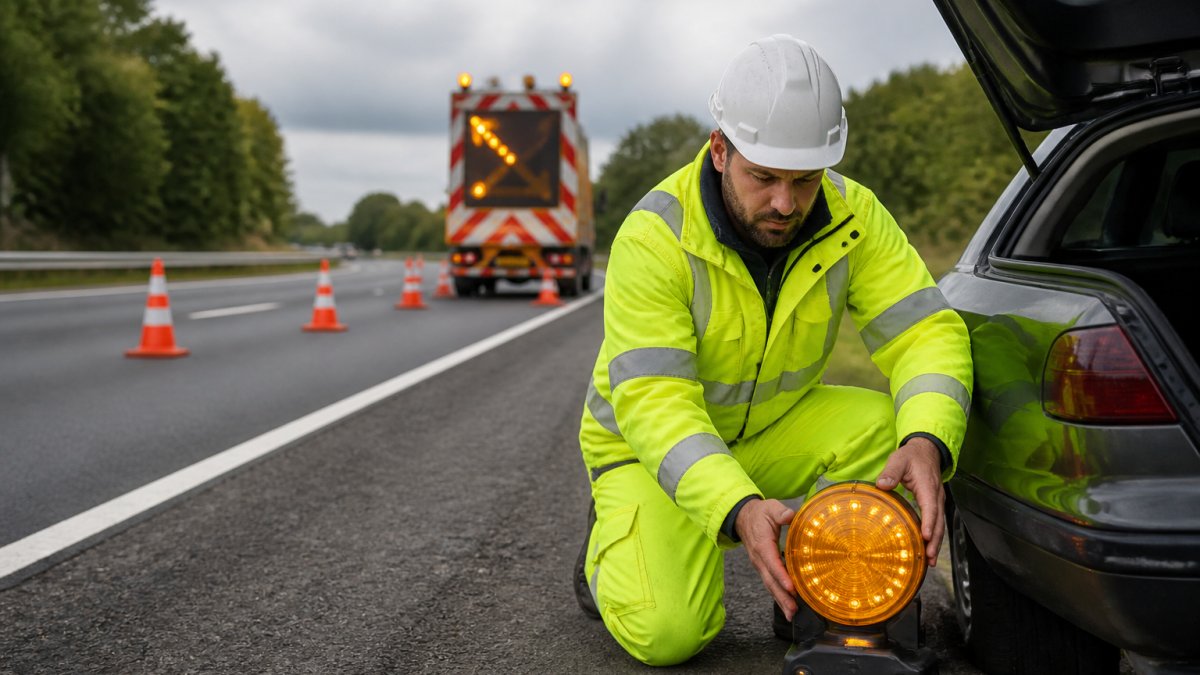
Roadflash’s multi-award-winning early warning systems use this principle through high-visibility lighting driver behavior optimization designed specifically for stationary vehicle scenarios.
However, the relationship between lighting intensity and driver behaviour isn’t purely linear. Beyond a certain brightness threshold, visibility plateaus. Excessive brightness can cause glare, which paradoxically reduces hazard detection by creating temporary visual impairment. This is where thoughtful design matters more than raw luminosity.
Driver response to flashing lights and warning signals
Recognition and reaction time
Flashing lights trigger faster recognition than steady illumination. A driver’s visual system is wired to detect motion and change, making intermittent signals more effective than constant brightness at the same intensity level. Recognition typically occurs within 1-2 seconds of a flashing beacon entering the driver’s visual field, compared to 3-4 seconds for static lighting.
The colour of the light also influences response speed. Amber and red wavelengths penetrate fog and rain more effectively than white light, which scatters in poor visibility conditions. This is why emergency beacons and warning lights favour these colour spectrums in adverse weather.
Reaction time, the interval between recognising a hazard and taking action, depends on the driver’s cognitive load and road familiarity. A driver already mentally taxed by heavy traffic or complex navigation responds more slowly than one in a calm driving state.
Speed adjustment and hazard avoidance
When drivers detect a stationary vehicle or roadside hazard early, they adjust speed proactively rather than reactively. A driver who sees a flashing beacon 200 metres ahead has time to decelerate smoothly. One who sees it at 50 metres must brake hard, risking rear-end collision from following traffic.
Speed perception itself is influenced by lighting conditions. On unlit roads, drivers often misjudge the speed of approaching vehicles because depth cues are limited. High-visibility lighting provides those cues, allowing drivers to gauge closing speed more accurately and adjust their own velocity accordingly.
Hazard avoidance effectiveness depends on whether the driver has a safe alternative. On a single-carriageway road with oncoming traffic, lighting alone cannot create a safe merge opportunity. On a motorway with multiple lanes, early detection via high-visibility lighting enables drivers to move away from the hazard before reaching it.
Roadside hazard warning lights and visibility in low-light conditions
Night driving challenges and visual scanning
Night driving reduces visual acuity by approximately 50% compared to daylight, even with vehicle headlights. The human eye adapts to darkness by dilating the pupil, but this also reduces the eye’s ability to focus sharply on distant objects. Peripheral vision deteriorates further at night, meaning drivers rely more heavily on the central visual field.
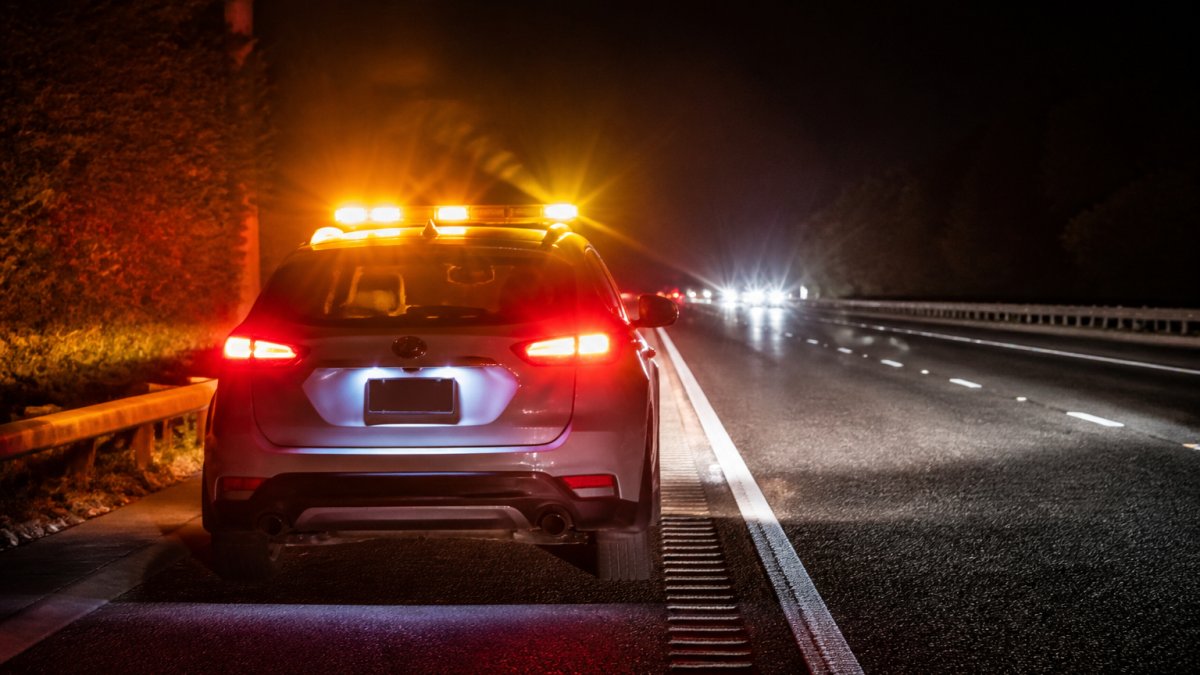
A stationary vehicle without high-visibility lighting becomes nearly invisible on an unlit rural road. The driver’s headlights may illuminate it, but only at the moment the vehicle enters the headlight beam, typically 100-150 metres away at motorway speeds.
Visual scanning patterns change at night. Drivers make more frequent eye movements, searching for hazards in the darkness. This increases cognitive load and fatigue. When a high-visibility beacon is present, the scanning becomes more efficient because the hazard location is already known. The driver’s attention is directed rather than searching blindly.
Glare, brightness, and driver distraction
Glare occurs when light sources are too bright relative to the surrounding environment, causing temporary visual impairment. On a dark road, even a moderately bright light source can produce glare if the contrast is extreme. A driver experiencing glare loses the ability to see the road ahead clearly, which is counterproductive to safety.
The relationship between glare and hazard detection is a critical tension in high-visibility lighting design. Too little light and the hazard remains invisible. Too much light and the driver becomes temporarily blinded.
Distraction is a separate concern from glare. An excessively bright or unusual light pattern can capture attention so completely that the driver fixates on it rather than processing the broader road environment. This is why emergency beacons are designed to be noticeable without being hypnotic, the goal is to alert the driver, not mesmerise them.
Vehicle visibility at night and conspicuity on motorways
Dipped headlights versus high-visibility lighting
Dipped headlights illuminate the road ahead for the driver operating the vehicle, not to make that vehicle visible to others. A driver approaching a stationary vehicle sees that vehicle illuminated by their own headlights, but other approaching drivers cannot see the stationary vehicle until it enters their own headlight beam.
This is a fundamental distinction. Dipped headlights are about forward visibility for the driver; high-visibility lighting is about conspicuity for other road users. A stationary vehicle relying only on dipped headlights is effectively invisible to approaching traffic until the final moments before impact.
Conspicuity, the ability to be noticed quickly and accurately, is the primary function of high-visibility lighting on stationary vehicles. Roadflash’s emergency beacons with GPS and high-visibility lighting are engineered specifically to maximise conspicuity during the critical moments when a driver might collide with a disabled vehicle.
Approaching vehicle detection and speed perception
Speed perception at night is notoriously unreliable. A driver approaching a stationary vehicle at 70 mph may underestimate their closing speed because visual reference points are limited in darkness. The oncoming vehicle appears to move slowly until suddenly it is very close.
High-visibility lighting provides visual reference points that improve speed perception. Flashing lights create a sense of motion and distance that helps the driver judge closing speed more accurately. This is particularly important on motorways where even a 5 mph misjudgement in approach speed can be the difference between a controlled stop and a collision.
The colour and pattern of the lighting also matter. A steady red light is perceived as stationary; a flashing amber light conveys warning and urgency. These perceptual differences influence how quickly a driver responds to the visual signal.
Stationary vehicle safety and collision prevention
Breakdown scenarios and roadside operations
A vehicle breakdown on a motorway is one of the highest-risk scenarios in road safety. The vehicle is stationary in an environment where traffic is moving at high speed, often in poor visibility conditions.
High-visibility lighting transforms this scenario. When a breakdown vehicle is equipped with emergency beacons and high-visibility lighting, approaching drivers have clear, early warning. The risk of rear-end collision drops significantly. Roadflash’s systems are specifically designed for this use case, providing the early warning that prevents collisions during the most critical moments of a breakdown.
Roadside operations, maintenance work, accident scene management, recovery operations, face similar hazards. Workers and equipment are stationary in the path of moving traffic. High-visibility lighting alerts approaching drivers and gives them time to slow and move around the hazard safely.
Dual carriageways, rural roads, and high-speed environments
Dual carriageways present unique hazards because traffic moves in one direction at high speed with limited opportunity to change lanes. A breakdown on a dual carriageway is more dangerous than on a single carriageway because the driver cannot move into the opposite lane to create distance from the hazard.
Rural roads often lack street lighting entirely, making high-visibility lighting the only source of hazard detection at night. A stationary vehicle on an unlit rural road is invisible until the approaching driver’s headlights pick it up.
High-speed environments amplify all these risks. At 70 mph, a vehicle travels 31 metres per second. The difference between detecting a hazard at 300 metres versus 100 metres is the difference between a safe, controlled response and an emergency braking scenario. High-visibility lighting is not optional on motorways, it is essential collision prevention equipment.
Evidence gaps and practical limitations of high-visibility lighting
What research shows and what remains uncertain
High-visibility lighting demonstrably improves hazard detection distance and reduces reaction time in controlled conditions. The evidence for this is consistent across multiple studies and real-world observations. Where the evidence becomes less clear is in predicting actual collision reduction under varied real-world conditions.
Collision prevention depends on multiple factors beyond detection: road design, traffic volume, driver fatigue, weather, vehicle speed, and driver compliance with warnings. A driver who detects a hazard but is unable to stop safely because they are following too closely will still collide. High-visibility lighting cannot overcome poor driving behaviour or dangerous following distances.
Individual driver differences also matter. Younger drivers, experienced motorists, and alert drivers respond faster to visual warnings than older drivers, inexperienced drivers, and fatigued drivers. The same high-visibility lighting system produces different outcomes depending on who is driving.
Driver experience, context, and individual differences
A professional driver who regularly encounters breakdowns and roadside hazards learns to interpret warning lights quickly and respond appropriately. A commuter who rarely experiences such scenarios may take longer to process the signal and decide on a course of action.
Contextual factors influence response as well. A driver in heavy traffic has less ability to change lanes or reduce speed than one on a clear road. A driver in fog has reduced visual acuity even with high-visibility lighting present. A driver distracted by a phone call may not notice the warning at all, regardless of brightness.
The implication is clear: high-visibility lighting is a necessary but not sufficient safety measure. It provides the early warning that enables safe responses, but it does not guarantee safe outcomes. Drivers must still maintain appropriate speed, following distance, and attention to the road.
Practical recommendations for safer roads
High-visibility lighting should be standard equipment on all vehicles regularly used on motorways and high-speed roads. The cost and weight of modern emergency beacons is minimal compared to the collision risk they prevent.
For road authorities and traffic management, high-visibility lighting on temporary hazards, accident scenes, roadworks, breakdowns, should be mandatory. The installation time is seconds; the safety benefit is substantial.
For drivers, the practical takeaway is straightforward: when you experience a breakdown or roadside emergency, activate every available warning system. Use hazard lights, deploy reflective triangles, and if you have high-visibility lighting equipment, activate it immediately.
Stationary vehicle collisions on motorways and high-speed roads remain a significant safety risk, particularly during breakdowns and roadside operations. High-visibility lighting addresses this risk directly by extending hazard detection distance and improving driver response time.
Frequently Asked Questions
How does high-visibility lighting affect driver behaviour on motorways?
High-visibility lighting increases hazard detection by making stationary vehicles and roadside hazards conspicuous from greater distances. Drivers who spot warning beacons earlier report higher confidence in collision avoidance and tend to adjust speed sooner. The flashing pattern itself triggers faster recognition than static light alone, giving drivers more time to react in high-speed environments.
Do drivers respond differently to flashing lights than to steady warning signals?
Yes. Flashing lights capture attention more effectively than steady illumination because the human eye responds to motion and change. Research suggests drivers detect flashing beacons faster and initiate braking or lane changes more promptly. However, response quality depends on driver fatigue, weather conditions, and whether the flashing pattern is recognisable as a hazard warning rather than general traffic lighting.
What is the difference between vehicle visibility at night with standard headlights and high-visibility lighting?
Standard dipped headlights illuminate the road ahead for the driver but make a stationary vehicle difficult for approaching drivers to see until they are very close. High-visibility lighting, especially flashing beacons, is designed to be seen by other road users rather than to light the road. This distinction is critical on motorways where closing speeds are high and reaction time is limited.
Can high-visibility lighting reduce the risk of roadside collisions during breakdowns?
High-visibility lighting significantly improves conspicuity and reduces collision risk by alerting approaching drivers to stationary hazards much earlier. Stationary vehicle safety depends on early warning, adequate visibility distance, and driver reaction time. Roadside hazard warning lights address all three factors, making them essential for motorway breakdowns where high-speed traffic poses the greatest risk.