
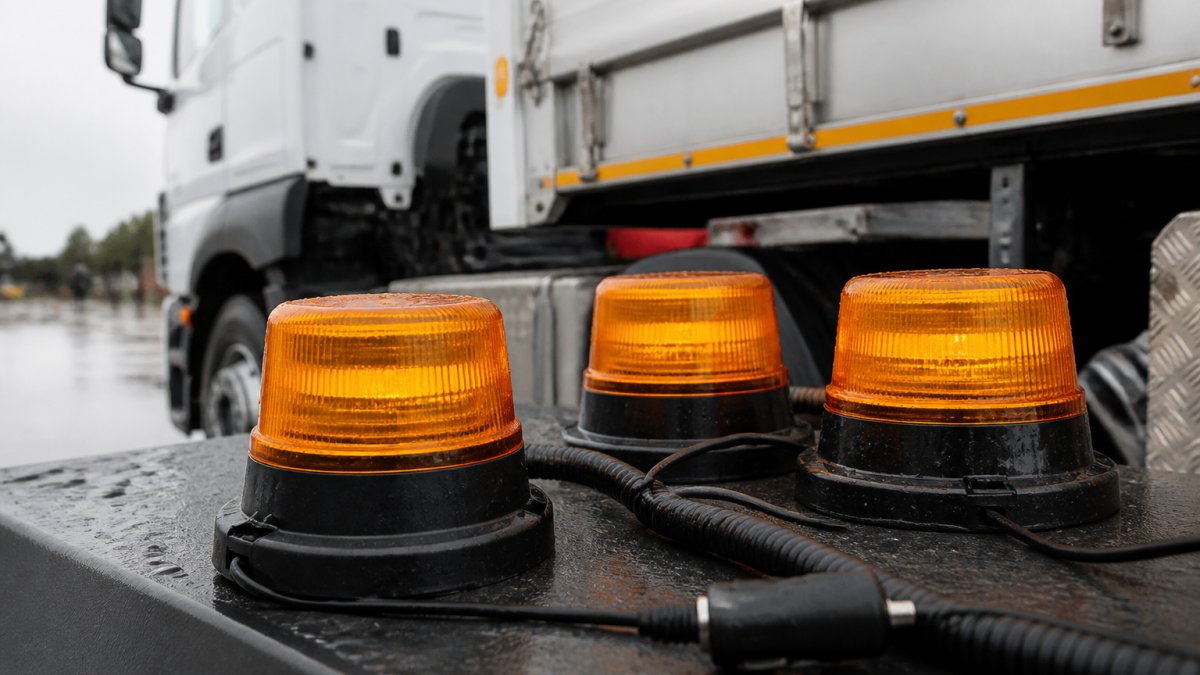
How to Choose Durable LED Beacons for Heavy Goods Vehicles
Last Updated: November 1, 2026
Quick Summary
Choosing durable led beacons for heavy goods vehicles means matching the IP rating to the duty cycle rather than the price tag, with IP67 as the sensible baseline and IP69K where steam or pressure washing is routine. Confirm the rating applies to the assembled unit, including the lens seal and cable entry, and ask for the test standard behind every durability claim.
- Durability in an HGV beacon means keeping brightness, seal and mounting integrity through vibration, weather and repeated cleaning.
- Amber is the standard warning colour for slow or stationary work vehicles, while blue is reserved for emergency services.
- Look for an IK rating of IK08 or better on cab-roof and body-mounted units.
- At motorway speeds a magnetic base that holds at 30 mph can shift at 60, so bolt down permanent fleet fitments.
- Match the beacon to the vehicle’s 12V or 24V system and use a fused circuit rated for its draw.
Table of Contents
- What Makes an LED Beacon Durable Enough for an HGV
- HGV LED Beacon Lights: Types, Colours and Where They Fit
- Reading an LED Beacon IP Rating and Test Standards
- HGV Beacon Mounting Options That Survive Motorway Speeds
- Electrical Compatibility and Fleet Installation Checks
- LED Beacon Maintenance Checklist for Fleet Operators
- Total Cost of Ownership: Why Cheap Beacons Cost More
- Specify Your Next Beacon Order with Roadflash
- Frequently Asked Questions
What Makes an LED Beacon Durable Enough for an HGV
Choosing durable LED beacons for heavy goods vehicles starts with one question: will this unit still work after two winters of salt spray, constant vibration and daily wash-downs? Durability is a set of measurable properties, not a marketing word.
Durability in an HGV beacon means the unit keeps its brightness, seal and mounting integrity through vibration, weather and repeated cleaning over years of service. Three things decide it:
- Sealing: how well the housing keeps out water and dust
- Housing and lens material: resistance to impact, UV and chemical cleaners
- Electronics: how the driver and circuitry cope with voltage swings and heat
A cheap beacon can look identical on the shelf. The difference shows up in month eighteen, when the lens has clouded or water has got behind the reflector.
Match the rating to the duty cycle, not the price tag.
Three measurable properties decide whether a beacon survives HGV duty.
| Factor | What it covers | Why it matters |
|---|---|---|
| Sealing | How well the housing keeps out water and dust | Water behind the reflector signals failure |
| Housing and lens material | Resistance to impact, UV and chemical cleaners | Cheap lenses cloud over time |
| Electronics | Coping with voltage swings and heat | Driver and circuitry decide service life |
HGV LED Beacon Lights: Types, Colours and Where They Fit
HGV LED beacon lights fall into four practical groups: rotating-style beacons, fixed strobe units, low-profile bars and compact magnetic units for temporary use. Each suits a different job.
- Rotating-style LED beacons: a sweeping flash pattern; familiar to other drivers
- Strobe beacons: sharp, fast flashes for high-visibility warning
- Low-profile beacons: low height for cab roofs and tight clearances
- Magnetic beacons: quick installation, no-drill mounting for pool vehicles
Colour carries legal meaning, and the rules are not the same everywhere. Amber is the standard warning colour for slow or stationary work vehicles. Blue is reserved for emergency services and should not be fitted to a general fleet vehicle (How to stay compliant with aftermarket light products). White or red supplemental lighting has narrow uses, so check before you specify. For a closer look at colour choice, see amber vs blue hazard lights.
Compliance before you specify
Permitted beacon colours, flash patterns, mounting positions and when a beacon may be used on the public highway are set by the relevant road vehicle lighting rules. Check the current requirements with the authority that governs your operating area before specifying.
Before ordering, confirm four things with the authority that governs your operating area:
- Colour: which warning colours your vehicle class may display, and whether any colour is restricted to emergency services.
- Flash pattern and rate: some jurisdictions restrict the flash frequency or the type of pattern permitted on a moving vehicle.
- Placement and height: rules on where a beacon may be mounted, how high it may sit and whether it may be used while the vehicle is in motion.
- Use conditions: whether the beacon is permitted only when stationary or working, or at any time.
Keep a written record of the regulation or guidance you relied on for each fleet specification, and review it whenever you add vehicles or operate in a new area. It is far cheaper than refitting a fleet after an enforcement stop.
Reading an LED Beacon IP Rating and Test Standards
An IP rating is a two-digit code showing how well a beacon keeps out solid objects and water. The first digit covers dust; the second covers water. For HGV work, treat IP67 as the sensible baseline: dust-tight and able to survive short immersion.
A single IP number does not tell you whether a beacon will survive a truck. Ask for the test basis behind every durability claim, and use the checklist below to compare units on equal terms. Readers wanting more depth can turn to our guide on IP ratings for outdoor maintenance equipment.
- Ingress protection: IP67 minimum; IP69K where steam or pressure washing is routine. Confirm the rating applies to the assembled unit, including the lens seal and cable entry, not just the housing moulding.
- Impact resistance: look for an IK rating (IK08 or better is a reasonable target for cab-roof and body-mounted units) and ask what the lens is made from, polycarbonate and acrylic behave very differently under stone strike and UV.
- Vibration: the beacon should have been tested to a recognised vibration standard, with the test covering the mounting bracket as well as the lamp. A unit that passes on a bench but shakes loose on a bracket has not been proven for HGV duty.
- Temperature cycling: confirm the operating range covers both a cold overnight stand and a cab roof in direct summer sun. Repeated heating and cooling is what opens seal gaps over time.
- Chemical resistance: windscreen wash, traffic-film remover, diesel and salt spray all attack seals and lens coatings. Ask which cleaners the manufacturer has tested against.
- Service life: treat quoted LED life as an estimate under stated conditions, not a guarantee. Ask what duty cycle and ambient temperature the figure assumes, and whether the driver electronics are rated for the same life as the LEDs.
A badge on the box is not a test report. Ask for the test standard, the date and the laboratory behind any durability claim, and check that the rating applies to the complete beacon rather than a component.
HGV Beacon Mounting Options That Survive Motorway Speeds
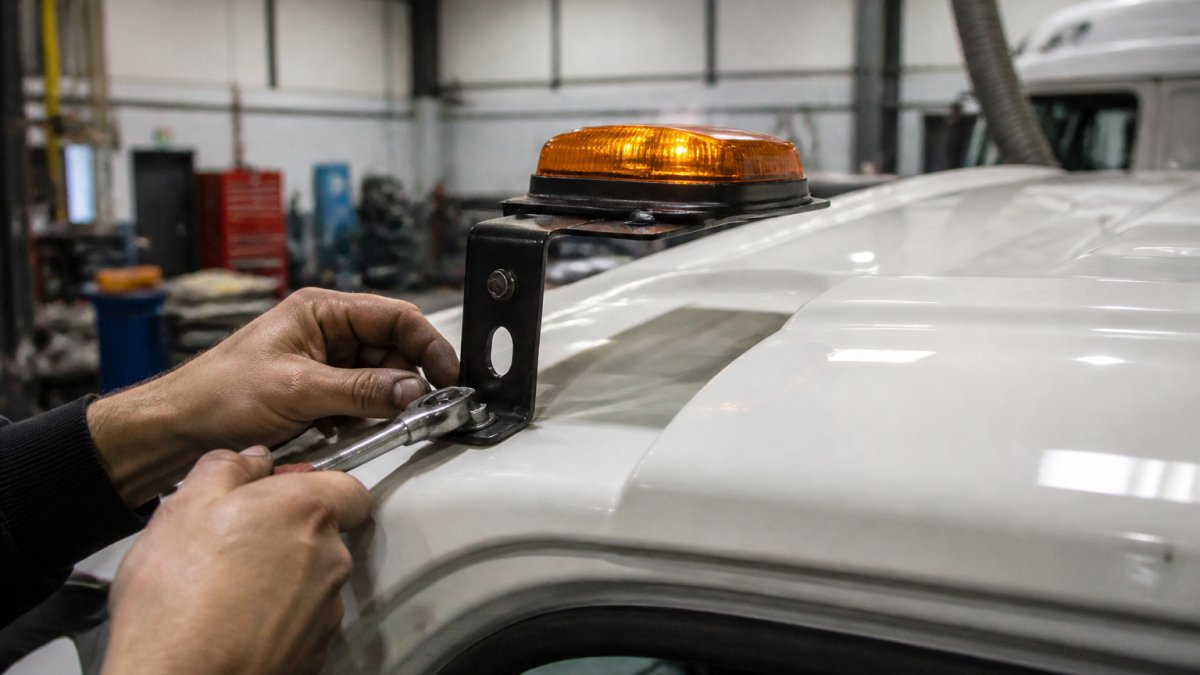
HGV beacon mounting options come down to three choices: fixed mount, magnetic mount and bracket mount. The right pick depends on whether the beacon stays on one vehicle or moves between several.
- Fixed mount: bolted to the cab or body; the most secure at speed
- Magnetic mount: fast to fit and remove; best for occasional use
- Bracket mount: positions the beacon for maximum visual range
At motorway speeds, wind load and vibration attack every fixing. A magnetic base that holds fine at 30 mph can shift at 60. For permanent fleet fitment, bolt it down and use a bracket that keeps the beacon clear of spray. Our article on emergency beacon mounting locations for storms expands on mounting locations for demanding conditions.
Electrical Compatibility and Fleet Installation Checks
Electrical compatibility is where fleet installations quietly go wrong. Before you order, confirm three things:
- Voltage: match the beacon to the vehicle’s system, typically 12V or 24V
- Current draw: check the total load when several beacons run together
- Wiring and fusing: use a fused circuit rated for the beacon’s draw
Run a test fit on one vehicle before committing the whole fleet. Check that the flash pattern is visible from the angles that matter, and that the wiring is protected from chafing.
Watch out: mixing voltages across a mixed fleet is a common and costly mistake. Label each unit clearly.
LED Beacon Maintenance Checklist for Fleet Operators
A short, regular check keeps beacons working and catches failures before a vehicle goes out. For a deeper look at maintaining LED warning beacons for longevity, see our dedicated article. Use this checklist at every service interval:
- Wipe the lens and check for clouding or cracks
- Test every flash pattern, not just the default
- Inspect seals and the mounting bracket for corrosion
- Check wiring connections and fuse condition
- Confirm brightness against a known-good unit
Total Cost of Ownership: Why Cheap Beacons Cost More
A cheap beacon is rarely the cheaper option. The real cost includes replacement, labour to swap it, and the risk of a failed unit on the road. A durable beacon spreads its cost over a longer service life and fewer fitter hours.
Pricing depends on quantity, dates and delivery, so check Roadflash’s website for current prices or request a quote. Factor in fitting time and downtime when you compare options.
Specify Your Next Beacon Order with Roadflash
Specifying a durable beacon order means matching sealing, mounting and electrical spec to how your vehicles actually work. Roadflash offers multi-award-winning early warning systems, including DGT 3.0 compliant emergency beacons with GPS and geolocation, designed to raise hazard awareness and protect drivers during breakdowns.
When you are ready to specify, our guide on how to choose a reliable roadside safety beacon helps you shortlist with confidence.
Frequently Asked Questions
What should you look for when choosing an LED beacon for an HGV?
Start with the IP rating: IP67 or higher keeps dust and water out of the housing, which matters on motorway spray and construction sites. Check the mounting system can take vibration at speed, confirm the voltage suits your vehicle’s 12V or 24V system, and look for a flash pattern that meets the warning rules where you operate. A durable led beacon should also carry a stated impact and temperature range, because a beacon that fails in cold or heat leaves the vehicle without warning lighting.
How bright should an HGV LED beacon be?
Brightness is about visual range, not just lumen count. A beacon needs enough output to be seen at the distance traffic approaches, so look for stated effective range rather than peak figures. Beam pattern matters as much as brightness: a wide spread warns drivers at angles, while a focused beam reaches further down the carriageway. Too much glare can dazzle, so match the output to the vehicle size and the site. Ask the supplier for the measured range at which the light is clearly visible.
Are LED beacons suitable for use in wet and dusty conditions?
Yes, provided the LED beacon IP rating is suitable. IP67 means the housing is dust-tight and can survive temporary immersion, while IP69K adds protection against high-pressure washing, which suits construction and maintenance fleets. Seals, lens material and cable entry points decide how well a beacon keeps working after months of rain, grit and jet washing. Check the rating is stated for the whole unit, not just the lamp, and inspect seals during your maintenance checks.
How should an HGV LED beacon be maintained and when should it be replaced?
Run a simple LED beacon maintenance checklist: wipe the lens, inspect seals and cable glands, test every flash pattern, and check the mount for movement. Do this at each vehicle inspection and after any high-pressure wash. Replace the unit when the lens cracks, water gets inside, the flash pattern becomes erratic, or output visibly drops. LED beacons last far longer than bulb units, but seals and mounts wear out first, so replace those parts before the whole beacon fails.
The wrong beacon fails when you need it most, at the roadside in poor light. Roadflash designs early warning systems that increase hazard awareness, improve vehicle visibility and protect drivers and passengers during breakdowns, backed by multi-award-winning products and DGT 3.0 compliant beacons with GPS geolocation. Get started with Roadflash and specify warning lighting you can rely on.
