
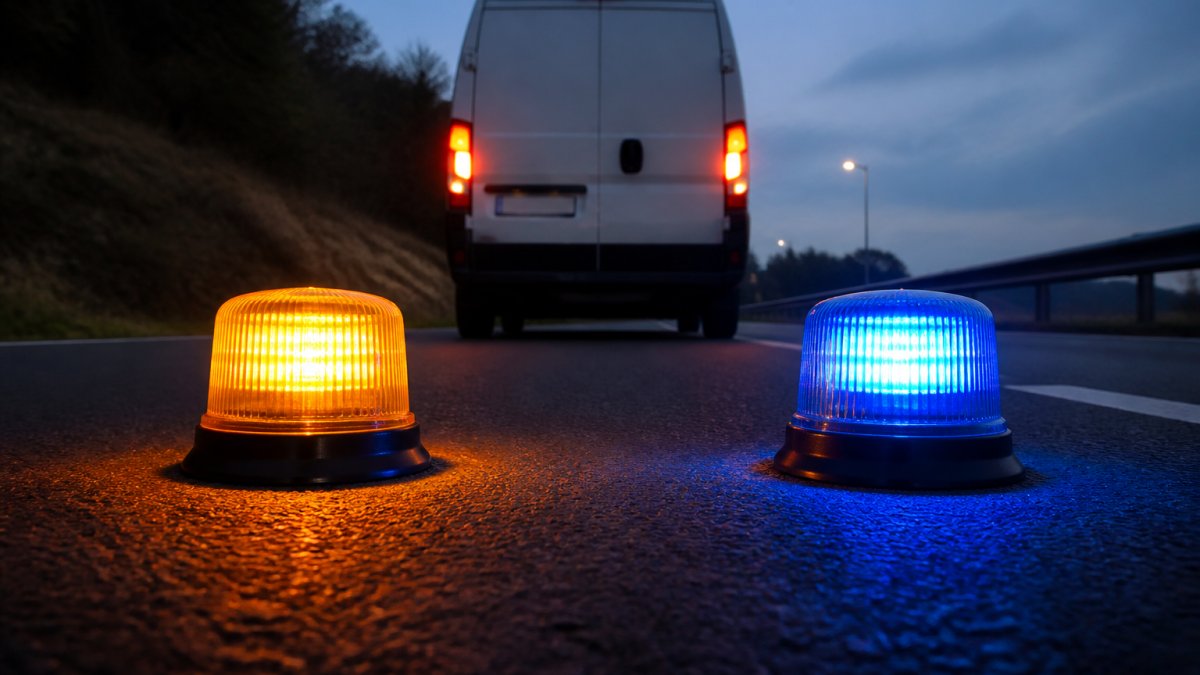
Amber vs Blue Hazard Lights: Which Works Best
Table of Contents
- Amber Versus Blue Hazard Lights: Core Differences
- Visibility and Early Risk Recognition
- The Road Vehicles Lighting Regulations 1989 and Compliance
- Amber Beacon Requirements for Construction Vehicles
- The Highway Code Hazard Warning Lights Rules
- Night Performance and Driver Reaction Times
- Choosing the Right Light for Your Roadwork Operation
- Frequently Asked Questions
Last Updated: September 29, 2026
Amber Versus Blue Hazard Lights: Core Differences
Amber versus blue hazard lights serve fundamentally different purposes on the road, and understanding which to use can mean the difference between a safe roadwork operation and a collision. Amber lights signal caution and non-emergency work zones, construction vehicles, maintenance crews, and roadside assistance use them to warn approaching traffic that work is underway. Blue lights, by contrast, are reserved for emergency services: police, fire, and ambulances. This distinction matters legally and practically. Using the wrong colour can confuse drivers, create liability issues, and fail to meet regulatory standards that govern roadwork safety.
Amber versus blue hazard lights aren’t interchangeable. For roadwork operations, amber is the correct choice, it’s what regulations require, what drivers expect, and what research shows performs best in preventing collisions.
Visibility and Early Risk Recognition
Early risk recognition involves three cognitive stages: detection (can the driver see it?), discrimination (what colour?), and interpretation (what does it mean?). Amber and blue perform differently at each stage.
Detection and Contrast Sensitivity
Amber light (590-620 nanometres) sits near the peak of human photopic vision sensitivity (555 nanometres), which is why it’s used for traffic signals and roadwork beacons. Blue light (450-495 nanometres) sits further from this peak, requiring higher intensity to achieve the same perceived brightness.
An amber beacon of moderate intensity is spotted at greater distance than a blue beacon of the same intensity. In fog or rain, this advantage widens because amber wavelengths scatter less in water droplets.
Colour Discrimination and Driver Expectation
Once detected, the driver’s brain assigns meaning based on learned association. Amber has been the UK standard for roadwork and non-emergency hazards for decades; drivers learn this during initial instruction and reinforce it through years of road experience.
When a motorist sees amber flashing, their brain immediately categorises it as a non-emergency hazard requiring caution. The neural pathway is automatic.
Blue lights signal emergency and urgency. When blue lights appear on a stationary work vehicle, the signal becomes ambiguous: Is this an emergency? That cognitive confusion costs milliseconds, time during which the driver’s foot is not moving from accelerator to brake.
Cognitive Load and Colour Fatigue
Unfamiliar warning signals impose higher cognitive load than familiar ones. Amber for roadwork requires minimal conscious processing; blue on a stationary work vehicle forces deliberation, slowing reaction time.
Repeated exposure to mismatched colour signals creates “colour fatigue”. If blue sometimes means emergency and sometimes means roadwork, the colour loses communicative power. Regulatory consistency preserves the reliability of colour-based warnings.
Reaction Time Data
Reaction time to a familiar warning signal averages 0.5-1.5 seconds; to an unfamiliar signal, 1.5-2.5 seconds or longer. At 70 mph, an extra second of delay means 31 metres of additional travel, the difference between a safe stop and a collision.
Amber beacons trigger automatic recognition, producing faster reaction times, a matter of how human perception works.
The Road Vehicles Lighting Regulations 1989 and Compliance
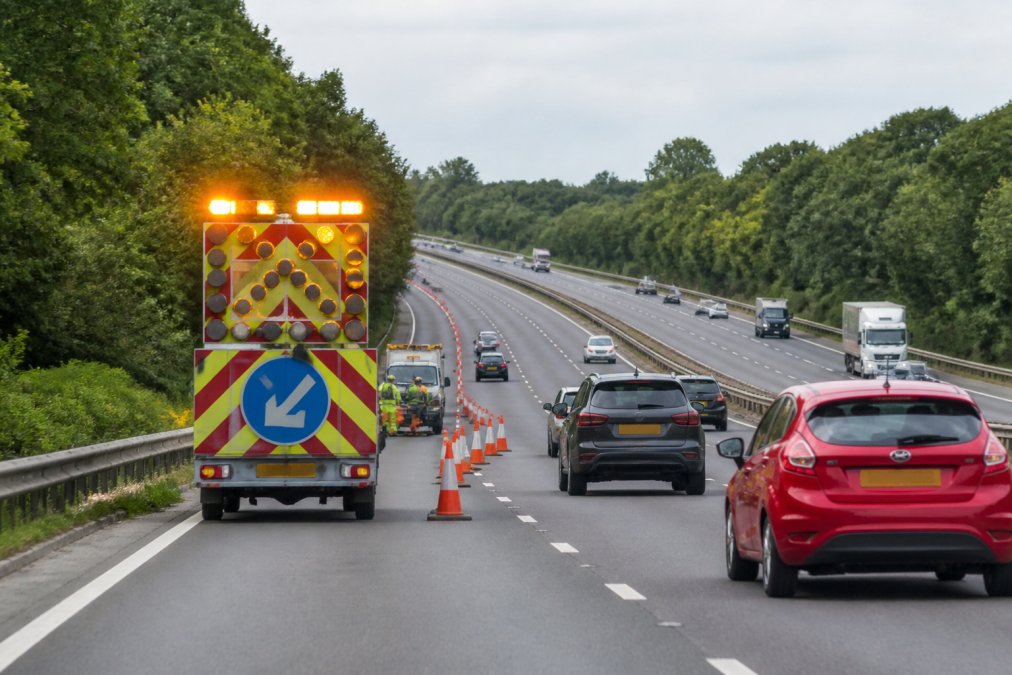
The Road Vehicles Lighting Regulations 1989 mandate amber flashing beacons for construction vehicles, maintenance vehicles, and roadwork operations.
Blue lights are restricted to emergency services. Using blue on a roadwork vehicle violates regulations, risks fines and prosecution, and undermines safety by sending the wrong signal to traffic.
Compliance creates a predictable, safe traffic environment. When every roadwork vehicle displays amber and every emergency vehicle displays blue, drivers develop reliable expectations that translate into faster reaction times and fewer collisions.
Amber Beacon Requirements for Construction Vehicles
Amber beacons must produce sufficient light output to be visible in daylight from at least 100 metres, flash at 60-90 flashes per minute, be positioned high on the vehicle, and operate reliably across weather conditions.
Roadflash’s DGT 3.0 compliant emergency beacons offer high-intensity amber LED output engineered for motorway conditions, designed to cut through rain and fog where visibility drops dramatically.
Many roadwork operations benefit from multiple beacons positioned to maximise visibility from all angles.
The Highway Code Hazard Warning Lights Rules
The Highway Code specifies that hazard warning lights (the vehicle’s standard hazard switch) differ from beacon-based systems. Hazard lights alert drivers to temporary obstructions, breakdowns, or slow-moving vehicles.
Beacon-based systems actively draw attention to hazards from a distance, giving drivers more time to react.
The Highway Code specifies amber for non-emergency hazards. Using blue breaks learned expectations and creates confusion.
Night Performance and Driver Reaction Times
Night driving and poor-visibility conditions expose critical differences between amber and blue. Understanding these differences is essential for 24/7 roadwork operations.
Wavelength Physics and Atmospheric Penetration
Amber light’s longer wavelength (590-620 nanometres) versus blue (450-495 nanometres) has direct consequences for light propagation through fog, rain, and darkness.
Shorter wavelengths scatter more readily in fog and rain than longer wavelengths. An amber beacon remains visible at greater distance through fog and rain than a blue beacon of the same intensity.
In twilight and partial visibility conditions common on motorways during autumn and winter, amber’s longer wavelength penetrates haze more effectively, reaching drivers’ eyes from greater distances.
Scotopic Vision and Colour Perception at Night
Human vision operates in photopic (daylight) and scotopic (night) modes. Mesopic vision occurs in low-light conditions typical of dusk, dawn, and poorly lit motorways.
In scotopic conditions, rod cells are most sensitive to blue-green light. However, roadwork operations rarely occur in complete darkness; motorways are lit by headlights and street lighting, creating mesopic conditions.
In mesopic conditions, amber beacons retain an advantage because:
-
Contrast against ambient light: Motorway ambient lighting (headlights, street lamps) is predominantly warm-toned. An amber beacon blends into this background. However, amber beacons used for roadwork are high-intensity and flashing, which creates temporal contrast (the on-off cycle) that the eye detects even if the colour itself blends. Blue light, being cooler and less common in ambient motorway lighting, creates both colour contrast and temporal contrast, which might initially seem advantageous.
-
Glare and adaptation: High-intensity blue light causes more glare and pupil constriction than amber light of the same intensity. This can actually reduce visibility for drivers whose eyes are adapted to the darker conditions of night driving. Amber light, being closer to the warm-toned ambient lighting drivers are already adapted to, causes less disruptive glare and allows faster visual processing.
-
Flashing frequency and temporal summation: A flashing beacon (typically 60-90 flashes per minute) is detected by the eye’s temporal resolution, not just its colour sensitivity. In darkness and low-light conditions, the flashing pattern itself becomes the primary detection cue. Amber and blue beacons with the same flash frequency perform more similarly at night than in daylight, but amber retains an edge in fog and rain due to wavelength penetration.
Visibility Distance: Day Versus Night
A high-intensity amber beacon might be visible at 200-250 metres in clear daylight. In fog or heavy rain, visibility drops to 80-120 metres. At night in clear conditions, visibility extends to 300+ metres because there is no competing ambient light. In fog at night, visibility can drop to 50-80 metres.
These distances are critical. A driver travelling at 70 mph (31 metres per second) needs approximately 3-4 seconds of warning to safely decelerate. At night in fog, a beacon visible at only 80 metres provides less than 3 seconds of warning.
Driver Reaction Time in Low-Light Conditions
This increase is due to:
- Reduced ambient light requiring eye adaptation
- Lower contrast making the hazard harder to distinguish from the background
- Increased cognitive load as the driver processes a more ambiguous visual scene
- Fatigue, which is higher during night driving
Practical Implications for 24-Hour Roadwork Operations
- Amber beacons maintain consistent visibility and driver recognition across all lighting conditions. They perform best in fog, rain, and darkness, precisely the conditions where visibility is most critical.
- Blue beacons are restricted to emergency services by law and would be illegal for roadwork use. Even if they were permitted, their shorter wavelength would reduce visibility in poor conditions and create cognitive confusion about the vehicle’s status.
Choosing the Right Light for Your Roadwork Operation
Selecting between amber versus blue hazard lights should be straightforward: amber is correct for roadwork and non-emergency operations. Blue is illegal for your use case. But beyond the legal requirement, there are practical considerations that affect which amber system you choose.
| Feature | Amber Beacon (Roadwork Standard) | Blue Light (Emergency Only) |
|---|---|---|
| Legal use | Construction, maintenance, roadwork | Police, fire, ambulance only |
| Driver expectation | Caution, temporary obstruction | Emergency, move aside |
| Visibility in fog | Superior (longer wavelength) | Limited (shorter wavelength) |
| Night performance | Excellent at distance | Adequate at close range |
| Regulatory compliance | Required for roadwork | Illegal for non-emergency use |
| Cognitive clarity | Drivers know what it means | Confusion when misused |
Frequently Asked Questions
Are blue hazard lights legal for private roadworks vehicles in the UK?
No. Blue flashing lights are reserved for emergency services (police, ambulance, fire) under The Highway Code and Road Vehicles Lighting Regulations 1989. Private roadworks vehicles, construction fleets, and maintenance teams must use amber hazard lights. Using blue lights without authorisation is illegal and can result in prosecution. Amber is the mandated colour for non-emergency roadside hazard warning.
What does The Highway Code say about amber warning lights?
The Highway Code permits amber flashing or strobe lights on construction vehicles, maintenance equipment, and roadwork sites to warn approaching traffic of a hazard or obstruction. Amber beacon requirements for construction vehicles specify that lights must be visible, functional, and used when the vehicle is stationary or moving slowly in traffic. Amber is preferred because it signals caution without implying emergency, reducing driver confusion and panic.
Why are amber lights better than blue for roadworks visibility?
Amber hazard lights penetrate fog, rain, and poor visibility more effectively than blue because of their longer wavelength. Blue light scatters in adverse weather, reducing visibility distance. Amber also causes less eye strain for passing motorists and is instantly recognisable as a work-zone warning rather than an emergency signal. Amber is preferred because it signals caution without implying emergency, reducing driver confusion and panic.
How do high-visibility beacons improve safety on motorways?
High-intensity amber beacons increase early risk recognition by making stationary or slow-moving vehicles visible from greater distances, giving drivers more time to react and adjust speed. Strobe or flashing patterns draw attention more effectively than static lights. On motorways, where closing speeds are high, early warning systems significantly reduce collision risk during breakdowns or roadworks. Modern LED beacons with GPS integration also enable emergency services to locate hazards precisely.