
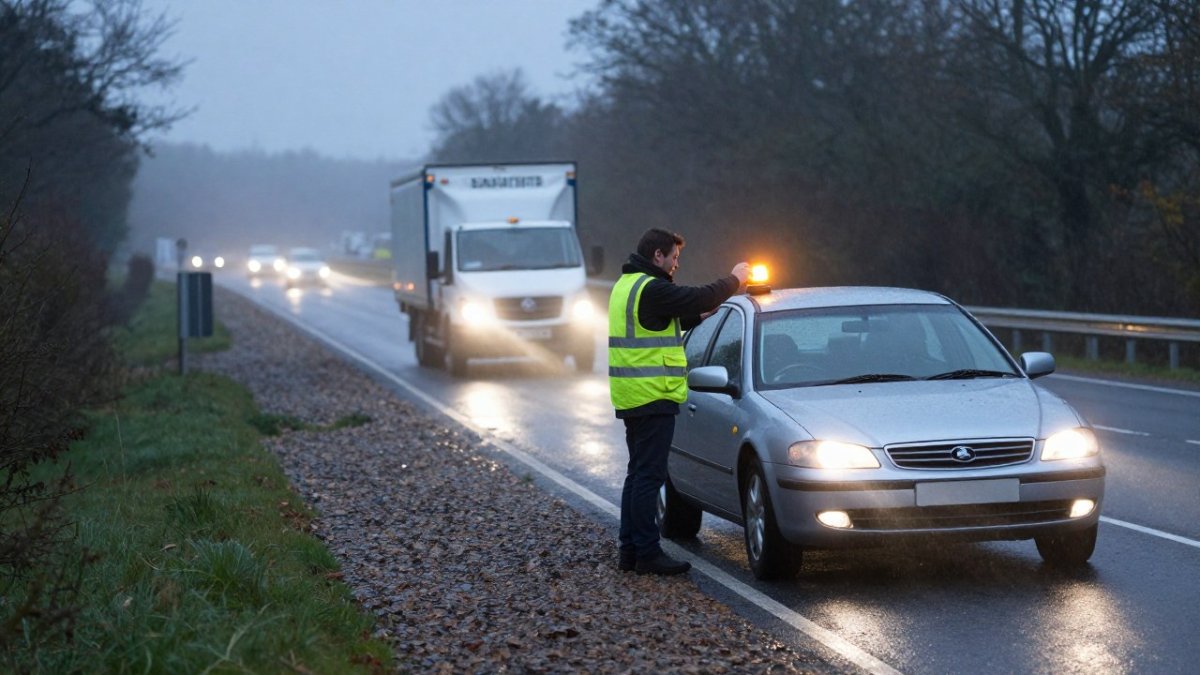
Essential Safety Steps After a Highway Breakdown
Last Updated: November 8, 2026
Quick Summary
A highway breakdown demands that you switch on hazard lights first, then move as far left as possible to the hard shoulder, an emergency area, or a lay-by. If you cannot reach a safe place, exit on the side away from traffic and get behind the safety barrier before calling for help.
- The first 60 seconds of a highway breakdown matter most, so get seen, get safe, then get help.
- In a live lane, never stay inside a vehicle you cannot move; exit and get behind the barrier.
- Give the operator your motorway, direction of travel, and nearest marker post number.
- Put on high-visibility clothing before you exit, not after you reach the barrier.
- Keep children’s hands held and pets on a lead from the moment you exit the vehicle.
Table of Contents
- What to Do First When Your Vehicle Breaks Down
- What to Do If You Break Down in a Live Lane
- Where to Wait After a Motorway Breakdown
- How to Call for Help After a Breakdown
- Motorway Breakdown Safety Checklist
- Breakdowns in Poor Weather, Darkness, or Low Visibility
- Keeping Children, Pets, and Your Group Together
- Stocking Your Vehicle with the Right Warning Equipment
- Frequently Asked Questions
What to Do First When Your Vehicle Breaks Down
A highway breakdown is a high-risk moment, and the first 60 seconds of a highway breakdown matter most. The same principle guides every step below: get seen, get safe, then get help.
The Highway Code guidance on breakdowns and incidents sets out the core rules. Those rules work. But knowing them before you need them is what separates a calm exit from a dangerous one.
Staying Calm and Assessing the Situation
Stay calm and assess before you act. Panic causes more injuries at the roadside than the breakdown itself.
Work through this quickly:
- Grip the wheel firmly if the car is still moving
- Check your mirrors and blind spots
- Note your lane, the traffic flow and the nearest exit or emergency area
- Decide whether you can roll clear of moving traffic
If the car is still rolling, keep steering. Coast to the left where you can. Do not brake hard in a live lane unless you have no choice.
Moving Out of Traffic and Using Hazard Lights
Hazard warning lights are the first thing you switch on. Do it before anything else, even before you stop.
Then move the vehicle as far left as possible. Aim for the hard shoulder, an emergency area, or a lay-by. On a smart motorway, an emergency area is your target.
Switch on your hazard lights the moment you sense trouble.
What to Do If You Break Down in a Live Lane
A live lane breakdown is the most dangerous scenario on any motorway. The National Highways guidance on smart motorways is clear: if your vehicle cannot reach a safe place, you should not stay inside it.
Work through this decision tree in order, and do not skip a step because you think the next one is obvious:
- Car still moving? Keep steering, indicate left, and coast to the hard shoulder, an emergency area, or a lay-by. Do not brake hard in a live lane unless there is no alternative.
- Car stopped in a live lane and you can move? Switch on hazard lights immediately, exit on the side away from traffic, and get behind the safety barrier. Leave belongings in the car.
- Car stopped and you cannot exit safely? Stay belted, keep hazard lights on, and call 999 immediately. Tell the operator you are in a live lane and cannot get out.
- Car stopped and you are unsure whether it is safe to exit? Treat it as unsafe. Call 999, stay belted, and wait for instruction.
If you can reach a safe place, do. If you cannot, get out and get behind the barrier. Read our full guide on what to do if you break down in a live lane for the specific steps.
Exiting a Live-Lane Vehicle Safely
The exit itself is where most injuries happen. Use the doors on the side away from traffic, on a left-hand-drive road that means the left-hand doors, and the passenger side where possible.
Once out, move straight to the barrier, not along the carriageway. Keep low, keep behind the barrier, and do not cross back to the car unless a recovery operator or emergency responder tells you it is safe.
Watch out: never stand in front of or behind your car in a live lane.
What to Say When You Call 999 from a Live Lane
Give the operator four things, in this order:
- That you are in a live lane and cannot exit, or that you have exited and are behind the barrier
- Your motorway, direction of travel, and the nearest marker post number
- How many people are with you, and whether anyone is injured or cannot exit unaided
- Your vehicle’s colour, make, and whether it is still in the live lane
Stay on the line until they tell you to hang up. If you are behind the barrier, keep your phone with you, not in the car.
Where to Wait After a Motorway Breakdown
Where you wait matters as much as where you stop. The safe place is behind the safety barrier, well away from the carriageway.
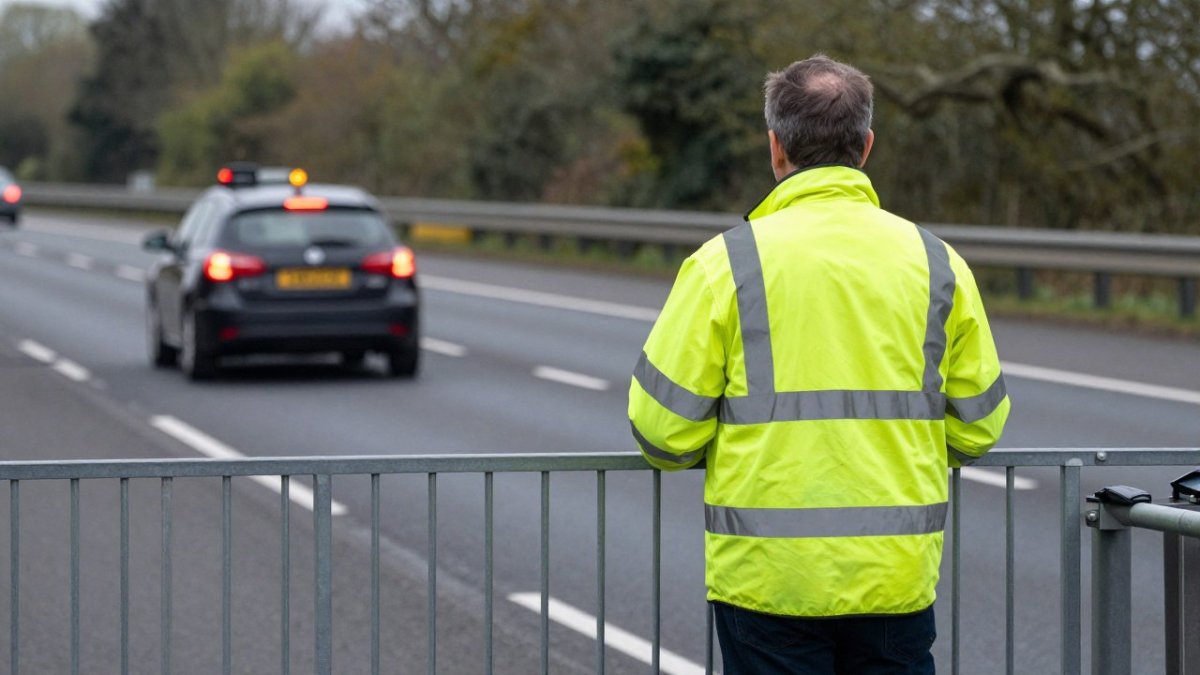
Exiting Safely and Reaching the Safety Barrier
Exit on the side away from traffic. That means the left doors on a left-hand-drive road, and the passenger side where possible.
Then follow these steps:
- Check mirrors and blind spots before opening any door
- Leave bags and belongings in the car
- Move straight to the barrier, not along the carriageway
- Keep low and stay behind the barrier once you are there
- Never cross back to the car unless it is safe
Our step-by-step guide on how to safely exit a vehicle on the motorway covers the door-to-barrier move in detail.
Passengers with Mobility, Sensory, or Medical Needs
Not everyone can exit quickly. Plan for that before you travel.
For passengers with mobility needs, keep a folding wheelchair or walking aid within reach. For deaf or hard-of-hearing passengers, agree on a hand signal for “get out now”. For anyone with a medical condition, keep medication on their person, not in the boot.
If a passenger cannot exit safely, call 999 and tell them. They will prioritise the response.
How to Call for Help After a Breakdown
Call for help as soon as you are behind the barrier. Use a mobile phone if you have signal. If not, use a roadside emergency phone.
Emergency phones connect straight to the control room and pinpoint your location automatically. Look for the orange marker posts along the barrier.
Our guide on how to use motorway emergency phones correctly walks through the process.
What Information to Give Emergency or Recovery Services
Give clear, short answers. The operator needs four things:
- Your location: motorway, direction of travel, and the nearest marker post number
- What happened: breakdown, collision, or medical issue
- How many people are with you, and whether anyone is injured
- Your vehicle: colour, make, and whether it is in a live lane
Stay on the line until they tell you to hang up. Keep your phone charged and keep it with you, not in the car.
Motorway Breakdown Safety Checklist
Use this checklist before you set off, and again if you break down.
| Step | Action | Why It Matters |
|---|---|---|
| 1 | Switch on hazard lights | Warns traffic behind you early |
| 2 | Move left to a safe stopping place | Gets you out of the traffic flow |
| 3 | Exit away from traffic | Reduces the risk of being struck |
| 4 | Get behind the safety barrier | Puts a physical barrier between you and vehicles |
| 5 | Call for help with your location | Speeds up recovery and emergency response |
| 6 | Keep passengers together and calm | Prevents people wandering into the carriageway |
Print it, keep it in the glovebox, and read it before you need it.
Breakdowns in Poor Weather, Darkness, or Low Visibility
Darkness and bad weather make a breakdown far more dangerous. In darkness or bad weather, staying visible and choosing a safe place to wait matter even more when arranging Towing PerfekTow.
Switch on hazard lights immediately. Put on high-visibility clothing before you exit, not after, a vest you put on at the barrier is a vest that did nothing while you were crossing the verge.
Rain, Fog, and Spray
In heavy rain or fog, your hazard lights compete with spray and glare. Keep them on, but do not rely on them alone. If you are behind the barrier, stay there and keep low; do not walk along the verge to signal traffic. Drivers in low visibility see movement late, and a person on the verge is harder to see than a vehicle.
Darkness and Cold
At night, the barrier is your safest place, but it is also cold and easy to lose sight of. Keep a torch with you, not in the boot, and use it to signal only when you are behind the barrier.
Watch out: do not leave passengers inside a vehicle that is in a live lane, even in cold weather. A belted passenger in a live lane is still in the impact zone; the barrier is the safer wait.
If You Cannot Reach the Barrier
If weather or injury stops you reaching the barrier, stay belted, keep hazard lights on, and call 999. Tell the operator the conditions, fog, heavy rain, darkness, because that changes how responders approach and how quickly they need to close the lane.
Our guide on motorway breakdown safety at night covers the extra steps for low light.
Keeping Children, Pets, and Your Group Together
Children and pets need a plan before you travel. A frightened child who runs toward the carriageway is a serious risk.
- Hold children’s hands from the moment you exit
- Keep pets on a lead or in a carrier, never loose
- Appoint one adult to lead the group to the barrier
- Count heads once you are behind the barrier
- Keep everyone there until recovery arrives
If you have a pet that cannot be safely handled at the roadside, keep it in the car with a window cracked and tell the operator.
Stocking Your Vehicle with the Right Warning Equipment
The right kit makes every step above faster and safer. Keep it in the car, not the boot, and check it before long journeys.
A basic kit should include:
- High-visibility vest for every occupant
- A warning beacon or light for the rear of the vehicle
- A charged mobile phone and a power bank
- A torch and spare batteries
- A warm blanket and water
At Roadflash, we make early warning beacons and high-visibility lighting designed to make a stationary vehicle easier to see. Our high visibility roadside safety equipment guide shows what to buy and why.
A breakdown is stressful, but the right steps keep it from becoming dangerous. Get seen, get behind the barrier, and call for help with a clear location.
Frequently Asked Questions
What should you do first if your car breaks down on a motorway?
Stay calm and keep steering. If you can, move the vehicle onto the hard shoulder or into an emergency area, then switch on your hazard warning lights immediately. If you cannot reach a safe stopping place, remain in the vehicle with seat belts fastened and call 999. Do not stand between your car and oncoming traffic, and do not attempt repairs on the carriageway.
Where should you wait after breaking down on a motorway?
Wait behind the safety barrier, well away from the carriageway and traffic flow. If there is no barrier, stand on the verge as far from the road as possible. Never wait in front of or beside your vehicle. Keep your passengers together and remain alert for unseen hazards such as debris or uneven ground.
Should you use a warning triangle on a motorway?
No. Warning triangles should not be used on motorways because placing one means walking into a live lane, which is extremely dangerous. Instead, rely on hazard warning lights and a high-visibility warning beacon. A motorway breakdown safety checklist should prioritise equipment you can activate from inside or beside the vehicle without entering traffic.
What should you do if your car breaks down in a live lane?
If your vehicle cannot reach the hard shoulder or an emergency area, stay inside with your seat belt on and call 999 immediately. Put on hazard warning lights. Do not exit the vehicle unless there is a clear, safe gap and a barrier nearby. If a smart motorway lane is live, emergency services can close it once you have given your location and direction of travel.
