
How to Safely Exit a Vehicle on the Motorway
Table of Contents
- Step 1: Immediate Actions After a Breakdown on the Motorway
- Step 2: How to Exit a Vehicle Safely on the Motorway
- What to Do If You Break Down on a Smart Motorway
- Highway Code Breakdown Rules Every Driver Should Know
- High Visibility Roadside Safety Equipment for Breakdowns
- How to Move Passengers and Vulnerable Occupants to Safety
- Common Mistakes to Avoid When Exiting on the Motorway
- Conclusion
- Frequently Asked Questions
Last Updated: September 16, 2026
Step 1: Immediate Actions After a Breakdown on the Motorway
A breakdown at motorway speed is a genuine emergency, and knowing how to safely exit a vehicle on the motorway starts before you even touch the door handle. Your first job is to make the car visible and get it away from the flow of traffic.
Pull onto the hard shoulder or into an emergency refuge area if you can. Stop as far to the left as possible, turn the wheels away from the carriageway, and switch on your hazard lights immediately. Apply the parking brake, then leave the engine ignition off once you have cut it.
If you cannot reach the hard shoulder, stop in the left lane and keep everyone belted in until it is safe to move. According to National Highways breakdown guidance, you should exit on the left and never attempt repairs from a live lane.
Never step into a live lane or attempt to change a wheel while traffic is passing. Rear-end collisions at motorway speed are almost always fatal, and no breakdown is worth that risk.
Step 2: How to Exit a Vehicle Safely on the Motorway
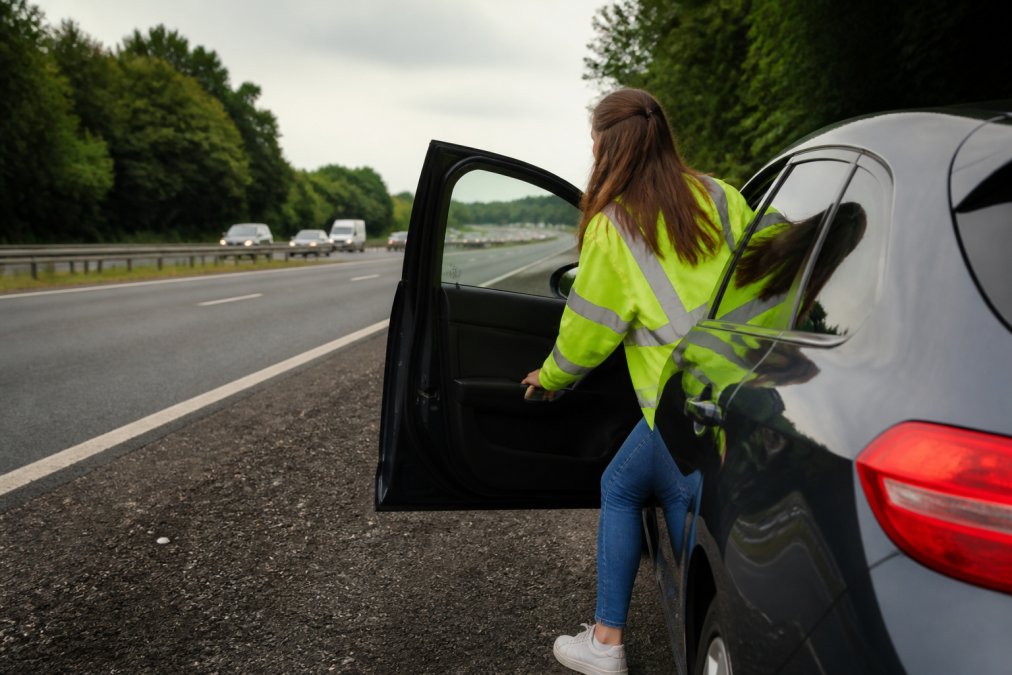
The safest way to exit is through the nearside doors, on the left, away from passing traffic, and only once you have checked for approaching vehicles. This single habit prevents most of the serious injuries that happen on the hard shoulder.
Work through it in this order:
- Switch on hazard lights and leave them running
- Ask passengers to stay seated until you give the word
- Check your mirrors and glance over your shoulder for traffic
- Open the nearside door a fraction, listen, then open fully
- Exit one at a time, keeping low and close to the car
- Move straight to the safety barrier or verge, never the central reservation
Which Side to Exit From: Nearside vs. Offside Doors
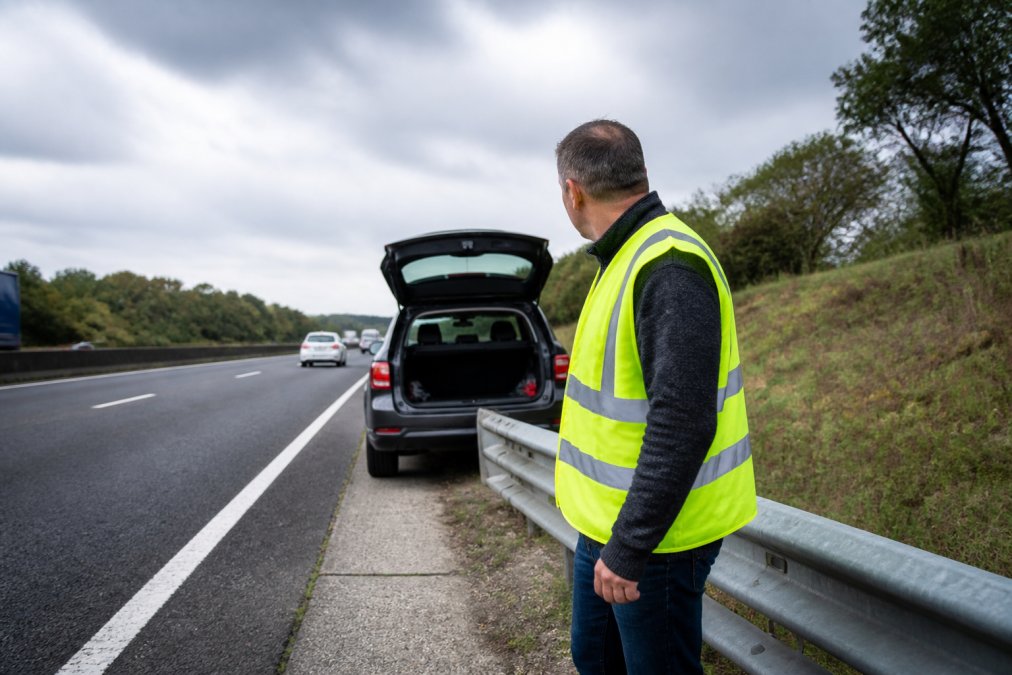
Always use the nearside doors. The offside doors open into the path of fast-moving traffic, and the blind spot from a passing lorry can hide an adult, let alone a child.
The only exception is when the nearside is genuinely blocked by a barrier or obstruction and there is no safe alternative. Even then, wait for a clear gap and move deliberately. The Highway Code on motorway breakdowns is blunt on this: exit on the left and wait behind the barrier.
What to Do If You Break Down on a Smart Motorway
Smart motorways change the calculation because the hard shoulder may be a live running lane, and the rules that apply on a conventional motorway do not map cleanly onto them. What to do if you break down on a smart motorway depends on which type of stretch you are on and whether you can reach an emergency refuge area.
There are three configurations you need to recognise:
- All-lane running. The hard shoulder has been permanently converted into a live lane. There is no hard shoulder at all, only emergency refuge areas at intervals.
- Dynamic hard shoulder. The hard shoulder operates as a live lane only at busy times, indicated by overhead signs. When the signs show a red X over it, it is closed; when they show a speed limit, it is a running lane.
- Controlled motorway. The hard shoulder remains a hard shoulder, but variable speed limits are enforced by camera.
On an all-lane running stretch, emergency refuge areas are spaced at intervals along the carriageway. They are marked by blue signs with an orange SOS symbol, and they are the only genuinely safe place to stop. If you can coast, roll or limp to one, do it, even if it means travelling further than feels comfortable. Once inside, park as far forward as you can, put on your hazard lights, and use the emergency roadside telephone rather than your mobile.
- Move as far left as you can and stop.
- Put on your hazard lights.
- If you can safely get out on the nearside and stand behind the barrier, do so.
- If you cannot, because traffic is still moving around you, or there is no barrier, stay in the vehicle with your seatbelt on and call 999.
If you are in a live lane and cannot move, stay in the car with your seatbelt on and call 999. Leaving the vehicle in a running lane is more dangerous than staying put, and control rooms can close the lane once they know where you are. Give the operator the carriageway, direction and the nearest marker post number if you can see one.
One detail that catches drivers out: on a dynamic hard shoulder stretch, the hard shoulder may be a live lane when you break down. Do not assume the left-hand strip is safe just because it looks like a hard shoulder. Check the overhead signs before you commit to stopping there.
Highway Code Breakdown Rules Every Driver Should Know
Highway Code breakdown rules exist to keep stationary vehicles from becoming the cause of a second, worse crash. The rules are not optional, and they apply whether you are on a quiet stretch or a busy commuter route.
The core requirements are straightforward:
- Put on hazard lights the moment you slow down
- Move to the left and stop as far from traffic as possible
- Leave the vehicle by the nearside door and wait behind the barrier
- Wear high-visibility clothing if you have it
- Do not place a warning triangle on a motorway
High Visibility Roadside Safety Equipment for Breakdowns
High visibility roadside safety equipment is what turns a driver into a person other road users can actually see, and it is the cheapest insurance you will ever buy for a motorway breakdown. At 70mph, a driver has roughly the length of a football pitch to react, and a dark figure on a hard shoulder is invisible until it is too late.
The essentials worth keeping in the boot:
- A high-visibility vest or jacket, ideally one per occupant
- A powerful warning beacon or hazard light visible from a distance
- A torch with fresh batteries
- A fully charged mobile phone and a power bank
| Equipment | Purpose | When to Use |
|---|---|---|
| High-visibility vest | Makes occupants visible | Any time you leave the vehicle |
| Warning beacon | Alerts traffic early | On the hard shoulder or verge |
| Torch | Visibility and signalling | Night-time breakdowns |
| Mobile and power bank | Call for help | Every breakdown |
How to Move Passengers and Vulnerable Occupants to Safety
Getting passengers to safety is the part most guides skip, and it is where panic does the most damage. Children, older passengers, anyone with limited mobility, and pets all need a plan before the doors open, and the plan changes depending on whether it is daylight or dark.
The safest position after any motorway breakdown is behind the barrier, on the far side from traffic, with everyone accounted for, including pets. Everything else can wait. If a passenger cannot reach that position safely, staying belted in and calling 999 is the better call.
Common Mistakes to Avoid When Exiting on the Motorway
Most motorway breakdown injuries come down to a handful of predictable errors, and every one of them is avoidable. Knowing them in advance is what separates a scary story from a tragedy.
The mistakes I see most often:
- Exiting through the offside door. This puts you directly into the path of traffic and into a lorry driver’s blind spot.
- Standing between the car and the barrier. If a vehicle hits your car, it will crush that gap first.
- Setting up a warning triangle. The Highway Code advises against this on motorways for good reason.
- Leaving passengers in the car on a live lane. On a smart motorway with no hard shoulder, staying belted in is safer, but on a hard shoulder, get everyone behind the barrier.
- Trying to fix the car yourself. A roadside repair is not worth your life.
Conclusion
A motorway breakdown is frightening, but the steps that keep you alive are simple and learnable. The difference between a close call and a catastrophe usually comes down to visibility: whether other drivers saw your vehicle in time.
Frequently Asked Questions
Can you get out of your car on the motorway if you break down?
Yes, you can and should exit your vehicle after a breakdown on the motorway, but only if it is safe to do so. The Highway Code advises moving to a place of safety, such as behind the safety barrier, if you cannot reach an emergency refuge area. Never exit from the offside doors into live traffic. If you feel unsafe or are injured, stay inside with your seatbelt on and call 999.
Which side of the car should you exit from on a motorway?
Always exit from the nearside doors, which are the doors closest to the hard shoulder or verge. Exiting from the offside doors puts you directly into the path of fast-moving traffic. Before opening any door, check for passing vehicles and signal your intention by turning on your hazard lights. Once out, move immediately behind the safety barrier and away from the carriageway.
What should you do if your car breaks down on a smart motorway?
On a smart motorway, try to reach an emergency refuge area (ERA) if one is within safe distance. If you cannot, pull onto the hard shoulder if present, or stop in the left lane if the hard shoulder is being used as a live lane. Turn on hazard lights, exit from the nearside doors if safe, and wait behind the barrier. Use the ERA’s emergency phone to contact the control centre, providing your location and vehicle details.
How do you safely move passengers to a place of safety?
Move passengers to the safest available location, ideally behind the safety barrier and away from the carriageway. Lead children and vulnerable adults by the hand, keeping them close. If a passenger is injured or immobile, do not attempt to move them unless there is an immediate danger. Call 999 and follow operator instructions. For nighttime breakdowns, ensure everyone wears high-visibility clothing to remain visible to passing traffic.