
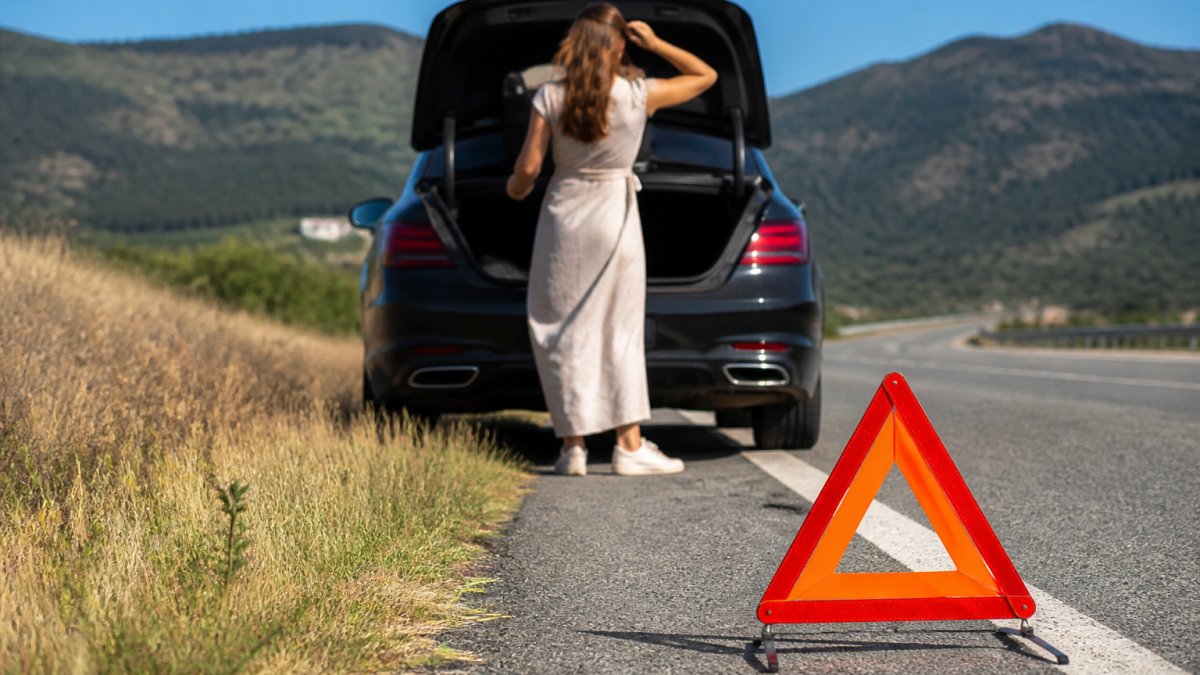
Car Breaks Down in Spain: Step-by-Step Safety Guide
Last Updated: October 23, 2026
Quick Summary
When your car breaks down in Spain, turn on hazard lights immediately, steer safely to the side of the road or hard shoulder, turn off the engine, and move yourself and passengers at least 10 metres away from traffic. Call 112 if anyone is injured or you are in immediate danger, or contact your breakdown provider for routine assistance.
- Place a warning triangle at least 50 metres behind your vehicle on regular roads, but never on motorways where walking the carriageway is more dangerous than the breakdown itself.
- Wear a high-visibility vest before exiting your vehicle and keep it in the cabin, not the boot, so you can put it on before opening the door into traffic.
- Check your UK breakdown cover before travelling to confirm Spain is included and whether you need a DGT 3.0 compliant V-16 emergency beacon, as requirements differ from UK equipment.
- On motorways and in tunnels, never attempt repairs yourself; stay out of traffic lanes entirely and call for assistance immediately to alert emergency services and prevent pile-ups.
Table of Contents
- What to Do Immediately When Your Car Breaks Down
- Make Your Vehicle Visible and Warn Other Road Users
- Getting Yourself and Passengers to a Safe Place
- Calling for Roadside Assistance in Spain
- Spanish Breakdown Cover for UK Drivers
- Car Recovery and Towing in Spain
- After Recovery: Repair, Onward Travel, and Next Steps
- Frequently Asked Questions
What to Do Immediately When Your Car Breaks Down
When your car breaks down in Spain, safety comes first, yours, your passengers’ and other road users’.
Here’s what to do first:
- Turn on your hazard lights immediately. This alerts drivers behind you.
- Steer to the side of the road. Get as far from traffic as safely possible; on motorways, aim for the hard shoulder.
- Turn off the engine. This prevents further damage and reduces fire risk.
- Stay calm and check for injuries. Make sure you and your passengers are okay.
On a motorway or busy highway, do not attempt roadside repairs yourself, the risk of being struck by passing traffic is real and serious.
Keep a breakdown kit in your car: a torch, basic tools, jump leads, and a first aid kit. These items can help you manage minor issues while you wait for assistance.
Make Your Vehicle Visible and Warn Other Road Users
Using warning triangles and hazard lights
Making your vehicle visible is critical: most collisions involving stationary vehicles happen because drivers did not notice them in time.
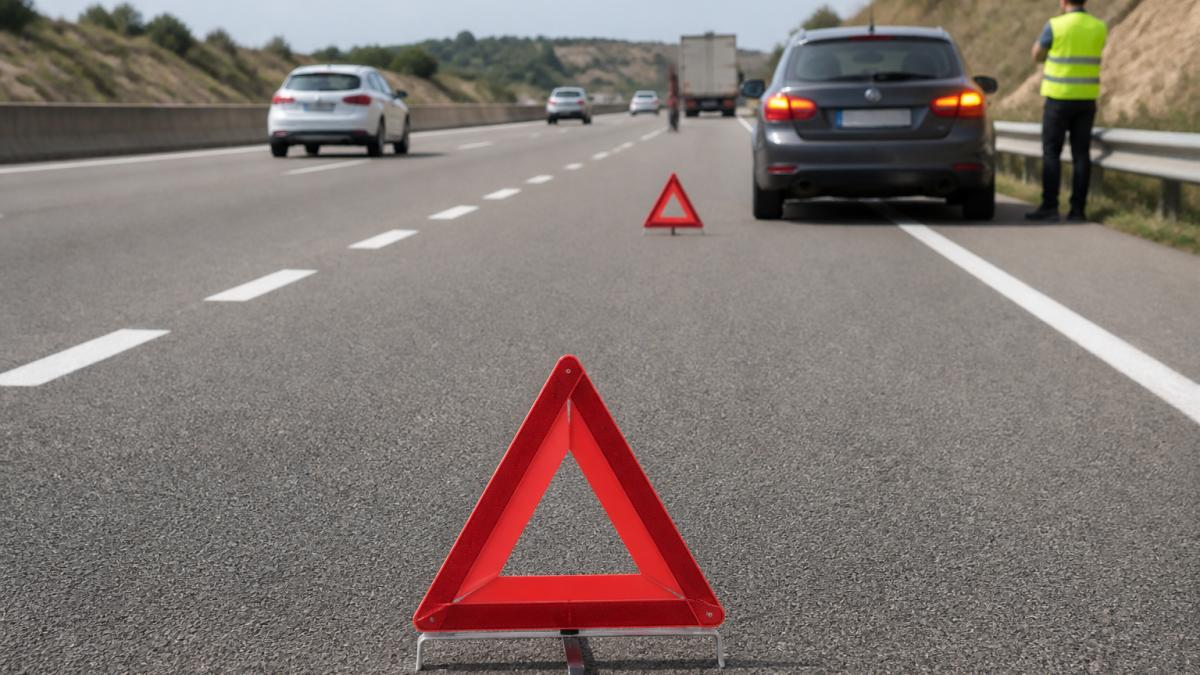
Switch on your hazard lights the moment you realise you have a problem, they are your first and fastest signal.
Place the triangle at least 50 metres behind your vehicle, and further back on fast roads if it is safe to walk that far.
V-16 emergency beacons: what the rules require
The V-16 is a yellow flashing emergency light used to signal a stationary vehicle. Spain has been phasing it in as an alternative to warning triangles, and the rules have changed more than once, so check the current position before you travel.
A standard V-16 is a battery-powered amber flashing beacon with a magnetic or suction base that you place on the roof.
A newer specification, the V-16 with connectivity (DGT 3.0), adds mobile connectivity so the beacon registers your position with the traffic authority’s platform. Whether you need a connected rather than a basic V-16 depends on the vehicle and the date, and the transition has been subject to delays, so confirm the current requirement with the Dirección General de Tráfico (DGT) or your ferry operator before departure. Roadside Safety Devices in Spain: Legal Requirements explains Spain’s legal requirements for roadside safety equipment.
How to use a V-16 in practice:
- Stop as far from the traffic stream as you safely can.
- Put on your high-visibility vest before exiting.
- Take the beacon from the cabin, switch it on and place it on the highest practical point of the vehicle, normally the roof.
- Return to a safe position behind the barrier or well away from the carriageway.
- Do not walk back to retrieve the beacon until assistance has arrived and it is safe to do so.
Do not assume your UK breakdown cover or your vehicle’s UK equipment satisfies Spanish requirements. A warning triangle that is acceptable at home may not meet the Spanish requirement, and a basic V-16 may not meet a connected-beacon requirement if one applies to your vehicle. Check your policy and the current DGT position before you travel.
If you drive a foreign-registered car: carry a high-visibility vest for every occupant, carry a warning triangle for use where it is safe and lawful, and check whether a V-16 (and, if required, a connected V-16) is expected on your routes. The law sets the minimum equipment, but your safety judgement comes first, if deploying any device would put you in the path of traffic, do not do it.
Keep the beacon and vests within reach of the driver’s seat. In a breakdown you may have seconds to act, and you do not want to be standing at the boot with traffic passing inches away.
Getting Yourself and Passengers to a Safe Place
Once your hazard lights are on and warning devices are in place, move yourself and your passengers away from the roadside. Do not stay inside the vehicle.
Exit on the side away from traffic. How to Safely Exit a Vehicle on the Motorway provides step-by-step instructions for exiting safely during a breakdown. On a motorway, walk at least 10 metres behind your vehicle and stand behind the safety barrier if one exists, this protects you if another vehicle hits yours (The Highway Code – Breakdowns and incidents (275 to 287) – Guidance).
Keep children and elderly passengers close and away from the road edge; on a motorway, even a glancing blow can cause serious injury.
Keep pets contained and calm, and never let them wander onto the road.
Motorway and tunnel breakdowns: special considerations
Motorways and tunnels are high-risk breakdown environments: traffic moves fast, visibility can be poor, and there’s nowhere to hide. Car Broke Down on a Smart Motorway: What to Do covers the specific steps to follow in these high-risk situations.
On a motorway:
- Never attempt repairs yourself
- Stay out of the traffic lanes entirely
- Use the emergency refuge areas if available
In a tunnel:
- Turn on your hazard lights
- Exit the vehicle only if it’s safe to do so
- Move to the nearest emergency exit or refuge area
Tunnel breakdowns are especially dangerous because traffic cannot see far ahead and speeds remain high. Alert operators immediately so they can manage traffic flow and prevent pile-ups.
On motorways and in tunnels, your goal is to get yourself out of the traffic stream and alert emergency services as quickly as possible. Do not worry about your vehicle, focus on personal safety.
Calling for Roadside Assistance in Spain
Emergency numbers and when to use them
Spain’s emergency number is 112, free, and covering police, fire, medical and traffic emergencies (Single emergency number – missing children helpline). For a routine breakdown where everyone is safe and off the carriageway, call your breakdown provider or a recovery service instead. Safety Tips for Stranded Motorists: A How-To Guide covers what to do while waiting for assistance to arrive.
For non-emergency assistance, call your breakdown cover provider or a local recovery service, with your policy number, location and vehicle details ready before you dial.
What to have ready before you call
A short, ordered checklist gets the right equipment sent first time:
- Location. GPS coordinates if you have them, plus the road number, direction of travel, nearest kilometre marker or exit, and any landmark. On a motorway, name the carriageway and the nearest junction.
- Vehicle. Make, model, colour, registration, and whether it is a car, van, motorhome or towing a trailer, recovery vehicles have weight and length limits.
- Problem. What happened, what you can see or hear, and whether the vehicle will start or move at all.
A short Spanish call script
If you do not speak Spanish, these phrases cover the essentials. Read them slowly, or show them on your phone.
- “Mi coche se ha averiado.”, My car has broken down.
- “Estoy en la autovía / autopista, dirección…”, I am on the dual carriageway / motorway, heading towards…
- “Kilómetro…”, Kilometre…
Useful words to recognise: avería (breakdown), grúa (recovery truck), taller (garage), remolque (tow), arcén (hard shoulder), salida (exit), peaje (toll).
Save your breakdown provider’s emergency number and your travel insurer’s number in your phone before you leave, and store the Spanish phrases above as a note or screenshot so they work without a data connection.
If you have no breakdown cover
If your UK policy does not extend to Spain, or you chose not to buy cover, you can still arrange recovery locally by calling a nearby garage or recovery operator, or asking at the next service area. Before authorising a tow, confirm the total price (fixed call-out plus per-kilometre charge?), where the vehicle will be taken, and whether storage charges apply.
Whether you call 112, your insurer or a local recovery firm, the same rule applies: give your location first, then your vehicle, then the problem. Clear information gets you help faster.
Have this information ready before you call for help.
| Information | Details | Why it matters |
|---|---|---|
| Location | GPS coordinates, road number, kilometre marker, nearest junction | Ensures help reaches you quickly |
| Vehicle details | Make, model, colour, registration, type | Recovery vehicles have weight and length limits |
| Problem description | What happened, what you hear or see, whether it starts | Determines what equipment is needed |
| Occupants | Number of people, injuries, children or pets present | Affects response priority and resources |
| Drivability | Whether vehicle can move or is completely immobilised | Determines recovery method required |
| Hazards | Fuel leak, smoking, blocking a lane, in a tunnel | Affects safety response and urgency |
| Cover details | Policy number and provider’s emergency line | Speeds up authorisation and billing |
Spanish Breakdown Cover for UK Drivers
UK breakdown cover often includes European coverage, but terms vary widely: some policies cover Spain automatically, others require additional cover, and some cover only breakdown assistance, not vehicle recovery or onward travel costs.
Before you travel, check your policy documents carefully. Look for:
- Whether Spain is included
- What the cover includes (breakdown assistance, recovery, accommodation, onward travel)
- What equipment you’re required to carry
If your UK cover doesn’t extend to Spain or doesn’t cover what you need, buy Spanish breakdown cover before you travel. It’s cheaper than paying for emergency recovery out of pocket.
Spanish breakdown cover typically includes recovery to a nominated garage, emergency accommodation if you’re stranded overnight, and onward travel arrangements; costs depend on vehicle type and cover level.
Car Recovery and Towing in Spain
What information to collect before calling recovery
Before you call a recovery service, gather these details so the operator knows what equipment they need and how long recovery might take:
- Vehicle type and size. Is it a small car, SUV, van, or motorhome? Recovery vehicles have weight limits.
- The exact problem. Engine won’t start? Flat tyre? Collision damage? Mechanical failure?
- Your exact location. Use GPS coordinates, road number, kilometre marker, or nearby landmarks.
Having this ready means the recovery team arrives with the right equipment and can give you a realistic timeframe.
Recovery costs in Spain vary. With breakdown insurance, your provider arranges and covers recovery; without it, you pay the service directly. Costs depend on distance, vehicle type and time of day, with night and weekend recovery more expensive.
After Recovery: Repair, Onward Travel, and Next Steps
Once your vehicle is recovered, decide whether it can be repaired locally or you need alternative transport.
If your vehicle cannot be repaired in Spain:
- Contact your travel insurance provider
- Arrange a hire car if you need to continue your journey
- Consider flying home and arranging vehicle recovery later
Keep all receipts and documentation. You’ll need these for insurance claims or to claim back expenses under your breakdown cover.
Breakdowns in Spain don’t have to derail your trip. Preparation is your best defence.
Roadflash’s multi-award-winning emergency beacons with GPS geolocation are designed to increase hazard awareness and improve vehicle visibility at the roadside, protecting you and your passengers during breakdowns.
Frequently Asked Questions
What should you do first if your car breaks down in Spain?
First, switch on your hazard lights immediately to alert other road users. If safe to do so, move your vehicle away from traffic. Put on a high-visibility vest, which is a legal requirement. Set up warning triangles at least 50 metres behind your vehicle on motorways. If you have a DGT 3.0 emergency beacon, activate it now, this device provides GPS location data to emergency services and increases your vehicle’s visibility significantly. Then assess whether you need to call roadside assistance or emergency services.
Is a DGT 3.0 emergency beacon mandatory in Spain?
DGT 3.0 emergency beacon requirements vary depending on your vehicle type and how long you plan to stay in Spain. While not universally mandatory for all vehicles, these beacons are highly recommended for enhanced safety during breakdowns, particularly on motorways and high-speed roads. They provide GPS/geolocation data and improve visibility. Check your vehicle’s documentation and travel insurance to understand whether your specific situation requires compliance with DGT 3.0 standards.
What number do you call for roadside assistance in Spain?
Call 112 for emergencies. If you have breakdown cover through a UK insurer or roadside assistance provider, contact their emergency line, they can dispatch help or arrange translation services. Have your vehicle registration, location details, and policy number ready. If you’re on a motorway, use the emergency telephone posts which connect directly to local authorities. Language barriers are common; many assistance providers offer multilingual support or can connect you with an English-speaking operator.
Can UK breakdown cover help if your car breaks down in Spain?
Many UK breakdown cover policies include European coverage, but benefits and limits vary widely. Check your policy documents before travelling to confirm Spanish breakdown cover is included, what the geographical limits are, and whether recovery is included or subject to a charge. Some policies cover only roadside repair, whilst others include vehicle recovery and accommodation. If your policy doesn’t cover Spain, you’ll need to arrange assistance independently or purchase additional European cover. Always verify coverage details with your provider before departure.
