
Safety Tips for Stranded Motorists: A How-To Guide
Table of Contents
- Stay Calm and Assess the Situation
- Activate Hazard Lights and Deploy Warning Equipment
- What to Do If Your Car Breaks Down on the Motorway
- Roadside Emergency Kit Essentials
- How to Stay Safe While Waiting for Breakdown Assistance
- Car Breakdown in Bad Weather: Safety Priorities
- Special Considerations: Passengers, Children, Pets, and Mobility
- What to Tell Dispatch and How to Identify Your Location
- Frequently Asked Questions
Last Updated: October 15, 2026
Stay Calm and Assess the Situation
The first moments after a motorway breakdown are critical to stranded motorists safety. Stay calm, check for injuries, and note any unusual noises or smells of smoke or fuel.
Then assess your location: is traffic moving fast, and can you reach the hard shoulder safely? These details determine your next steps.
Activate Hazard Lights and Deploy Warning Equipment
Switch on your hazard lights immediately, the single most important action you can take. They tell other drivers your vehicle is stationary and to pass safely.
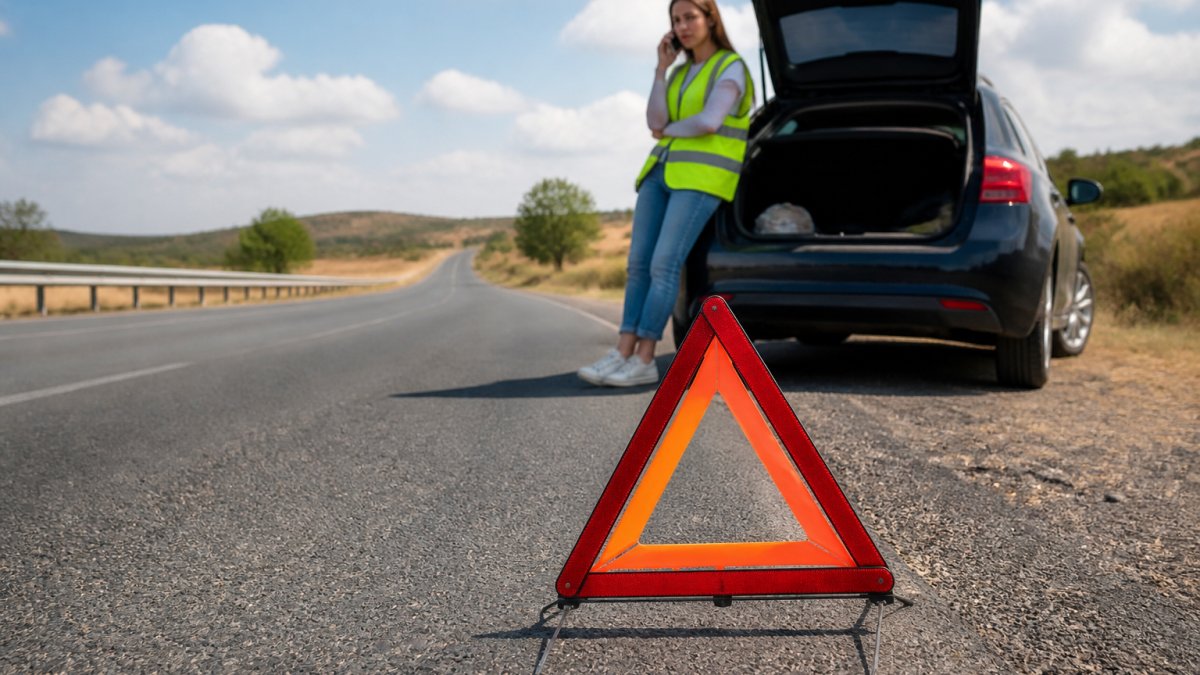
Next, deploy warning equipment if you have it. A warning triangle goes at least 45 metres behind your vehicle, further back in fog, rain or darkness if it is safe to do so.
If you have high-visibility equipment like an emergency beacon or LED warning light, deploy it now. Products like those from Roadflash, including GPS-enabled beacons and high-visibility lighting, significantly increase your vehicle’s visibility to oncoming traffic and are designed to prevent collisions with stationary vehicles on busy roads.
Wear a reflective vest if you have one, it makes you visible in low light and could save your life if you must exit.
What to Do If Your Car Breaks Down on the Motorway
Motorway breakdowns follow a different set of rules from ordinary roads, and the Highway Code is explicit about what you should and should not do.
1. Keep the vehicle moving if it is safe. If you lose power but still have steering and brakes, use your momentum to reach the hard shoulder or an emergency area. Do not coast in a live lane.
**2. On a smart motorway, do not stop on the hard shoulder, look for an emergency area (ERA), marked with blue signs and typically no more than about 800 metres apart.
3. Decide whether to stay in or get out. The Highway Code says leave by the left-hand door if it is safe and wait behind the barrier, away from the carriageway.
4. Use the emergency telephone if you can reach one. Orange SOS telephones sit along the hard shoulder, generally around one mile apart, and connect directly to the regional control centre.
5. Do not attempt repairs on the hard shoulder. Changing a wheel, topping up coolant or checking a fuse there or in a live lane is extremely dangerous. Let a recovery operator move the vehicle to a safe place.
6. Do not place a warning triangle on a motorway. The Highway Code advises against it because walking along a live carriageway puts you at greater risk than the triangle reduces; triangles are for ordinary roads where traffic is slower.
Never stand between your vehicle and oncoming traffic, and never walk along a live lane to retrieve equipment. If you have already placed a triangle on a motorway, leave it and stay behind the barrier.
7. If you cannot reach the hard shoulder. If your vehicle stops in a live lane, keep your seatbelt on, switch on your hazard lights, and call 999 immediately. Do not get out unless the vehicle is on fire or you are in immediate danger. Control room operators can set signals to protect you and dispatch traffic officers.
8. What happens next. National Highways traffic officers patrol the strategic road network and can close lanes, set warning signs and arrange recovery.
Roadside Emergency Kit Essentials
A well-stocked roadside emergency kit can be the difference between a minor inconvenience and a dangerous situation. Keep these in your vehicle:
- Warning triangle, Place it 45 metres behind your vehicle
- Reflective vest, Wear it if you exit your vehicle
- Torch with spare batteries, Essential for nighttime breakdowns
- Mobile phone charger, Ensures you can call for help
- First aid kit, Treats minor injuries while waiting for assistance
- Jumper cables or jump starter, Helps with battery-related breakdowns
- Spare fuses and bulbs, Quick fixes for electrical issues
- High-visibility emergency beacon or LED warning light, Modern alternative to traditional triangles that increases visibility significantly
Roadflash’s multi-award-winning emergency beacons combine high visibility with GPS geolocation, transmitting your exact location to emergency services to reduce response time.
Store your kit accessibly, the boot or under a seat, and check it twice a year for working batteries and expiry dates.
How to Stay Safe While Waiting for Breakdown Assistance
Once your hazard lights are on, warning equipment is deployed and help is called, prioritize stranded motorists safety by staying safe and visible while you wait.
Stay inside with your seatbelt fastened, this protects you from passing traffic and the weather. Only exit if there is immediate danger, such as fire or smoke.
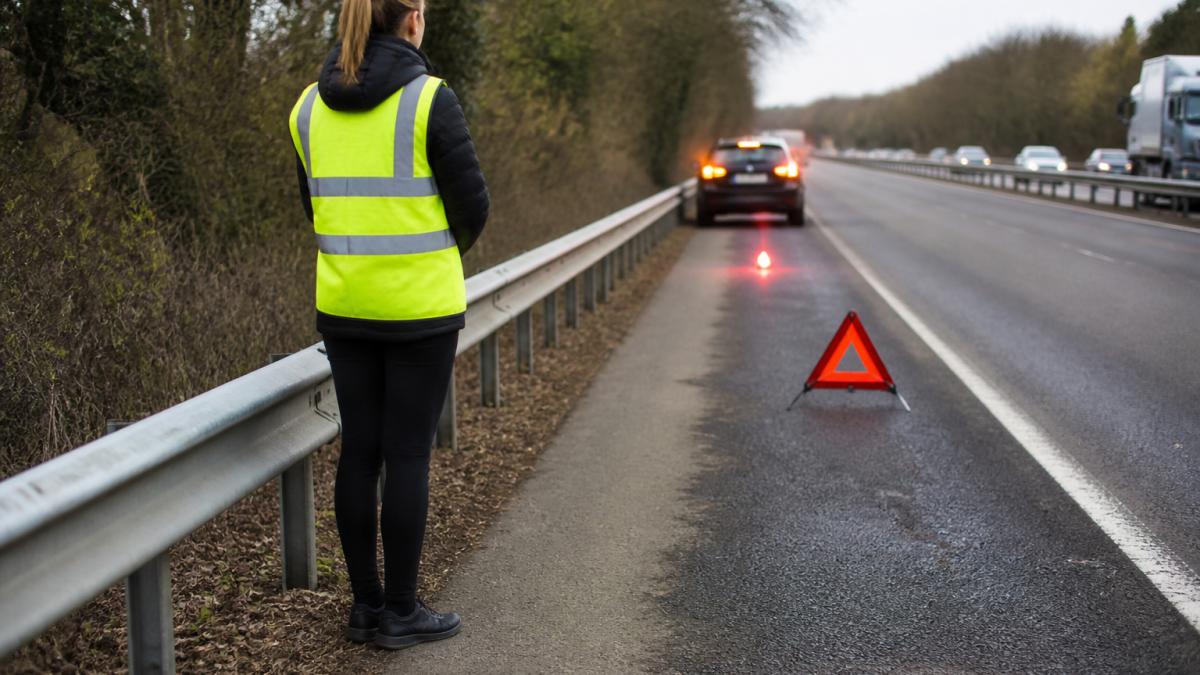
If you must exit, wear your reflective vest, stand well behind the crash barrier, and never stand between your vehicle and oncoming traffic. Keep children and pets inside unless there is immediate danger.
Stay alert and watch approaching traffic. If a vehicle comes too quickly or seems out of control, move further from the road.
Keep your phone charged with your provider’s number saved, and be ready to describe your location, including the nearest junction or landmark.
Car Breakdown in Bad Weather: Safety Priorities
Bad weather changes the risk profile of a breakdown, advice that works on a dry summer afternoon can be actively dangerous in fog, snow or standing water. These priorities cover conditions on the strategic road network.
Fog and heavy rain. Visibility is the limiting factor. Put your hazard lights on before you stop, not after, so drivers behind have maximum warning, and activate an electronic beacon from inside the cabin rather than stepping out.
Snow and ice. Do not walk along the carriageway to place or retrieve a warning triangle, the risk of slipping into a live lane is far higher than in dry conditions.
Flooding and standing water. Do not drive through floodwater. If your vehicle has stalled in water, do not restart it, that can draw water into the engine and strand you in a rising situation.
High winds and storms. Avoid standing near trees, overhead signs or gantries, stay behind the barrier, and keep clear of loose debris. In an emergency area, remain inside with your seatbelt on until recovery arrives.
Winter equipment and legal points. In the UK, winter tyres are not legally required, but if fitted they must meet the same construction and use requirements as any other tyre, and your insurer should be informed. Snow chains are permitted but must not damage the road surface and are unsuitable for sustained high-speed use.
Warning systems to check before you travel. National Highways publishes live information on its website and social media, and variable message signs give short-notice warnings of incidents, closures and weather. The Met Office issues yellow, amber and red warnings; amber or red is a strong signal to delay your journey if you can.
Before any winter journey, check the Met Office forecast, the National Highways traffic feed and your breakdown provider’s app. A five-minute check can prevent a breakdown in the worst possible conditions.
If you are stranded overnight. Cold, darkness and fatigue compound each other. Run the engine only as long as you need heat, never in an enclosed space, and keep hazard lights and any electronic beacon on continuously. Put on a reflective vest before opening a door, even if you intend to stay inside. Keep passengers belted and calm, and share your location with your provider so they can prioritise your call.
Special Considerations: Passengers, Children, Pets, and Mobility
Your responsibilities change if you’re not alone. Children, elderly passengers, pets, and people with mobility challenges all need special care during a breakdown.
Children: Keep them inside with seatbelts fastened, explain calmly that help is on the way, and distract them with activities, books, games or conversation. Never let children exit onto the hard shoulder.
Elderly or mobility-impaired passengers: They may struggle to remain in the vehicle for long periods, so ensure they are comfortable and consider their medication needs. If they need to stretch, do so only in a safe location.
Pets: Keep pets inside and never unattended, provide water if you have it, and ensure adequate ventilation in hot weather. If your pet needs medication or special care, mention it when you call.
Pregnant women: If a passenger is heavily pregnant and assistance is delayed, call emergency services rather than a standard breakdown provider, complications can develop quickly.
What to Tell Dispatch and How to Identify Your Location
When you call for help, the information you provide affects how quickly assistance reaches you. Be clear and specific.
Tell dispatch:
- Your exact location, the motorway number and nearest junction
- The direction you’re heading (north, south, east, west)
- A description of your vehicle, colour, make, model, registration plate
- The nature of the problem, engine failure, puncture, overheating, electrical issue
- Number of occupants and any special needs, injuries, children, elderly passengers, pets
- Whether you’ve deployed warning equipment
- Current weather or visibility conditions
How to identify your location accurately:
Most modern motorways have numbered distance markers along the hard shoulder, read the number to dispatch. If you see none, describe nearby landmarks such as a service station, bridge or sign.
If your vehicle has a built-in emergency call system (eCall), use it, it transmits your location automatically. Many breakdown providers also offer apps that show your location to their control centre.
GPS-enabled emergency beacons like those from Roadflash transmit your exact coordinates automatically, removing guesswork and ensuring emergency services know precisely where to find you, especially valuable if you are injured or disoriented and cannot communicate your location clearly.
Stay on the line if dispatch asks, they may have safety instructions based on hazards you cannot see.
Breaking down on a motorway is stressful, but staying calm and following these steps keeps you and your passengers safe. Activate your hazard lights, deploy warning equipment, call for help, and stay inside your vehicle. Equip yourself with essential safety gear, a warning triangle, reflective vest, torch, and ideally a modern emergency beacon with GPS capability. At Roadflash, we’ve designed our multi-award-winning emergency beacons specifically for situations like this. They increase visibility dramatically and transmit your location to emergency services automatically, ensuring help reaches you faster. Get started with Roadflash and give yourself greater peace of mind on every journey.
Frequently Asked Questions
What should you do if you’re stranded on the motorway?
First, stay calm and assess your situation. Switch on your hazard lights immediately to alert other traffic. If safe, move your vehicle off the carriageway onto the hard shoulder. Exit the vehicle only when it is safe to do so, wearing a reflective vest. Deploy warning equipment such as hazard beacons or triangles behind your vehicle. Stand well clear of traffic, preferably behind a crash barrier. Call roadside assistance or emergency services with your location details. Never stand between your vehicle and oncoming traffic.
Should you stay in your car during a motorway breakdown?
This depends on your circumstances. If you are on a busy motorway with fast-moving traffic and cannot safely exit, remain inside your vehicle with seatbelts fastened and doors locked until help arrives. However, if you can safely move your vehicle off the hard shoulder and exit away from traffic, do so and stand clear behind a barrier. Never remain in the vehicle on the carriageway itself. If you have passengers, children, or pets, assess whether exiting is safer than staying put based on traffic speed and visibility.
What emergency equipment should you keep in your car?
A roadside emergency kit should include a reflective vest, warning triangles or hazard beacons, a torch with spare batteries, a first aid kit, jumper cables, a spare tyre and jack, a fire extinguisher, and a phone charger. High-visibility hazard beacons with GPS/Geolocation features provide enhanced visibility to oncoming traffic and help emergency services locate you quickly. Keep these items easily accessible in your vehicle boot. In severe weather, add extra blankets, water, and non-perishable snacks.
How can you make a broken-down vehicle more visible to other drivers?
Switch on your hazard lights immediately. Deploy warning equipment at least 45 metres behind your vehicle to give drivers time to react. Use reflective triangles or modern hazard beacons that flash or emit bright light. Wear a reflective vest so you are visible to approaching traffic. In low visibility conditions such as fog, rain, or darkness, position additional warning devices further back. High-visibility early warning systems increase hazard awareness significantly more effectively than triangles alone, especially at night or during poor weather.