
Smart Motorway vs Traditional Motorway Safety
Table of Contents
- How Smart Motorways Compare to Traditional Motorways
- Safety Statistics and Casualty Rates Compared
- What to Do If You Break Down on a Smart Motorway
- High Visibility Roadside Safety Equipment That Makes a Difference
- Variable Speed Limits, Red X Signals, and Driver Compliance
- The Psychological Impact of Driving on Smart Motorways
- Conclusion
- Frequently Asked Questions
Last Updated: September 22, 2026
How Smart Motorways Compare to Traditional Motorways
Smart motorway vs traditional motorway safety is a debate that has reshaped how millions of drivers think about breakdowns. A smart motorway is a section of motorway that uses traffic management technology, including variable speed limits and lane control signals, to manage congestion and improve traffic flow. At Roadflash, we build early warning systems for exactly the scenario these roads create: a stationary vehicle sitting in a live lane with traffic approaching at speed. This guide compares the two designs, examines casualty rates, and gives you a clear emergency protocol for when things go wrong.
The core difference comes down to what happens to the hard shoulder. On a conventional motorway, that strip of tarmac exists purely as a refuge. On a smart motorway, it is often repurposed as a running lane or opened to traffic at peak times.
The safety of any motorway depends less on its design and more on what you do in the first 60 seconds after a breakdown. Lane discipline and early warning matter more than the road type.
All-Lane Running, Dynamic Hard Shoulder, and Controlled Motorways
There are three distinct smart motorway types, and they carry very different risk profiles. All-lane running removes the hard shoulder permanently and converts it into a live lane. Dynamic hard shoulder schemes open the hard shoulder as a lane only at busy periods, using gantry signage to signal when it is available. Controlled motorways keep a permanent hard shoulder but add variable speed limits and lane management technology above it.
- All-lane running: no permanent refuge, so emergency refuge areas (ERAs) are spaced along the route
- Dynamic hard shoulder: the shoulder switches between refuge and live lane, which can confuse drivers unfamiliar with the section
- Controlled motorway: retains the hard shoulder, making it the closest to a conventional motorway
Safety Statistics and Casualty Rates Compared
Collision and casualty data on smart motorways has been the subject of intense scrutiny. National Highways publishes stopped vehicle detection (SVD) performance data and collision statistics for the motorway network, and independent reviews have repeatedly examined whether removing the hard shoulder increases collision risk. Rather than quote figures that shift with each reporting period, check the National Highways smart motorway safety data for the current position.
| Factor | Traditional Motorway | Smart Motorway (All-Lane Running) |
|---|---|---|
| Hard shoulder | Permanent refuge | Removed, ERA spacing |
| Speed control | Fixed limits | Variable speed limits |
| Incident detection | Mostly manual | Radar-based SVD |
| Breakdown risk | Lower exposure | Higher live-lane exposure |
| Key mitigation | Driver discipline | Early warning and lane closure |
What to Do If You Break Down on a Smart Motorway
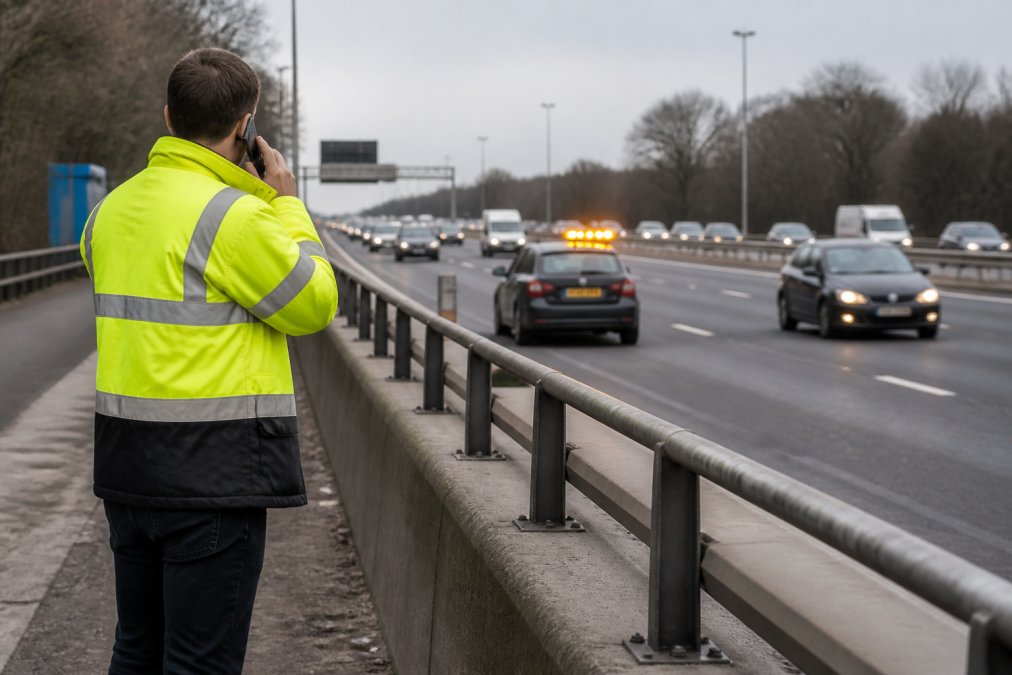
If your vehicle loses power or suffers a fault, the priority is to reach an emergency refuge area or the left lane, then get yourself and passengers behind the barrier. Do not stay in the vehicle. Do not attempt repairs on a live lane. Move to the safest available place, exit on the side away from traffic, and call for help.
Step-by-Step Emergency Protocol for Modern Vehicles
- Hazard lights on immediately. Signal your intention before you slow, and keep them on for the entire incident.
- Assess whether you still have drive. If the vehicle is in limp mode, you usually have reduced power and a short window to move. Use it to reach an ERA or the left lane rather than stopping where you are.
- If you have no drive at all, do not fight the vehicle. A car that has shut down may have no power steering and a much longer stopping distance. Steer for the left as momentum allows and accept that you may stop in a live lane.
- Apply the electronic parking brake. On many modern cars this is a switch rather than a lever, and it may need to be held rather than flicked. Know where it is before you need it.
- Exit on the passenger side, away from passing traffic, and only when it is safe to open the door.
- Stand behind the barrier, never in front of or beside the vehicle, and never on the verge between the barrier and the carriageway.
- Call your breakdown provider or 999 and give the gantry location marker. On an all-lane running section, tell the operator explicitly that you are in a live lane.
- Deploy a high-visibility warning beacon if it is safe to place one on the roof before you step away. If it is not safe, leave it.
Electric and hybrid vehicles
An EV that loses power behaves differently from a petrol or diesel car. There is no engine braking to slow you gradually, and the vehicle may enter a reduced-power state before shutting down entirely. If you drive an EV, treat any range or powertrain warning on a smart motorway as a signal to reach an ERA or leave at the next junction, not as something to monitor.
If you cannot reach an ERA
- Keep hazard lights on and, if you have one, activate a warning beacon on the roof immediately.
- Exit the vehicle on the side away from traffic as soon as it is safe, and move behind the barrier.
- Do not stand behind the car or between it and oncoming traffic.
- Call 999 and state clearly that you are stationary in a live lane. Control rooms can set red X signals to close the lane.
- If you cannot exit safely, stay belted in the vehicle and call 999. This is the one situation where remaining in the car may be the lesser risk.
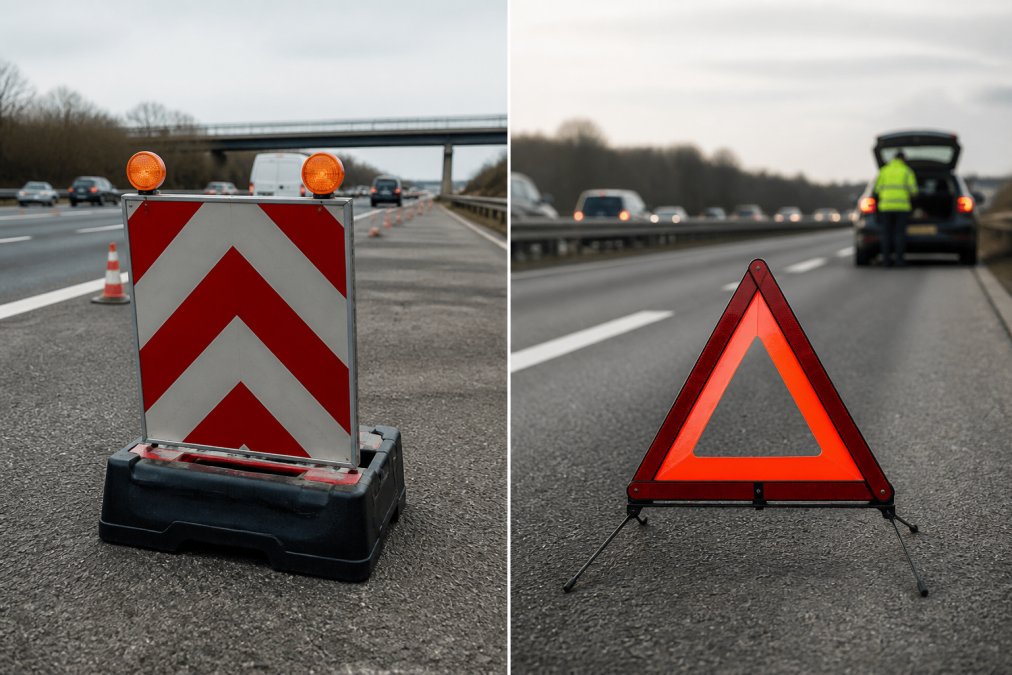
Never attempt to place a warning triangle on a live lane of a smart motorway. Walking into a running lane to set equipment is far more dangerous than leaving the vehicle unmarked while you wait behind the barrier.
The common thread across all of these scenarios is time. The first 60 seconds after a breakdown determine whether the situation stays a breakdown or becomes a collision, and the actions that buy time are the ones taken before you need them.
High Visibility Roadside Safety Equipment That Makes a Difference
The right high visibility roadside safety equipment turns a stationary vehicle from an invisible hazard into something approaching traffic can see from a distance. On a conventional motorway, a stationary car at the side of the road is already exposed. On a smart motorway with no hard shoulder, visibility is the difference between a near miss and a collision.
Variable Speed Limits, Red X Signals, and Driver Compliance
Variable speed limits and red X signals only work if drivers obey them, and compliance is the weakest link in the entire smart motorway system. A red X on a gantry means the lane is closed, usually because of a stopped vehicle, an incident, or debris. Driving under a red X is both dangerous and enforceable, with cameras on gantries capturing offences.
Treat every gantry signal as live information, not background noise. A red X can appear seconds after a vehicle stops ahead, so lift off the accelerator as soon as you see one.
The Psychological Impact of Driving on Smart Motorways
Driver anxiety is the most under-discussed issue in the smart motorway debate. Many motorists describe genuine unease about breaking down in a live lane with no hard shoulder to reach. That anxiety is not irrational; it reflects a real change in the consequences of a breakdown.
Conclusion
Breakdowns happen without warning, and the road type you happen to be on decides how much danger you face. Understanding the difference between smart and traditional motorway safety, and carrying the right warning equipment, is what keeps a bad day from becoming a serious one. Roadflash builds multi-award-winning early warning systems for exactly this moment, including the DGT 3.0 Emergency Beacon with GPS and geolocation, a high-intensity LED strobe, and a magnetic base for rapid deployment.
Frequently Asked Questions
Are smart motorways more dangerous than traditional motorways?
National Highways data shows that overall casualty rates are lower on smart motorways than on conventional motorways. However, the risk profile is different: the removal of a permanent hard shoulder means a breakdown in a live lane carries a higher collision risk. The key factor is how quickly a stranded vehicle is detected and how effectively lanes are closed. Stopped vehicle detection systems and driver compliance with Red X signals directly affect safety outcomes.
What should I do if my car breaks down on a smart motorway?
If you can, move your vehicle into an emergency refuge area or onto the hard shoulder where one exists. If neither is possible, pull as far left as you can, switch on hazard lights, and exit the vehicle from the left side only. Wait behind the barrier, never in the car. Call 999 immediately and give your location using the marker posts or the What3Words app. Do not attempt to place a warning triangle on a live carriageway.
What is an emergency refuge area and how do I use one?
An emergency refuge area is a designated stopping zone on smart motorways, typically spaced up to 2.5 kilometres apart. They are marked with blue signs and a telephone linked directly to National Highways control rooms. Pull in fully, switch on hazard lights, and use the emergency phone to report your situation. You should rejoin the motorway only when instructed or when it is safe to do so, using the acceleration lane provided.
What high visibility roadside safety equipment should I carry?
A high-visibility vest stored inside the cabin, not the boot, is essential. A GPS-enabled emergency beacon that mounts magnetically to your vehicle roof significantly increases visibility to oncoming traffic at speed, especially in low light. Warning triangles are no longer recommended for motorway breakdowns because placing them puts you in a live lane. LED warning lights with strobe functions offer a safer alternative for alerting approaching drivers.
How does National Highways monitor smart motorway safety?
National Highways uses radar-based stopped vehicle detection systems, CCTV cameras, and regional operations centres to monitor smart motorway sections. When a stationary vehicle is detected, operators set Red X signals on gantry signage to close the affected lane and dispatch roadside assistance. Enforcement cameras support compliance by identifying vehicles that ignore Red X signals, which carry a fixed penalty and penalty points.