
9 Things to Do After a Motorway Breakdown to Stay Safe
Last Updated: November 27, 2026
Quick Summary
After a motorway breakdown, stay calm, switch on your hazard lights and get the vehicle to the hard shoulder or nearest refuge area as soon as it is safe. Then call your breakdown provider or 999, giving your exact location from a marker post or junction.
- Keep both hands on the wheel and switch on your hazard warning lights straight away.
- Use your left indicator and move gradually to the hard shoulder or nearest refuge area.
- Leave the vehicle only through the passenger-side door, once a gap in traffic allows it.
- Use the emergency roadside phone if you can reach one, as it automatically identifies your location.
- A red X signal means the lane is closed, so never drive in it.
Table of Contents
- Why the First Minute After a Motorway Breakdown Matters
- Get Off the Live Lanes: What to Do If You Break Down in a Live Lane
- Using the Hard Shoulder and Refuge Areas Safely
- Leaving the Vehicle and Keeping Passengers Away From Traffic
- Calling for Help and Sharing Your Exact Location
- Staying Visible and Safe While You Wait, Including at Night and on Smart Motorways
- Preparing Your Car and Kit So You Are Ready for Next Time
- Frequently Asked Questions
The first minute after a motorway breakdown matters more than almost anything else you do. Most drivers who stop in a live lane are not in danger from the breakdown itself. They are in danger from what happens next, when traffic is moving at speed and they are standing beside a stationary car.
Why the First Minute After a Motorway Breakdown Matters
A motorway breakdown is most dangerous in the first few seconds, before you have moved away from the flow of traffic. Your priority is to get the vehicle and yourself out of the live lanes as quickly and calmly as you can.
Here is what to do straight away:
- Stay calm and keep both hands on the wheel
- Switch on your hazard warning lights
- Look for the nearest safe exit point, such as the hard shoulder or an emergency refuge area
- Avoid braking sharply, which can cause a collision behind you
Many drivers freeze at this point. A common mistake is stopping dead in the lane because they are unsure where to go. Decide quickly, signal early and move steadily towards the left.
Get Off the Live Lanes: What to Do If You Break Down in a Live Lane
If your car stops in a live lane, your aim is to reach the hard shoulder or the nearest refuge area as soon as it is safe. Use your left indicator to show other drivers your intention, check your mirrors, and move gradually.
If you cannot reach the hard shoulder, do not try to push the car or leave it in the middle of traffic. Leave the vehicle only if it is safe to do so, and make your way to the central reservation or the nearest safe point. For detailed guidance on doing this safely, see step-by-step guidance on leaving a vehicle on the motorway.
Watch out: Never walk along the carriageway to find help. Stay with your vehicle where possible, or move well clear of the traffic lanes.
Using the Hard Shoulder and Refuge Areas Safely
Once you are on the hard shoulder, park as far left as you can, with the front wheels turned away from the carriageway. Keep your hazard lights on and your seatbelt fastened until you are ready to leave the car.
Emergency refuge areas are usually spaced along the motorway. They offer more room than the hard shoulder and a call point to contact the control centre. If one is closer than the hard shoulder, use it.
Leaving the Vehicle and Keeping Passengers Away From Traffic
If you need to get out, always use the passenger-side door, which faces away from the traffic. Wait for a gap in the traffic before you open the door, and move everyone away from the vehicle.
Keep children and anyone who needs help walking behind the safety barrier or well up the bank, away from the carriageway (The Highway Code – Breakdowns and incidents (275 to 287) – Guidance). Do not stand between the car and moving traffic, and do not return to the vehicle to retrieve items until the motorway is clear.
Calling for Help and Sharing Your Exact Location
Once everyone is safe, call your breakdown provider, or 999 if anyone is injured, in danger or stopped in a live lane. The single most useful thing you can give the call handler is an exact location, and there are three reliable ways to find it.
Use the emergency roadside phone if you can reach one. These are free, connect directly to the control centre and automatically tell the operator which phone you are using, so your location is known even if you cannot describe it. They are found at emergency refuge areas and at intervals along the hard shoulder. If you have no mobile signal, this is your best option.
If you are calling from a mobile, read the location from a marker post. Marker posts run along the verge and carry a code that identifies the carriageway, direction and distance. Give the operator the code on the nearest post, plus the motorway name and direction of travel.
If there is no marker post in sight, use junctions and landmarks. Tell the operator the motorway, the direction you are travelling, the last junction you passed and the next one ahead, and whether you are on the hard shoulder, in a refuge area or in a live lane. Mention any visible features such as a bridge, gantry sign or service area.
Have these details ready before you call:
- Your motorway name and direction of travel
- The nearest junction number or marker post code
- Whether you are on the hard shoulder, in a refuge area or in a live lane
- The make, model and colour of your vehicle
- Whether anyone in the vehicle is injured, disabled or a child
Watch out: Do not walk along the carriageway to read a marker post. Note the code from where you are standing safely, or ask the operator to help you identify the location from the junction numbers you can see.
Giving the call handler a precise location is the most useful thing you can do, and the article describes three ways to pin it down.
| Method | Best when | Key detail |
|---|---|---|
| Emergency roadside phone | You can reach one | Free; operator knows your location automatically |
| Marker post code | Calling from a mobile | Gives carriageway, direction and distance |
| Junctions and landmarks | No marker post in sight | Quote last and next junction numbers |
Staying Visible and Safe While You Wait, Including at Night and on Smart Motorways
Once help has been called, your job is to stay visible, stay warm and stay out of the carriageway until recovery staff arrive. Being seen is critical: keep your hazard warning lights on, and if you have a high-visibility jacket, put it on before you leave the vehicle rather than after. Learn why being seen matters and how to stay visible to other traffic.
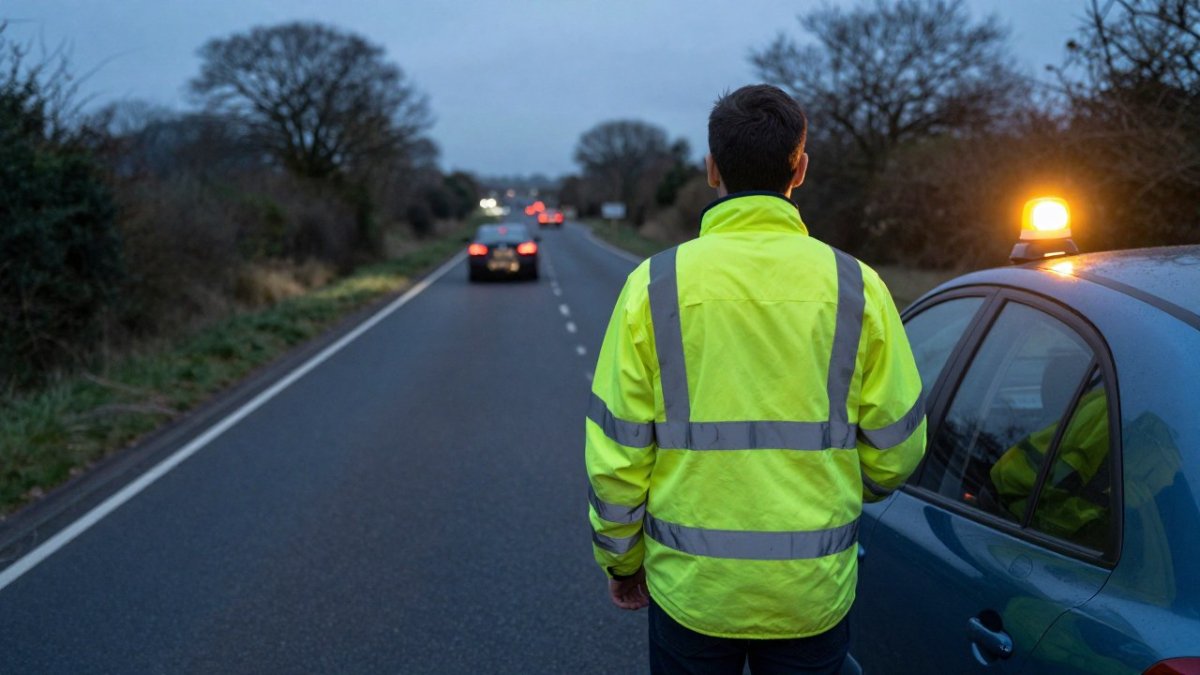
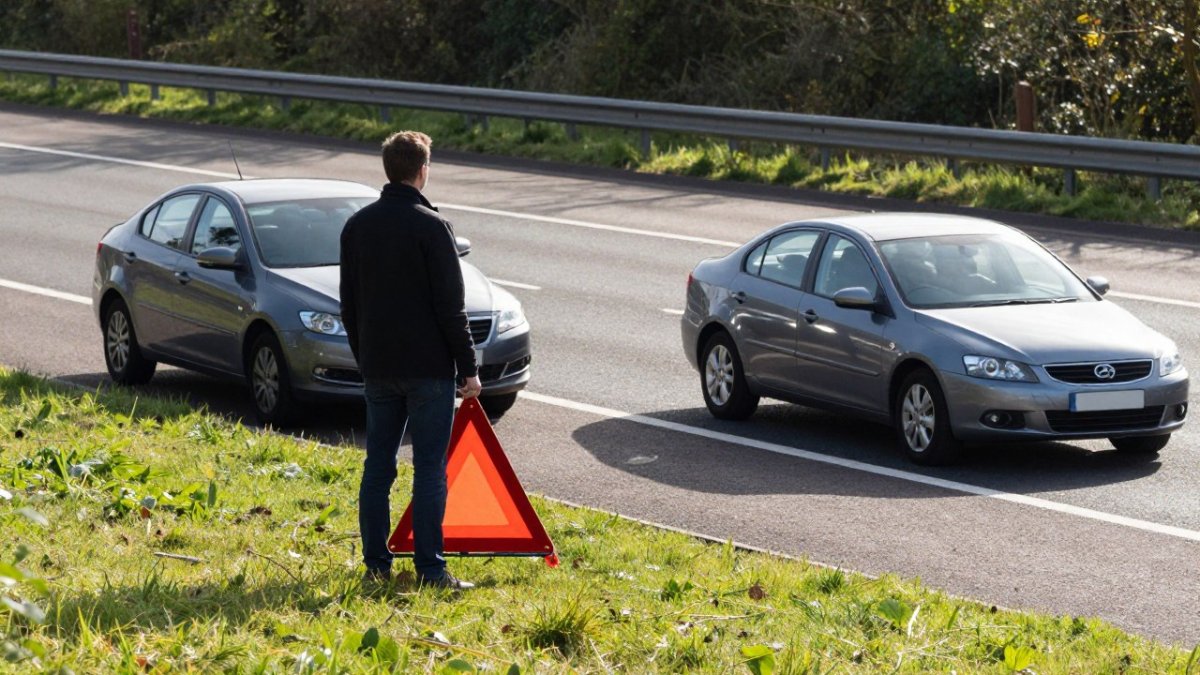
On a conventional motorway with a hard shoulder, a warning triangle can add useful early warning in good daylight, but it must be placed well behind the vehicle and only if you can do so without stepping into a live lane. Many drivers now carry a high-visibility beacon instead, which can be placed on the roof or behind the car without walking into traffic.
At night or in poor visibility, the risk rises sharply. Read specific night-time safety tips for a motorway breakdown. Use high-visibility clothing, keep passengers behind the safety barrier and well up the bank, and avoid using a phone torch as your only light source because it can dazzle approaching drivers. Early warning products can help increase hazard awareness for stationary vehicles on busy roads.
Smart motorways need a different response. On a smart motorway there may be no hard shoulder, and lanes can be closed remotely using red X signals on the overhead gantries. Find out what to do when a car breaks down on a smart motorway. A red X means the lane is closed, never drive in it, even if it looks clear, because it may be protecting a stopped vehicle, a recovery crew or an incident ahead (Red X means don’t drive in that lane).
If your vehicle stops in a live lane on a smart motorway:
- Put your hazard warning lights on immediately and, if you can, steer towards the nearest emergency refuge area .
- If you cannot reach a refuge area, stop as far left as you can, keep your seatbelt on, and call 999 immediately, the control centre can set the red X signals above your lane once your location is known.
- If you are able to leave the vehicle safely, exit through the left-hand passenger door and move behind the safety barrier, taking passengers with you.
- If it is not safe to leave, stay in the vehicle with seatbelts fastened and call 999, giving the carriageway, direction and nearest marker post or junction.
Watch out: Do not assume a red X will appear the moment you stop. Signals are set by the control centre, so calling 999 from a live lane is what triggers the lane closure, waiting for a red X before you call wastes the most valuable seconds.
Preparing Your Car and Kit So You Are Ready for Next Time
Preparation makes a breakdown far less stressful. Keep a basic kit in your boot, including a high-visibility jacket, a warning triangle, a torch, a phone charger and a bottle of water.
Check your breakdown cover details and save the number in your phone. Carry a paper note with your policy number in case your phone runs out of battery.
Explore our range of high-visibility safety products to find the right kit for your car. Highways England guidance on motorway breakdowns
Frequently Asked Questions
What should I do first if my car breaks down on a motorway?
Switch on your hazard warning lights straight away and try to steer the car safely onto the hard shoulder or the nearest emergency refuge area. Keep your seatbelt on until the car has stopped, then check your mirrors and indicate before pulling over. Avoid braking suddenly in a live lane. Once you are stopped, turn off the engine, put on your high-visibility vest if you have one, and call for help. Do not attempt roadside repairs on a live carriageway.
Should I get out of my car after a motorway breakdown?
In most cases, the safest option is to leave the vehicle through the passenger-side door, away from the traffic, and wait behind a barrier if one is present. Leaving the car is dangerous if you are in a live lane or if the hard shoulder is narrow and traffic is fast. If you are in a live lane, or if it feels unsafe to get out, stay in the car with your seatbelt fastened and your hazard lights on until emergency help arrives. Never walk along the carriageway.
Who should I call after breaking down on a motorway?
Call 999 and ask for the police if you are in danger, if someone is injured, or if you are in a live lane. Otherwise, call your breakdown provider or recovery service. Tell the operator your exact location, which you can find from the nearest marker post, an emergency phone sign, or the grid reference shown on your phone’s map app. Note the direction of travel and the junction number if you know it. Stay on the line if the operator asks you to, and tell them about any passengers with mobility, medical or child-safety needs.
What should I do if my car breaks down on a motorway at night?
At night, prioritise visibility. Keep your hazard lights flashing and, if you have a high-visibility vest, wear it before you step out. Where it is safe to do so, use an emergency phone, which connects you directly to a control centre. Keep passengers inside the vehicle with the doors locked until help arrives. On a smart motorway with a red X overhead, do not stop in that lane; move to the nearest hard shoulder or refuge area if you can do so safely.
