
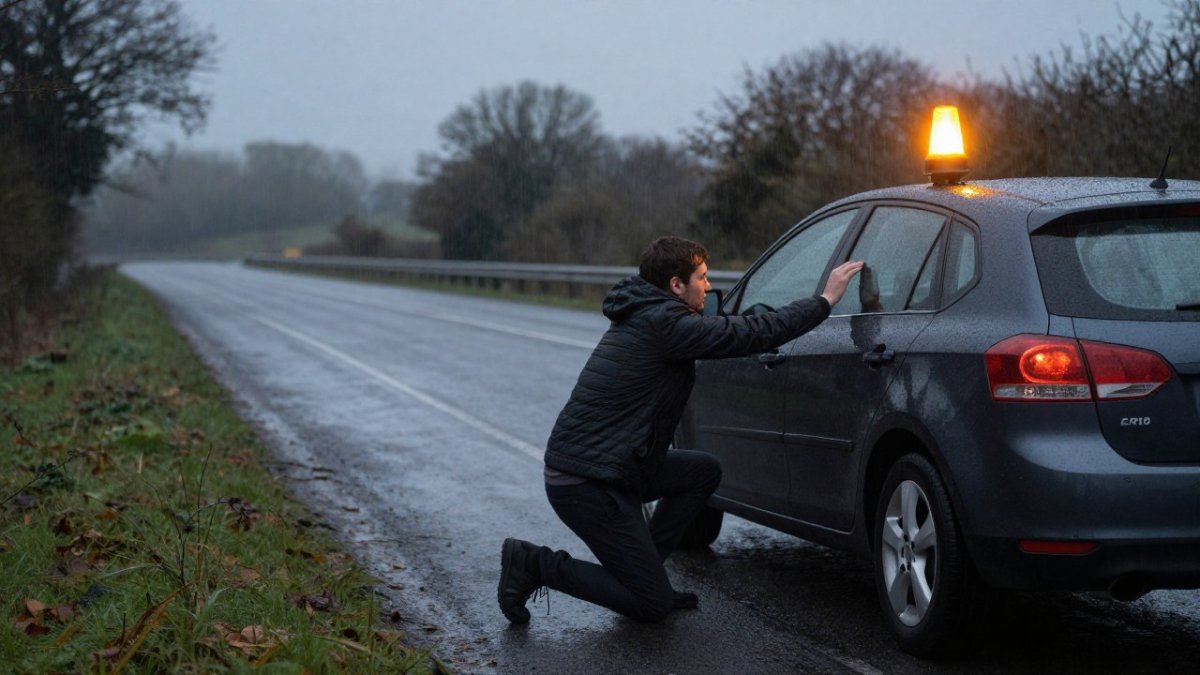
Choosing the Right Emergency Beacon: A Vehicle Guide
Last Updated: November 11, 2026
Quick Summary
Choosing the right emergency beacon for vehicles starts with whether you are warning drivers about a stationary car or marking a slow-moving work vehicle. A portable roadside emergency beacon suits breakdowns and motorway stops, while a fixed vehicle beacon is wired in for maintenance and utility work. For a breakdown, amber is the correct and expected signal.
- Amber is the general-purpose warning colour for breakdowns, slow-moving vehicles and maintenance.
- Fitting blue flashing lights to a normal car is an offence under the Road Vehicles Lighting Regulations 1989.
- Spain requires a connected V16 beacon with location sharing from 1 January 2026 for certain vehicles.
- A roof beacon is visible over hill crests and above intervening traffic, unlike a ground-placed light.
- Check, recharge and store your beacon quarterly, and keep spare cells if your model takes them.
Table of Contents
- Roadside Emergency Beacon or Work Vehicle Warning Light?
- Beacon Types, Colours and What Each Signal Communicates
- Emergency Beacon Legal Requirements UK Drivers Must Meet
- Vehicle Beacon Visibility: Brightness, Range and Weather
- How a GPS Emergency Beacon for Cars Gets Help to You
- Emergency Beacon Battery Life, Charging and Readiness Checks
- Mounting, Power and Vehicle Compatibility
- Add a Roadflash Beacon to Your Boot Kit
- Frequently Asked Questions
Roadside Emergency Beacon or Work Vehicle Warning Light?
Choosing the right emergency beacon for vehicles starts with one question: are you warning drivers about a stationary car, or marking a slow-moving work vehicle?
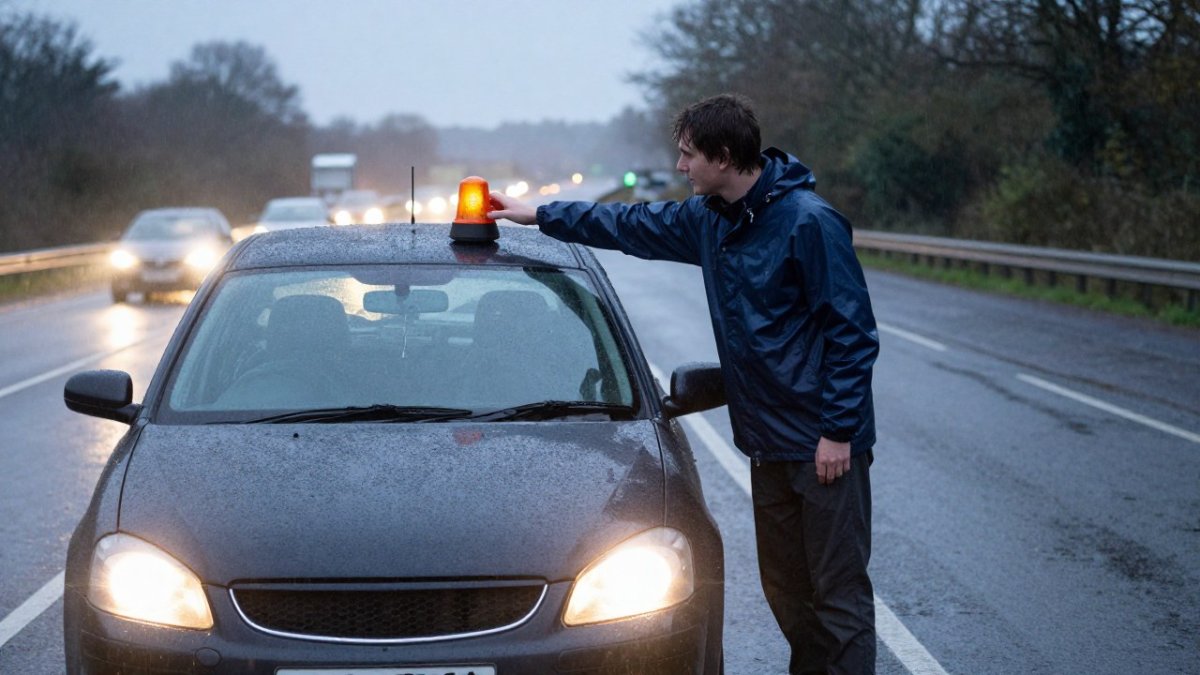
A roadside emergency beacon is a portable device you deploy when your car breaks down. It sits on the roof or behind the vehicle, flashes to draw attention, and in some markets shares your location with emergency services.
Get this wrong and you either buy a beacon you cannot deploy from a boot kit, or wire a permanent light you did not need. Here is one way to split the decision:
| Your situation | Right choice | Why |
|---|---|---|
| Breakdowns, punctures, motorway stops | Portable roadside emergency beacon | Deployable in seconds, runs on its own battery |
| Maintenance, gritting, slow-moving works | Fixed vehicle beacon | Wired to 12V/24V, built for daily switching |
| Fleet of mixed vans and cars | Both, specified per vehicle | One product cannot cover both duties |
| Occasional motorway driving | Portable beacon for the boot | Cheapest cover for the real risk |
If you drive the motorway even a couple of times a week, a portable version may be worth considering.
Beacon Types, Colours and What Each Signal Communicates
Colour is not decoration on a vehicle beacon. It tells other road users what kind of hazard they are approaching, and in some cases it carries legal weight.
- Amber: the general-purpose warning colour. Used for breakdowns, slow-moving vehicles, maintenance and wide loads. An amber beacon is what most drivers actually need.
- Blue: reserved for emergency services in the UK. Fitting blue flashing lights to a normal car is an offence (The Road Vehicles Lighting Regulations 1989).
- Green: used by doctors responding to emergencies in some settings, and by certain infrastructure vehicles.
The practical takeaway: for a breakdown beacon, amber is the correct and expected signal. If you want a deeper comparison of what each colour means and where it is permitted, our guide to amber vs blue hazard lights covers the rules and the reasoning.
Light pattern matters too. A rotating beam sweeps and is easy to spot from an angle. A flashing LED is brighter and more energy-efficient but can be harder to judge distance on.
Emergency Beacon Legal Requirements UK Drivers Must Meet
Emergency beacon legal requirements UK drivers must meet depend on the beacon type, the vehicle, the road, and the country. A device compliant in one setting can be illegal in another. This section sets out the core UK framework and a dated compliance table.
The UK framework
UK lighting rules for vehicles are set out in the Road Vehicles Lighting Regulations, which govern which lamps and colours may be fitted and when they may be used. Restrictions on blue warning lights for emergency vehicles apply, and fitting blue flashing lights to a normal car is not permitted. Check the current version of the regulations on legislation.gov.uk for the specific provisions that apply to your vehicle.
Dated compliance table for common scenarios
The table below summarises the position for typical UK driving situations. It is a guide only and does not replace the legislation or advice from a qualified professional.
| Scenario | Beacon type | Legal position | Key source | Effective date |
|---|---|---|---|---|
| Breakdown on a motorway hard shoulder | Portable amber beacon | Permitted; amber is the correct warning colour. Place on roof or behind vehicle if safe. | Road Vehicles Lighting Regulations 1989, reg. 11 | In force (1989) |
| Breakdown on a rural road at night | Portable amber beacon | Permitted; use in addition to hazard warning lights. | Road Vehicles Lighting Regulations 1989, reg. 11 | In force (1989) |
| Maintenance van parked on a verge | Fixed amber beacon | Permitted if the vehicle is used for an authorised purpose; check the regulation’s list. | Road Vehicles Lighting Regulations 1989, reg. 11 | In force (1989) |
| Private car with a blue flashing light | Blue beacon | Illegal for civilian use; blue is reserved for emergency services. | Road Vehicles Lighting Regulations 1989, reg. 11 | In force (1989) |
| Driving in Spain with a UK-registered car | Connected emergency beacon (V16) | Spain requires a connected V16 beacon with location sharing from 1 January 2026 for certain vehicles; UK rules do not require this. | Spanish DGT 3.0 framework | 1 January 2026 |
| Driving in France with a UK-registered car | Amber beacon | Permitted for breakdown warning; a reflective triangle is also required in some circumstances. | French Code de la Route | In force |
Watch out: The Spanish V16 requirement is not the same as a UK warning light. A device meeting UK rules may not meet Spanish approval requirements, and vice versa. Check the destination country’s rules before you travel.
What to check before buying
- The beacon is legal for the vehicle and use you have in mind.
- Any colour restrictions are respected (amber only for civilian warning use).
- If you drive abroad, the device meets that country’s approval scheme and any connectivity requirements.
For a detailed walkthrough of the connected-beacon rules, see our V16 beacon regulatory compliance guide. For the UK position, always check the current version of the Road Vehicles Lighting Regulations 1989 on legislation.gov.uk, as amendments can change the detail.
Vehicle Beacon Visibility: Brightness, Range and Weather
Vehicle beacon visibility is where cheap products fall down and marketing claims are hardest to verify. Brightness figures on a box tell you little, because what matters is performance in daylight, rain, fog and around a bend. This section sets out a practical testing method and the mechanisms that separate a beacon that buys time from one that disappears into the background.
A real-world visibility test you can run
A more useful approach than relying on specifications alone is a simple side-by-side test in the conditions you actually drive in.
- Choose a test route. Pick a straight section with a clear view for at least 200 metres, plus a gentle curve. Test at the same time of day each time.
- Set a reference distance. Mark points 100 metres and 200 metres from the beacon using a phone app or measured pace.
- Test in four conditions. Daylight (overcast is best), heavy rain, fog (if safe and legal), and dusk. Record the distance at which the beacon first becomes clearly distinguishable from background lights.
- Compare patterns. Test rotating and flashing settings. Note which is easier to locate and which is easier to judge distance on.
- Record the results. A table with columns for beacon model, condition, pattern and first-visible distance reveals differences that specifications hide.
Watch out: Never conduct visibility tests on a live carriageway or in conditions that put you or others at risk. Use a private road or a closed area with permission.
What the test reveals
In practice, three factors decide whether a driver sees you in time:
Light output and lens design. A high-output LED behind a focused lens throws light further than a bare bulb. Rotating patterns spread light across a wider arc, helping on curves where a straight-on flash disappears behind bodywork. A focused rotating beam is often visible further in daylight, while a wide flashing pattern is easier to spot from an angle at dusk.
Mounting height. A roof beacon is visible over the crest of a hill and above intervening traffic. One placed on the ground behind the car is hidden by the vehicle from many angles.
Contrast against conditions. In fog and heavy rain, a bright point source can blur into the grey. A flashing pattern with a slower rhythm reads better than a rapid strobe.
Measured performance: what to expect
Without laboratory equipment, you cannot produce absolute brightness figures, but comparative results are more useful than a box claim. Visibility varies with the beacon, vehicle and conditions, and the most useful measure is a comparison between products tested in the same conditions rather than a single absolute figure.
The honest limitation
No beacon makes a stationary car safe on a live lane. It buys other drivers time to react, and time is the whole point. Get out, get behind the barrier where you can, and let the light do its work.
How a GPS Emergency Beacon for Cars Gets Help to You
A GPS emergency beacon for cars can warn approaching traffic and share its location, which helps emergency services find the vehicle.
When you break down on a motorway, the hardest thing to communicate is your precise location.
Here is how the sequence typically works:
- You activate the beacon and place it on the vehicle roof.
- The device begins flashing to warn traffic.
- It shares its GPS position with the relevant emergency or traffic service.
- The control centre receives a location, not a description.
That last step is the difference between a clear handover and a stressful phone call. For the mechanics in more detail, see our explanation of how GPS breakdown beacons work.
Emergency Beacon Battery Life, Charging and Readiness Checks
Emergency beacon battery life is the specification most buyers ignore until the night it matters.
Most portable beacons run on rechargeable cells or standard batteries, and runtime depends heavily on the flash pattern and brightness setting.
Build a simple readiness routine:
- Check quarterly. Switch the beacon on and confirm it flashes at full brightness.
- Recharge on a schedule. Set a phone reminder for the same date each season.
- Store it warm and dry. Extreme cold drains cells; a damp boot corrodes contacts.
Winter is the harshest test, because cold slows battery chemistry just when breakdowns become more likely. Our guide to emergency beacon battery maintenance for winter sets out a seasonal check you can follow in a few minutes.
Watch out: leaving a rechargeable beacon permanently plugged into a cigarette socket can mask a failing cell, because the device always appears charged until the moment the socket loses power.
Mounting, Power and Vehicle Compatibility
Mounting options decide whether a beacon is genuinely usable or a faff you stop bothering with.
| Mount type | Best for | Trade-off |
|---|---|---|
| Magnetic mount | Cars, quick deployment from the boot | Needs a clean steel roof panel |
| DIN pole mount | Vans and utility vehicles | Permanent fit, requires wiring |
| Suction or adhesive | Temporary use, smooth glass or panels | Can loosen in wind and rain |
Power requirements split along the same line. Portable beacons carry their own battery, so they work on any vehicle with no installation.
Vehicle compatibility is mostly about the roof.
For a full comparison of mount types and how to match one to your vehicle, read our guide on how to choose a reliable roadside safety beacon.
Add a Roadflash Beacon to Your Boot Kit
The gap between a near miss and a serious collision is often a few seconds of warning.
If you have been meaning to sort out your breakdown kit, start with the beacon rather than the triangle.
A warning triangle and hazard lights only work if other drivers see them in time, and on a busy motorway that margin is thin.
Frequently Asked Questions
Are vehicle emergency beacons a legal requirement in the UK?
No. UK law does not require you to carry an emergency beacon, and a warning triangle is not compulsory either. What the law does require is that any warning light you fit complies with the Road Vehicles Lighting Regulations 1989, which restrict colours and flashing patterns on the road. Amber is the standard colour for hazard warning on vehicles. If you drive abroad, check the rules for every country you travel through before you rely on one device.
How does GPS work in a vehicle emergency beacon?
A GPS emergency beacon for cars uses a satellite receiver to fix its position, then sends that location onward, usually over a mobile network, to a connected platform or emergency contact. The beacon itself does not call the emergency services. It shares coordinates so that you, your recovery provider or the responding service can find the vehicle quickly. Because the location is captured automatically, it still works if you are injured, disoriented or standing away from the car when help is arranged.
How long does an emergency beacon battery last?
Runtime depends on the model, the flash pattern and the brightness setting. Check the stated runtime on the product specification rather than assuming, and recharge or replace batteries on a regular schedule. A beacon that is flat when you need it is worse than no beacon, so add a readiness check to your routine.
Where should I place an emergency beacon on my vehicle?
Put it where approaching drivers see it earliest and from the widest angle: on the roof or the highest practical point, not on the boot floor or behind the car. A magnetic mount suits a quick deployment on a steel roof, while a DIN pole mount suits vans and fleet vehicles that need a permanent fitting. Place it before you step into the carriageway where possible, keep yourself on the verge side, and never stand between your vehicle and oncoming traffic while fitting it.
