

V16 Beacon Regulatory Compliance: A 2026 Guide
Table of Contents
- What Is a V16 Emergency Beacon and Why Compliance Matters
- When V16 Requirements Take Effect and Which Vehicles Must Carry One
- How to Check V16 Beacon Approval and DGT Certification
- DGT 3.0 Beacon Requirements and Technical Specifications
- V16 Beacon Connectivity Duration and Location Transmission
- V16 Beacon Placement on Vehicle and Proper Use During Breakdown
- Compliance Checklist and Common Mistakes to Avoid
- Frequently Asked Questions
Last Updated: October 21, 2026
What Is a V16 Emergency Beacon and Why Compliance Matters
A V16 emergency beacon is a portable roof-mounted warning device for breakdowns, and V16 beacon compliance ensures it meets regulatory standards.
The V16 standard emerged from Spanish traffic regulations to prevent collisions with stationary vehicles on motorways.
Compliance matters for safety and legality.
V16 beacon compliance ensures every beacon meets the same technical specifications, so emergency services interpret the signal correctly and drivers recognise the warning instantly.
When V16 Requirements Take Effect and Which Vehicles Must Carry One
The V16 requirement became mandatory on January 1, 2026, in Spain.
Which vehicles must carry a V16 beacon depends on where they’re registered and where they’re driven:
- Spanish-registered vehicles: Mandatory in Spain from January 1, 2026
- Foreign-registered vehicles travelling in Spain: Must comply with Spanish law while in the country
- Vehicles registered elsewhere in the EU: Check your home country’s regulations; some have adopted similar standards, others have not
The requirement applies to all vehicle types, cars, vans, trucks, motorcycles. There’s no exemption for professional drivers, occasional motorists, or small fleet operators.
One common misconception: the old warning triangle doesn’t satisfy the V16 requirement. Spain now mandates electronic warning, and a compliant beacon is your primary safety tool.
How to Check V16 Beacon Approval and DGT Certification
Verifying V16 beacon approval means checking the device’s DGT certification status. The Dirección General de Tráfico (DGT) is Spain’s traffic authority and approves all compliant beacons.
Here’s how to confirm a beacon is genuinely certified:
- Check the device’s documentation. Every compliant beacon comes with a certificate listing the model, manufacturer, and DGT approval reference number.
- Look for the DGT approval marking on the device itself, usually on the casing or in the user manual.
- Request the approval certificate from the seller. Reputable sellers provide this documentation automatically.
- Verify the approval number online through the DGT website, which maintains a registry of approved devices.
A beacon without DGT certification is not compliant, regardless of performance. Using a non-certified device exposes you to fines and leaves you unprotected legally if an accident occurs.
Always request the DGT approval certificate before buying a V16 beacon. A seller unwilling to provide documentation is a red flag. Roadflash provides full certification details with every beacon sold.
DGT 3.0 Beacon Requirements and Technical Specifications
The DGT 3.0 beacon requirements define the technical standard for compliant devices. Knowing them helps you tell a genuinely compliant beacon from one that merely claims compliance, and verify a device before relying on it at the roadside.
DGT 3.0 beacons must meet these core technical requirements:
- Light intensity and visibility: Visible from at least 500 metres in daylight and 1,000 metres at night, with a distinctive flashing pattern.
- 360-degree visibility: Warning light in all directions; forward- or backward-only flashing fails the standard.
- Flashing frequency: Typically 1 to 2 Hz, maintaining visibility without distraction or seizure risk.
- Magnetic base or secure mounting: Firm roof attachment that cannot shift or fall in wind or vehicle movement.
Connected versus non-connected beacons
A frequent confusion is the difference between a connected DGT 3.0 beacon and an older non-connected V16 light. Both may flash, but only a connected device transmits location data to the emergency response network. Check for the connectivity module and the SIM or embedded connectivity specification in the documentation. A non-connected light may satisfy the visual warning requirement but won’t deliver the location transmission the connected standard is built around.
How to verify the approval reference
Every compliant beacon carries a DGT approval reference. The practical verification routine is:
- Locate the approval reference on the device casing, the user manual, or the certificate of approval.
- Cross-reference the reference against the DGT’s published list of approved devices; it should match an entry there.
- Confirm the model and manufacturer in the registry match the device in your hand. A reference pointing to a different model is not proof of compliance.
- Keep the certificate with the vehicle documents so you can produce it if required.
A beacon without a verifiable DGT approval reference is not compliant, regardless of performance. Using a non-certified device exposes you to fines and leaves you unprotected legally if an accident occurs.
Ask the seller for the approval reference before you buy, then check it against the DGT registry yourself. A seller who cannot supply a reference, or whose reference does not match the model, is a red flag. Roadflash provides full certification details with every beacon sold.
What the technical standard does not cover
DGT 3.0 sets the performance and connectivity baseline, but doesn’t guarantee performance in every condition. Mobile coverage varies, so a connected beacon may be unable to transmit in remote areas even though its lights still function. Battery performance also degrades over time, so a device that met the standard when new may fall short after years in a hot vehicle.
DGT 3.0 compliance means the beacon has passed testing for visibility, durability, and connectivity, and that it carries a verifiable approval reference. Check the reference against the DGT registry and confirm whether the device is connected or non-connected before you rely on it.
V16 Beacon Connectivity Duration and Location Transmission
How location transmission works:
A compliant V16 beacon uses mobile network connectivity (typically 4G or 5G) to transmit GPS coordinates to emergency response systems.
Connectivity duration requirements:
DGT 3.0 beacons must maintain active connectivity for the duration of the battery life.
The practical benefit: if you’re injured or disoriented after a breakdown, you don’t need to communicate your location.
Data handling and privacy:
Your location data is transmitted only to authorized emergency response networks.
One important detail: connectivity depends on mobile network coverage.
V16 Beacon Placement on Vehicle and Proper Use During Breakdown
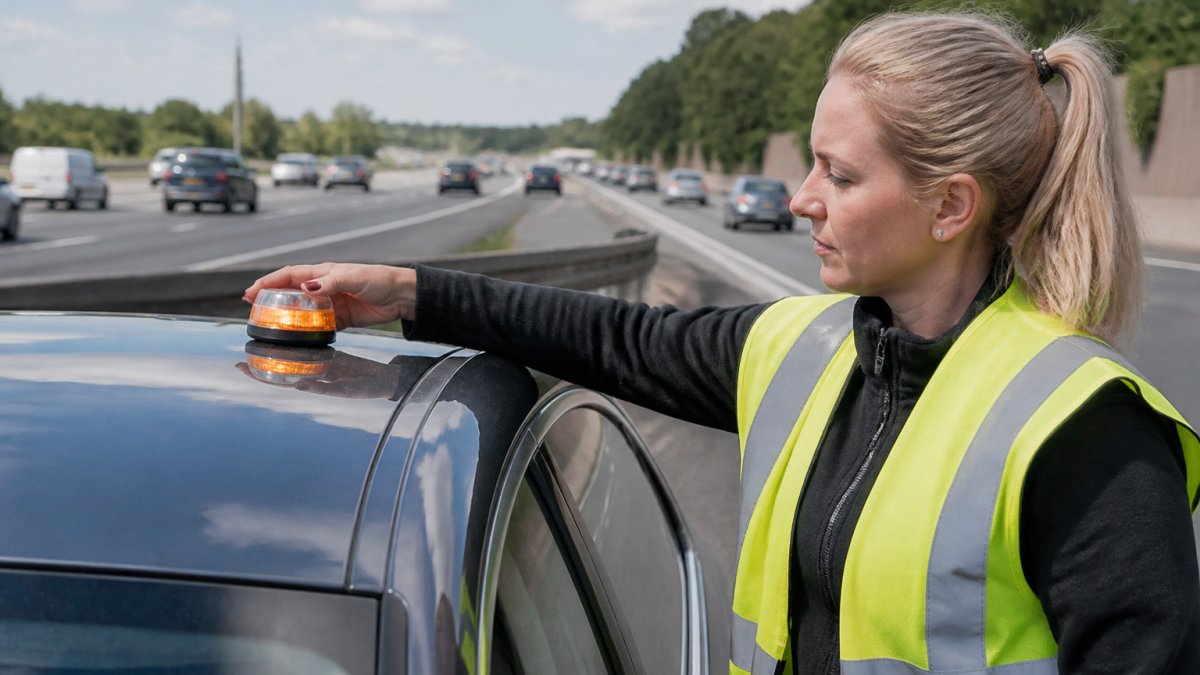
Correct placement of the V16 beacon is essential for maximum visibility and regulatory compliance; poor placement can render it ineffective or fail inspection.
Where to place the beacon:
- Roof mounting: The beacon must sit on the vehicle’s roof, centred or slightly toward the rear, for 360-degree visibility and maximum distance visibility.
- Magnetic base positioning: Ensure the metal surface is clean and free of debris; the magnet must grip firmly, so test it before relying on it in an emergency.
- Height consideration: Sit the beacon as high as possible on the roof. Avoid roof racks or positions behind aerials, which obstruct the light.
- Stability check: Before driving, confirm the beacon is secure; vibration or movement during transit can damage it or cause it to fall.
Proper use during a breakdown:
- Pull over safely. Move as far from traffic as possible; on a motorway, use the hard shoulder or designated lay-by.
- Activate hazard lights immediately.
- Place the beacon on the roof centre using the magnetic base or mounting bracket.
- Activate the beacon. It will begin flashing and transmitting location data (if connected).
- Exit the vehicle safely. Move away from traffic and stand behind the safety barrier if available.
- Wait for assistance. The beacon is now alerting other drivers and emergency services to your location.
Never place the beacon on the bonnet or boot. These positions fail the 360-degree visibility requirement and may not comply with DGT regulations. Incorrect placement can result in a failed inspection.
Compliance Checklist and Common Mistakes to Avoid
Use this checklist to verify your V16 beacon meets regulatory compliance before relying on it during a breakdown. The sequence matters: verify approval first, then test the device, then confirm it’s ready for travel.
Step-by-step compliance checklist
| Step | Check | How to verify |
|---|---|---|
| 1 | DGT approval reference present | Locate the reference on the casing, manual, or certificate |
| 2 | Reference matches the DGT registry | Cross-reference the reference and confirm model and manufacturer match |
| 3 | Device is connected or non-connected as expected | Check documentation for connectivity specification |
| 4 | 360-degree light output | Activate in a dark environment and walk around the vehicle |
| 5 | Flashing frequency steady | Count flashes over a timed interval; the pattern should be consistent |
| 6 | Magnetic base secure | Test grip on a clean metal surface before travel |
| 7 | Battery holds full charge | Charge fully and confirm operating duration meets the stated minimum |
| 8 | Weatherproofing intact | Check the IP rating and inspect seals for damage |
| 9 | Location transmission works | Test in an area with mobile coverage and confirm the device reports connectivity |
| 10 | Mounting position correct | Confirm the beacon sits on the roof centre, clear of racks and aerials |
Maintenance and testing schedule
A beacon that passed inspection when new can fail silently after months in a hot vehicle. A repeatable routine keeps it ready:
- Monthly: activate the beacon briefly and confirm the lights flash and, for a connected device, that it reports connectivity.
- Before long journeys: charge the battery fully and check the magnetic base for debris or damage.
- Seasonally: inspect seals and casing for cracks, and confirm the approval reference is still legible.
- Annually: review the manufacturer’s stated service life and replace the device if it approaches the end of its rated operating period.
What to do if a compliant beacon fails or is unavailable
Even a compliant device can fail at the roadside. If the beacon won’t activate, or is missing or damaged:
- Move as far from traffic as possible and switch on hazard warning lights.
- Use any secondary warning device you carry, such as a warning triangle where it’s safe and legal to place one.
- Call the emergency services and give your location using marker posts or the emergency roadside telephone where available.
- Stay behind the safety barrier and away from the carriageway while you wait.
A failed beacon doesn’t remove your obligation to warn other road users, so carry a backup plan and know how to describe your location without the device.
Common mistakes to avoid
- Using a non-certified beacon. A device that looks like a V16 beacon but lacks a verifiable DGT approval reference is not compliant. Fines apply, and it won’t protect you legally.
- Buying a non-connected light by mistake. Confirm the device is the connected type if the standard requires it for your use.
- Neglecting battery maintenance. Test monthly and replace batteries before they fail; a dead beacon is useless in an emergency.
- Placing the beacon incorrectly. Roof mounting is mandatory; bonnet, boot, or dashboard placement fails compliance.
- Assuming the beacon works without testing. Activate it in a safe location and confirm flashing and connectivity before relying on it.
Roadflash’s V16 beacons come with detailed user guidance and certification documents. Review these materials before your first breakdown scenario. Familiarity with the device reduces errors during high-stress situations.
Frequently Asked Questions
How can I check whether a V16 beacon is DGT-approved?
Verify DGT approval by checking the device’s documentation for an official approval number and certification mark. Contact the manufacturer directly to confirm their beacon meets current DGT 3.0 technical requirements. Check the device’s packaging, manual, or the seller’s website for visible certification symbols. Roadflash provides full documentation of approval status with every beacon sold, ensuring you have proof of compliance before purchase.
Do I need a V16 light in Spain if I’m a UK-registered vehicle?
Yes, if you’re driving in Spain, you must comply with Spanish traffic regulations. Foreign-registered vehicles, including those from the UK, must carry a compliant V16 emergency beacon when travelling on Spanish motorways and highways from 1 January 2026 onwards. Check with your insurer and vehicle documentation to confirm any additional requirements for cross-border travel. Carrying a DGT 3.0 compliant beacon protects you legally and ensures emergency services can locate you quickly if you break down.
How long must a connected V16 beacon transmit its location?
A DGT 3.0 compliant connected beacon must transmit geolocation data continuously whilst activated during a breakdown. The minimum operating duration depends on battery capacity, but devices must function for at least the duration specified in the manufacturer’s technical documentation. Most compliant beacons maintain connectivity for several hours on a single charge. Always verify the battery life specification in your beacon’s manual and test the device regularly to confirm it meets the regulatory minimum before relying on it during an emergency.
Can I still use a warning triangle with a V16 beacon?
Yes, using both a warning triangle and a V16 beacon provides redundant safety protection. The V16 beacon does not replace the warning triangle under current regulations; rather, it complements it by providing active visibility and automated location transmission. Deploying both devices during a breakdown maximises hazard awareness to approaching traffic and ensures emergency services have precise geolocation data. Check your vehicle’s insurance and the specific rules of any country you’re travelling in to confirm whether both are required or recommended.