
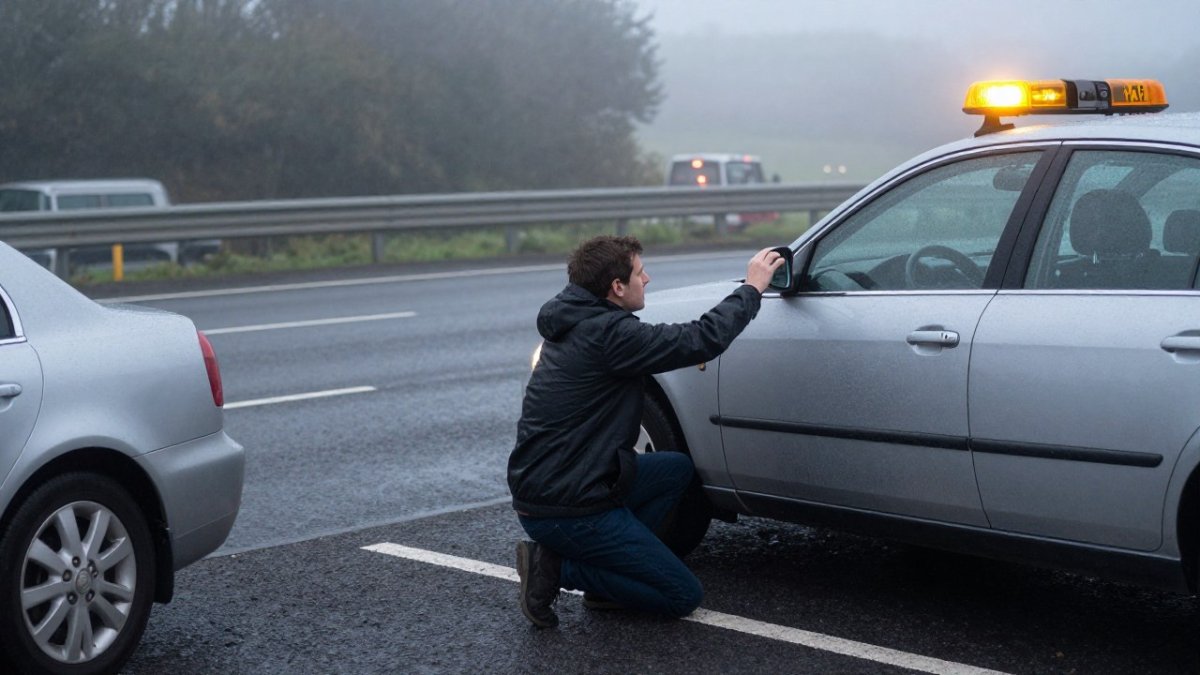
7 Steps to Use V-16 Emergency Lights Correctly
Last Updated: November 17, 2026
Quick Summary
To properly use V-16 emergency lights, pull as far left as you safely can, switch on your hazard lights and put on your reflective vest before opening the door. Then switch the beacon on and reach through the window to place it on the roof, magnetic base down, staying inside the vehicle if it is safe to do so.
- Store the beacon in the glove compartment or a door pocket, never in the boot.
- Run a battery test every few months using the unit’s test button.
- Place the beacon on the highest point of the vehicle, as close to the roof centre as practical.
- The V-16 beacon avoids walking down the road to place a warning triangle.
- A connected beacon may need mobile coverage, so treat the flashing light as the primary warning.
Table of Contents
- What a V-16 Emergency Beacon Is and When to Switch It On
- What You Need Before You Set Off
- Step-by-Step: How to Activate and Place Your V-16 Emergency Lights
- V-16 Beacon Placement Requirements on the Vehicle Roof
- V-16 vs Warning Triangles: What Changes at the Roadside
- Is a DGT 3.0 Beacon Mandatory in Spain?
- Connectivity, Location Data and Privacy Explained
- Common Mistakes to Avoid at the Roadside
- Frequently Asked Questions
What a V-16 Emergency Beacon Is and When to Switch It On
A V-16 emergency beacon is a portable, battery-powered amber flashing light that you place on your vehicle’s roof to warn approaching traffic that you have broken down. In Spain it is now the approved replacement for the warning triangle, and learning how to properly use V-16 emergency lights takes about two minutes of practice before you ever need them for real.
Early warning systems of this kind are built for exactly this moment: a stationary car on a fast road with traffic closing in behind it. The beacon’s job is simple. It makes your vehicle visible from a long way back, so other drivers have time to slow down and move over.
Switch the beacon on when your vehicle stops where it should not be:
- A breakdown on a motorway or dual carriageway
- A puncture or mechanical fault on any road
- A road accident where you are stranded
- Any stop where you cannot reach a safe lay-by
Do not use it for routine parking or to mark a delivery stop. It is an emergency signal, not a courtesy light.
What You Need Before You Set Off
Preparation is the whole game with roadside safety. A beacon buried under luggage is useless when you are stopped in a live lane.
Keep these items within arm’s reach of the driver’s seat:
- A DGT-approved V-16 beacon with charged batteries
- A reflective high-visibility vest
- A torch for night breakdowns
- A charged phone with your breakdown provider’s number saved
Store the beacon in the glove compartment or a door pocket, never in the boot. The glove box keeps it dry and close, and you can grab it without leaving the car. Run a battery test every few months. Most units have a test button that flashes the light briefly; if the flash looks weak, change the batteries.
Step-by-Step: How to Activate and Place Your V-16 Emergency Lights
Here is the full procedure, in order. Practise it once in daylight so the sequence is automatic under stress.
- Pull as far left as you safely can and switch on your hazard lights.
- Put on your reflective vest before opening the door.
- Take the beacon from the glove box.
- Switch it on; the amber light should start flashing immediately.
- Reach through the window and place it on the roof, magnetic base down.
- Check it is sitting flat and steady.
- Stay inside the vehicle if it is safe to do so, or stand behind the barrier well away from traffic.
- Call for roadside assistance and give your location.
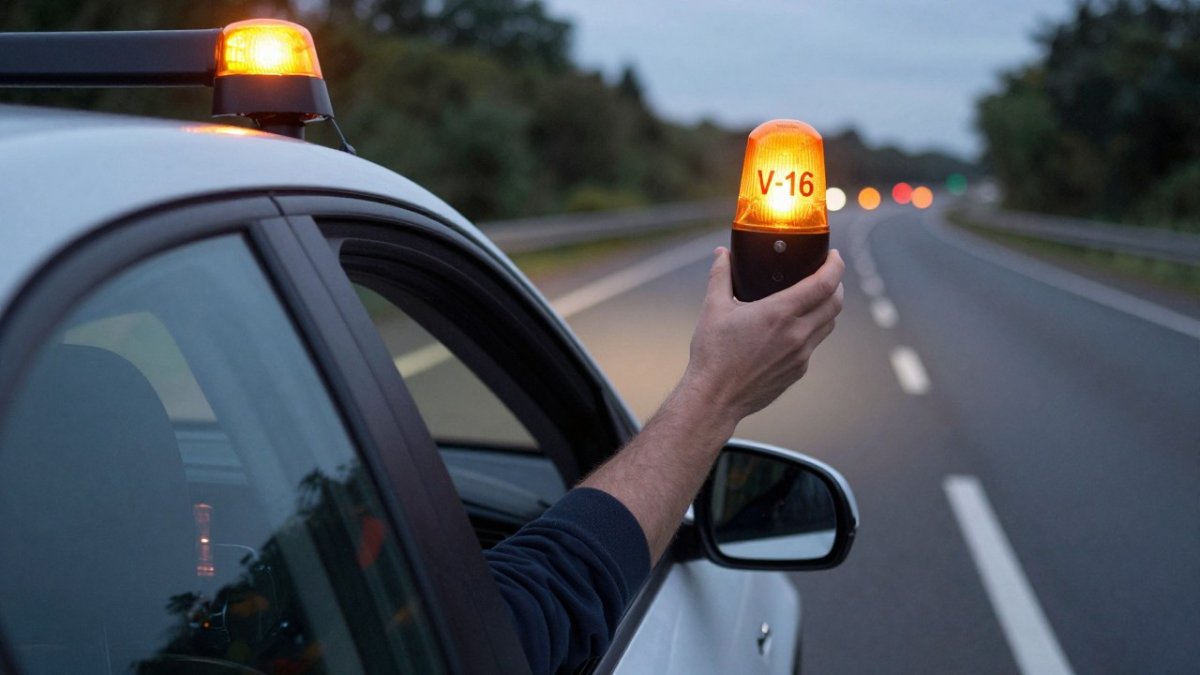
Placing the Beacon Without Leaving the Vehicle
The safest placement method keeps you inside the car. Lower the window, reach up and out, and set the beacon on the roof above your door. The magnetic base grips the metal panel and holds the light steady at speed.
Placing the beacon from inside the vehicle means you do not need to step into a live lane. If you want the detail on exact roof positioning, our guide to V16 beacon placement on the roof covers it position by position.
If the Roof Is Out of Reach: Safe Alternatives
Some vehicles make roof placement awkward. High-sided vans, motorhomes and cars with roof racks or glass panels can leave no clear magnetic spot.
Try these in order:
- Place the beacon on the bonnet if it is metal and within reach from the driver’s window
- Set it on the roof rack crossbar if the base grips
- Rest it on the dashboard behind the windscreen as a last resort, facing oncoming traffic
A beacon inside the car is less visible, so treat it as a fallback, not a plan. Never stand in the carriageway to reach a better spot.
V-16 Beacon Placement Requirements on the Vehicle Roof
The beacon belongs on the highest point of the vehicle, as close to the centre of the roof as practical.
Placement rules that matter:
- Highest point first. The roof beats the bonnet, and the bonnet beats the dashboard.
- Flat metal surface. The magnetic base needs clean, bare steel to grip.
- Clear of obstructions. Keep it away from roof bars, aerials and sunroof glass.
- Upright and level. A tilted beacon throws light sideways instead of back down the road.
Wipe the roof panel before you fit the beacon. Grit and water film weaken the magnetic hold.
V-16 vs Warning Triangles: What Changes at the Roadside
The V-16 beacon is used in place of the warning triangle for Spanish-registered vehicles, which avoids walking down the road to place a triangle.
The differences that matter in practice:
| Feature | V-16 Beacon | Warning Triangle |
|---|---|---|
| Placement | Roof, from inside the car | Ground, 50 m behind the vehicle |
| Leaving the vehicle | Not required | Required |
| Visibility at night | Flashing amber, high | Reflective only |
| Connected models | Send location to traffic services | None |
| Storage | Glove box | Boot |
The triangle still has a place in some other countries, so check the rules for wherever you are driving. Our breakdown of roadside safety device requirements explains what applies where.
Is a DGT 3.0 Beacon Mandatory in Spain?
A connected DGT 3.0 beacon is required for Spanish-registered vehicles, and the requirement should be checked against the current position from the DGT before travelling.
The requirement is written for vehicles registered in Spain, which is where visitors get caught out. The practical position for each group is set out below, and the official DGT guidance should be checked for the current rules:
- Spanish-registered vehicles. The beacon is required. Carry a compliant unit at all times and keep it within reach of the driver’s seat.
- Rental and hire cars collected in Spain. Check the glove box before you drive off the forecourt; if there is no beacon, ask at the desk before you leave.
- Foreign-registered vehicles visiting Spain. Rules for vehicles registered outside Spain should be checked against the official guidance before travelling. Carrying a compliant beacon is a sensible precaution.
- Vehicles transiting other countries. Check the rules for every country on your route before you set off.
Watch out: check that any beacon you buy carries the relevant DGT certification, as a CE mark alone does not confirm it.
Roadflash beacons include DGT 3.0 compliant emergency beacons with GPS/Geolocation. For current compliance details, see our DGT 3.0 compliance guide and the official DGT guidance.
Connectivity, Location Data and Privacy Explained
A connected beacon does two jobs at once. It flashes to warn drivers, and it sends a signal that pinpoints your position to traffic services. That second job is why emergency response can reach you faster on an unlit stretch of motorway.
How the connection works, step by step:
- You switch the beacon on. The unit wakes its mobile data connection.
- It acquires a GPS fix.
- It sends a data packet to the DGT 3.0 platform over the mobile network.
- The platform passes the location to the relevant traffic management service.
- The beacon repeats the transmission at intervals while it stays on, so the reported position stays current if the vehicle is moved.
Check the current DGT 3.0 privacy notice for details of what the device transmits and how the data is handled, particularly if you need this for a fleet policy.
Watch out: a connected beacon may need mobile coverage to report its position, so treat the flashing light as the primary warning.
If you want the technical detail on how the connection works, our guide to V16 beacon connectivity and power walks through it.
Common Mistakes to Avoid at the Roadside
Most roadside failures are small errors made in a hurry. Avoid these and you remove most of the risk.
- Storing the beacon in the boot. You cannot reach it safely once you have stopped.
- Skipping the vest. Opening the door without one puts you in traffic in dark clothing.
- Standing behind the car. If another driver fails to stop, the space behind your vehicle is the impact zone.
- Forgetting the battery test. A dead beacon is a dark car on a dark road.
- Placing it on glass or plastic. The magnet will not hold.
The biggest one is leaving the vehicle at all when you do not need to. Secondary collisions are the real danger after a breakdown, and our guide to preventing secondary collisions explains how to position yourself and your warning gear to stay out of harm’s way.
A breakdown on a busy motorway gives you seconds to make the right call, and a beacon you cannot reach in time is no help at all. Roadflash builds multi-award-winning early warning beacons with GPS geolocation, high-visibility amber flashing and a magnetic base that grips the roof from inside the car. Keep one in the glove box, test it monthly, and you will be ready before you ever need it. Get started with Roadflash and put a proven warning system within arm’s reach of the driver’s seat.
Frequently Asked Questions
Where should I place the V-16 beacon on my vehicle?
Place it on the highest point of the roof, ideally the centre, so the flashing amber light is visible from the greatest distance. The magnetic base holds it in place at motorway speeds. Keep the roof clean and dry before attaching it, and never fix it to a window, bonnet or side panel, because those positions reduce visibility and do not meet V-16 beacon placement requirements. If the roof is genuinely unreachable, keep the beacon flashing inside the vehicle on the dashboard and stay belted in.
Is a DGT 3.0 beacon mandatory in Spain for UK drivers?
A connected DGT 3.0 beacon is required for vehicles registered in Spain, so check the current position with the official DGT guidance. Visitors in UK-registered cars should carry a compliant beacon or triangles as their home rules require and check the current position before travelling, because rules for foreign-registered vehicles differ. The safest approach is to carry a DGT-certified connected beacon so you are covered whichever vehicle you drive.
Can I use a V-16 beacon instead of warning triangles?
In Spain, a certified V-16 beacon replaces the warning triangle for Spain-registered vehicles, so you no longer need to walk up the road to set out triangles. A V-16 emergency light gives you a warning signal you can deploy from inside the car without stepping into traffic. Carry both if you drive across borders.
How do I know if my V-16 beacon is DGT 3.0 compliant?
Look for a DGT-certified connected beacon with GPS geolocation and mobile connectivity that sends its position to the DGT 3.0 platform. The packaging and device should name the certification and the connectivity standard. Check the battery test function works and that the device registers a location before you rely on it. If you cannot confirm certification, treat it as a non-compliant light and replace it, because an uncertified beacon will not pass inspection.
