
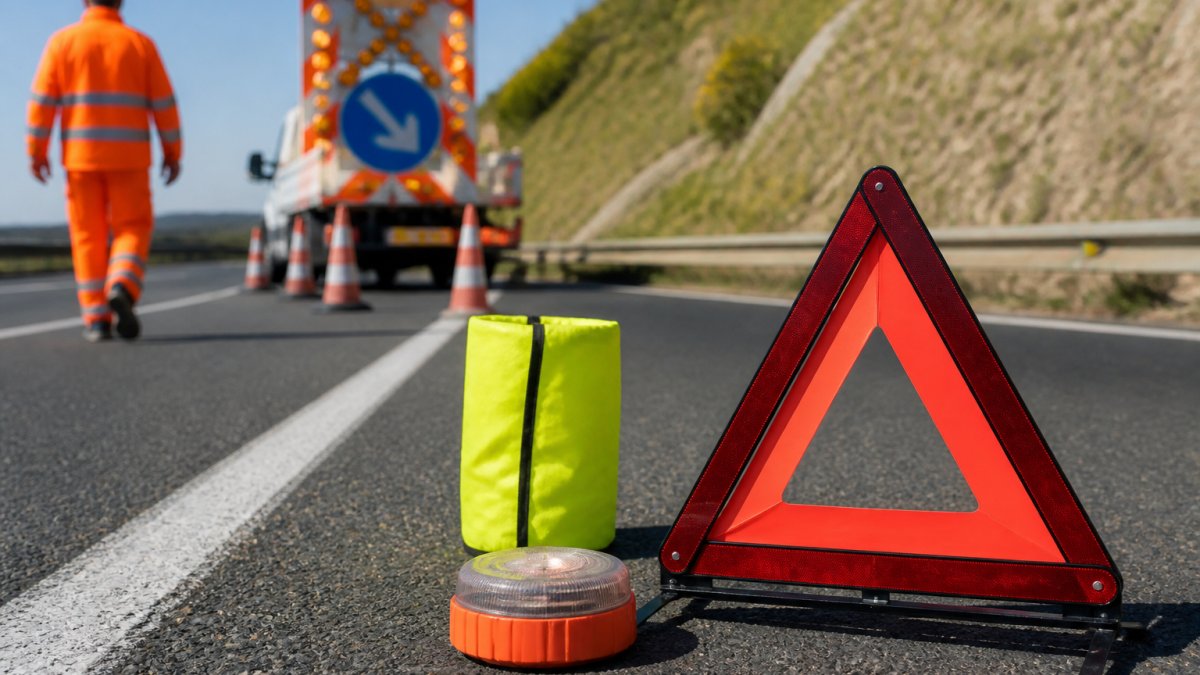
Guide to Spanish Vehicle Safety Regulations 2026
Last Updated: October 25, 2026
Quick Summary
Spanish vehicle safety regulations require all vehicles to carry a DGT 3.0 V-16 connected emergency beacon as of 2026, which uses GPS geolocation and wireless connectivity to alert emergency services during breakdowns. Foreign tourists under 90 days are exempt, but commercial operators and long-term residents must comply, with penalties ranging from €200 to €600 for non-compliance.
- The V-16 beacon must produce at least 1,500 candelas visible from 300 metres and maintain a 48-hour operational life per charge.
- Warning triangles must be placed 50 metres behind vehicles on motorways and 30 metres on regular roads as mandatory backup equipment.
- Spain’s motorway speed limit is 120 km/h, with fines of €100 for exceeding by up to 20 km/h and €600+ for exceeding by more than 40 km/h.
- All occupants must wear seat belts at all times, with €100 fines per unbelted occupant.
- The drink-drive limit is 0.5 mg/ml blood alcohol for experienced drivers and 0.3 mg/ml for novice drivers.
Table of Contents
- Spanish Vehicle Safety Regulations Overview
- Is DGT 3.0 Beacon Mandatory in Spain
- DGT 3.0 V-16 Beacon Requirements 2026
- How to Use a V-16 Emergency Beacon
- Foreign Vehicles V-16 Beacon Requirements in Spain
- Essential Emergency Equipment and Breakdown Procedures
- Other Critical Safety Rules: Speed Limits, Seat Belts, and Alcohol Limits
- Vehicle Documents, Driving Licences, and Technical Inspection
- Frequently Asked Questions
Spanish Vehicle Safety Regulations Overview
Understanding Spanish vehicle safety regulations is essential for anyone driving in Spain.
Spain’s traffic safety framework is governed by the Dirección General de Tráfico (DGT). For drivers from outside Spain, non-compliance can result in substantial fines, vehicle impoundment, or liability after an accident.
The 2026 regulations centre on the DGT 3.0 V-16 connected emergency beacon standard, which changes how stationary vehicles communicate their presence to approaching traffic, reducing collision risk during breakdowns.
Is DGT 3.0 Beacon Mandatory in Spain
The DGT 3.0 beacon is mandatory for all vehicles in Spain as of 2026, applying to Spanish-registered vehicles and foreign vehicles operating on Spanish roads for extended periods or commercial purposes.
Triangles remain required as backup, but the connected V-16 beacon is now the primary emergency warning device.
For foreign-registered vehicles, the requirement depends on classification and length of stay. Tourists and short-term visitors (under 90 days) in passenger vehicles are exempt, though carrying one is strongly recommended.
The penalty for non-compliance ranges from €200 to €600.
DGT 3.0 V-16 Beacon Requirements 2026
The V-16 beacon is a connected emergency warning light combining GPS geolocation, wireless connectivity, and high-intensity LED lighting. Unlike passive triangles, it actively communicates the vehicle’s position to emergency services and traffic management systems.
GPS connectivity and geolocation features
When activated during a breakdown, the beacon transmits your exact location to emergency services, reducing response time, particularly valuable on motorways with poor visibility or in rural areas.
For foreign drivers, the GPS feature is invaluable. Emergency services in Spain can pinpoint your location without relying on your ability to describe it in Spanish.
Technical specifications and approval standards
DGT 3.0 certification requires strict technical standards for light intensity, battery life, wireless range, and durability.
It must operate from -10°C to +60°C without degradation and maintain a wireless signal at motorway speeds up to 120 km/h.
Battery specifications require a 48-hour operational life per charge and at least 500 charge cycles before capacity drops below 80%.
DGT 3.0 approval is issued by the Spanish Ministry of Transport.
How to Use a V-16 Emergency Beacon
Proper use of a V-16 emergency beacon is straightforward, but mistakes during activation can delay emergency response.
Activation and placement on the roadside
When your vehicle breaks down on a motorway or major road, activate the beacon immediately.
Place the beacon on your roof or dashboard, at least 1.5 metres above ground level. On a motorway inside lane, position it on the central reservation side, directing the light toward oncoming traffic.
Place it on a stable surface, vibration from passing traffic can dislodge it, and on the uphill side if you’re on a slope. The GPS antenna should face upward with no obstructions.
Common mistakes to avoid
Watch out: leaving the beacon in your vehicle during a breakdown. A device left in your car won’t alert approaching drivers.
Many drivers activate the beacon but forget their hazard lights.
Don’t place the beacon on the ground unless your vehicle is parked safely off the road.
Another common error is failing to recharge the beacon after use.
Foreign Vehicles V-16 Beacon Requirements in Spain
Foreign-registered vehicles have different compliance obligations depending on intended use and duration of stay.
Commercial vehicles registered outside Spain must comply with full DGT 3.0 standards, including V-16 beacon installation.
Long-term residents and expats should verify their vehicle’s registration status: a UK-registered vehicle permanently based in Spain must meet DGT 3.0 requirements.
Essential Emergency Equipment and Breakdown Procedures
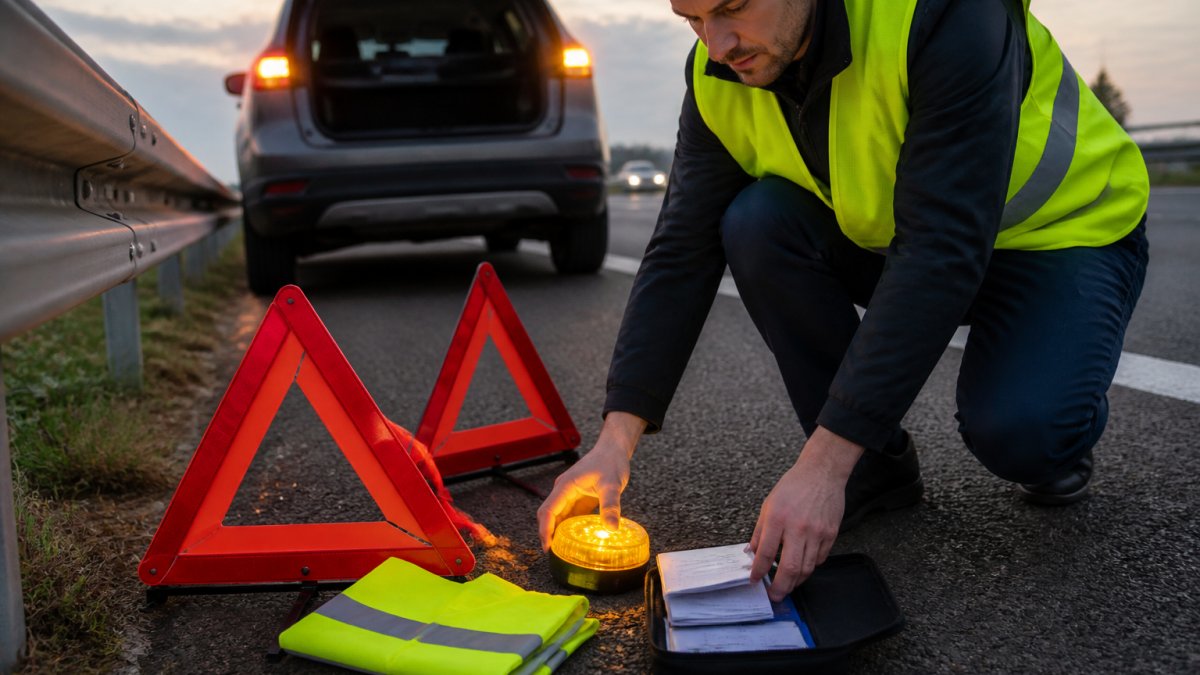
Warning triangles, hazard lights, and visibility gear
Warning triangles remain mandatory backup equipment. You must carry at least two reflective warning triangles, each meeting EN ISO 3864 standards.
High-visibility vests are mandatory for all occupants who exit the vehicle during a breakdown.
Hazard lights must be activated immediately when your vehicle becomes stationary due to breakdown or emergency.
A torch with spare batteries is essential, particularly for breakdowns occurring after dusk.
What to do when your vehicle breaks down
On a motorway mechanical failure, your immediate priority is activating the V-16 beacon and hazard lights before exiting the vehicle. Learn the step-by-step procedures for safely handling a breakdown in Spain.
Call emergency services (112 in Spain) and provide your location. The V-16 beacon’s GPS data will be visible to emergency services, but verbal confirmation of your situation accelerates response.
Remain outside your vehicle but away from traffic lanes. Stand on the verge or central reservation, not on the roadway itself.
For extended breakdowns or complex mechanical issues, contact a recovery service. Spanish motorways are patrolled by traffic officers, and they can assist with recovery arrangements.
Other Critical Safety Rules: Speed Limits, Seat Belts, and Alcohol Limits
Spanish vehicle safety regulations extend beyond emergency equipment to core driving practices. Non-compliance with these rules carries fines and potential driving bans.
Speed limits and enforcement
Speed limits in Spain are enforced through fixed cameras, mobile radar units, and traffic officer stops. Motorway speed limits are 120 km/h in normal conditions, reduced to 90 km/h in rain or poor visibility.
Exceeding the speed limit by up to 20 km/h results in a €100 fine. Exceeding by 20-40 km/h incurs €300-€600 fines. Exceeding by more than 40 km/h can result in €600+ fines plus potential driving licence suspension.
Seat belt and child restraint requirements
All occupants must wear seat belts at all times, front and rear. Drivers are responsible for ensuring all passengers comply. Failure to wear a seat belt incurs a €100 fine per unbelted occupant.
Child restraints are mandatory for children under 135 cm in height or under 12 years of age. Children must use appropriate car seats or booster seats meeting ECE R44/04 or R129 standards.
Drink-driving and drug-driving limits
Spain’s drink-drive limit is 0.5 mg/ml blood alcohol concentration for experienced drivers (over three years’ experience) and 0.3 mg/ml for novice drivers. Breath testing is routine at traffic stops, and refusing a test carries penalties equivalent to failing it.
Driving under the influence of drugs (including cannabis and prescription medications that impair alertness) is illegal and carries penalties ranging from €600 to €1,000, plus potential licence suspension and vehicle impoundment.
Spain enforces strict penalties for violations of core driving safety rules.
| Violation | Penalty | Additional consequence |
|---|---|---|
| Exceeding speed limit by up to 20 km/h | €100 | None |
| Exceeding speed limit by 20-40 km/h | €300-€600 | None |
| Exceeding speed limit by more than 40 km/h | €600+ | Potential driving licence suspension |
| Not wearing seat belt per occupant | €100 | None |
| Incorrect child restraint | €100 | Same as not using one |
| Drink-driving (over limit) | €600-€1,000 | Licence suspension, vehicle impoundment |
| Drug-driving | €600-€1,000 | Licence suspension, vehicle impoundment |
Vehicle Documents, Driving Licences, and Technical Inspection
What documents you must carry
You must carry your vehicle registration document (Permiso de Circulación), proof of motor insurance, and your driving licence at all times.
You must also carry your UK driving licence (photocard and paper counterpart) or an International Driving Permit if your licence doesn’t meet Spanish standards.
Proof of roadworthiness (MOT certificate equivalent) is not required to be carried, but your vehicle must be roadworthy.
Minimum driving age and licence requirements
The minimum driving age in Spain is 18 years for standard cars. Provisional or learner drivers must display L-plates and are subject to lower speed limits (80 km/h on motorways instead of 120 km/h).
Driving licences issued in the UK are recognised throughout Spain for up to one year. After one year of residence in Spain, you must exchange your UK licence for a Spanish licence or obtain a Spanish residence permit that extends your UK licence’s validity.
ITV technical inspection and roadworthiness standards
The ITV (Inspección Técnica de Vehículos) is Spain’s mandatory vehicle safety inspection, equivalent to the UK MOT.
Foreign-registered vehicles are exempt from ITV while temporarily in Spain (under 90 days). However, if your vehicle is permanently based in Spain or you reside there, you must arrange ITV inspection. Spanish ITV technical standards and inspection procedures provides detailed information on inspection requirements and testing protocols.
Vehicles failing ITV inspection cannot legally operate on Spanish roads until defects are rectified and the vehicle passes re-inspection.
Spanish vehicle safety regulations are comprehensive and strictly enforced, particularly around emergency equipment and the new DGT 3.0 V-16 beacon standard.
Frequently Asked Questions
Is a DGT 3.0 V-16 beacon mandatory in Spain in 2026?
Yes. From 2026, the DGT 3.0 V-16 connected emergency beacon becomes mandatory for all vehicles in Spain. This replaces the traditional warning triangle requirement. The V-16 beacon transmits your vehicle’s GPS location and hazard status directly to the Dirección General de Tráfico, enabling faster emergency response. All Spanish-registered vehicles must comply; foreign-registered vehicles also need the beacon when driving in Spain.
What is the difference between a V-16 emergency beacon and a warning triangle?
A V-16 emergency beacon is an electronic device with GPS connectivity that alerts the DGT to your exact location when your vehicle breaks down. Warning triangles are passive reflective devices placed behind a stationary vehicle. The V-16 beacon provides real-time notification to authorities and other road users through connected systems, whereas triangles rely solely on visibility. The V-16 significantly reduces response time and collision risk during breakdowns.
Do foreign-registered vehicles need a V-16 beacon when driving in Spain?
Yes. Foreign-registered vehicles driving in Spain must carry a DGT 3.0 compliant V-16 beacon from 2026 onwards. This applies whether you are a tourist, expat, or international delivery driver. Your home country’s registration does not exempt you from Spanish safety regulations. Failure to comply can result in fines. Ensure your beacon is DGT-approved before travelling to Spain.
How do I activate and use a V-16 emergency beacon during a breakdown?
When your vehicle breaks down on a motorway or highway, switch on the V-16 beacon’s power and place it on your roof or dashboard. The GPS system transmits your location. Activate your hazard lights and wear a high-visibility vest. The beacon’s signal ensures emergency services locate you quickly. Always store the beacon in an accessible location inside your vehicle, not in the boot.
What fines can I receive for non-compliance with Spanish vehicle safety regulations?
Fines vary by violation. Driving without a DGT 3.0 V-16 beacon from 2026 can result in significant penalties. Missing emergency equipment, improper seat belt use, or exceeding speed limits incur separate fines ranging from minor to substantial amounts depending on severity. Foreign drivers are subject to the same penalties as Spanish residents. Penalties are enforced at roadside stops and traffic checks.
What emergency equipment must I carry in my vehicle in Spain?
You must carry a DGT 3.0 V-16 emergency beacon, two warning triangles, and a high-visibility vest for each occupant. Additional requirements depend on vehicle type and season. Motorcycles have reduced equipment requirements. All equipment must meet Spanish standards and be in working order. Keep everything easily accessible during breakdowns.
What are the current speed limits on Spanish motorways?
The standard speed limit on Spanish motorways is 120 km/h. Minimum speeds of 60 km/h apply during certain conditions. Speed limits are strictly enforced with fixed cameras and mobile radar units. Exceeding limits results in fines and penalty points on your driving licence. Foreign drivers are subject to identical speed restrictions. Wet weather or heavy traffic may warrant lower speeds, though posted limits remain the legal maximum.
