
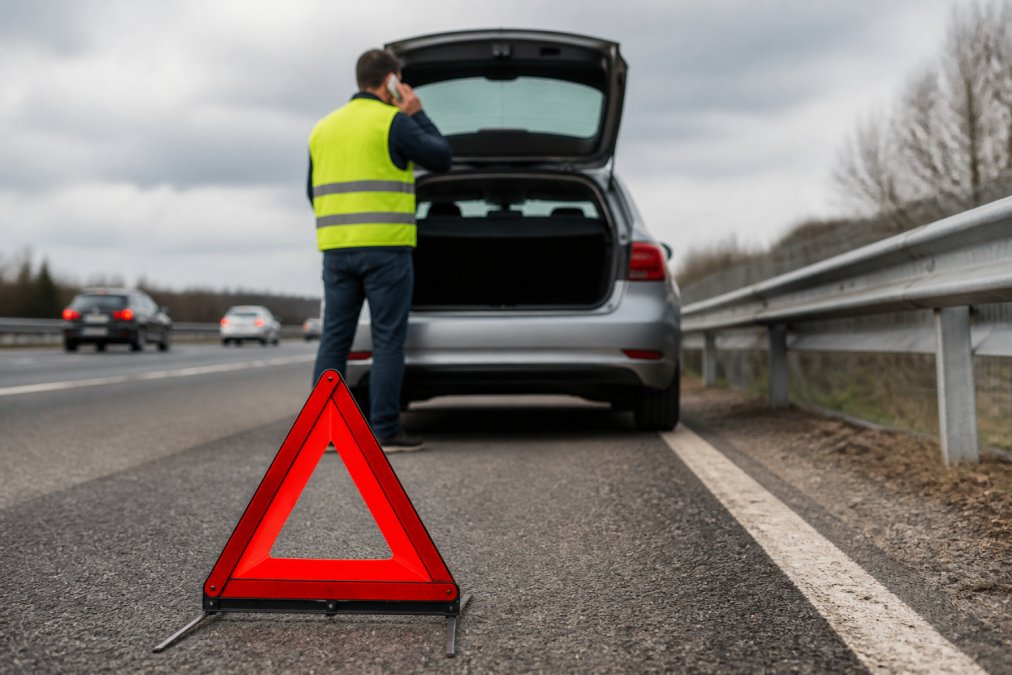
Motorway Breakdown Rules: Highway Code Guide
Table of Contents
- Understanding Motorway Breakdown Rules Under The Highway Code
- Step 1: Activate Hazard Warning Lights and Find a Place of Relative Safety
- Step 2: Exit Your Vehicle Safely and Position Warning Equipment
- Step 3: Alert Other Traffic and Use Emergency Refuge Areas
- What to Do if You Break Down on a Smart Motorway
- High Visibility Roadside Safety Equipment You Must Carry
- Emergency Breakdown Kit Essentials and Contact Procedures
- Common Mistakes to Avoid During a Motorway Breakdown
- Frequently Asked Questions
Last Updated: September 23, 2026
Understanding Motorway Breakdown Rules Under The Highway Code
When your vehicle breaks down on a motorway, every decision matters. Understanding motorway breakdown rules protects you, your passengers, and other road users from the dangers of stationary vehicles on high-speed roads.
A breakdown on a busy motorway creates an immediate hazard. The Highway Code Rule 275 requires you to switch on hazard warning lights immediately and move to the hard shoulder if it’s safe to do so, making your vehicle visible and getting yourself and passengers to safety quickly.
This guide covers the exact steps the Highway Code requires, what equipment you must carry, and the common mistakes that put drivers at serious risk.
The moment you realise your vehicle is breaking down, activate hazard warning lights before anything else. This single action alerts traffic behind you within seconds, giving drivers time to change lanes or slow down.
Step 1: Activate Hazard Warning Lights and Find a Place of Relative Safety
Switch on your hazard warning lights the moment you notice a problem. This is Rule 275 of the Highway Code and the first critical action.
Once hazard lights are on, reach the hard shoulder by steering smoothly across lanes, signalling clearly and checking mirrors.
On smart motorways, emergency refuge areas are designated safe zones marked on the nearside, specifically designed for breakdowns and monitored by traffic officers. Use them if you can reach them safely.
If your vehicle fails completely and you cannot reach the hard shoulder or emergency refuge area, switch on hazard lights, contact emergency services immediately, and stay in your vehicle with seatbelts fastened.
| Breakdown Location | Action | Safety Level |
|---|---|---|
| Hard shoulder | Move to it safely, switch on hazards | Protected from live traffic |
| Emergency refuge area | Move to it if accessible | Monitored, designed for breakdowns |
| Live lane (cannot escape) | Stay in vehicle, hazards on, call 999 | Call emergency services immediately |
| Slip road | Move off motorway if possible | Safest option if accessible |
Step 2: Exit Your Vehicle Safely and Position Warning Equipment
Once stopped safely, exit your vehicle carefully, opening the door slowly and checking for traffic.
Get all passengers out and position them on the verge away from traffic, especially children and elderly passengers.
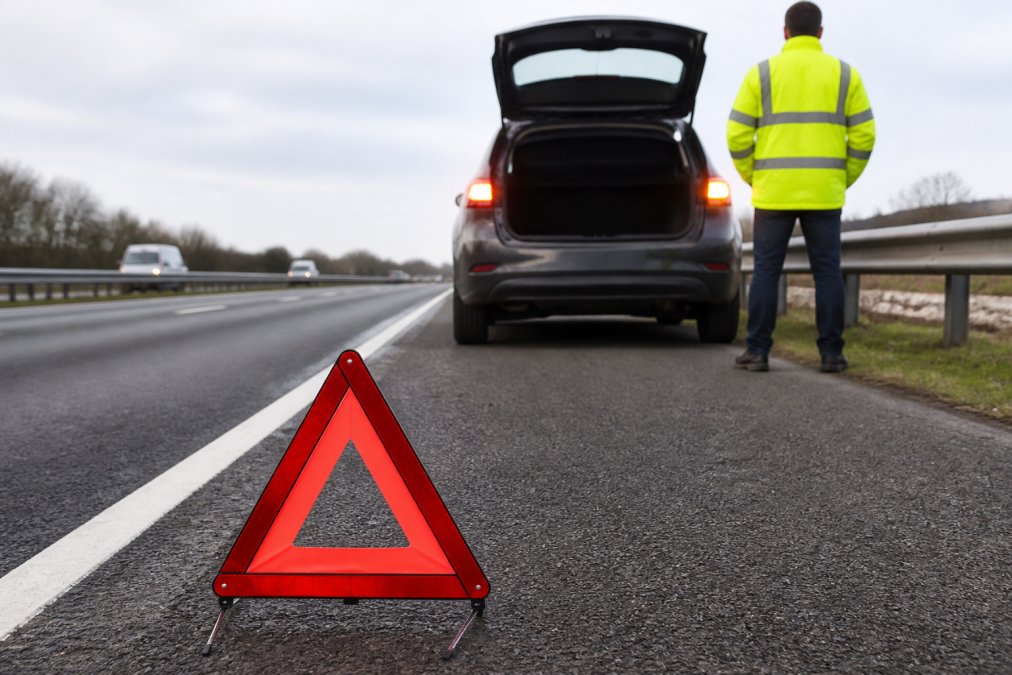
Position your warning triangle at least 45 metres behind your vehicle on the hard shoulder (The Highway Code – Breakdowns and incidents (275 to 287) – Guidance). In poor visibility or darkness, position it further back.
Wear high-visibility clothing. The Highway Code Rule 283 requires high-visibility vests or jackets when exiting your vehicle on a motorway (The Highway Code – Breakdowns and incidents (275 to 287) – Guidance). Keep these in your vehicle at all times, your visibility can mean the difference between a safe breakdown and a serious collision.
Position yourself and passengers on the verge side, away from the roadway. If you must return to your vehicle, do so quickly and carefully.
Standing on the hard shoulder without high-visibility clothing is dangerous and illegal. Drivers may not see you, especially in poor light or bad weather. A single lapse in visibility has caused fatal accidents.
Step 3: Alert Other Traffic and Use Emergency Refuge Areas
On smart motorways, use the emergency refuge area phone to report your breakdown directly to the control centre, which can manage traffic flow and dispatch recovery services.
On standard motorways, call 999 and provide: your location (using blue and white marker posts), vehicle registration and colour, nature of breakdown, whether anyone is injured, and number of passengers.
Stay in your vehicle if traffic is heavy, it provides protection from impact.
Do not attempt repairs unless it’s a simple fix like a loose fuel cap. For anything more serious, wait for recovery services.
What to Do if You Break Down on a Smart Motorway
Smart motorways use variable speed limits and lane control signs. Some sections have no traditional hard shoulder, requiring different breakdown handling.
If your vehicle fails on a smart motorway, activate hazard lights immediately. Use the hard shoulder if available, or slow down gradually to reach the next emergency refuge area or exit slip road.
Emergency refuge areas on smart motorways are spaced roughly every mile. They’re clearly marked with blue signs. These areas have emergency telephones and are monitored by traffic control systems. Use the emergency phone to contact the control centre, this is the safest option.
If you break down in a live lane and cannot reach safety, stay in your vehicle with hazards on. Call 999 immediately. Do not attempt to exit onto the live motorway. Traffic officers or emergency services will manage the incident and close the lane if necessary.
Smart motorway incidents are managed more actively than traditional motorways. Once you’ve reported your breakdown via the emergency refuge area phone or by calling 999, traffic control can close the lane you’re in, reducing the risk of further collisions.
Smart motorways require you to reach an emergency refuge area or move to the hard shoulder. Never attempt to repair a vehicle or retrieve items from a live lane. Your safety depends on getting out of traffic flow as quickly as possible.
High Visibility Roadside Safety Equipment You Must Carry
The Highway Code requires certain equipment for motorway travel. High-visibility clothing is mandatory. A warning triangle is mandatory. But many drivers carry additional equipment that significantly improves safety.
High-visibility vests or jackets must meet British Standard BS EN ISO 20471 (British Standards Institution). They must be worn whenever you exit your vehicle on a motorway. Keep at least one in your vehicle at all times, stored where you can access it quickly.
Warning triangles must be reflective and visible from at least 100 metres away. The Highway Code requires at least one triangle. Many drivers carry two, one for behind the vehicle and one for additional warning further back.
Hazard warning lights are built into your vehicle. Ensure they work before long motorway journeys. Test them in your driveway and listen for the distinctive clicking sound.
Beyond mandatory equipment, Roadflash emergency beacons provide significantly enhanced visibility and hazard awareness. These multi-award-winning early warning systems are designed to prevent vehicle collisions, especially for stationary vehicles on busy highways and motorways.
Consider carrying:
- Spare high-visibility vests for all passengers
- Torch or headlamp for night-time breakdowns
- Reflective gloves for working in darkness
- First aid kit
- Jumper cables or portable jump starter
- Basic tool kit
- Mobile phone charger
Emergency Breakdown Kit Essentials and Contact Procedures
Your emergency breakdown kit should contain items that help you manage a breakdown safely while waiting for recovery. Not all items are mandatory, but they significantly improve your ability to handle common problems.
Essential items:
- Spare fuses (matching your vehicle’s electrical system)
- Spare fan belt
- Jump leads or portable jump starter
- Spare coolant
- Engine oil
- Spare wheel (or puncture repair kit if your vehicle uses one)
- Jack and wheel brace
- Spare bulbs (headlight, tail light, brake light)
Additional safety items:
- Torch with spare batteries
- Reflective gloves
- Spare high-visibility vests
- First aid kit
- Fire extinguisher (small, vehicle-rated)
- Spare keys (kept separately from your main keys)
Contact procedures depend on your location:
- Emergency refuge area on smart motorway: Use the emergency phone (connects directly to control centre)
- Hard shoulder on standard motorway: Call 999 if there’s immediate danger, or your breakdown provider if it’s a routine breakdown
- Mobile phone: Provide your location using the blue and white marker posts (they show your distance along the motorway)
Always provide:
- Vehicle registration
- Vehicle colour and make
- Nature of the breakdown
- Your location (distance marker or junction number)
- Whether anyone is injured
- Number of passengers
- Your contact number
Common Mistakes to Avoid During a Motorway Breakdown
Most motorway breakdown incidents that turn serious involve preventable errors. Understanding these mistakes could save your life.
Frequently Asked Questions
What are the key motorway breakdown rules in The Highway Code?
The Highway Code requires you to activate hazard warning lights immediately, move to a place of relative safety (hard shoulder or emergency refuge area), exit the vehicle away from traffic, and contact emergency services. You must position a warning triangle at least 45 metres behind your vehicle and wear high-visibility clothing. On smart motorways, use emergency refuge areas rather than the hard shoulder where possible. Never attempt repairs on the motorway itself, stay safe and call for roadside assistance.
What should you do if you break down on a smart motorway?
Smart motorways have electronic signs and emergency refuge areas spaced at regular intervals. If your vehicle breaks down, activate hazard lights and move to the nearest emergency refuge area if possible. If you cannot reach one safely, pull onto the hard shoulder as a last resort. Do not attempt to fix the vehicle. Use the emergency telephone in the refuge area or call emergency services. Stay inside your vehicle with doors locked, away from traffic. Smart motorways have CCTV monitoring, so help will be dispatched quickly once you contact them.
What high visibility roadside safety equipment must I carry?
You must carry a warning triangle, high-visibility gilet or jacket, and hazard warning lights. The warning triangle should be placed 45 metres behind your vehicle on the road. High-visibility clothing must be worn by anyone exiting the vehicle. Many drivers now carry LED warning beacons or emergency lights as additional safety equipment, which improve vehicle visibility at the side of roads, protecting drivers and passengers during breakdowns, especially in poor visibility or darkness. These items are essential for alerting other traffic to your stationary vehicle.
What should an emergency breakdown kit contain?
An emergency breakdown kit should include: warning triangle, high-visibility gilet, hazard warning lights or LED beacons, torch with spare batteries, first aid kit, jump leads, spare fuses, tools (screwdrivers, adjustable wrench), spare belts, coolant, oil, and water. Include a mobile phone charger, blanket, and contact numbers for roadside assistance. Keep the kit easily accessible in your vehicle. For motorway travel specifically, prioritise the warning triangle, visibility clothing, and lights, these are non-negotiable. Consider adding an emergency beacon with GPS/Geolocation for faster emergency response if you break down in remote areas.