
How to Prepare Your Car for Long Motorway Journeys
Table of Contents
- Step 1: Check Your Engine Fluids and Coolant
- Step 2: Inspect Your Tyres, Pressure, and Tread Depth
- Step 3: Test Lighting, Wipers, and Electrical Systems
- Step 4: Pack High Visibility Roadside Safety Equipment
- Step 5: Prepare Motorway Breakdown Safety Tips and Emergency Essentials
- Step 6: Plan Your Route and Manage Driver Fatigue
- Step 7: Verify Documentation and Breakdown Cover Before You Go
- Frequently Asked Questions
Last Updated: September 21, 2026
Understanding how to prepare your car for long motorway journeys prevents breakdowns that can turn dangerous in seconds. This guide covers how to prepare your car for long motorway journeys, from mechanical checks to safety equipment.
Most motorway incidents are preventable with proper pre-journey preparation. The steps below focus on what matters when you’re stationary on a high-speed road.
Step 1: Check Your Engine Fluids and Coolant
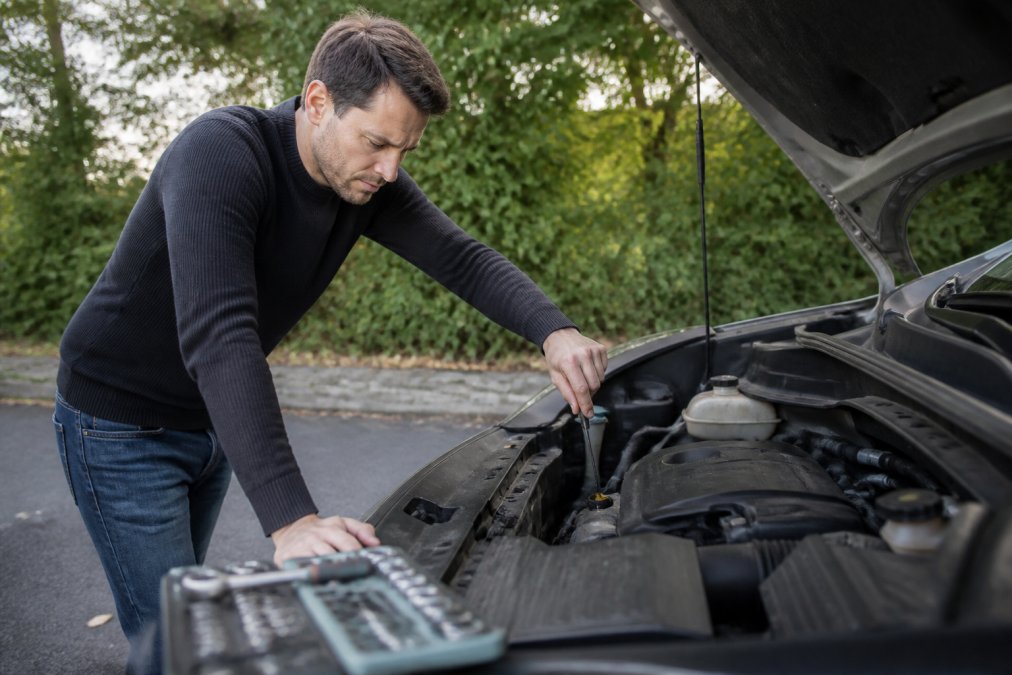
Check your oil level using the dipstick when the engine is cold before driving. Low oil causes engine failure on motorway journeys and is a common breakdown reason.
Check your coolant reservoir (not the radiator cap, which is dangerous when hot) and top up with the correct type. Overheating is a serious motorway risk, especially in summer or when towing.
Check brake fluid levels. A noticeable drop indicates a leak; have the system inspected before driving.
Keep a small bottle of your vehicle’s correct engine oil in the boot. On a motorway, you cannot nip to a garage if you run low. Having oil with you means you can top up safely at a service station rather than risk engine damage.
Step 2: Inspect Your Tyres, Pressure, and Tread Depth
Check tyre pressure when cold using the correct PSI listed on the sticker inside your driver’s door. Under-inflated tyres cause blowouts at high speed.
Tread depth must be at least 1.6 mm, though 3 mm is recommended for motorway driving. Use a tread depth gauge to check accurately.
Check all four tyres for damage, bulges, uneven wear, and embedded objects. Uneven wear suggests alignment issues needing attention before motorway driving.
Don’t forget the spare tyre. Inspect it for damage and check its pressure. Many drivers discover their spare is flat only when they need it, on a motorway with no recovery nearby.
Step 3: Test Lighting, Wipers, and Electrical Systems
Check all lights function: headlights, fog lights, brake lights, indicators, and reversing lights. Faulty lighting is dangerous and illegal.
Replace wiper blades if they streak or skip. Keep screenwash topped up to prevent visibility loss from spray.
Test battery condition, especially in winter. If your car struggles to start, have it checked before the journey.
Check heating, air conditioning, and demister, essential for visibility and comfort on long motorway stretches.
Step 4: Pack High Visibility Roadside Safety Equipment
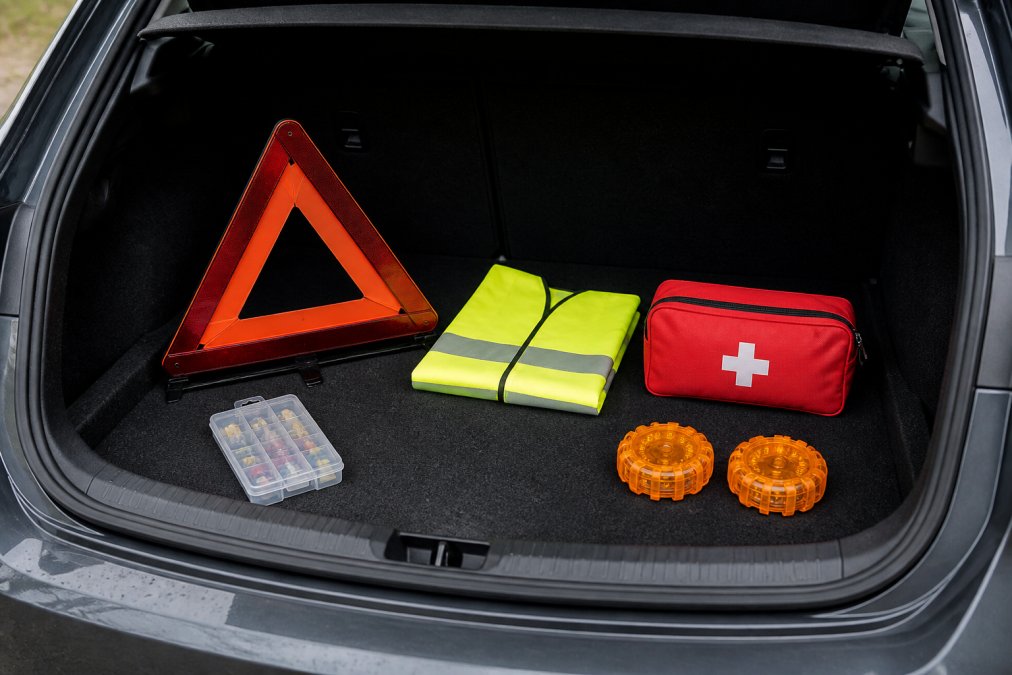
Pack a warning triangle, fluorescent jacket, and first aid kit, legally required in many European countries and essential for motorway safety.
Place a warning triangle 45 metres behind your vehicle. However, LED warning lights are more effective in darkness or poor visibility.
Wear a fluorescent jacket whenever you exit your vehicle on the motorway. Keep one for each occupant.
Pack a first aid kit with bandages, antiseptic, pain relief, and personal medications. Immediate treatment before emergency services arrive can be lifesaving.
Also carry spare fuses, jump leads, a torch, a mobile phone charger, and a tow rope in your boot.
Never stand between your vehicle and oncoming traffic. Position yourself behind the barrier or as far from the carriageway as possible. Approaching vehicles may not see you or your warning triangle in time. This is where high-visibility beacons become critical, they alert drivers at greater distances than static triangles.
Step 5: Prepare Motorway Breakdown Safety Tips and Emergency Essentials
If you break down, switch on hazard lights immediately and move to a safe location behind a barrier or away from traffic.
Place your warning triangle 45 metres behind the vehicle. High-visibility emergency beacons with GPS provide superior visibility and alert emergency services to your exact location.
Call breakdown cover immediately with your location and vehicle details. If you can safely reach an emergency refuge area, wait there rather than on the hard shoulder.
Do not attempt repairs on a motorway. Wait for professional recovery; your safety is worth more than the cost of a tow.
Keep your mobile phone charged and accessible. A dead battery when you need to call for help is a genuine emergency. Carry a portable charger in your vehicle.
Motorway-Specific Driving Techniques to Prevent Breakdown Risk
Many breakdowns occur not from mechanical failure but from driver error under high-speed conditions. Understanding motorway-specific handling reduces your risk significantly.
Cruise control usage: Use cruise control only in dry conditions on well-maintained roads. Disable it if weather deteriorates or visibility reduces, as it masks tyre grip loss in wet conditions.
Lane discipline and positioning: Stay in the left lane unless overtaking. Constant lane-changing increases fuel consumption, tyre wear, and collision risk. Avoid sitting in the middle lane.
Handling crosswinds and high-speed stability: Grip the steering wheel firmly and be prepared for small corrections near bridges or when passing large vehicles. If you feel a sudden gust, ease off the accelerator rather than braking sharply.
Tyre temperature and pressure management: Tyre pressure increases with heat during motorway driving. Check pressure only when cold; do not deflate warm tyres. This is why pre-journey pressure checks are critical.
Fuel management and range anxiety: Plan refuelling stops before your tank drops below half full. Running low on fuel on a motorway is entirely preventable and increasingly common with drivers unfamiliar with their vehicle’s actual range. Modern vehicles display estimated range, but this varies with driving style, weather, and load. Conservative estimates prevent the stress and danger of searching for a service station on empty.
Motorway breakdowns are survivable if you’re prepared, but many are preventable through proper driving technique. Visibility equipment, breakdown cover, and a charged phone transform a dangerous situation into a manageable one. The difference between a near-miss and a collision is often just seconds, which is why high-visibility equipment and motorway-aware driving matter more than most drivers realise.
Step 6: Plan Your Route and Manage Driver Fatigue
Use a sat-nav with up-to-date mapping and programme your destination before driving. Avoid programming while moving.
Plan refuelling stops before your tank drops below half full. Running out of fuel on a motorway is entirely preventable.
Electric Vehicle Motorway Planning
If you’re driving an electric vehicle, route planning becomes more complex and critical. Unlike petrol or diesel vehicles, EVs require deliberate charging infrastructure planning.
Charging network mapping: Before departure, identify charging points along your route using apps such as Zap-Map or PlugShare, which show real-time availability and charging speeds. Motorway service stations increasingly offer rapid chargers (50 kW to 350 kW), but availability varies by location and network operator. Plan your route to include charging stops at intervals matching your vehicle’s real-world range, not the manufacturer’s optimistic estimate.
Battery pre-conditioning: Modern EVs allow you to pre-condition the battery before departure. On a long motorway journey, pre-condition to around 80% state of charge (not 100%), which optimises charging speed at rapid chargers. Cold batteries charge more slowly; if your vehicle has thermal management, activate heating 15-20 minutes before departure to warm the battery. This reduces charging time at service stations by 10-20%.
Range calculation and weather impact: EV range decreases in cold weather (typically 20-40% loss below 5°C) and at motorway speeds due to aerodynamic drag. Calculate your real-world range conservatively: if your vehicle claims 300 miles in ideal conditions, assume 200-220 miles in winter or at sustained motorway speeds. Plan charging stops accordingly. Headwinds and hilly terrain further reduce range; check your route profile.
Charging time and journey planning: Rapid charging from 10% to 80% typically takes 20-40 minutes depending on charger speed and battery size.
Managing Driver Fatigue on Long Motorway Journeys
Driver fatigue is a serious risk on long motorway journeys. Fatigue-related accidents are as dangerous as drink-driving. The Highways Agency estimates that fatigue contributes to approximately 10% of motorway accidents.
If you feel drowsy, do not rely on music, open windows, or pinching yourself to stay awake. These are temporary measures that mask fatigue. Stop at a service station, have a 20-minute nap, or hand over to another driver. Fatigue-related accidents are often fatal; prevention is far simpler than recovery.
Step 7: Verify Documentation and Breakdown Cover Before You Go
Verify your MOT certificate is current. An expired MOT is not legally roadworthy and motorway patrols can stop you.
Frequently Asked Questions
What are the essential car checks before a long motorway journey?
Before setting out, check engine oil and coolant levels, inspect tyre pressure and tread depth, test all lights and wipers, verify your MOT status and insurance are current, and ensure your battery is in good condition. For motorway journeys specifically, also confirm your breakdown cover is active and pack a high-visibility jacket, warning triangle, and first aid kit. These checks take 20 minutes but significantly reduce the risk of breakdown or accident.
How does high visibility roadside safety equipment actually prevent accidents?
When your vehicle is stationary on a motorway, high-visibility equipment like fluorescent jackets and warning lights make you and your car visible to approaching drivers much earlier. Research shows drivers need extra time to react at motorway speeds; early warning systems give them that time. Modern emergency beacons with LED technology are visible from much greater distances than traditional triangles, especially in poor light or bad weather. This visibility gap is the difference between a near-miss and a collision.
What motorway breakdown safety tips should I follow if I break down?
If you break down on a motorway, turn on your hazard lights immediately, steer onto the hard shoulder if safe, and switch off the engine. Put on your fluorescent jacket before exiting the vehicle. Place a warning triangle or activate an emergency beacon at least 45 metres behind your vehicle to alert approaching traffic. Stay behind the barrier if possible and call for roadside assistance. Never attempt repairs in live traffic lanes, and keep passengers away from the moving traffic side of the vehicle.
How often should I take a break during a long motorway drive?
Take a break at least every two hours or every 100 miles, whichever comes first. Fatigue is a major factor in motorway accidents. During breaks, get out of the vehicle, stretch, hydrate, and if possible, take a 15-minute nap in a safe location. Avoid heavy meals before driving, as they increase drowsiness. If you feel tired, stop immediately, no break is too frequent when safety is at stake. For journeys longer than six hours, plan to share driving with another qualified driver.