

Motorway Breakdown Safety: Why It’s Critical
Table of Contents
- Why Motorway Breakdown Safety Is Critical
- What to Do If Your Car Breaks Down on a Motorway
- High Visibility Roadside Safety Equipment That Works
- Highway Code Breakdown Rules You Must Know
- Staying Safe on Smart Motorways and Emergency Refuge Areas
- Managing Panic and Staying Alert During a Breakdown
- When to Call for Professional Assistance
- Conclusion
Last Updated: August 21, 2026
Why Motorway Breakdown Safety Is Critical
Motorway breakdowns happen without warning. A mechanical failure, a puncture, or an electrical fault can leave you stranded on one of the busiest road networks in the country, where vehicles travel at 70 mph or more. The difference between a managed breakdown and a catastrophic collision often comes down to preparation and immediate action. Motorway breakdown safety is not optional, it’s the barrier between an inconvenient stop and a life-threatening emergency.
Every year, thousands of drivers experience breakdowns on motorways. Many pull onto the hard shoulder unprepared, without the right equipment or knowledge of what to do next. The risks are substantial: stationary vehicles become invisible to approaching traffic in poor visibility, blind spots swallow entire cars, and a single collision at high speed can cause multiple casualties. The pattern is clear: drivers who take motorway breakdown safety seriously, by carrying proper equipment and understanding the rules, walk away. Those who don’t often don’t.
The stakes are higher on a motorway than anywhere else. Traffic flow is continuous, speeds are high, and reaction time is measured in seconds. This guide covers the practical steps, essential equipment, and legal requirements that keep you safe when your vehicle stops.
What to Do If Your Car Breaks Down on a Motorway
When your car breaks down on a motorway, the first 60 seconds determine your safety. Your immediate actions can mean the difference between a controlled situation and a dangerous one.
Immediate Actions: The First 60 Seconds
The moment you notice a problem, a warning light, a strange noise, loss of power, assess whether you can reach the next exit or the hard shoulder safely. If you can, do so without sudden movements. If you cannot, activate your hazard warning lights immediately. This single action tells other drivers that your vehicle is stationary.
Once you’ve stopped on the hard shoulder, turn off the engine. Leave your seatbelt fastened and do not attempt to repair anything roadside. Set your hazard lights to flash continuously. If you have an emergency beacon or high-visibility warning system, activate it now. This is the critical window where visibility equipment prevents collisions.
Call for assistance. Use your mobile phone to contact breakdown cover, or dial 999 if you’re in immediate danger. Provide the traffic officers with your location, use the nearest motorway marker post number, visible on small green signs every 100 metres along the hard shoulder. This information is far more precise than describing where you think you are.
Exiting Your Vehicle Safely
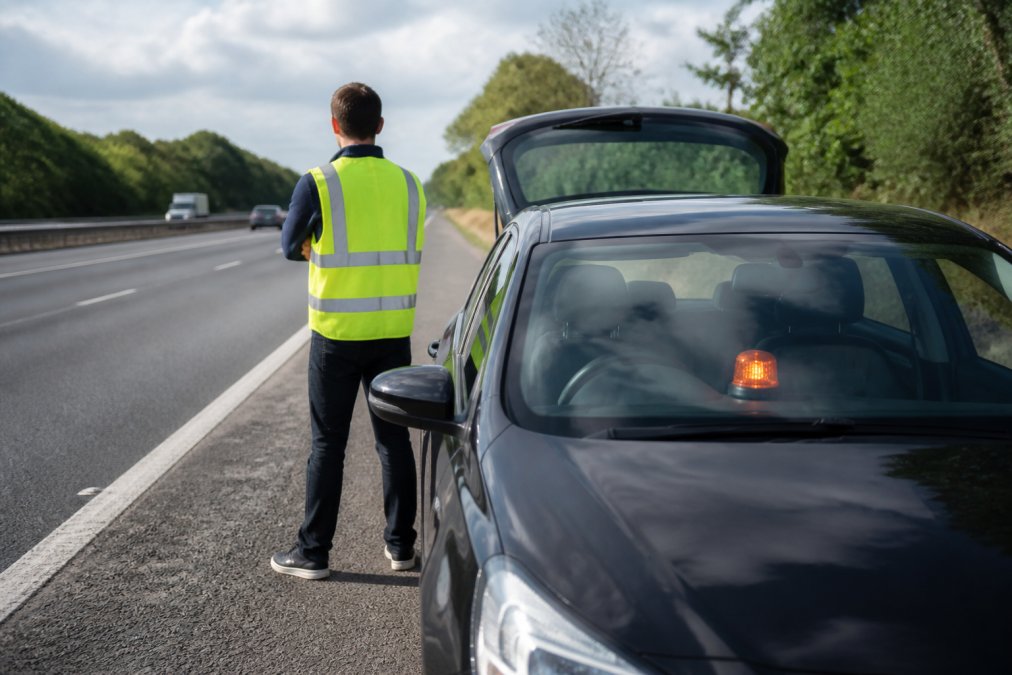
Exiting your vehicle on a motorway hard shoulder requires deliberate, cautious movement. Do not open the door into live traffic. Check your mirrors and look over your shoulder before opening the door. Step out onto the hard shoulder side, away from the traffic flow. Never stand between your vehicle and the live lanes.
Move to a safe position behind your vehicle or, if possible, move away from it entirely toward the safety barrier. Wear your high-visibility vest, it must be visible from at least 100 metres in daylight (gov.uk). If you have passengers, ensure they also wear high-visibility clothing and move away from the vehicle.
Do not attempt to flag down other motorists or stand in the traffic lanes. Do not lean against your vehicle or sit inside it. The safest position is behind the safety barrier, away from both your vehicle and the hard shoulder edge. If the weather is poor or visibility is low, stay inside your vehicle with the doors locked and hazard lights on, but only if you are in immediate danger from the traffic. Otherwise, move to the barrier.
Keep children and pets with you and and away from the traffic. Elderly passengers or those with mobility issues should move to a safe location and remain there until help arrives.
High Visibility Roadside Safety Equipment That Works
High-visibility equipment serves one purpose: to make your stationary vehicle impossible to miss. The hazard warning lights built into your car are designed for moving traffic; they’re not bright enough to alert approaching drivers to a stationary vehicle, especially in poor light or bad weather.
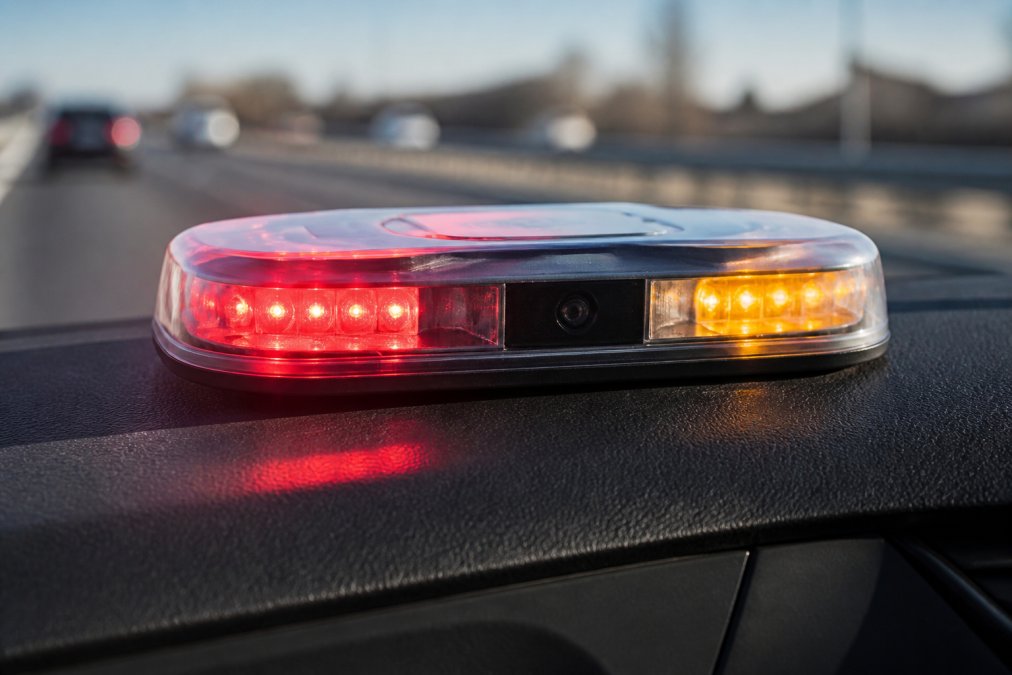
A reflective warning triangle is the legal minimum in many situations, but it has severe limitations. It’s low to the ground, easily obscured by weather, and offers no active warning. Drivers approaching at speed may not see it until it’s too late. Modern early warning systems address this gap. Roadflash’s multi-award-winning emergency beacons combine high-intensity LED lighting with GPS geolocation, ensuring that your vehicle is visible from a significant distance and that emergency services can locate you precisely.
LED hazard warning lights mounted on your vehicle roof or dashboard are far more visible than reflective triangles alone. They pulse at a frequency that draws attention and can be seen from hundreds of metres away, even in daylight. The best systems include both front and rear warning lights, creating a visible perimeter around your vehicle.
For drivers who frequently travel motorways, investing in a dedicated high-visibility system is practical insurance. Roadflash beacons are DGT 3.0 compliant, meaning they meet the strictest international standards for visibility and reliability. They activate instantly and require no manual setup, critical when you’re stressed and traffic is approaching.
Keep a reflective warning triangle in your vehicle regardless of what other equipment you carry. It’s a legal requirement in many situations and serves as backup if your primary warning system fails. Store it where you can access it quickly, not buried in the boot.
Highway Code Breakdown Rules You Must Know
The Highway Code sets out specific rules for breakdowns on motorways. Understanding these rules keeps you legal and safe.
Rule 275 of the Highway Code states that if your vehicle breaks down on a motorway, you must switch on your hazard warning lights immediately (gov.uk). You must also display a warning triangle at least 45 metres behind your vehicle (or use hazard lights if you don’t have a triangle). This distance accounts for the stopping distance of an approaching vehicle at motorway speeds.
Rule 276 requires that you move your vehicle off the motorway if possible. If you cannot do so, you must move all passengers away from the traffic and the hard shoulder. Do not stand on the hard shoulder itself, move to the safety barrier or beyond.
Rule 277 instructs you to use the emergency telephone system. These phones connect directly to the police without charge and provide your exact location. If you use your mobile phone, the emergency services may take longer to locate you. The emergency phones are positioned every mile along the motorway.
Rule 278 covers recovery. You must not attempt to repair your vehicle on the motorway unless it’s a minor, safe adjustment (such as refitting a loose wheel trim). Any repair work puts you and other motorists at risk. Wait for professional recovery.
These rules exist because stationary vehicles on high-speed roads create collision hazards. Every second your vehicle remains unmarked or unnoticed increases the risk. Following the rules precisely is not bureaucracy, it’s survival.
Staying Safe on Smart Motorways and Emergency Refuge Areas
Smart motorways use variable speed limits and dynamic hard shoulder management to control traffic flow. On some smart motorways, the hard shoulder becomes a live traffic lane during peak hours. This fundamentally changes where you can safely stop.
If your vehicle breaks down on a smart motorway, the key is to identify whether the hard shoulder is currently active as a live lane. If it is, do not stop there. Instead, try to reach an emergency refuge area (ERA). These are marked bays set back from the live lanes, spaced approximately 1.6 kilometres apart (gov.uk). They’re designed specifically as safe stopping points for breakdowns on smart motorways.
If you cannot reach an ERA, stop on the hard shoulder and immediately activate your hazard lights and high-visibility warning system. Move away from your vehicle toward the safety barrier. The absence of a traditional hard shoulder means traffic is closer and faster, visibility equipment becomes even more critical.
Smart motorways present a unique hazard: drivers may not expect stationary vehicles in certain locations. A high-visibility beacon or LED warning system alerts approaching traffic to your presence before they’re committed to a collision course. Roadflash beacons are particularly effective on smart motorways because their GPS feature helps emergency services locate you in emergency refuge areas, where pinpointing your exact location can be difficult.
If you reach an emergency refuge area, stay inside your vehicle with doors locked and hazard lights on. These areas have their own emergency phones and are monitored by traffic officers. Do not stand outside unless visibility is extremely poor or you’re in immediate danger.
Managing Panic and Staying Alert During a Breakdown
A motorway breakdown triggers stress responses that impair judgment. Your heart rate increases, your focus narrows, and you may make decisions you’d normally avoid. Managing this psychological response is as important as the practical steps.
The first thing to do is acknowledge the panic response. You’re not in immediate danger if you’ve stopped safely and activated your hazard lights. Repeat this to yourself: "I am stopped safely. I have activated my warning lights. Help is on the way." This simple mental reset prevents reactive mistakes.
Breathing matters. When stressed, people hold their breath or breathe shallowly, which increases anxiety. Deliberately breathe slowly and deeply for 30 seconds. This calms your nervous system and restores clear thinking.
Stay in your vehicle if it’s safer to do so. If traffic is moving at speed and visibility is poor, remaining inside with doors locked and hazard lights on is more sensible than standing on the hard shoulder. You’re protected by your vehicle’s structure, and you’re out of the traffic stream. Only exit if you’re certain it’s safer to do so.
Do not attempt to flag down traffic or leave your vehicle to direct other drivers. This puts you in the path of high-speed traffic and distracts approaching drivers. Let the warning lights do their job. They’re far more effective than hand signals.
If you have passengers, especially children, keep them calm. Explain what’s happening in simple terms. Keep them inside the vehicle or, if you’ve moved to the safety barrier, keep them close and away from the traffic edge. Their sense of safety depends on your composure.
Avoid using your phone to take photos or videos of the incident. Your attention should be on the situation around you, not on documenting it. If you need to contact someone, make the call, then put the phone away.
When to Call for Professional Assistance
Do not attempt roadside repairs on a motorway. Even simple fixes, reattaching a loose panel, checking fluid levels, require you to stand in or near the traffic stream and distract your attention from approaching vehicles. The risk is not worth the time saved.
Call your breakdown cover provider or the emergency services immediately. Provide your exact location using the motorway marker posts. These green and white signs appear every 100 metres on the hard shoulder and include a unique reference number. This is far more reliable than describing where you think you are.
If you don’t have breakdown cover, call 999. The police will attend and arrange recovery. You’ll pay for recovery costs, but the emergency response is free. If you’re injured or in immediate danger, 999 is the right choice regardless of breakdown cover.
For non-emergency breakdowns (your vehicle has stopped but you’re safe and not blocking traffic), you can use the emergency telephone system or your mobile phone. If you use your mobile, inform the operator that you’re on a motorway and provide the marker post number.
Do not accept help from strangers offering to repair your vehicle or tow it away. Professional recovery services are insured and accountable. Unofficial recovery can leave you without legal protection if something goes wrong.
Wait inside your vehicle with doors locked until professional help arrives. Keep your hazard lights and warning system activated. If recovery takes longer than expected and you’re concerned about safety, contact the emergency services again.
Conclusion
Motorway breakdown safety depends on three things: preparation, immediate action, and the right equipment. A breakdown is not a failure, it’s an inevitable part of driving. What matters is how you respond.
Roadflash has designed emergency beacons and high-visibility warning systems specifically to address the gaps in standard vehicle safety equipment. Their multi-award-winning beacons combine LED hazard lighting with GPS geolocation, ensuring you’re visible to approaching traffic and locatable by emergency services. When your vehicle stops on a motorway, Roadflash equipment makes the difference between a managed incident and a collision.
Prepare now: carry a warning triangle, invest in a high-visibility beacon, and understand the Highway Code rules. When a breakdown happens, activate your hazard lights, move to safety, and call for help. The 60 seconds after your vehicle stops determine everything that follows. Make them count.
Frequently Asked Questions
Q: What should I do immediately if my vehicle breaks down on a motorway?
A: Turn on your hazard warning lights immediately and steer to the hard shoulder if safe to do so. Switch off the engine. If on a smart motorway without a hard shoulder, proceed to an emergency refuge area. Put on a high-visibility vest before exiting. Stay behind a safety barrier or as far from live traffic as possible. Call the emergency services on 999 if there's danger, or use the motorway emergency phone or your mobile to contact Highways England. Do not attempt repairs in live traffic.
Q: Why is high visibility roadside safety equipment essential during a breakdown?
A: High visibility equipment, including hazard lights and emergency beacons, dramatically increases your vehicle's visibility to oncoming traffic at high speed. Early warning systems with GPS/Geolocation features alert approaching drivers much sooner than passive reflective triangles, reducing collision risk. On busy motorways where traffic approaches at 70 mph or faster, the few extra seconds of warning these systems provide can be the difference between a safe incident and a catastrophic collision.
Q: What does the Highway Code say about motorway breakdowns?
A: The Highway Code requires you to switch on hazard warning lights, move to the hard shoulder if possible, and stay outside your vehicle away from traffic. You must wear a high-visibility vest. On smart motorways, you must reach an emergency refuge area. Never attempt repairs on a live lane. Always use the nearest emergency telephone or call Highways England. Keep passengers, especially children and pets, away from the traffic flow and behind safety barriers.
Q: How can I stay calm and alert if I break down on a motorway?
A: Panic impairs decision-making when you need it most. Take three deep breaths before exiting your vehicle. Focus on one action at a time: hazard lights, then exit, then visibility gear. Remind yourself that stationary vehicles are visible hazards, your job is to warn approaching traffic. If you have passengers, assign them tasks (calling for help, watching for traffic) to keep them engaged. Once you're safely behind a barrier in high-visibility clothing, the immediate danger drops significantly, which helps reduce anxiety.
This article was written using GrandRanker