
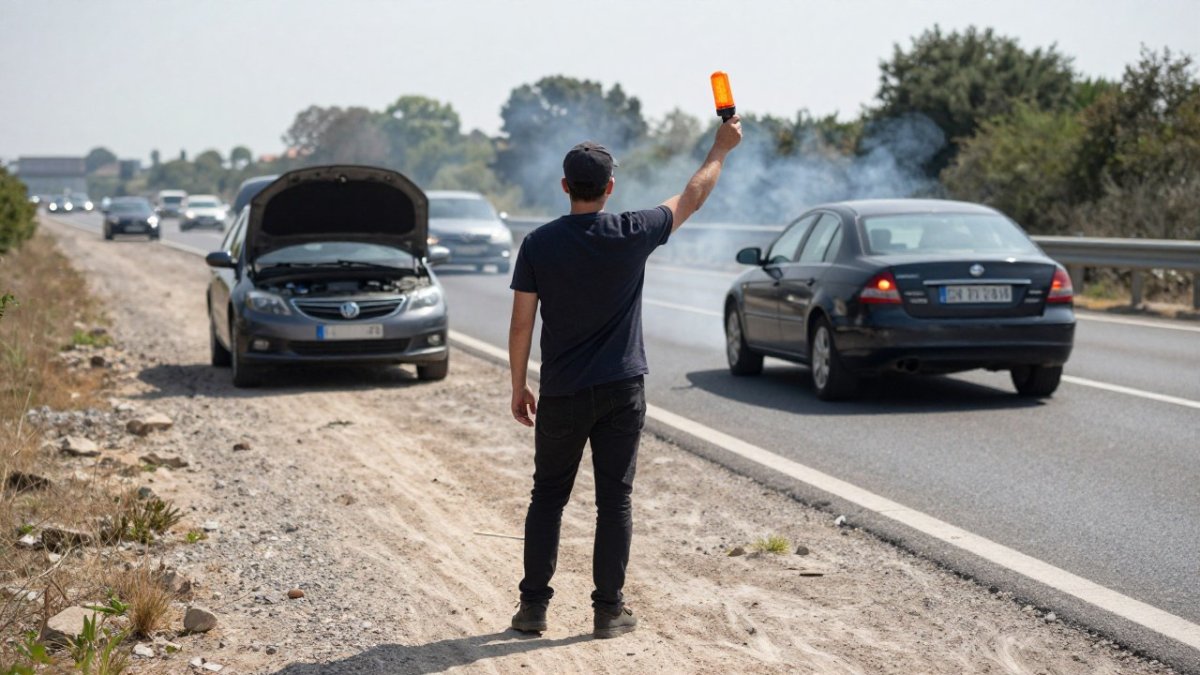
7 Steps to Take If Your Car Breaks Down in Spain
Last Updated: November 20, 2026
Quick Summary
If your car breaks down on Spanish motorways, switch on your hazard lights first, steer to the hard shoulder, and get everyone out on the side away from traffic. Wait behind a barrier and call 112 if anyone is hurt or the car blocks a lane.
- Switch on hazard warning lights before doing anything else.
- Get everyone out on the side away from traffic and wait behind a barrier.
- Call 112 for injuries, fire, or a car stopped in a live lane.
- Note the motorway number, direction, and nearest kilometre marker before calling.
- Check current DGT rules for approved warning devices before travelling.
Table of Contents
- Why Breakdowns on Spanish Motorways Need a Different Response
- Decision Tree: Emergency or Ordinary Breakdown?
- What to Do If Your Car Breaks Down in Spain: The Step-by-Step Sequence
- DGT 3.0 Emergency Beacon Requirements and Warning Triangles
- How to Use a V16 Beacon on a Motorway
- Calling 112, SOS Telephones and Roadside Assistance in Spain
- Planning Ahead Before Your Next Spanish Motorway Trip
- Frequently Asked Questions
Why Breakdowns on Spanish Motorways Need a Different Response
A breakdown on a Spanish motorway is not the same as one on a quiet B-road. Traffic moves fast, the hard shoulder can be narrow, and drivers may not expect a stopped car around the next bend. This guide walks you through the steps to take if your car breaks down in Spain, so you know what to do before it happens.
The most dangerous moment is often the few minutes after you stop. Following a clear sequence keeps you and your passengers safer while help is on the way.
Watch out: Never stand between your car and oncoming traffic, even to look at the engine.
For the full step-by-step walkthrough, see what to do when a car breaks down in Spain.
Decision Tree: Emergency or Ordinary Breakdown?
Not every stop is an emergency, but the response changes depending on the situation. Ask yourself these questions first:
- Is anyone injured? Call 112 immediately.
- Is the car blocking a lane or stopped on a fast road? Treat it as urgent and act quickly.
- Is the car stopped on a quiet road with no traffic? Follow the normal breakdown steps and call roadside assistance.
- Is it unsafe to leave the vehicle? Stay belted in with your hazard lights on, and call 112.
If you are unsure, treat it as an emergency. It is safer to call 112 and be told it was minor than to wait and risk a collision.
What to Do If Your Car Breaks Down in Spain: The Step-by-Step Sequence
Work through these steps in order. Each one builds on the last.
- Switch on your hazard warning lights.
- Steer the car to the hard shoulder, as far from traffic as you can.
- Put the handbrake on and turn off the engine.
- Place your warning devices behind the vehicle.
- Get everyone out on the side away from traffic.
- Move to a safe place behind a barrier.
- Call for help and share your exact location.
For more detail on the post-breakdown actions, read essential safety steps after a highway breakdown.
Stopping and Positioning the Vehicle Safely
Stop the car as far to the right as possible. Keep the wheels straight so the car does not swing into traffic if it is bumped. Turn on your hazard lights straight away, before you do anything else.
Getting Occupants Out and Where They Should Wait
Leave the car on the passenger side, away from the road. Keep children and pets close and never let them run near traffic. Wait behind a crash barrier or well away from the carriageway, not in the car and not beside it. Stay where drivers can see you clearly, and wear a high-visibility vest if you have one.
The sequence below summarises the steps to take after a breakdown on a Spanish road, in the order they should be done.
| Step | What to do | Note |
|---|---|---|
| 1 | Switch on hazard warning lights | Do this first, before anything else |
| 2 | Steer to the hard shoulder | As far from traffic as possible |
| 3 | Handbrake on, engine off | Keep wheels straight |
| 4 | Place warning devices behind the vehicle | Check current DGT rules |
| 5 | Get everyone out on the side away from traffic | Keep children and pets close |
| 6 | Move behind a barrier | Stay where drivers can see you |
| 7 | Call for help and share exact location | Give motorway number and kilometre marker |
DGT 3.0 Emergency Beacon Requirements and Warning Triangles
Spain’s DGT (Dirección General de Tráfico) sets the rules for warning devices. Drivers traveling in Spain should check the current DGT requirements on the official DGT website before a trip, as the rules have changed in recent years. Warning triangles have long been standard, and the DGT 3.0 system adds connected emergency beacons that alert other drivers.
Check that any beacon you carry is approved for use in Spain before you travel. You can confirm your device’s status by reading is my V16 beacon DGT approved? how to check, and you can read the full legal overview in roadside safety devices in Spain: legal requirements.
How to Use a V16 Beacon on a Motorway
A V16 beacon is a yellow-orange flashing light that you place on the road surface behind your vehicle. On a motorway, the placement point and the walk to it matter more than the speed with which you set it down.
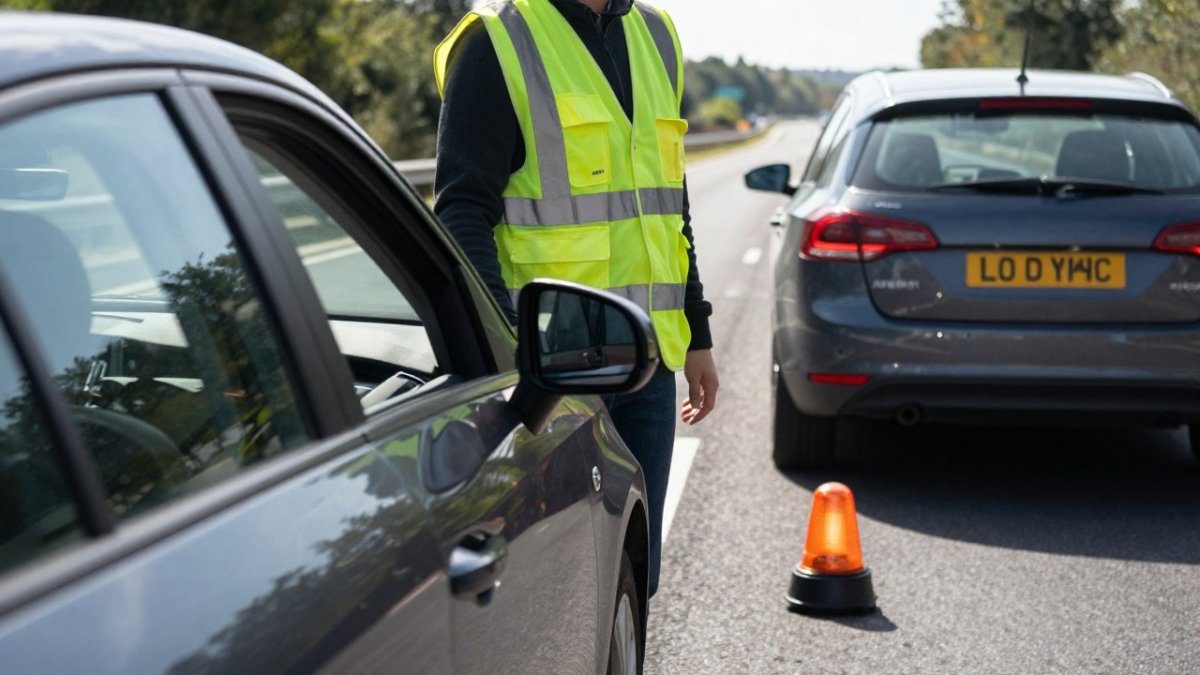
Before you leave the car, put on your high-visibility vest. Carry a high-visibility vest within reach from the driver’s seat, not buried in the boot. Then follow this sequence:
- Switch on the hazard warning lights before opening any door.
- Exit on the side away from traffic, keeping children and pets with you.
- Walk along the verge or hard shoulder, never in a live lane, to the placement point.
- Set the beacon on the road surface or hard shoulder behind the vehicle, with the light facing oncoming traffic.
- Return to the safe waiting area behind the barrier without crossing lanes.
A common pattern among drivers new to Spanish motorways is placing the beacon too close to the rear bumper.
Watch out: Do not place a warning triangle on a motorway. Warning triangles are not recommended for motorway use, as setting one down means walking behind the vehicle into fast traffic. Check current DGT rules for the device you should use.
Triangles, Connected Beacons and Foreign-Registered Vehicles
The rules have changed in recent years, and the position is not identical for every driver. As you check which warning device applies to your car, it is also worth making sure your emergency supplies are ready, with Preppi Prepper offering a useful next step in thinking through what to keep on hand.
For a visitor in a foreign-registered vehicle, the practical position is that you should carry and use a device that meets current Spanish requirements rather than relying on the triangle that came with your home-country kit.
You can confirm your device’s status by reading is my V16 beacon DGT approved? how to check, and you can read the full legal overview in roadside safety devices in Spain: legal requirements. For step-by-step usage details, see 7 steps to use V-16 emergency lights correctly.
Calling 112, SOS Telephones and Roadside Assistance in Spain
Who you call depends on what has happened, not on how inconvenient the breakdown is. Use this order of decision:
- Injuries, fire, a vehicle stopped in a live lane, or anyone in danger: call 112. It is the European emergency number, it is free, and it connects to the emergency services for the location you are in (Single emergency number – missing children helpline).
- You are on a motorway and can reach an SOS telephone: use it. SOS telephones on the motorway can be used to contact the operator.
- The car is safely on the hard shoulder, no one is hurt, and you have breakdown cover: call your assistance provider. This is a recovery job, not an emergency.
- You are unsure: call 112. The operator can redirect you, and a short call costs far less than a delayed response.
Sharing Your Location Accurately
Motorway location descriptions are the part visitors most often get wrong. Before you call, note four things: the motorway number (for example AP-7 or A-4), the direction of travel (towards which city or exit), the kilometre marker nearest to you, and the nearest exit number. Kilometre markers are small posts on the verge; if you can see one, read the number aloud to the operator. If you used an SOS telephone, the operator already has the post’s location, so say which SOS post you are at. On a smartphone, the what3words app or your map app’s dropped pin can supplement this, but do not rely on it alone, the kilometre marker and direction are what the recovery service will use.
What to Have Ready
- Your exact location, including motorway number, direction of travel and nearest kilometre marker
- Your vehicle registration number
- Your driving licence and proof of insurance
- Whether anyone is injured and whether the car is blocking a lane
- Your breakdown cover policy number and provider’s assistance number
Language Barriers: A Short Call Script
Emergency operators may not speak English, and recovery call centres often do not. Speak slowly, use the Spanish terms below, and have your details written down before you dial.
- “Hola, necesito ayuda.”, Hello, I need help.
- “Mi coche se ha averiado.”, My car has broken down.
- “Estoy en la autopista [number], dirección [city].”, I am on the motorway [number], towards [city].
- “En el kilómetro [number].”, At kilometre [number].
- “No hay heridos.”, There are no injuries.
- “Hay heridos.”, There are injuries.
- “El coche está en el arcén.”, The car is on the hard shoulder.
- “El coche está en un carril.”, The car is in a lane.
If you cannot make yourself understood, say “¿Habla inglés?” and, if the answer is no, ask for the nearest exit or SOS post number to be repeated back to you so you can confirm it. Save your breakdown cover assistance number before you travel.
Watch out: Only accept help from an authorised recovery service. Be wary of unsolicited offers at the roadside, and do not hand over your keys or documents to anyone who has not been dispatched by your provider or the emergency services.
Planning Ahead Before Your Next Spanish Motorway Trip
Preparation makes the difference between a stressful breakdown and a manageable one. Before you set off, check that your warning devices meet current DGT rules, that your breakdown cover applies in Spain, and that you know the emergency numbers. Store the key information somewhere you can reach it quickly, such as your phone’s lock screen or a paper card in the glovebox.
Pack a high-visibility vest and a DGT 3.0 compliant beacon in an easy-to-reach spot, not the boot. Being able to reach your equipment quickly is what makes the sequence above work. Good preparation is the best way to keep your journey safe.
Frequently Asked Questions
What should you do if your car breaks down on a Spanish motorway?
Switch on your hazard warning lights, move the vehicle onto the hard shoulder as far from traffic as possible, and get everyone out on the side away from the road. Put on a high-visibility vest before you walk anywhere near the carriageway. Place your warning device at the correct distance behind the car, then call 112 or use the nearest SOS telephone to report your exact location, including the kilometre marker and direction of travel. Keep passengers together behind the safety barrier while you wait for help.
Can you leave your car during a motorway breakdown in Spain?
Yes, but only when it is safe to do so. If the car is stopped in a live lane, or you cannot reach the hard shoulder without crossing traffic, stay inside with your seatbelt fastened and the hazard lights on, and call 112 immediately. If you are on the shoulder and can get well away from the road, leave the vehicle through the side furthest from traffic and wait behind the barrier. Never walk along the carriageway itself.
What emergency number should you call in Spain?
Call 112, the single European emergency number, for police, ambulance or fire services. It works from any phone, including mobiles without a SIM card. Give your location as precisely as you can, using the motorway name, direction of travel and nearest kilometre marker. If you have a breakdown cover policy, also call your roadside assistance line with your policy number and vehicle registration, but treat 112 as the first call whenever someone is injured or the vehicle is in danger.
Is a DGT 3.0 emergency beacon mandatory in Spain?
Drivers in Spain should check the current DGT rules before travelling, as the requirements for emergency warning devices have been changing. Check the current DGT rules for your vehicle and route to confirm which warning device you need. Keep your device in the car and confirm its compliance status on the official DGT website before you set off.
