
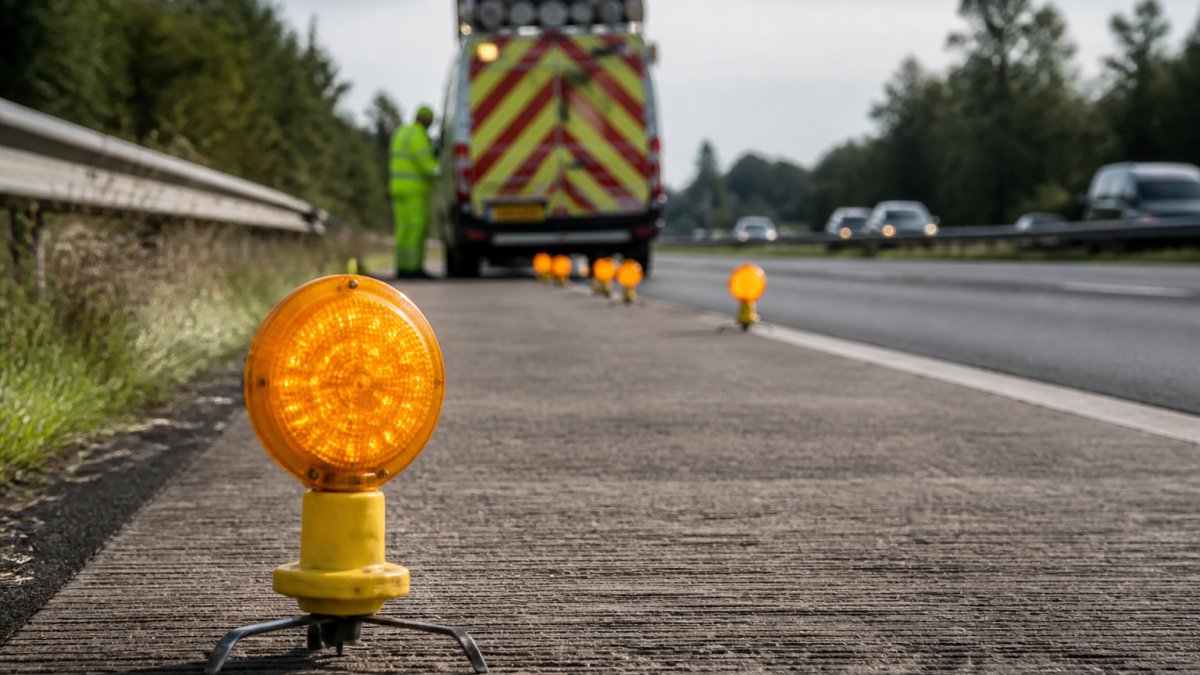
How Smart Hazard Lights Reduce Emergency Response Times
Table of Contents
- How Smart Hazard Lights Reduce Emergency Response Times
- What Makes a Hazard Light ‘Smart’
- The Step-by-Step Mechanism: From Breakdown to Faster Response
- How GPS Emergency Tracking Works in a Roadside Breakdown
- What a GPS-Enabled Emergency Beacon Does That a Triangle Cannot
- Warning Lights for Stationary Vehicles: Why Visibility Decides Survival
- Roadside Breakdown Safety: What Drivers Should Do Before Help Arrives
- Smart Hazard Lights vs Traffic-Signal Preemption: What Each System Actually Does
- Conclusion
- Frequently Asked Questions
Last Updated: October 13, 2026
How Smart Hazard Lights Reduce Emergency Response Times
A smart hazard light is a portable warning beacon that uses GPS and wireless communication to alert approaching drivers and emergency services to a stationary vehicle, transmitting location data automatically.
Smart hazard lights reduce emergency response times by cutting two delays: the time it takes another driver to notice your vehicle, and the time it takes emergency services to find you.
What Makes a Hazard Light ‘Smart’
A hazard light becomes smart when it adds location awareness and wireless communication to a standard flashing warning. That separates three things people often confuse:
- Ordinary hazard lights: fixed-speed flashing indicators, no location data
- Smart hazard lights: portable beacons with GPS and wireless alerts
- Traffic-signal preemption: infrastructure that turns lights green for emergency vehicles
Only the second is a driver-owned safety device; the third belongs to the road network. We cover both later, because they solve different problems.
Smart beacons typically add three things. GPS fixes the vehicle’s position to within a few metres. According to GOV.UK guidance on breakdowns on motorways and high-speed roads, getting yourself and your passengers to a safe place comes first, before any warning device.
A smart hazard light is defined by two added capabilities: it knows where it is, and it can tell others. Without both, it is just a brighter lamp.
The Step-by-Step Mechanism: From Breakdown to Faster Response
The response-time mechanism runs through four stages: detection and location, alert transmission, driver notification, and escalation into the dispatch chain. Each removes a different delay and can fail independently.
Stage 1: Detection and Location Fix
The beacon powers on and acquires a GPS fix, usually within seconds under open sky, giving latitude, longitude and often heading. It then checks whether the vehicle is stationary and the ignition is off.
If both are true, the beacon arms itself and transmits its position on a short repeating cycle. No driver input is needed after activation, which matters when someone is injured or disoriented.
Stage 2: Alert Transmission
The beacon broadcasts a warning. Depending on the model, it reaches nearby vehicles by radio-frequency signal, a control centre by mobile network, or both.
Stage 3: Driver Notification
Approaching drivers get an early alert well before they see the vehicle, as a dashboard warning, navigation prompt, or brighter flash pattern, so they can slow and change lane rather than brake hard.
Stage 4: Escalation to Dispatch
Control rooms receive a location they can pass to responders. It is more precise than a verbal description and can be updated if the vehicle moves, so responders are routed to the exact point, not a general stretch of road.
A Worked Example: Breakdown to Arrival
Consider a driver who suffers a puncture on a dual carriageway at dusk:
- The driver pulls onto the hard shoulder and switches on the beacon.
- The beacon acquires a GPS fix and confirms the vehicle is stationary.
- It begins transmitting its position every few seconds.
- A vehicle two hundred metres back receives the warning and the driver begins to slow.
- The control centre receives the coordinates and passes them to the recovery operator.
- The recovery vehicle is routed to the exact marker post, not the nearest junction.
The gain is several small savings: the following driver reacts sooner, the control room does not triangulate a vague description, and the recovery vehicle does not overshoot.
| Stage | What Happens | Delay It Removes |
|---|---|---|
| Detection | GPS fix and stationary check | Time to confirm location |
| Transmission | Wireless warning sent | Time for the message to travel |
| Notification | Driver sees the alert | Time for drivers to notice |
| Escalation | Location sent to dispatch | Time for responders to find you |
What the Evidence Actually Shows
Measured outcomes for smart hazard lights specifically are thin. Most published figures come from adjacent fields: emergency vehicle preemption trials, eCall deployment, and motorway incident detection.
For eCall, the European in-vehicle emergency call system, regulators have reported faster notification times because the call carries location data automatically.
Treat any single percentage with caution. Pilot results from a controlled corridor rarely hold on a busy urban network, and a beacon that works on a rural A-road may struggle in a multi-storey car park.
A beacon that cannot get a GPS fix in a tunnel, multi-storey car park or deep cutting will fall back to a weaker warning. Never assume the location alert has gone through. If you can, confirm your position with a marker post or app.
The mechanism is four stages, not one. Detection, transmission, notification and escalation each remove a separate delay, and each can fail on its own.
How GPS Emergency Tracking Works in a Roadside Breakdown
GPS emergency tracking works by fixing a device’s position from satellite signals, then transmitting it over a wireless link to a receiving system.
Here is the sequence in plain terms:
- The beacon locks onto several satellites and calculates its position.
- It checks that the vehicle is stationary and the engine is off.
- It transmits coordinates on a repeating cycle.
- A control system or nearby vehicle receives the coordinates.
- Responders are routed to the exact point, not a general stretch of road.
The practical gain is precision. This is the same principle behind Ofcom’s guidance on emergency location data from mobile calls, where location accuracy directly affects how fast a caller can be found.
For a driver, the takeaway is simple. A GPS-enabled emergency beacon removes the guesswork from the one part of a breakdown you cannot control: being located.
What a GPS-Enabled Emergency Beacon Does That a Triangle Cannot
A GPS-enabled emergency beacon does four things a reflective triangle cannot: it broadcasts a warning, knows its own position, works without you standing in traffic, and keeps working after you have moved to safety.
A triangle does none of these.
The difference matters most in poor conditions. In heavy rain, spray or darkness, a triangle may not be seen until a driver is almost on top of it.
A triangle asks a driver to look. A smart beacon makes them look.
Warning Lights for Stationary Vehicles: Why Visibility Decides Survival
Visibility is the single biggest factor in whether a stationary vehicle is hit. A driver who sees a hazard three seconds earlier can slow, change lane and pass safely; one who sees it half a second earlier often cannot.
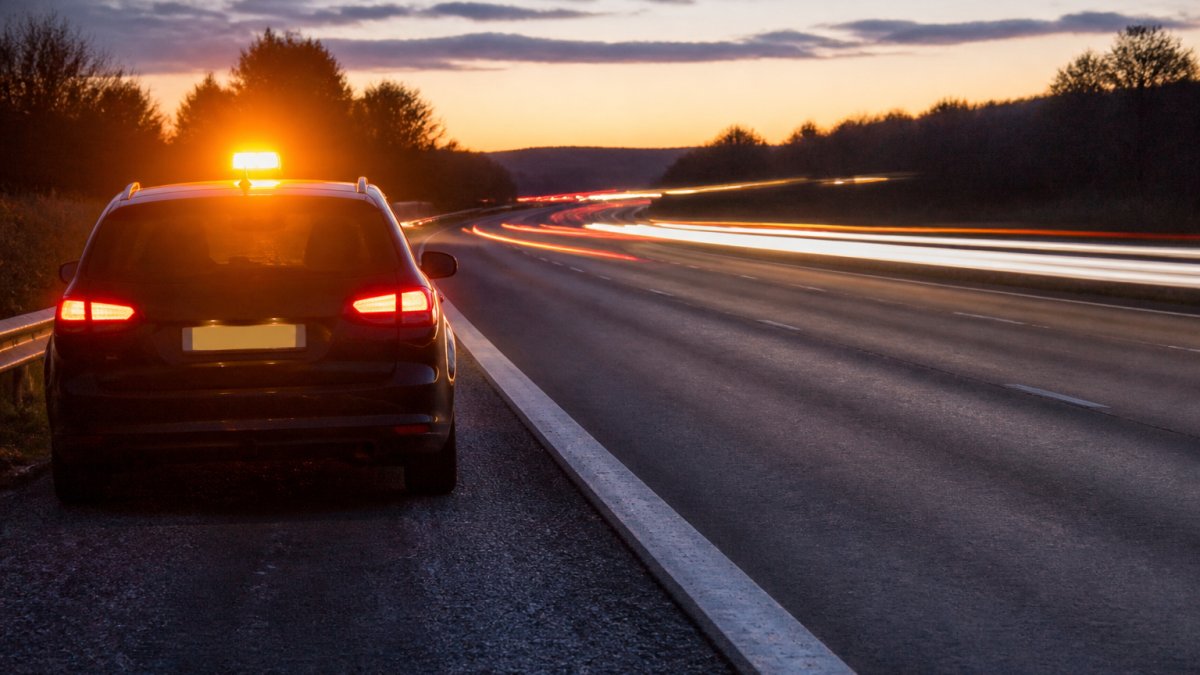
Three things drive how visible a warning light is:
- Brightness: LED lights outperform older bulb units and hold their output longer.
- Flash pattern: faster-flashing hazards and high-contrast patterns are picked up sooner in peripheral vision.
- Height and position: a beacon above the roofline is seen over crests and through traffic.
Daylight visibility is the hard test. Low-light conditions flatter almost any light. Bright sun, spray and glare do not. That is why we focus on LED output and flash rate rather than just “bright enough.”
Mount the beacon as high as you safely can, ideally above the roofline. Height does more for early detection than raw brightness, because it lifts the light above the cars between you and the driver approaching.
Roadside Breakdown Safety: What Drivers Should Do Before Help Arrives
Roadside breakdown safety comes down to one rule: get people away from the carriageway first, then worry about the vehicle.
Work through this in order:
- Move the vehicle as far left as you can, onto the hard shoulder or a layby
- Switch on hazard lights immediately
- Put on a high-visibility vest before opening your door
If you cannot reach a safe place, stay in the vehicle with seatbelts on and call emergency services. Do not stand behind or beside the car.
For anyone who drives the motorway regularly, a beacon is not a professional’s tool.
Smart Hazard Lights vs Traffic-Signal Preemption: What Each System Actually Does
Smart hazard lights and traffic-signal preemption are not competitors. They operate at opposite ends of the same journey, and confusing them leads people to expect the wrong thing.
Traffic-signal preemption is the road-side system.
Smart hazard lights are the vehicle-side system.
The two systems meet at intersection clearance. Preemption gets responders through junctions faster; smart beacons stop a breakdown becoming a second incident that blocks the same junction.
Interoperability: Where the Two Systems Have to Talk
Preemption systems are not uniform. Different highway authorities run different controllers and different emergency services use different on-board units, so a fire appliance that triggers green priority on one corridor may not on the next. That is why interoperability standards matter.
Smart beacons face a similar problem: a beacon broadcasting on one radio protocol may not be received by a vehicle listening on another.
Failure Modes and Fallbacks
Both systems can fail, and both need a fallback.
- Connectivity loss: a beacon out of mobile coverage can still flash, but it cannot send a location. The warning becomes local only.
- False alerts: a beacon triggered accidentally can send responders to a location where nothing is wrong. This wastes resource and erodes trust in the system.
- Cybersecurity: any wireless link can be spoofed or jammed. Preemption systems in particular must be protected against unauthorised activation, because a false green priority is a safety risk.
Never treat a smart beacon as a substitute for getting yourself to safety. If the beacon fails, the priority is still to move people away from the carriageway.
Legal Authorisation and Data
Preemption is authorised by the highway authority that runs the signals; a vehicle cannot simply decide to change a traffic light.
That data question matters. A beacon reporting its position is, in effect, reporting the position of its owner. Operators need a lawful basis for collecting and sharing that data, and drivers should know what is transmitted and to whom.
Equity: Who Benefits and Who Does Not
Preemption and smart beacons do not benefit every road equally. A corridor with modern signals and good connectivity gains more than a rural road with older infrastructure.
There is also a question of access. Different emergency services and recovery operators may not all receive the same alerts, and a system that only works for one service is only half a system.
Drivers who use motorways and high-speed roads regularly, and anyone who wants a location alert that works when they are injured or disoriented. A reflective triangle suits none of these situations.
Conclusion
The hardest part of a breakdown is the wait, and the wait is longest when nobody knows exactly where you are.
Our multi-award-winning early warning systems are designed for exactly this moment, with DGT 3.0 compliant emergency beacons that combine GPS geolocation with high-visibility LED lighting.
Add to basket and give yourself the warning system that speaks before you have to.
Frequently Asked Questions
How do smart hazard lights help emergency responders reach an incident faster?
Smart hazard lights transmit a precise GPS location and an alert to connected systems the moment they activate. Emergency dispatch receives the exact position rather than a vague description, and nearby drivers get an earlier warning to slow down or change lanes. That combination cuts the time responders spend locating the incident and reduces the chance of secondary collisions blocking their route.
How does GPS emergency tracking work when I break down on a motorway?
A GPS-enabled beacon fixes its position using satellite signals, then shares those coordinates over a mobile network. The location is accurate to a few metres, which matters on a long stretch of motorway where a junction reference alone is not enough. Emergency services can route directly to the beacon rather than searching the carriageway, and the beacon keeps broadcasting so the position stays current if the vehicle moves.
What is the difference between a warning beacon and my vehicle’s hazard lights?
Standard hazard lights flash all four indicators at a fixed rate and rely on other drivers noticing them in time. A warning beacon is a separate, high-intensity light designed to be seen from a greater distance, often with a faster flash pattern and a wider viewing angle. Many beacons also add GPS and connectivity, so they warn drivers and alert emergency services at the same time. Hazard lights alone do neither.
Can connected warning lights alert other drivers to a stopped vehicle?
Yes, when they are paired with a connected platform or in-vehicle system. The beacon broadcasts the vehicle’s position, and that alert can reach navigation apps or roadside signage, giving drivers advance notice of a stationary vehicle. Faster-flashing, high-visibility lights also improve detection in daylight and low-light conditions, which is when rear-end collision risk on the hard shoulder is highest.