
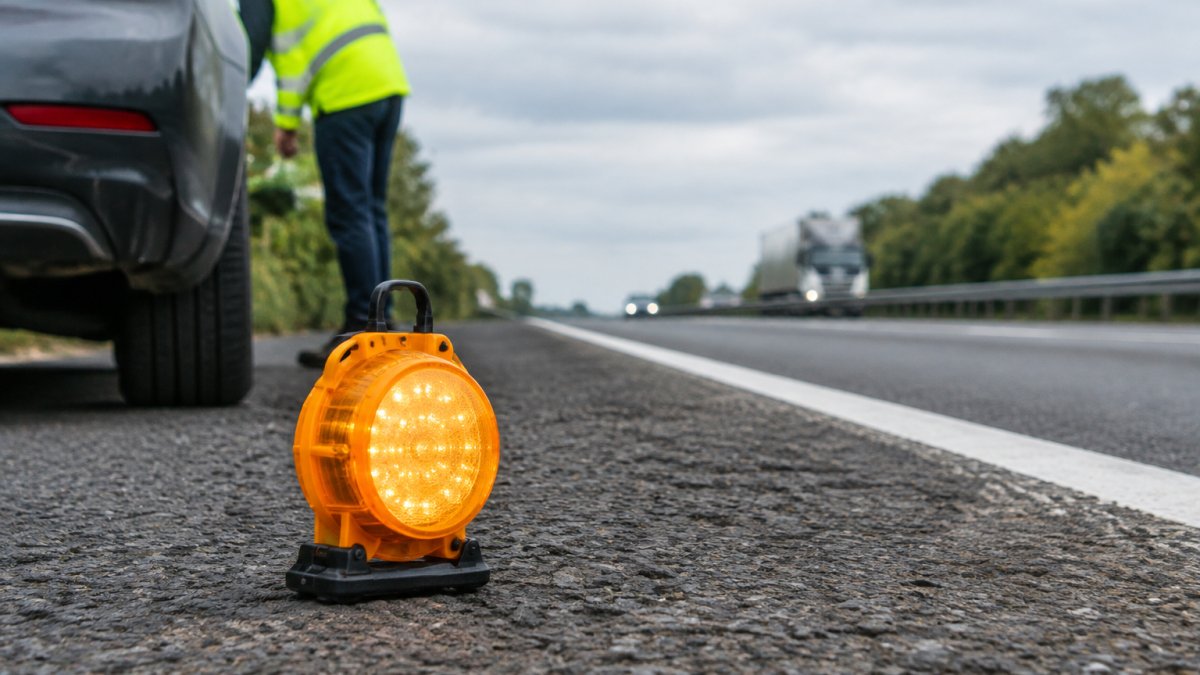
How Do You Choose Reliable Roadside Warning Lights?
Last Updated: November 5, 2026
Quick Summary
Choose reliable roadside warning lights by comparing brightness and viewing distance, honest battery runtime on the flash setting you will actually use, a sealed weather-resistant housing, and a strong magnetic base or roof mount that holds at speed. Test the magnet on your own roof and check runtime on the highest flash pattern before buying.
- Amber is the standard warning colour for breakdowns; blue is reserved for emergency services.
- Check stated runtime on high output, not eco mode, and keep the battery topped up.
- Test the magnet on your own roof, since a weak mount is a common mistake.
- Switch a portable beacon off before driving off, and never place one in a live traffic lane.
- Look for a stated IP rating, a declaration of conformity, a warranty and a replaceable battery.
Table of Contents
- What Separates a Reliable Warning Light from a Cheap One
- Best Emergency Warning Lights for Cars: What Actually Matters
- Aftermarket Vehicle Lighting Compliance: What the Law Allows
- Is a GPS-Enabled Emergency Warning Beacon Worth It?
- How to Use a Warning Light During a Breakdown
- How to Check Reliability Before You Buy
- Choose Your Roadflash Warning Light
- Frequently Asked Questions
What Separates a Reliable Warning Light from a Cheap One
Reliable roadside warning lights are portable beacons that keep working when you need them most: in the dark, in the rain, on a hard shoulder with traffic thundering past. The difference between a dependable unit and a cheap one comes down to four things: real light output, honest battery runtime, a housing that survives weather and impact, and a mount that holds firm at speed.
Early warning systems for this moment need to be built with care, because cheap units tend to cut corners in the same places.
- Weak LEDs that look bright in a shop but wash out at distance
- Optimistic runtime claims measured on a low flash setting
- Brittle plastic that cracks in cold weather
- Weak magnets that let the beacon slide or fly off
For a deeper look at what to check, see our guide on how to choose a reliable roadside safety beacon.
Best Emergency Warning Lights for Cars: What Actually Matters
When shopping for emergency warning lights for cars, compare four specs side by side: brightness and viewing distance, battery runtime, build quality, and how fast you can deploy it.
Here is how to weigh them:
| Feature | Why It Matters | What to Look For |
|---|---|---|
| Brightness | Seen before drivers reach you | High-output LEDs, clear viewing distance |
| Runtime | Works through a long wait | Honest hours on a realistic flash pattern |
| Build quality | Survives rain, cold and knocks | Sealed housing, impact resistance |
| Mounting | Stays put at motorway speed | Strong magnetic base or roof mount |
| Deployment | Set up in seconds, one-handed | Simple switch, no fiddly parts |
Brightness, Colour and Viewing Distance
Brightness and viewing distance decide how early a driver sees your hazard. Look for high-output LEDs and a stated viewing distance, not just a lumen figure.
Colour matters too. Amber is the standard warning colour for breakdowns and slow vehicles. Blue warning lights are reserved for emergency services, so a private car should not use them (How to stay compliant with aftermarket light products). For a full breakdown of the options, read our comparison of amber vs blue hazard lights.
Battery Runtime and Power Source
Check the battery runtime on the setting you will actually use, and consider units you can recharge from a car socket.
- Rechargeable battery: cheaper to run, no disposable cells
- Stated runtime: check it on high output, not eco mode
- Charging: keep it topped up between journeys
- Cold weather: batteries lose capacity in low temperatures
Durability, Weather Resistance and Mounting
Durability and mounting decide whether the beacon survives a winter on the hard shoulder. Look for a sealed, weather-resistant housing, impact resistance for the inevitable knock, and a magnetic base or roof mount that grips at speed.
A weak mount is a common mistake, so test the magnet on your car’s roof before you rely on it.
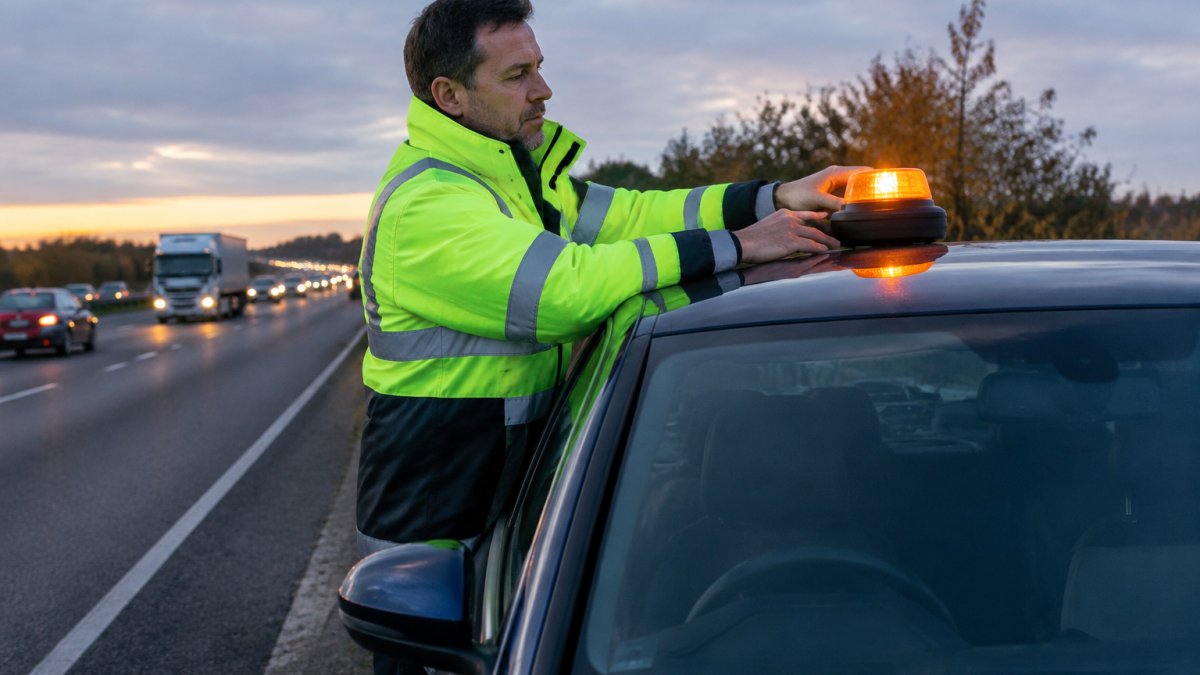
Once the beacon is in place, keeping a clear warning visible through dusk and poor weather matters just as much, which is why choosing rescue lights for visibility can help drivers signal their presence when conditions worsen.
Aftermarket Vehicle Lighting Compliance: What the Law Allows
Aftermarket vehicle lighting compliance means matching the lamp to its legal use. A portable warning beacon placed on the road or roof is treated differently from lights wired into the vehicle, so check the rules that apply to each before fitting or using a lamp.
The key distinction is between a portable warning beacon and a fixed vehicle lamp. A portable beacon is a temporary warning device that you deploy when stationary. Fixed lamps, lightbars and coloured lights wired into a vehicle are subject to separate rules. Blue warning lights are restricted to emergency vehicles, and amber is the usual warning colour for breakdowns and slow vehicles.
A plain-language way to keep yourself out of trouble:
- Amber flashing beacon, portable, used while stationary: generally acceptable as a warning device; keep it off while driving.
- Amber lightbar wired into the vehicle: treated as a fixed lamp; check approval and switch it off on the public highway unless the use is permitted.
- Blue or red portable beacon: do not use on a private car; these colours are reserved.
- White or red additional lamps to the front or rear: restricted; do not fit without checking the specific requirement.
Watch out: switch a portable beacon off before you drive off.
If you drive abroad, the rules change and some countries require certified connected beacons for breakdown warning. Always check the official government guidance on vehicle lighting before fitting any aftermarket lamp, and keep the manufacturer’s compliance statement with the unit in case you need to show it.
Is a GPS-Enabled Emergency Warning Beacon Worth It?
A GPS-enabled emergency warning beacon can be useful if you drive alone, at night, or on fast roads, because it flashes a warning to traffic and shares your location.
The location feature can be helpful when you cannot easily explain where you are, such as on an unlit stretch of motorway.
- Solo drivers: the location share is a genuine safety net
- Night breakdowns: visible warning plus a precise location
How to Use a Warning Light During a Breakdown
Using roadside warning lights during a breakdown comes down to one rule: get them visible before you do anything else, and keep yourself out of the traffic lane. Set the beacon, then step to safety.
- Stop safely. Pull onto the hard shoulder or as far left as you can.
- Switch on hazard lights straight away.
- Put on a high-visibility jacket before leaving the car.
- Place the beacon on the roof or behind the car, facing traffic.
- Exit on the safe side, away from passing vehicles.
- Stand behind the barrier and call for help.
Watch out: never place a beacon in a live traffic lane, and never stand between your car and oncoming traffic. For a full night-time walkthrough, read what to do if your car breaks down at night.
How to Check Reliability Before You Buy
Checking reliability before you buy means testing the claims rather than relying on the packaging. A few repeatable checks can help you judge whether a beacon is likely to last, and many can be done without specialist equipment.
Ingress protection. Look for a stated IP rating on the housing and the charging port, and check that the port cover seats firmly.
Impact resistance. Check the unit for cracks or loose parts after handling it, and make sure the battery does not rattle inside.
Magnet grip. Test the base on your own roof, not a shop shelf. A magnet that holds a spanner is not the same as one that holds at motorway speed. Look for a rubberised foot that resists sliding and a pull force stated by the manufacturer.
Runtime under realistic conditions. Compare stated runtime on the highest flash pattern, not eco mode. Charge fully, run it on high for an hour, and see whether brightness visibly drops. Cold weather reduces battery capacity, so a unit that dims quickly indoors will be worse on a winter night.
Controls and accessibility. Operate the switch one-handed, wearing gloves, in the dark. Check that the button is distinguishable by touch and that the unit can be switched on without looking. Colour-vision differences matter too: a beacon that relies on colour alone is weaker than one with a distinct flash pattern.
Certifications and evidence. Look for a declaration of conformity, a stated warranty period, and whether the battery is replaceable.
-
IP rating stated for housing and charging port
-
Magnet holds firmly on your own roof
-
Runtime stated on the highest flash pattern
-
Switch works one-handed with gloves in the dark
-
Declaration of conformity and warranty supplied
-
Battery is replaceable, not sealed in
A common mistake is buying on brightness alone. A blinding light with a weak magnet is a liability. Our guide on how to maintain LED warning beacons shows how to keep a good unit working for years.
Choose Your Roadflash Warning Light
A breakdown on a busy road is a challenge no driver plans for, but the right beacon turns a dangerous moment into a managed one. We built Roadflash around that single moment: a stationary vehicle that needs to be seen, fast.
Our multi-award-winning early warning systems are designed to help prevent collisions. The DGT 3.0 compliant beacons include GPS and geolocation, and offer high-visibility lighting in a portable design.
Frequently Asked Questions
What should I look for when choosing a roadside emergency warning light?
Prioritise four things: a high-output LED with an amber flash pattern bright enough to be seen from a safe distance, a rechargeable battery with a runtime that covers a typical breakdown, a magnetic base that holds firm at motorway speeds, and a housing rated for rain and impact. Check the flash pattern is distinct from indicators and that the unit is quick to deploy one-handed. Legal compliance matters too, so confirm the light is intended as a warning beacon rather than a restricted vehicle lamp.
Are flashing warning lights legal for private cars?
Amber flashing beacons are treated differently from blue lights, which are reserved for emergency services. Aftermarket vehicle lighting compliance depends on how and where the lamp is used, so check the rules that apply to your situation. Never fit blue or red warning lamps to a private car, and do not leave a beacon flashing while driving normally. Check the manufacturer’s stated intended use before you buy.
How long should a portable warning light battery last?
Look for a runtime that comfortably exceeds the time you might wait for recovery, ideally several hours on a single charge. Battery life depends on brightness setting and flash pattern, so check the quoted runtime at the output level you would actually use. Rechargeable lithium units hold charge better between uses than disposable batteries, but top them up every few months so the light is ready when you need it.
Are GPS-enabled emergency warning lights worth buying?
A GPS-enabled emergency warning beacon shares your location, which can be helpful on unlit motorway stretches or at night. If you commute regularly on high-speed roads, the added location accuracy is a genuine safety benefit. For occasional town driving the value is lower, but the peace of mind for motorway users is hard to argue against.
Where should I place a warning light if my car breaks down?
Put the beacon on the roof or a high, visible point of the vehicle so it can be seen over crests and around bends, and switch on your hazard lights as well. On a motorway, exit on the side away from traffic and never place anything on the carriageway itself. Face the light toward approaching traffic and keep yourself behind the barrier while you wait for assistance.
