
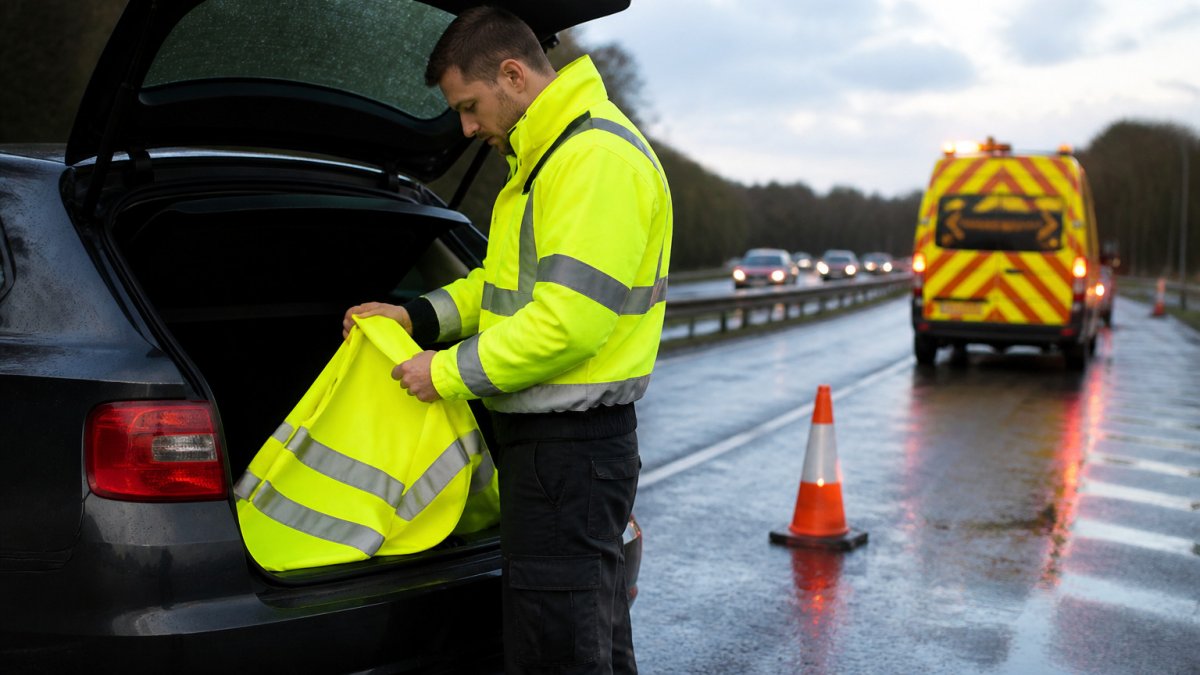
7 Reasons to Keep High-Vis Clothing in Your Car
Last Updated: October 29, 2026
Quick Summary
Keeping high visibility clothing in your car makes you easy to see from a distance when you stand at the roadside after a breakdown. Bright fluorescent colours and reflective strips help drivers spot you in daylight, at night and in poor weather, giving them more time to react.
- Put on high visibility clothing as soon as you step out of the car and keep it on.
- Fluorescent yellow and orange stand out best against most roadside backgrounds.
- Reflective strips catch headlight beams and make you visible after dark.
- Keep one vest per occupant plus a spare, sized correctly for children.
- Store vests in the glovebox and boot, and avoid burying them under heavy luggage.
Table of Contents
- Why Being Seen Matters After a Breakdown
- 1. Stay Visible to Drivers When Parked at the Roadside
- 2. Improve Visibility at Night and in Poor Weather
- 3. Reduce the Risk of Being Struck by Passing Vehicles
- 4. Protect Passengers, Children and Family Members
- What to Keep in a Car Emergency Kit
- What to Do If Your Car Breaks Down on a Motorway
- High Visibility Clothing Standards and Choosing the Right Garment
- Frequently Asked Questions
Why Being Seen Matters After a Breakdown
A breakdown on a busy road is one of the most dangerous moments a driver can face. Standing at the roadside, you are exposed to passing traffic, often at high speed. Keeping high visibility clothing in your car is one of the simplest ways to make sure drivers see you before they reach you.
Here are several reasons to keep high-vis clothing in your boot, along with practical advice on how to use it.
1. Stay Visible to Drivers When Parked at the Roadside
A car on the hard shoulder is easy to miss, especially in fast-moving traffic. High visibility clothing makes you stand out against the road, the verge and the cars around you. It is designed to be seen from a distance, so drivers have more time to react.
Put it on as soon as you step out of the car. Keep it on until you are back inside a safe place. Bright colours such as fluorescent yellow and orange are the most effective, because they stand out against most backgrounds.
2. Improve Visibility at Night and in Poor Weather
Darkness, rain, fog and spray from lorries all reduce how far drivers can see. Plain clothing can disappear into the background, even under headlights. Garments with reflective strips catch light from car headlamps and send it back, so you show up clearly after dark.
- Reflective strips work best when they face oncoming headlights
- Fluorescent colours help most in daylight and dull weather
- A combination of both gives the best all-round visibility
3. Reduce the Risk of Being Struck by Passing Vehicles
Many roadside injuries happen when someone is hit while standing near a broken-down car. Being clearly visible gives drivers a better chance to steer clear. Combined with a warning triangle and hazard lights, it helps create a clear safe zone around your vehicle.
Stand behind the car’s barrier, away from the traffic lane, whenever it is safe to do so. Never stand between the car and the traffic.
4. Protect Passengers, Children and Family Members
Everyone in the car needs to be protected, not just the driver. Keep high-vis clothing sized for children and adults in the boot, so the whole family can be seen if they need to leave the vehicle. Children are especially hard for drivers to spot, because they are small and often unpredictable.
Teach children that they must stay inside the car on a motorway unless told otherwise. If they do need to get out, they should wear a high-vis garment and stay well away from the traffic.
What to Keep in a Car Emergency Kit
A good emergency kit makes a breakdown far less stressful, but the kit only works if it is built around the car rather than copied from a generic camping list. You can compare the best emergency beacons for car breakdowns to pair with your high-vis gear. High-visibility clothing is one of the items you are most likely to need first, so it should be easy to reach.
Where to store it
- Glovebox: one folded vest per front-seat occupant, so the driver and front passenger can put one on without opening the boot.
- Boot, near the tailgate: the rest of the vests, the warning triangle or beacon, and the torch, so you are not leaning into traffic to retrieve them.
- Under the passenger seat: a compact torch and a spare vest for a child or occasional passenger.
Avoid storing vests under heavy luggage or beneath a spare wheel, because you may need them within seconds of stopping. A common pattern is to keep one vest in the glovebox and the remainder in a boot bag that can be lifted out in one movement.
A practical checklist
- One high-visibility vest or jacket per occupant, including children
- Warning triangle or a modern emergency beacon
- Torch with spare batteries, stored where you can reach it without leaving the car
- Phone charger or power bank
- First-aid kit
- Water and snacks
- Warm layers and a blanket
- A small mat or bin bag to kneel on when changing a tyre
How many garments to carry
Carry one garment for every regular occupant plus one spare. A family of four should carry five, so an occasional passenger or a child’s friend is covered. Children need correctly sized garments rather than adult vests draped over them, because an oversized vest can ride up and obscure the reflective strips.
Maintenance and replacement
Check the kit every few months and replace batteries once a year. Faded, torn or cracked reflective strips lose their effect, so swap out any garment that looks worn. Store vests dry, because damp can degrade reflective tape over time.
The article recommends a set of items for each part of the car, and this breakdown shows where to keep them and why.
| Location | Items to store | Why it matters |
|---|---|---|
| Glovebox | One folded vest per front-seat occupant | Put on without opening the boot |
| Boot, near the tailgate | Remaining vests, warning triangle or beacon, torch | Avoids leaning into traffic to retrieve them |
| Under passenger seat | Compact torch, spare vest for a child | Reachable without leaving the car |
| Boot bag | Vests lifted out in one movement | Quick access when stopping |
| Anywhere dry | All garments | Damp degrades reflective tape |
What to Do If Your Car Breaks Down on a Motorway
A motorway breakdown is more dangerous than most roadside problems, because traffic moves very fast. Pull onto the hard shoulder as far left as you can. Check the motorway breakdown rules in the Highway Code guide for the official guidance that applies. Switch on your hazard lights straight away.
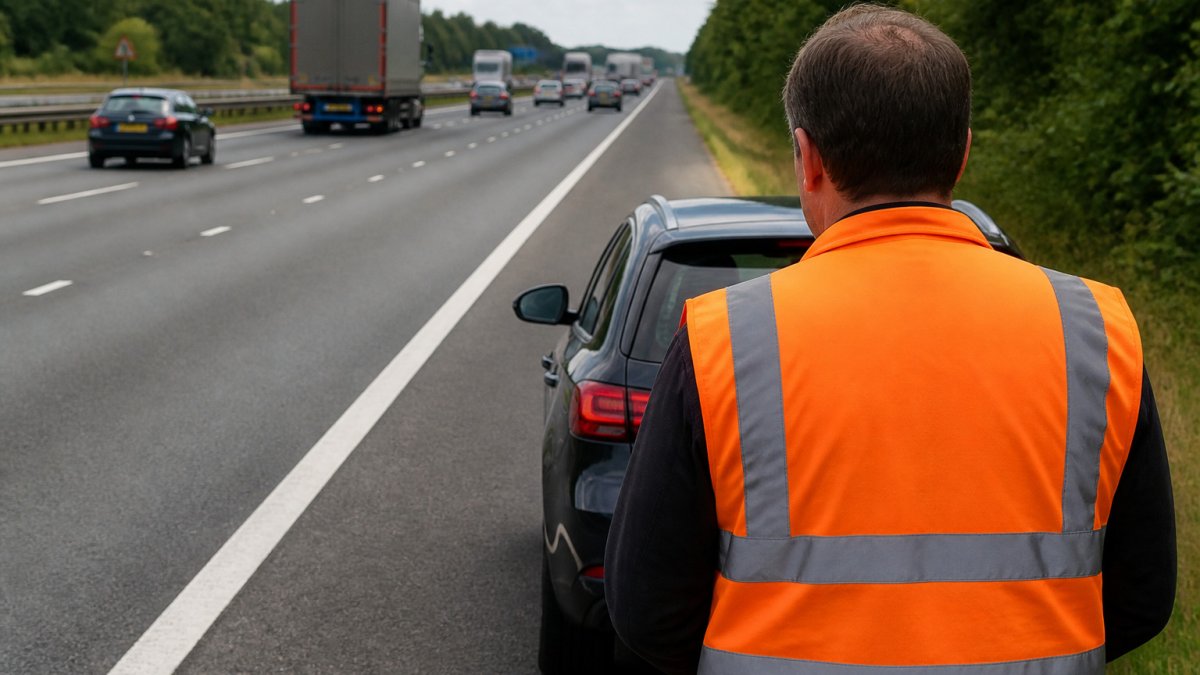
Put on your high-visibility clothing before you get out. Get everyone out of the car by the passenger side, away from the traffic. Learn more about preventing secondary collisions after a vehicle breakdown. Move behind the barrier if there is one. Call your breakdown provider or 999 if someone is injured or the car is in danger.
High Visibility Clothing Standards and Choosing the Right Garment
Not all high-vis clothing is the same, and workplace guidance does not always translate neatly to a car. You can browse a curated shortlist of the best high-visibility vests for roadside emergencies before you buy. Look for garments that carry a recognised standard, such as EN ISO 20471, which sets out requirements for colour and reflective performance (British Standards Institution). Check the label before you buy, and treat a garment without a standard marking as decorative rather than protective.
What the standard tells you
EN ISO 20471 grades garments by the area of fluorescent and retroreflective material they contain. In simple terms, a higher class means more visible material and better performance at distance. For a motorist, a waistcoat or jacket that meets the standard is usually sufficient, but check that the reflective bands are wide, continuous and positioned across the chest and shoulders rather than as thin piping.
Choosing for roadside use
- Size: It should fit over your outer layers comfortably, including a winter coat, without the hem riding up.
- Colour: Fluorescent yellow or orange works best in daylight; both contrast with most road surfaces and verges.
- Reflective strips: Look for clear, wide bands for night use, and check they are intact rather than cracked or peeling.
- Fastening: A zip or hook-and-loop front is quicker to put on than buttons, which matters at the roadside.
- Storage: Choose a compact style that folds easily into a glovebox or boot bag.
Fit and coverage trade-offs
A garment that is too loose can flap in wind and expose the clothing underneath, while one that is too tight will not fit over a coat. A common pattern is to size up one step from your normal clothing size for a vest intended to be worn over winter layers. If you carry a child’s garment, check that the reflective bands sit across the child’s chest and back rather than around the waist.
Pick garments that are easy to put on quickly. In a breakdown, speed matters, and a vest you can pull on in a few seconds is more useful than a jacket that needs careful fastening.
Frequently Asked Questions
Is it legal to wear a high-visibility vest in a car in the UK?
Yes. Wearing a high-visibility vest in a car is lawful in the UK, and there is no requirement to keep one in the vehicle. The Highway Code does not mandate high-visibility clothing for drivers, but it advises that you should wear it if you have to leave your vehicle on a motorway or unlit road. Keeping one in the glovebox or boot means it is available when you need it. Check the Highway Code and any applicable employer rules if you drive for work.
Does high visibility clothing work?
High visibility clothing works by using fluorescent colours and retroreflective strips to contrast with the background, so drivers notice you at a greater distance. Fluorescent materials make you stand out in daylight, while reflective strips return light from headlights at night. Effectiveness depends on the garment being clean, undamaged and worn over the outer layers rather than hidden. It improves your visibility but does not guarantee safety, so combine it with warning triangles, hazard lights and safe positioning.
When should you wear a high-visibility vest after a car breakdown?
Put on your high-visibility vest before you leave the vehicle, particularly on a motorway, dual carriageway or any road where traffic moves quickly. Get out on the passenger side away from traffic where possible, and keep the vest on while you work at the roadside. Wear it while placing a warning triangle or walking to a safe place, and keep it on until you are back inside a secure location or a recovery vehicle has arrived.
What type of high-visibility clothing should you keep in your car?
Keep a vest or jacket in fluorescent yellow or orange that carries a recognised EN ISO 20471 marking, which shows it meets the European standard for high-visibility clothing. Choose a size that fits over your coat, and consider reflective strips for use at night. Store one garment per person in the vehicle so passengers are protected as well, and check it periodically for fading, tears or dirt that reduce its effectiveness.
Keeping high-visibility clothing in your car is a small step that can make a big difference when you break down. Roadflash is committed to helping motorists stay safe and seen on the road, so you can get back on your journey with more peace of mind.
