
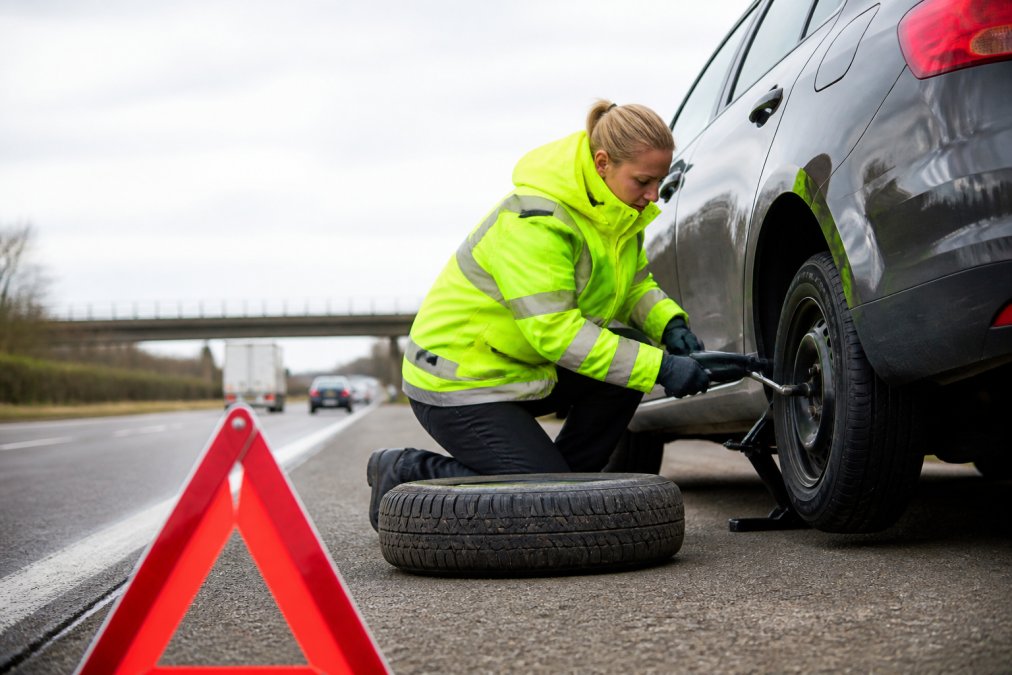
How to Change a Flat Tyre on the Motorway Safely
Table of Contents
- What to Do If You Break Down on the Motorway
- Smart Motorway Breakdown Procedure: What Changes
- Is It Legal to Change a Flat Tyre on the Motorway?
- Step-by-Step: How to Change a Flat Tyre on the Motorway Safely
- Best High Visibility Roadside Safety Equipment
- Night-Time, Bad Weather, and EV Considerations
- Common Mistakes to Avoid on the Motorway
- Conclusion
- Frequently Asked Questions
Last Updated: September 14, 2026
What to Do If You Break Down on the Motorway
Knowing how to change a flat tyre on the motorway safely starts with one rule: get yourself and your passengers out of the live carriageway and behind the barrier before you touch the boot. A puncture is a breakdown, and a motorway breakdown is life-threatening. This guide from Roadflash covers the exact sequence, including the smart motorway procedures most generic advice skips.
National Highways records tens of thousands of breakdowns on the strategic road network every year, and a stationary vehicle in a live lane is one of the most dangerous situations on the network (nationalhighways.co.uk).
Pulling Over Safely and Exiting Your Vehicle
Pull over at the first safe opportunity, not the first convenient one. If you feel the tyre deflate, grip the wheel firmly, ease off the accelerator, and let the car slow naturally. Do not brake hard or swerve. Signal left, check your mirrors, and move across when there is a clear gap.
On a conventional motorway, aim for the hard shoulder and stop as far left as possible, wheels turned slightly toward the verge. On a smart motorway, aim for an emergency refuge area (ERA) if one is within reach. If not, stop in the left lane, hazards on immediately, and get everyone out through the left-hand doors and over the barrier. Leave animals in the vehicle.
Once stopped, exit through the doors furthest from traffic. Never stand between your car and oncoming vehicles, and never attempt repairs from the traffic side.
Who to Call and When
Call your breakdown provider or National Highways on 0300 123 5000 if you cannot reach a place of safety. On a smart motorway, the emergency roadside telephone in a refuge area connects directly to the control room, faster than a mobile call, and automatically flags your location so the lane can be closed before recovery arrives.
If you are in a live lane and cannot move, call 999. The operator can alert the regional control centre to close the lane. Give your carriageway, direction, and the nearest marker post number if you can see one.
Do not stay in your vehicle on the hard shoulder or in a live lane. A rear-end impact at motorway speed gives occupants almost no chance. Get out, get behind the barrier, and stay there until recovery arrives.
Smart Motorway Breakdown Procedure: What Changes
The smart motorway breakdown procedure removes the hard shoulder entirely. On an all-lane running smart motorway, the left lane is a live traffic lane, so stopping in it means stopping in the path of vehicles at motorway speed, with no verge to aim for and often no refuge within sight.
The correct sequence: reach an emergency refuge area if one is within a short distance, otherwise stop in the left lane, hazards on, exit left, and get behind the barrier. From a refuge area, use the emergency roadside telephone. From a live lane, call 999.
Emergency Refuge Areas: What They Are and How They Are Spaced
An emergency refuge area (ERA) is a lay-by-style bay set back from the carriageway, marked with blue and white signage and an orange SOS symbol. ERAs are spaced along the route, with gaps of up to around 1.5 miles on some sections, you may not reach one before the tyre is fully flat, and gambling on the next refuge while losing steering control is the wrong trade (National emergency area retrofit).
If an ERA is genuinely within reach, take it. If not, the live lane stop is the correct action, not a failure. The priority is a controlled stop with hazards on, not a sprint to a refuge that may be a mile and a half away.
How the Control Room Detects and Responds to a Stopped Vehicle
Smart motorways are monitored by regional control centres using CCTV and stopped vehicle detection radar on many sections. When a stationary vehicle is detected, operators can set the red X signals over the affected lane and dispatch a traffic officer or recovery vehicle, which is why the emergency roadside telephone in a refuge area beats a mobile call.
If you are in a live lane and cannot move, call 999. The operator can alert the regional control centre to close the lane. Give your carriageway, direction, and the nearest marker post number if you can see one, those numbered posts identify your position to within a hundred metres or so.
The Legal Position on Stopping in a Live Lane
Stopping in a live lane on a smart motorway is not a designated breakdown position. The Highway Code’s motorway breakdown rules (Rule 274 onward) assume a hard shoulder exists; where it does not, the guidance is to reach a place of relative safety or, failing that, stop as far left as possible, switch on hazard lights, and exit the vehicle. A driver who stops through mechanical failure is not committing an offence, but one who stops to attempt a repair when a refuge was reachable may be treated as driving without due care. The distinction is between an unavoidable stop and a voluntary one.
Do not stay in your vehicle on a smart motorway live lane. A rear-end impact at motorway speed gives occupants almost no chance. Get out through the left-hand doors, get behind the barrier, and stay there until recovery arrives. Leave animals in the vehicle.
What Most Guides Miss
Most generic guides describe the hard shoulder procedure and add a sentence about smart motorways. The practical difference is that on an all-lane running section, stopping in a live lane is a legitimate, planned action rather than a last resort, and the sequence that follows, hazards, exit left, barrier, 999, is the one that keeps you alive.
Is It Legal to Change a Flat Tyre on the Motorway?
Changing a tyre on the hard shoulder is not explicitly illegal, but it is strongly discouraged and can breach the Highway Code’s guidance on motorway breakdowns. The Highway Code (Rule 274 onward) advises drivers not to attempt repairs on the hard shoulder, and to move behind the barrier and call for help instead. The Highway Code rules on motorway breakdowns set out the expected behaviour, and enforcement officers can treat a dangerous repair attempt as a driving offence.
The practical answer is simpler than the legal one: on a smart motorway, changing a tyre in a live lane is never safe and may be treated as dangerous driving. On a conventional hard shoulder, it remains high-risk and should only be considered if the vehicle is fully behind the barrier line and traffic has clear visibility of you.
| Situation | Legal Position | Recommended Action |
|---|---|---|
| Conventional hard shoulder | Not explicitly illegal, but discouraged | Call for recovery; repair only if fully safe |
| Emergency refuge area | Safe and legal to stop | Call from the emergency phone |
| Smart motorway live lane | Dangerous; may breach driving law | Hazards on, exit left, call 999 |
| Any position in traffic flow | Illegal and dangerous | Do not attempt repair |
Hard Shoulder vs Live Lane: The Legal Difference
The hard shoulder is a defined emergency stopping area; a live lane is not. On a conventional motorway, a hard shoulder stop is a recognised breakdown position. On a smart motorway, the same physical space is part of the carriageway, and stopping there is no different from stopping in lane two of a normal motorway.
Step-by-Step: How to Change a Flat Tyre on the Motorway Safely
If, and only if, you are in a genuinely safe position, behind the barrier line, with clear visibility and no live traffic lane alongside, the sequence below is how to change a flat tyre on the motorway safely. If any condition is missing, call for recovery.
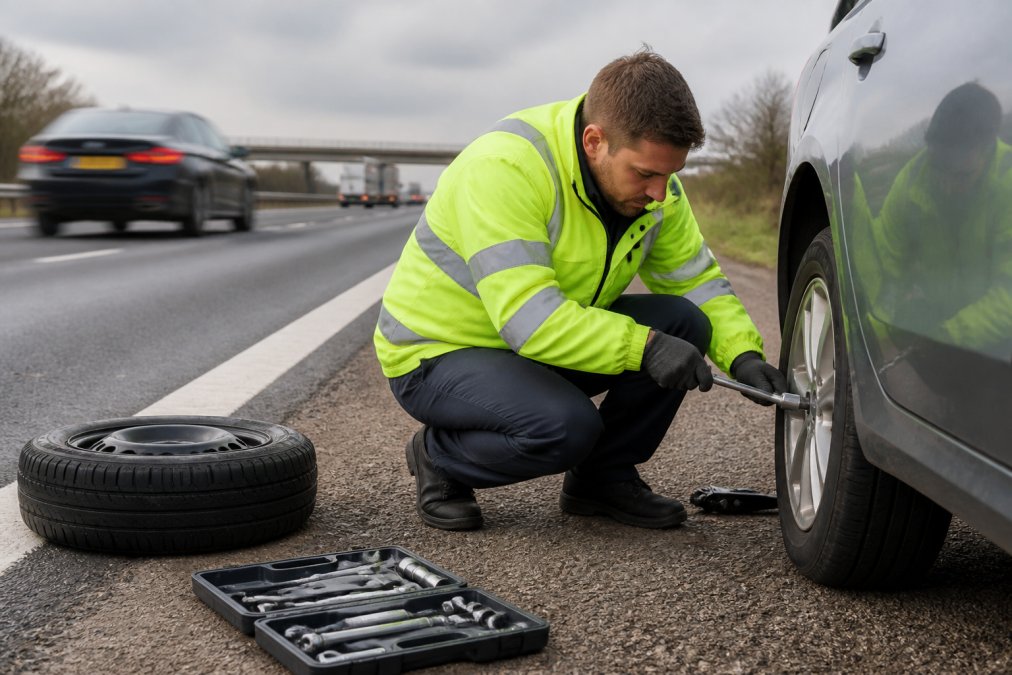
- Put on your high-visibility jacket before you leave the vehicle.
- Place wheel chocks or a heavy object behind the wheels on the opposite side.
- Retrieve the spare tyre, jack, and lug wrench from the boot.
- Loosen the wheel nuts a quarter turn while the tyre is still on the ground.
- Locate the jacking point nearest the punctured wheel using the vehicle manual.
- Raise the vehicle until the flat tyre clears the ground by a few centimetres.
- Remove the wheel nuts and lift the tyre clear.
- Fit the spare, hand-tighten the nuts in a star pattern, then lower the jack.
- Tighten the nuts fully with the wrench, in a star pattern.
- Check tyre pressure at the first opportunity and drive to a garage to have the torque checked.
Tools You Need Before You Start
A usable kit contains a jack rated for your vehicle’s weight, a lug wrench that fits your wheel nuts, wheel chocks, a high-visibility jacket for every occupant, and a torch. Check the spare’s pressure monthly, because a flat spare is useless when you need it. Many modern cars ship without a spare, in which case a sealant kit is your only on-road option and recovery is the correct call.
Locating Jacking Points and Loosening Wheel Nuts
Jacking points are reinforced sections of the sill, marked in the vehicle manual and often by small notches or arrows under the sill. Using the wrong point will crush the sill or punch through the floor. Loosen the wheel nuts before lifting, because once the wheel is off the ground it will simply spin. Use your body weight on the wrench, not a jerking motion, and never put any part of your body under a car supported only by a jack.
Crack the wheel nuts loose by standing on the wrench with the tyre still on the ground. Once the car is jacked, that same nut becomes almost impossible to shift because the wheel rotates with the force.
Best High Visibility Roadside Safety Equipment
The best high-visibility roadside safety equipment prioritises being seen early, from a distance, in poor light. A high-visibility jacket meeting the relevant standard is the baseline. Beyond that, an early warning system that projects light and signals your position to approaching traffic gives drivers far more reaction time than a jacket alone.
Roadflash builds multi-award-winning early warning systems for exactly this scenario: stationary vehicles on busy motorways. The range includes high-visibility lighting and DGT 3.0 compliant emergency beacons with GPS and geolocation, which signal your exact position to approaching traffic and emergency services. For drivers who break down rarely but drive motorways regularly, the case for carrying one is the same as for carrying a spare: you only need it once, and nothing else substitutes.
Warning triangles must be placed at least 45 metres behind the vehicle on a motorway, which means walking into the carriageway. On a smart motorway that walk is often not survivable. This is the gap that light-based early warning systems close.
Night-Time, Bad Weather, and EV Considerations
Darkness and heavy rain cut reaction distances dramatically and change the priority order. In poor visibility, get behind the barrier first and set up warning equipment second. Your hazard lights and any supplementary warning light should be the last thing you activate before retreating to safety, not the first, the opposite of the daytime instinct to start fiddling with the boot, and the most common error in low-visibility breakdowns.
Night-Time and Adverse Weather Procedures
At night, a stationary vehicle on the hard shoulder or in a live lane is far harder to see, and a driver at motorway speed on dipped headlights has less time to react. Practical adjustments:
- Put on a high-visibility jacket before you open the door, not after. In the dark, a jacket that is not reflective is almost invisible.
- Use a torch with a red or flashing mode to signal your position to approaching traffic while you move to the barrier. Do not shine a white light into oncoming traffic, as it dazzles drivers.
- In heavy rain, spray from passing vehicles reduces visibility further. Assume you cannot be seen and act accordingly: barrier first, warning equipment second.
- In fog, the same logic applies, and the temptation to stay in the car is stronger. Resist it. A stationary vehicle in fog is a magnet for rear-end impacts.
- If snow or ice is on the ground, do not attempt a wheel change. Cold hands, slippery surfaces and a jack on unstable ground are a recipe for a crush injury. Call for recovery.
Electric Vehicles: Why the Standard Advice Does Not Always Apply
Electric vehicles add two complications most motorway breakdown guides ignore.
First, many EVs have no spare tyre, only a sealant kit or run-flats. A sealant kit can seal a small tread puncture, but not a sidewall tear, a blowout, or a puncture larger than a few millimetres, and it renders the tyre unrepairable, a get-you-home measure, not a fix. If your EV has no spare and the damage is beyond a sealant kit, recovery is the realistic option.
Second, EVs are heavier than equivalent petrol or diesel models because of the battery pack, and the weight is distributed differently. A scissor jack rated for a 1.5-tonne hatchback may not be rated for a 2-tonne electric SUV. Check the manual for jacking points and maximum jack load before assuming your kit is suitable, an under-rated jack on a heavy EV is a genuine crush risk.
A third, less obvious point: some EVs have no traditional jacking points at all, and the manufacturer specifies a specific lifting procedure. If your manual does not show a jacking point you recognise, do not guess. Call for recovery.
Do not use a warning triangle on a smart motorway. Placing it requires walking into a live lane, and the risk of being struck far outweighs any warning benefit. Use your hazard lights and a light-based warning system instead. The same applies at night, where the walk to place a triangle is even more dangerous because drivers cannot see you.
Why This Matters More Than Most Guides Admit
Most motorway breakdown guides treat night, weather and EV as footnotes. In practice, these are the conditions where the standard hard shoulder procedure breaks down most often: you cannot see the barrier, the spare is a sealant kit, and the jack is the wrong one. Knowing in advance which applies to your vehicle turns a panic into a plan.
Common Mistakes to Avoid on the Motorway
The most common mistake is staying in the car. Occupants who remain belted in a stationary vehicle on the hard shoulder or in a live lane are the most exposed group in any motorway breakdown.
The second is attempting a repair from the traffic side. Even a brief lean into the carriageway puts you in the path of vehicles that will not see you until it is too late.
The third is relying on a warning triangle on a smart motorway. The walk to place it is the danger. Light-based and beacon-based warning systems avoid that walk entirely.
A fourth, less obvious mistake is failing to check the spare. A flat spare discovered at the roadside turns a manageable situation into a recovery call and a long wait in an exposed position.
Conclusion
A motorway puncture is one of the few driving situations where the wrong first move can be fatal. Get out, get behind the barrier, and only then think about the tyre. Roadflash exists to make that moment safer, with early warning systems designed for stationary vehicles on busy motorways: high-visibility lighting, GPS-enabled beacons, and DGT 3.0 compliant equipment that signals your position to approaching traffic and emergency services. Add to basket and keep a Roadflash beacon in the boot, so the one time you need it, you are already covered.
Frequently Asked Questions
Are you allowed to change a flat tyre on the motorway?
You can change a flat tyre on the hard shoulder if you have the tools and can do it safely, but it is not recommended. National Highways advises that the hard shoulder is dangerous because of passing traffic. If you can reach an emergency refuge area or motorway services, do that instead. On a smart motorway with no hard shoulder, never attempt a change in a live lane. Call for professional help and wait in a safe position behind the barrier.
What is the safest procedure if you get a puncture on a smart motorway?
On a smart motorway, move to an emergency refuge area if one is within reach. If not, pull as far left as possible, switch on hazard lights, and exit through the left-hand doors. Wait behind the barrier, facing traffic. Use the emergency phone or call 999. Do not attempt to change the tyre in a live lane. The smart motorway breakdown procedure prioritises getting you and your passengers away from moving traffic before anything else.
When should you call a professional breakdown service instead of changing a tyre?
Call a breakdown service if you are in a live lane, on a smart motorway without a hard shoulder, or if you have passengers including children or vulnerable adults. Also call for help at night, in heavy rain, or if you have a physical limitation that makes lifting a wheel unsafe. If your spare tyre is a space saver, remember it has a maximum speed of 50 mph and reduced grip, so plan your route to a garage carefully.
What safety equipment should I keep in my car for motorway emergencies?
Carry a high-visibility jacket for every occupant, a warning triangle, a torch, and a fully charged mobile phone. A reflective warning triangle should only be placed if you can do so without entering a live lane. Modern LED warning lights and GPS-enabled beacons offer better visibility than a basic triangle, especially at night or in poor weather. Check your spare tyre pressure and jack regularly, because a flat spare is useless when you need it most.