
Best Highway Breakdown Safety Equipment 2026
Table of Contents
- Why Highway Breakdown Safety Equipment Matters
- Emergency Beacons with GPS: The Modern Standard
- High-Visibility LED Warning Lights
- What to Do If Your Car Breaks Down on a Smart Motorway
- How to Use a Warning Triangle Correctly
- Additional Essential Breakdown Equipment
- Comparison: Active vs Passive Warning Systems
- Maintaining Your Breakdown Safety Kit
Last Updated: August 27, 2026
Why Highway Breakdown Safety Equipment Matters
A breakdown on a busy motorway transforms minutes into a crisis. Your vehicle stalls in the fast lane, traffic bears down at 70 mph, and in those critical moments before emergency services arrive, what you have in your car determines whether you walk away or become another collision statistic.
Stationary vehicles on motorways face extraordinary risk. A driver stopped on the hard shoulder is exposed to oncoming traffic, distracted motorists, and psychological stress (the CDC). The equipment you carry, from warning beacons to first aid supplies, directly influences how quickly other drivers spot you and how prepared you are to handle the immediate aftermath.
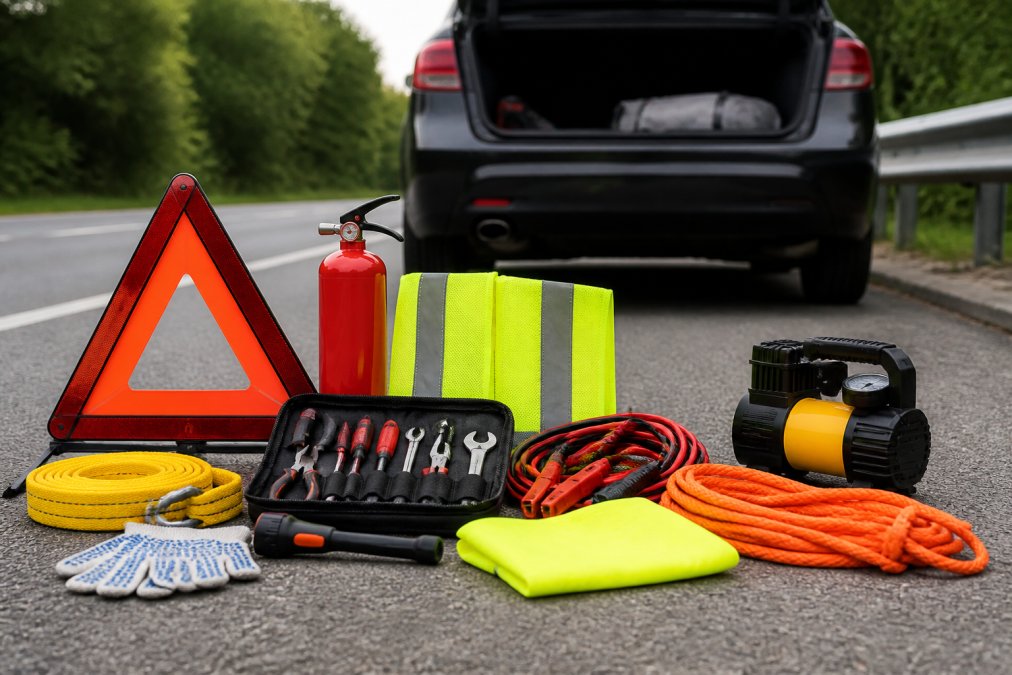
Modern highway breakdown safety equipment goes far beyond the reflective triangle. Today’s best systems combine active lighting, GPS geolocation, high-visibility wraps, and practical tools designed to prevent secondary collisions and protect you until help arrives.
The difference between a controlled breakdown and a dangerous one often comes down to visibility and preparation. Modern highway breakdown safety equipment addresses both, giving other drivers time to react and giving you the tools to stay safe.
Emergency Beacons with GPS: The Modern Standard
Emergency beacons have evolved dramatically in the past five years. The old reflective triangle can’t compete with modern active warning systems that combine flashing lights, geolocation, and automatic emergency alerts.
The Roadflash V16 Emergency Beacon with GPS/Geolocation represents the current generation of breakdown safety equipment. This DGT 3.0 compliant device sits on your vehicle roof and emits a powerful flashing amber light visible up to 1 kilometre in all directions. The built-in GPS transmits your exact location to traffic authorities every 100 seconds, meaning emergency services know precisely where you are without guesswork. The beacon mounts via magnetic or suction cup without tools and deploys from inside your vehicle, reducing your exposure to traffic.
How GPS-enabled beacons improve emergency response
GPS-enabled beacons cut response times by removing location ambiguity. Traditional breakdowns require you to identify your position while stressed and potentially injured. A beacon transmitting your coordinates automatically means responders arrive at the exact spot.
DGT 3.0 compliance and what it means for UK drivers
From 1 January 2026, Spanish regulations mandate DGT 3.0 compliant emergency beacons for vehicles on Spanish roads. Non-compliant systems can result in fines or vehicle impoundment. The Roadflash V16 meets DGT 3.0 specifications, making it legal across Europe. Even if you don’t travel to Spain, DGT 3.0 compliance signals a device built to rigorous modern safety standards.
If you drive Spain-bound routes, carry a DGT 3.0 compliant beacon. The cost of compliance is far lower than the cost of fines or the danger of non-compliant equipment that fails when you need it most.
High-Visibility LED Warning Lights
LED warning lights occupy the middle ground between passive visibility and GPS-enabled beacons. They’re more effective than reflective triangles alone, less complex than connected beacons, and genuinely useful in breakdowns where you need immediate, visible warning.
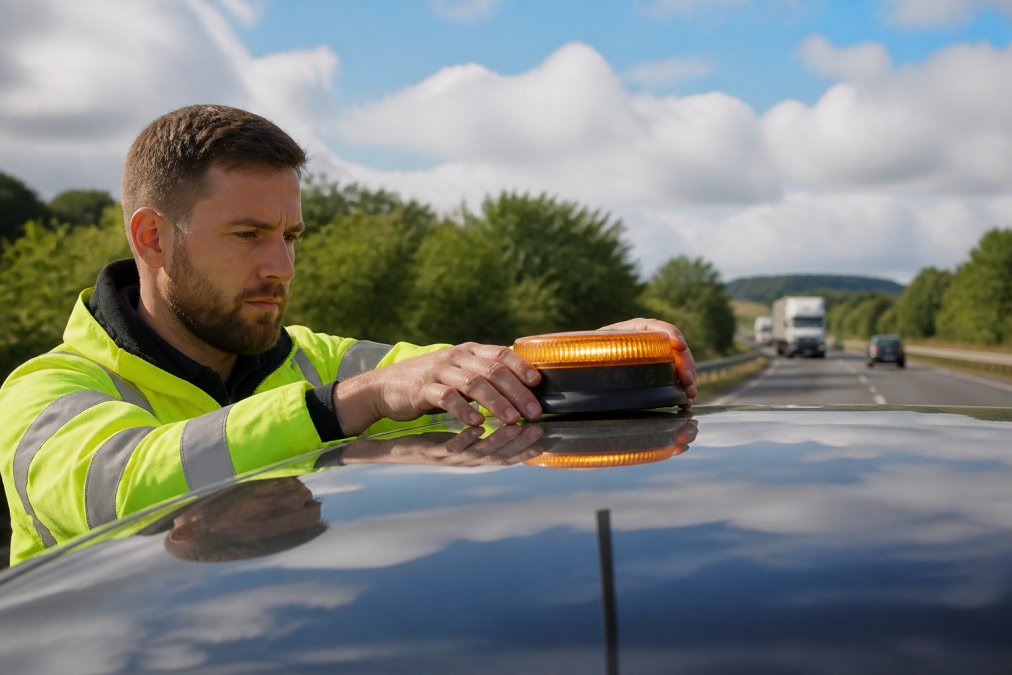
The Roadflash Hazard Warning Breakdown Light delivers high-visibility flashing in a compact, rechargeable package. It mounts via magnetic base or suction cup, offers multiple flashing modes to maximise attention, and runs for 9 to 50 hours depending on mode. The 3.7V lithium battery recharges via USB.
What makes this different from budget alternatives is consistency and reliability. The 10-year warranty signals durability. Multiple flashing patterns let you adapt the warning to conditions.
Motorists who want active, visible warning without the complexity or cost of GPS-enabled beacons. Ideal for frequent commuters who prioritise simplicity and reliability.
What to Do If Your Car Breaks Down on a Smart Motorway
Smart motorways, where the hard shoulder becomes an active traffic lane during peak times, create unique hazards. Your stationary vehicle is potentially in an active traffic lane with vehicles approaching at motorway speeds.
The moment you recognise a breakdown, activate your hazard lights immediately. Move to the hard shoulder if safe to do so, but prioritise your safety over positioning. A breakdown in the live lane with hazard lights flashing is safer than attempting a risky manoeuvre.
Safety protocols for stationary vehicles
Once stationary, your priority is visibility and escape. If you can safely exit the vehicle, move behind the barrier or as far from traffic as possible. If trapped in a live lane or unable to safely exit, stay in the vehicle with seatbelts fastened and hazard lights activated.
Deploy your warning beacon or LED light immediately. If you have a reflective triangle, place it 45 metres behind your vehicle, but only if you can do so safely. Never risk stepping into traffic. Call emergency services and provide your location. If your beacon has GPS, mention this; responders may already have your coordinates. Stay on the line until help arrives.
Using hazard lights and emergency beacons together
Hazard lights and active beacons work in concert. Hazard lights alert drivers immediately behind you; beacons extend visibility to approaching traffic further away. Together, they create a layered warning system that gives drivers maximum time to react.
Turn on hazard lights first, then deploy the beacon. The combination of flashing amber from the beacon plus the vehicle’s hazard lights creates a distinctive visual pattern that triggers faster recognition in approaching drivers.
How to Use a Warning Triangle Correctly
The reflective warning triangle remains a fundamental piece of highway breakdown safety equipment. Used correctly, it extends visibility and gives approaching drivers critical seconds to react.
Position the triangle 45 metres behind your vehicle, roughly 10 car lengths (gov.uk). This distance follows legal guidance and matches driver reaction times at motorway speeds. The triangle should be clearly visible in your vehicle’s lane, with reflective chevrons facing oncoming traffic.
Place the triangle on the road surface, not on the verge. It must be in the path of approaching traffic to be effective. Never place a warning triangle if doing so requires stepping into live traffic. Your personal safety takes priority. In wet conditions and fog, the triangle’s visibility diminishes, which is why combining it with active LED lights or GPS beacons creates a stronger warning system.
Additional Essential Breakdown Equipment
Beyond warning systems, your breakdown kit should contain tools and supplies for common motorway emergencies.
First aid kits and emergency tools
A proper first aid kit addresses injuries sustained in the breakdown itself: cuts from broken glass, minor burns, shock-related injuries. Include sterile dressings, antiseptic wipes, pain relief, and shock blankets.
Practical tools extend beyond first aid. A seatbelt cutter and window breaker allow escape if your vehicle becomes trapped. A torch lets you inspect mechanical issues or signal for help after dark. Jumper leads address battery failures, still one of the most common motorway breakdowns. A tyre inflator or puncture sealant handles deflation emergencies.
Reflective wraps and passive visibility solutions
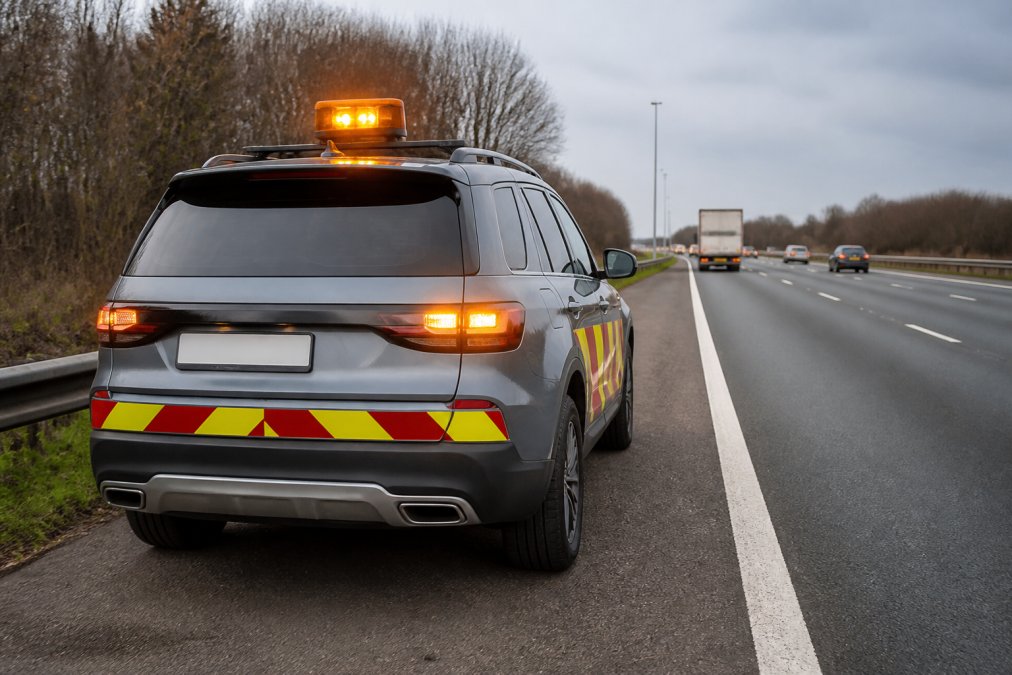
Reflective wraps like the Roadflash Hazard Awareness Wrap provide passive visibility through reflective chevrons visible up to 300 metres. Applied directly to your stationary vehicle, they transform its visibility without requiring batteries.
The wrap uses specially manufactured adhesive that’s paint-friendly and removable. It’s a single-use product; once deployed, it’s designed to be replaced. Wraps excel in daylight and twilight when active lights are less noticeable. Combining a wrap with an active beacon creates layered visibility.
Comparison: Active vs Passive Warning Systems
| System Type | Visibility Range | Requires Power | Best Conditions | Deployment Time |
|---|---|---|---|---|
| Reflective Triangle | 100-150m | No | Daylight, clear weather | 2-3 minutes |
| Reflective Wrap | Up to 300m | No | All conditions, especially daylight | 1-2 minutes |
| LED Warning Light | 300-500m | Yes (rechargeable) | All conditions, especially night | 30 seconds |
| GPS Beacon | 1km+ | Yes (data plan) | All conditions, automatic alerts | 30 seconds |
Active systems provide superior visibility in darkness, fog, and heavy rain, where passive systems lose effectiveness (peer-reviewed research). They also alert approaching drivers faster, reducing rear-impact collision risk.
Passive systems cost less, require no power, and work indefinitely. They’re reliable backups when active systems fail. The best-equipped vehicles carry both: passive systems for baseline visibility, active systems for enhanced protection.
For motorway driving, active warning equipment is worth the investment. The cost of a modern LED light or GPS beacon is negligible compared to the cost of a motorway collision.
Relying solely on hazard lights and reflective triangles leaves you vulnerable in darkness, fog, and heavy rain. Active LED warning lights or GPS beacons dramatically improve detection by approaching drivers, especially in poor visibility where passive systems become nearly invisible.
Maintaining Your Breakdown Safety Kit
Equipment only protects you if it works when needed. Check your kit quarterly. Test rechargeable lights, verify they charge and activate. Inspect reflective equipment for damage. Replace expired first aid items. Verify jumper cables are clean and corrosion-free.
Store your kit accessibly. Equipment buried in the boot won’t help in an emergency. Keep warning systems and first aid supplies in the front passenger area or a dedicated breakdown bag.
For GPS beacons like the Roadflash V16, verify the device powers on and shows a signal indicator. Test it annually; many modern beacons include self-test functions. If your beacon fails, contact the manufacturer immediately.
Seasonal maintenance matters. Winter salt and moisture corrode metal equipment. Spring inspections catch rust. Summer heat can degrade battery performance. Autumn debris can obscure reflective surfaces. A quick seasonal check prevents failures when weather conditions make breakdowns more likely.
Highway breakdowns are unpredictable, but your response doesn’t have to be. Modern highway breakdown safety equipment, GPS beacons, LED warning lights, reflective wraps, and practical tools, transforms a dangerous situation into a manageable emergency. Roadflash’s multi-award-winning systems, including DGT 3.0 compliant beacons with automatic geolocation and high-visibility lighting, are specifically designed to prevent collisions and protect you during breakdowns. Invest in equipment that works, maintain it regularly, and you’ll have genuine peace of mind every time you drive the motorway.
=== FAQ ANSWERS (audit these too, same rules) ===
[1] Q: What is the best car breakdown kit in the UK?
A: The best highway breakdown safety equipment combines multiple layers of protection. A comprehensive kit should include an emergency beacon with GPS for automatic location transmission, high-visibility LED warning lights, a properly positioned warning triangle, reflective wraps or high-visibility vests, jumper cables, a portable air compressor, basic first aid supplies, and a multi-tool with seatbelt cutter and window breaker. The specific best choice depends on whether you prioritise automatic emergency alerts (GPS beacons), passive visibility (reflective wraps), or affordability (basic LED lights). For frequent motorway users, GPS-enabled beacons offer the greatest safety advantage.
[2] Q: Are emergency beacons more effective than traditional warning triangles?
A: Yes, modern emergency beacons significantly outperform traditional warning triangles. GPS-enabled beacons automatically alert traffic authorities to your exact location every 100 seconds, ensuring rapid emergency response without you needing to exit the vehicle. They provide 360-degree visibility up to 1 kilometre away, even in poor weather or darkness. Warning triangles require manual placement on the road (exposing you to traffic) and are visible only from certain angles. Using both together, beacons for active warning and triangles as backup, provides the strongest protection during roadside emergencies.
[3] Q: What should I do if my car breaks down on a smart motorway?
A: On a smart motorway, activate your hazard lights immediately and move your vehicle to the hard shoulder if safe to do so. Switch on your emergency beacon or deploy high-visibility warning lights to alert approaching traffic. Remain inside your vehicle with seatbelts fastened unless there is immediate danger. Place a warning triangle at least 45 metres behind your vehicle (or use reflective wraps as an alternative). If you have a GPS-enabled beacon, it will automatically transmit your location to traffic authorities. Call for roadside assistance and wait for help. Never attempt repairs yourself on the motorway, and stay alert to traffic patterns.
[4] Q: Is it worth investing in a GPS-enabled emergency beacon for 2026?
A: GPS-enabled beacons are increasingly valuable, especially if you travel frequently on motorways or in Europe. They automatically notify traffic authorities of your precise location, reducing emergency response times significantly. For UK motorway use, they eliminate the need to exit your vehicle to place warning triangles, reducing exposure to high-speed traffic. If you travel to Spain or other European countries, DGT 3.0 compliant beacons are now mandatory from 2026, making them a legal requirement, not just a safety choice. The long-term data plans included (often to 2038) mean no recurring subscription fees, making the investment cost-effective over time.
[5] Q: What items are legally required in a car breakdown kit in the UK?
A: The UK does not mandate specific breakdown kit contents by law, unlike some European countries. However, practical safety requires a warning triangle (or approved alternative like reflective wraps), high-visibility vests, hazard warning lights, a torch with spare batteries, jumper cables, a spare fuse set, and basic first aid supplies. If you travel to Spain, you must carry DGT 3.0 compliant emergency beacons from January 2026. For motorway use, the Highway Code strongly recommends carrying reflective warning equipment and maintaining working hazard lights. Roadside assistance organisations recommend comprehensive kits that address common breakdown scenarios like flat tyres, dead batteries, and minor injuries.
Frequently Asked Questions
Q: What is the best car breakdown kit in the UK?
A: The best highway breakdown safety equipment combines multiple layers of protection. A comprehensive kit should include an emergency beacon with GPS for automatic location transmission, high-visibility LED warning lights, a properly positioned warning triangle, reflective wraps or high-visibility vests, jumper cables, a portable air compressor, basic first aid supplies, and a multi-tool with seatbelt cutter and window breaker. The specific best choice depends on whether you prioritise automatic emergency alerts (GPS beacons), passive visibility (reflective wraps), or affordability (basic LED lights). For frequent motorway users, GPS-enabled beacons offer the greatest safety advantage.
Q: Are emergency beacons more effective than traditional warning triangles?
A: Yes, modern emergency beacons significantly outperform traditional warning triangles. GPS-enabled beacons automatically alert traffic authorities to your exact location every 100 seconds, ensuring rapid emergency response without you needing to exit the vehicle. They provide 360-degree visibility up to 1 kilometre away, even in poor weather or darkness. Warning triangles require manual placement on the road (exposing you to traffic) and are visible only from certain angles. Using both together, beacons for active warning and triangles as backup, provides the strongest protection during roadside emergencies.
Q: What should I do if my car breaks down on a smart motorway?
A: On a smart motorway, activate your hazard lights immediately and move your vehicle to the hard shoulder if safe to do so. Switch on your emergency beacon or deploy high-visibility warning lights to alert approaching traffic. Remain inside your vehicle with seatbelts fastened unless there is immediate danger. Place a warning triangle at least 45 metres behind your vehicle (or use reflective wraps as an alternative). If you have a GPS-enabled beacon, it will automatically transmit your location to traffic authorities. Call for roadside assistance and wait for help. Never attempt repairs yourself on the motorway, and stay alert to traffic patterns.
Q: Is it worth investing in a GPS-enabled emergency beacon for 2026?
A: GPS-enabled beacons are increasingly valuable, especially if you travel frequently on motorways or in Europe. They automatically notify traffic authorities of your precise location, reducing emergency response times significantly. For UK motorway use, they eliminate the need to exit your vehicle to place warning triangles, reducing exposure to high-speed traffic. If you travel to Spain or other European countries, DGT 3.0 compliant beacons are now mandatory from 2026, making them a legal requirement, not just a safety choice. The long-term data plans included (often to 2038) mean no recurring subscription fees, making the investment cost-effective over time.
Q: What items are legally required in a car breakdown kit in the UK?
A: The UK does not mandate specific breakdown kit contents by law, unlike some European countries. However, practical safety requires a warning triangle (or approved alternative like reflective wraps), high-visibility vests, hazard warning lights, a torch with spare batteries, jumper cables, a spare fuse set, and basic first aid supplies. If you travel to Spain, you must carry DGT 3.0 compliant emergency beacons from January 2026. For motorway use, the Highway Code strongly recommends carrying reflective warning equipment and maintaining working hazard lights. Roadside assistance organisations recommend comprehensive kits that address common breakdown scenarios like flat tyres, dead batteries, and minor injuries.
This article was written using GrandRanker