

Emergency Light Installation for Passenger Cars: A Legal Guide
Table of Contents
- Understanding Legal Requirements for Emergency Light Installation
- Who Is Authorised to Use Emergency Lighting on Passenger Cars
- High Visibility Hazard Lights for Maintenance and Roadside Safety
- DGT 3.0 Compliant Emergency Beacons: Meeting International Standards
- Step-by-Step Emergency Light Installation Process
- Common Mistakes to Avoid During Installation
- Insurance and Liability Implications
- Conclusion
Last Updated: August 18, 2026
Understanding Legal Requirements for Emergency Light Installation
Emergency light installation for passenger cars is heavily regulated in the UK. The Road Vehicles Lighting Regulations 1989 sets out strict rules governing what lighting can be fitted to private vehicles, when it can be used, and who is legally permitted to operate it.
According to the UK Department for Transport guidance on vehicle lighting, any light fitted to a vehicle must comply with specific photometric requirements, colour standards, and mounting positions. Red and amber lights are strictly controlled. Blue lights are reserved for emergency services. Unauthorised use of emergency lighting can result in fines, vehicle impoundment, or prosecution.
Legality depends on three factors: the type of vehicle, the lighting system’s technical specification, and the driver’s authorisation to use it. A beacon that’s perfectly legal for a breakdown recovery vehicle is illegal on a family saloon unless you hold the proper credentials.
Installing emergency lighting without understanding these regulations can result in fines up to £1,000 and invalidation of your vehicle insurance. If you’re involved in an accident while using unauthorised emergency lighting, liability becomes your personal responsibility, not your insurer’s.
Who Is Authorised to Use Emergency Lighting on Passenger Cars
Not everyone is permitted to use emergency lighting on a passenger car. Traffic officers, police, ambulance personnel, fire service staff, and breakdown service operators (AA, RAC, Green Flag) are authorised because they hold explicit legal permission under the Road Vehicles Lighting Regulations 1989. Roadside maintenance crews, highway authority staff, and traffic control officers also fall within this remit when performing professional duties.
Private motorists occupy a different category entirely. If you’re a self-employed breakdown technician or run a small fleet maintenance operation, you may apply for authorisation from your local traffic authority, but simply commuting on a motorway does not qualify.
Unless you hold formal authorisation from a traffic authority or operate under a recognised emergency service or breakdown recovery organisation, emergency lighting on a passenger car is illegal. The fact that you can buy it online doesn’t make it legal to use.
High Visibility Hazard Lights for Maintenance and Roadside Safety
High-visibility hazard lights occupy a more permissive legal space than emergency beacons, particularly for roadside maintenance work and professional operations.
An emergency beacon is designed to warn approaching traffic of a stationary hazard. A high-visibility hazard light is a fixed or slowly flashing amber or red light designed to increase vehicle visibility during maintenance or breakdown recovery work. The Road Vehicles Lighting Regulations 1989 permits these lights on vehicles used for specific purposes, provided they meet technical standards for colour, intensity, and mounting position.
For fleet managers and maintenance contractors, high-visibility hazard lights are often the appropriate choice rather than full emergency beacons. They provide significantly improved roadside visibility without crossing into emergency service territory. Roadflash’s high-visibility hazard lights are specifically designed for maintenance and roadside safety applications, meeting the technical standards required for professional use.
Installation requirements include proper mounting position, typically on the roof or rear where approaching traffic can see them clearly. Wiring must be properly fused and grounded. Control switches must be clearly labelled and easily accessible to the driver.
DGT 3.0 Compliant Emergency Beacons: Meeting International Standards
For drivers and fleet operators working across Europe, DGT 3.0 compliance represents a critical legal requirement, particularly if you’re operating in Spain or other EU jurisdictions.
DGT 3.0 is the Spanish traffic authority’s standard for emergency vehicle lighting. It defines technical specifications including photometric output, flash frequency, colour standards, and mounting requirements. Many European countries have adopted similar standards or recognise DGT 3.0 compliance as meeting their own requirements.
A DGT 3.0 compliant emergency beacon must meet specific performance criteria: flash frequency between 60 and 120 flashes per minute, photometric intensity exceeding defined thresholds for daylight and poor weather visibility, and driver control with backup power or redundancy features.
Roadflash’s DGT 3.0 compliant emergency beacons with GPS/Geolocation functionality exceed baseline standards. When you activate the beacon during a breakdown, the system automatically transmits your precise location to emergency services. This is particularly valuable on motorways where visibility is poor or where a breakdown occurs in an unfamiliar location.
If you operate across Europe, DGT 3.0 compliance is worth prioritising. It simplifies regulatory navigation and often exceeds the minimum standards of other countries, reducing the risk of non-compliance when you cross borders.
Step-by-Step Emergency Light Installation Process
Emergency light installation requires methodical planning and careful execution. Mistakes in wiring or mounting can result in system failure when you need it most, or worse, electrical damage to your vehicle.
What You’ll Need Before Starting
Gather your materials and tools before beginning installation: the emergency light system, mounting hardware, wiring harness, hand tools (wire strippers, crimpers, multimeter, socket set), fuse holder, appropriately-rated fuses (typically 15-20 amp), electrical tape, heat-shrink tubing, and cable ties.
Before you start, consult your vehicle’s electrical schematic. Understanding your vehicle’s existing electrical architecture, fuse box location, available circuits, and voltage drop across different sections is critical for safe installation.
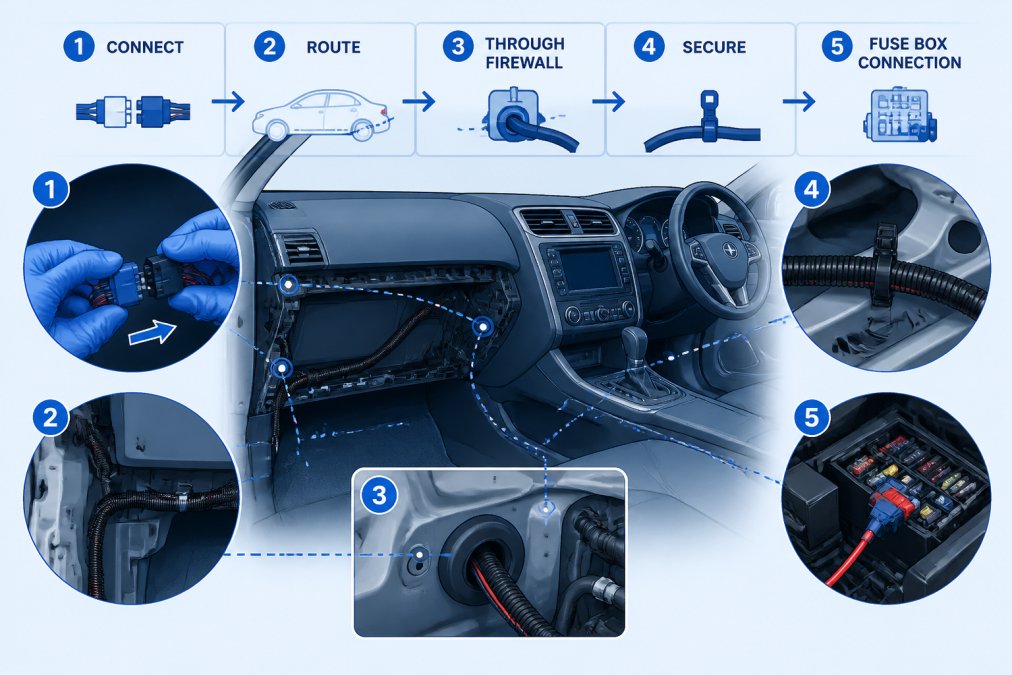
Wiring and Electrical Installation Basics
Proper wiring is the foundation of a reliable emergency light installation. Poor connections or inadequate wire gauge will cause voltage drop and create fire risk.
Start by identifying a suitable power source. Most emergency lighting systems draw 10-20 amps, which requires a dedicated circuit. Run a new cable from the vehicle’s main fuse box directly to the light control switch, then from the switch to the beacon unit.
Wire gauge matters. For runs under 5 metres, 10 AWG (American Wire Gauge) wire is typically sufficient. For longer runs, use 8 AWG. Never use wire smaller than 12 AWG. All connections must be crimped and soldered, never twisted and taped. Use proper crimp connectors rated for the wire gauge you’re using.
Grounding is equally critical. Run a dedicated ground cable from the light unit back to the negative terminal of the battery or a clean, unpainted point on the vehicle frame. Never rely on the chassis as a return path.
Circuit protection is non-negotiable. Install an appropriately-rated fuse holder as close as possible to the battery. For a 15-amp circuit, use a 15-amp fuse. Test continuity at every stage using a multimeter before energising the circuit.
Mounting and Placement Guidelines
Physical mounting determines visibility and system reliability. A beacon unit should be mounted on the roof of the vehicle, as high as possible, where it’s visible from all directions. Grill-mounted LED lights should be positioned low on the front of the vehicle, flush with the grille.
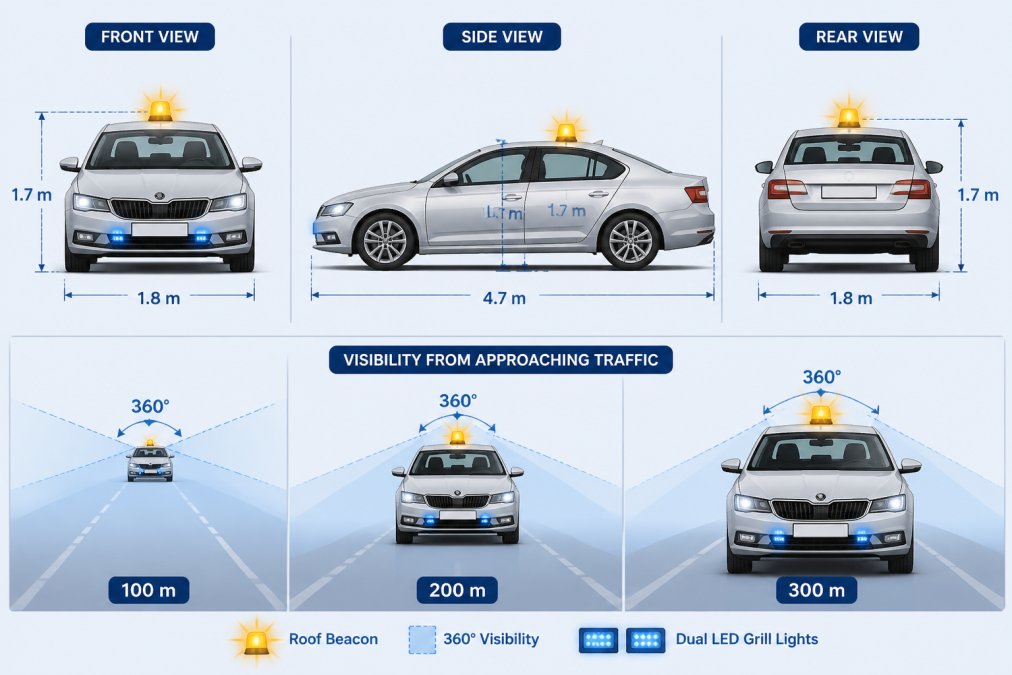
Mounting brackets must be strong and corrosion-resistant. Stainless steel or powder-coated steel are appropriate. Ensure the bracket is rated for the weight of your light unit and can withstand wind loading at motorway speeds.
Weatherproofing is essential. The junction between the light unit and mounting bracket must be sealed to prevent water ingress. Ensure the light unit itself is rated IP65 or higher. Cable routing must avoid sharp edges and moving parts. Run cables through protective conduit and secure them with cable ties every 150mm.
Post-Installation Testing and Safety Checks
Functional testing is critical. Activate the light and verify that it illuminates at full brightness. Test each brightness level if your system has multiple settings. Measure voltage at the light unit while it’s illuminated, it should be within 1 volt of the battery voltage.
Visibility testing should be done at night. Activate the light in darkness and observe visibility from different distances and angles. A properly installed emergency beacon should be visible from at least 500 metres away in clear conditions.
Weather testing is often overlooked. After a week of use, check the mounting point for water accumulation or corrosion. If you’re using a system with GPS/Geolocation functionality, test the location transmission in different locations to ensure GPS acquisition is reliable.
Never assume an emergency light system is working correctly without testing. A light that fails when you need it during a motorway breakdown creates a genuinely dangerous situation.
Common Mistakes to Avoid During Installation
The first common mistake is undersized wiring. Always verify wire gauge against your light unit’s power requirements and the length of the run.
The second mistake is poor grounding. Always run a dedicated ground wire from the light unit back to the negative battery terminal or a clean, unpainted chassis point.
The third mistake is inadequate circuit protection. Use the correct fuse rating for your circuit. An undersized or missing fuse creates fire risk.
The fourth mistake is poor cable routing. Route cables through protective conduit and secure them with cable ties. Never route cables near the exhaust manifold or moving parts.
The fifth mistake is mounting the light in a position where it’s not visible. Mount the light where it’s clearly visible from all directions.
The sixth mistake is skipping testing. Night-time visibility testing and weather testing are essential. Never assume an installation is correct without testing.
Insurance and Liability Implications
Installing emergency lighting on a passenger car creates significant insurance and liability implications that many drivers overlook.
If you install unauthorised emergency lighting and are involved in an accident, your insurer may refuse to pay claims. Insurance policies typically include exclusions for unauthorised modifications. If you’re using emergency lighting without proper authorisation and an accident occurs as a result, you could be personally liable for damages.
Using emergency lighting without authorisation can result in prosecution under the Road Vehicles Lighting Regulations 1989. Fines start at £1,000 and can escalate to £10,000 for persistent offences.
Before installing emergency lighting, contact your insurance provider and request written confirmation that the modification won’t affect your coverage. For professional operators, breakdown recovery services, and maintenance contractors, your fleet insurance should cover authorised emergency lighting, but confirmation from your insurer is still essential.
Roadflash’s emergency beacons are designed for authorised professional use. If you’re a breakdown recovery operator or roadside maintenance professional, you likely have the authorisation to use them. If you’re a private motorist, you almost certainly don’t.
Emergency light installation for passenger cars sits at the intersection of safety and legality. The technical aspects, wiring, mounting, testing, are manageable if you follow best practices. The legal aspects are more complex and more critical.
The core challenge isn’t installing the light. It’s understanding whether you’re authorised to use it. That determination depends on your vehicle type, your professional role, and your jurisdiction.
If you’re an authorised professional user, a breakdown recovery operator, maintenance contractor, or emergency service provider, Roadflash’s DGT 3.0 compliant emergency beacons with GPS/Geolocation functionality provide a significantly safer alternative to traditional beacons alone. The GPS integration ensures that emergency services locate you precisely. The DGT 3.0 compliance simplifies regulatory navigation across European jurisdictions.
If you’re a private motorist considering emergency lighting, the honest answer is: you probably don’t have the authorisation to use it. A reflective triangle, hazard flashers, and a high-visibility vest remain your legal options. They’re proven, they’re legal, and they work.
Frequently Asked Questions
Can I legally install flashing emergency lights on my private passenger car?
Private vehicles cannot display flashing emergency lights under Road Vehicles Lighting Regulations 1989. Only authorised emergency services, response vehicles, and specific maintenance or recovery personnel are permitted to use flashing beacons. However, you can install fixed amber or white lighting for additional visibility during breakdowns. Always check with your insurer before any installation, as non-compliant modifications may affect your cover.
What are the legal requirements for emergency lighting on passenger cars in the UK?
Road Vehicles Lighting Regulations 1989 govern emergency lighting. Private cars must use hazard warning lights (your existing flashers) during breakdowns. If you install additional lighting, it must be fixed (non-flashing), appropriately coloured, and not impersonate emergency service equipment. DGT 3.0 compliant emergency beacons are legal for vehicles operating internationally or in Spain, but check local compliance for your specific use case.
What is the difference between hazard lights and emergency beacons?
Hazard lights are your car's built-in warning flashers that alert other drivers to a breakdown or hazard. Emergency beacons are additional high-visibility lights, often roof-mounted or grill-mounted, that provide enhanced visibility during stationary situations. Beacons offer greater visibility range and are often used by recovery vehicles and maintenance crews. For private motorists, hazard lights meet legal requirements, but additional beacons can improve safety during roadside incidents.
Do I need professional installation or can I install emergency lights myself?
DIY installation is possible if you have basic electrical knowledge and follow proper wiring practices, including correct AWG gauge wire sizing, fuse protection, and grounding. However, improper installation risks electrical damage, fire hazard, or voiding your vehicle warranty. Professional installers ensure compliance with regulations and proper circuit protection. Consider professional installation if you're unfamiliar with automotive electrics or if your vehicle has complex electrical systems.
This article was written using GrandRanker