

Emergency Beacons for Small Fleets: A 2026 Guide
Table of Contents
- Why Emergency Beacons Matter for Small Fleet Operations
- Amber Beacon Legal Requirements in the UK
- Understanding Vehicle Beacon Voltage Requirements: 12V and 24V Systems
- LED Beacon Technology and Visibility Standards
- Mounting Options and Fleet Integration
- Maintenance of Emergency Warning Lights and Inspection Schedules
- Total Cost of Ownership and Fleet Procurement Strategy
- Conclusion
Last Updated: August 14, 2026
Why Emergency Beacons Matter for Small Fleet Operations
Breakdowns on motorways kill. A stationary vehicle becomes a collision hazard within seconds, especially in poor visibility or heavy traffic. Emergency beacons transform a stationary vehicle from invisible to unmissable. A high-visibility amber LED beacon with rotating or strobe patterns creates a warning signal that reaches drivers at distance, in daylight, and in conditions where reflective triangles and hazard lights alone don’t cut through the noise of a busy motorway.
For small fleet operators, the calculation is straightforward. You can’t eliminate breakdowns. You can dramatically reduce the consequences through visibility.
Emergency beacons transform stationary vehicles from invisible hazards into unmissable warnings. For small fleets, they’re the difference between a breakdown and a catastrophe.
Amber Beacon Legal Requirements in the UK
An amber beacon is a rotating or strobe-pattern warning light designed to alert approaching traffic to a stationary or slow-moving hazard. In the UK, amber beacons are not legally mandatory for private vehicles or small commercial fleets during normal operation, but their use is strongly recommended and heavily regulated in specific contexts.
The Road Vehicles (Construction and Use) Regulations 1986 define when amber lighting is permitted, what wavelengths and flash patterns are acceptable, and how beacons must be mounted. For emergency response and breakdown situations, amber beacons are expected equipment. The regulations permit amber beacons on stationary vehicles during emergency or breakdown scenarios, provided they meet strict visibility and technical standards. The amber colour, distinct from red (emergency services) and white (reversing), signals a warning or hazard alert.
Flash frequency matters legally. Beacons must flash at rates between 60 and 120 flashes per minute to comply with UK standards and maintain visibility without causing photosensitive seizure risks.
For small fleet operators, you can legally deploy amber beacons during breakdowns, roadside maintenance, or incident response, provided they meet UK construction standards and are mounted safely. Many fleet managers equip all vehicles preemptively so beacons are ready if needed.
Check your fleet insurance policy. Some insurers offer premium reductions if vehicles are equipped with approved emergency beacons, a direct financial incentive beyond the safety case.
Understanding Vehicle Beacon Voltage Requirements: 12V and 24V Systems
Vehicle electrical systems come in two standard voltages: 12V and 24V. A beacon designed for one system won’t function properly on the other, and forcing incompatible voltage can damage both the beacon and the vehicle’s electrical system.
Most cars and light vans operate on 12V systems. Larger commercial vehicles, HGVs, buses, and some fleet vehicles run 24V. A small fleet managing mixed vehicle types needs to know which beacons work with which vehicles before purchasing.
12V systems are standard across passenger cars, most light commercial vehicles under 3.5 tonnes, and delivery vans. A 12V emergency beacon draws power directly from the vehicle’s battery and wiring harness. Installation involves hardwiring to the vehicle’s electrical system or using a magnetic base with a 12V power lead.
24V systems are found on HGVs and larger commercial vehicles. A 24V beacon is engineered for higher voltage and current draw. Installing a 12V beacon on a 24V system will cause immediate failure or damage. Installing a 24V beacon on a 12V system won’t power on at all.
For small fleet procurement, audit your vehicle types and their electrical specifications first. If your fleet is entirely 12V, purchasing is straightforward. If you have mixed voltages, you’ll need separate beacon models or a dual-voltage option. Roadflash offers both 12V and 24V emergency beacons designed for this scenario.
Some modern beacons include USB rechargeable options or subscription-free GPS modules that operate independently of the vehicle’s electrical system, reducing voltage compatibility concerns.
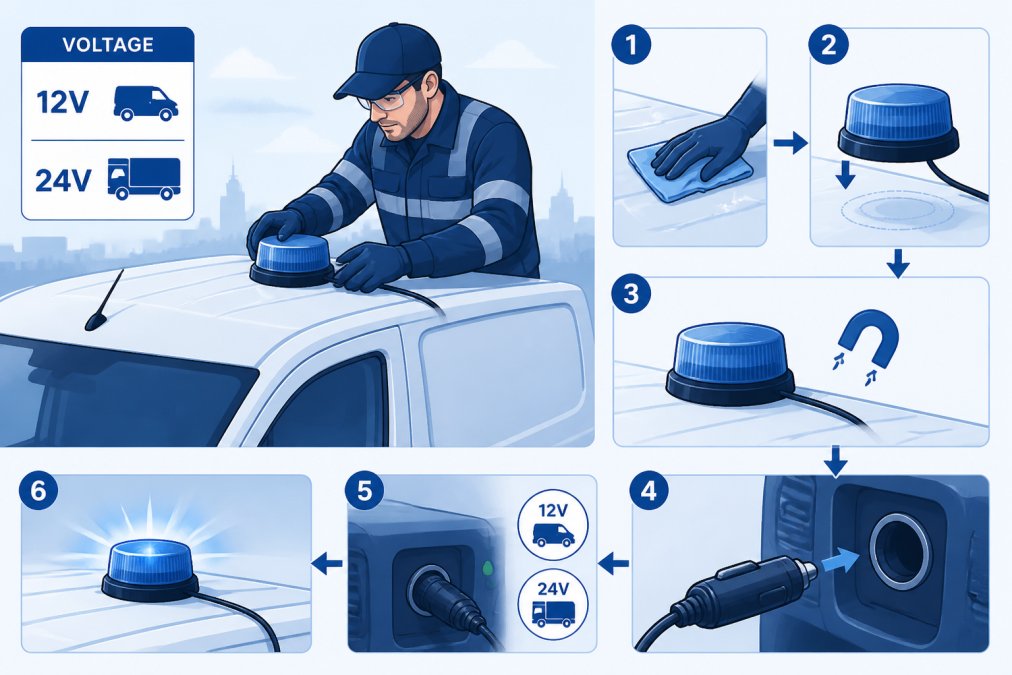
Never assume all vehicles in your fleet use the same voltage. A single 12V beacon installed on a 24V truck will fail silently. Verify each vehicle’s electrical system before purchasing beacons.
LED Beacon Technology and Visibility Standards
LED strobe beacons use light-emitting diodes to produce high-intensity flashing patterns. Unlike older halogen beacons, LEDs consume far less power, generate minimal heat, and produce consistent, bright light across their operational lifespan.
The visibility of an LED beacon depends on light output measured in candelas, flash frequency, lens clarity, and ambient light conditions. A high-quality amber LED beacon should be visible from at least 500 metres away in daylight and further in low-light conditions. The 360-degree coverage ensures drivers approaching from any direction see the warning signal.
LED beacons rated for IP65 or higher weatherproofing withstand motorway conditions: rain, salt spray, vibration, and temperature extremes. The polycarbonate lens must maintain optical clarity over years of UV exposure. Shock resistance is equally important; a beacon that fails after hitting a pothole is worse than no beacon at all.
The flash pattern, typically 60-120 flashes per minute for UK compliance, creates a visual rhythm that penetrates driver attention better than steady light. Strobe patterns are more effective than rotating beacons because discrete flashes catch the eye through motion.
For small fleets on tight budgets, the temptation to buy the cheapest LED beacon available becomes a false economy. A low-cost beacon with poor optical clarity, inadequate weatherproofing, or weak light output fails to deliver promised visibility. In a breakdown scenario, that failure becomes a safety liability.
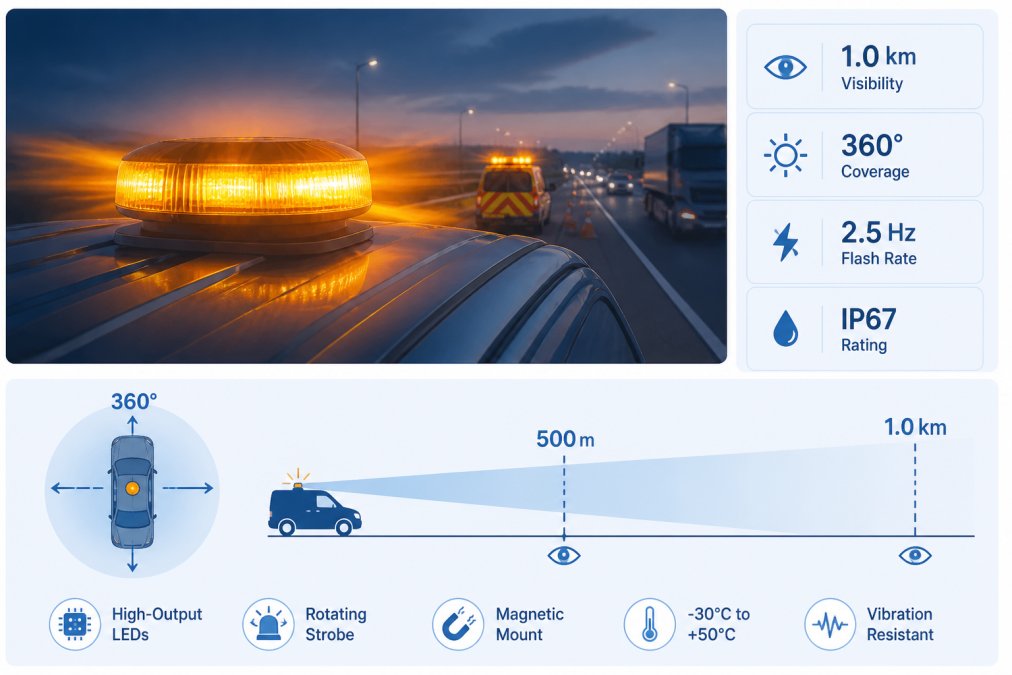
Roadflash’s emergency beacons use high-output LEDs with precision-engineered optics to maximise visibility across all light conditions, performing when it matters most during the first critical minutes of a breakdown.
Test your beacon’s visibility in the conditions you’ll actually use it. Install it on a vehicle, drive it at night on a quiet road, and observe how far away the warning is visible to oncoming traffic.
Mounting Options and Fleet Integration
An emergency beacon is only effective if mounted securely, positioned for maximum visibility, and integrated into your fleet’s operational workflow. Three primary mounting options exist: magnetic base, DIN rail mount, and fixed hardwired installation.
Magnetic base beacons use a strong neodymium magnet to attach directly to the vehicle roof. Advantages: no drilling, no permanent modification, can be moved between vehicles. Disadvantages: only works on ferrous metal surfaces, can vibrate loose on rough roads, requires manual placement before deployment. For small fleets with shared equipment, magnetic base beacons are practical.
DIN rail mounts are semi-permanent fixtures for vehicles with pre-installed DIN rails. They provide secure attachment and professional appearance but require compatible rail systems already in place.
Fixed hardwired installation involves permanently mounting the beacon to the roof and running electrical wiring to the battery or fuse panel. This is the most secure and reliable option for vehicles that will consistently carry the beacon. Hardwiring eliminates vibration issues and ensures the beacon is always ready without manual setup.
For small fleet procurement, the choice depends on your operational model. If vehicles are regularly shared, magnetic base beacons offer flexibility. If specific vehicles are dedicated to high-risk routes, hardwired installation is superior. Many small fleet operators use a hybrid approach: magnetic beacons for general deployment and hardwired beacons on primary vehicles.
Integration with telematics systems and GPS tracking transforms a beacon from a passive warning light into an active safety tool. When a beacon activates, a telematics system can automatically log the location, alert dispatch, and notify emergency services. Roadflash’s GPS/Geolocation-enabled beacons integrate with fleet management platforms, creating a seamless workflow.
Small fleets with 5-20 vehicles where each vehicle performs similar functions and follows predictable routes. Magnetic base beacons offer cost-effective flexibility; hardwired beacons on primary vehicles provide maximum reliability.
Maintenance of Emergency Warning Lights and Inspection Schedules
An emergency beacon that fails during a breakdown creates false confidence that your team is protected when they’re actually invisible. Maintenance and regular inspection are non-negotiable.
LED beacons require minimal maintenance compared to older halogen systems. Monthly visual inspection should confirm: the lens is clean and free of cracks, the mounting is secure and shows no corrosion, and the beacon powers on when tested. For hardwired beacons, check that wiring connections are tight and show no signs of corrosion or heat damage.
Quarterly testing should verify that the beacon operates at full brightness and maintains its flash pattern. If a beacon is dimmer than expected or flashes irregularly, the LED array may be degrading or power delivery may be compromised. Replace or repair before the beacon is needed in an actual emergency.
An annual deep inspection, removing the beacon and checking internal connections, extends operational life and catches problems before they become failures.
For small fleets, assign beacon maintenance to the person or team responsible for vehicle servicing. Document inspection dates and findings. If a beacon fails inspection, remove it from service immediately and repair or replace it.
Magnetic base beacons are easier to inspect because they’re removable. Store them in a clean, dry location when not deployed and check the magnet’s adhesion periodically.
A beacon that hasn’t been tested in six months is a liability. Test before every high-risk journey or at minimum quarterly. A five-minute test now prevents a catastrophic failure later.
Total Cost of Ownership and Fleet Procurement Strategy
Buying emergency beacons for small fleets requires thinking beyond purchase price. Total cost of ownership includes the beacon itself, installation, maintenance, replacement cycles, and the indirect cost of downtime or safety incidents if beacons fail.
A low-cost magnetic base beacon might cost less upfront than a hardwired strobe system with GPS integration. But if the cheap beacon fails after two years and delivers poor visibility during a critical incident, the total cost compounds. The expensive beacon that lasts five years, maintains visibility standards, and integrates with fleet management systems delivers better value over time.
For small fleets, procurement strategy should centre on standardisation. Choosing one beacon model that works across your vehicle types simplifies maintenance, training, and replacement logistics. Bulk purchasing from a single supplier like Roadflash often yields better pricing.
Consider fleet size and vehicle turnover. A five-vehicle fleet might invest in hardwired beacons on all vehicles. A fifteen-vehicle fleet with high turnover might prefer magnetic beacons for flexibility.
Regulatory compliance also factors into cost. If your fleet operates in Spain or other markets requiring DGT 3.0 certification, beacons must meet those standards. Roadflash’s DGT 3.0 compliant emergency beacons are certified for multiple markets, protecting your fleet across borders.
Insurance incentives can offset beacon costs. Some insurers reduce premiums if vehicles are equipped with approved safety equipment. Confirm with your insurer whether they offer this discount before purchasing.
The real cost of not having beacons is hidden in incidents that don’t happen. Every breakdown without a secondary collision, every motorway incident where emergency services reach your team quickly because they had GPS location data, these are invisible cost savings. Buying emergency beacons for small fleets isn’t an optional expense; it’s essential infrastructure that pays for itself through risk reduction.
Total cost of ownership favours standardised, durable beacons integrated with fleet management systems. The cheapest beacon is often the most expensive when you account for failure rates and replacement cycles.
Conclusion
Small fleet operators manage constant risk on UK motorways. A breakdown transforms a routine incident into a collision hazard within seconds. Emergency beacons eliminate the invisibility problem, making stationary vehicles unmissable, giving emergency services location data, and protecting your team during the most vulnerable moments.
Roadflash’s multi-award-winning emergency beacons with GPS/Geolocation and DGT 3.0 compliance are designed specifically for this challenge. They deliver high-visibility amber warning signals, integrate seamlessly with fleet management systems, and operate reliably across 12V and 24V vehicle types. Whether you need magnetic base beacons for flexibility or hardwired systems for maximum reliability, Roadflash provides the visibility and safety infrastructure that small fleets depend on.
Add to basket and equip your fleet with the emergency beacons that have proven their worth in real-world breakdowns. Your team deserves protection that works when it matters most.
Frequently Asked Questions
What are the legal requirements for amber beacons on commercial vehicles in the UK?
Commercial vehicles operating on motorways and major roads should carry emergency warning equipment to meet safety standards. Amber beacons improve visibility during breakdowns and stationary situations. The Health and Safety at Work etc. Act 1974 requires employers to ensure the safety of employees, including drivers. Check with your insurer and local authority for specific requirements for your fleet type, as regulations vary by vehicle class and operation type.
How do I choose between 12V and 24V emergency beacon systems for my fleet?
Your choice depends on your vehicles' electrical systems. Most cars and light vans run 12V systems, while larger commercial vehicles often use 24V. Check your vehicle documentation or consult your maintenance team to confirm. Using the correct voltage ensures reliable operation and prevents electrical damage. If your small fleet contains mixed vehicle types, you may need both 12V and 24V beacons, or consider universal-fitment models that support both voltages.
How often should emergency beacons be tested or maintained?
Test your emergency beacons monthly to ensure the strobe function, lens clarity, and mounting are secure. Check the lens for cracks, cloudiness, or dirt that reduces visibility. Inspect weatherproof seals and connectors for corrosion. Replace batteries or recharge USB-powered units before they deplete. Perform a full visual inspection every six months and replace any beacon showing reduced light output or physical damage. Keep maintenance records for compliance and insurance purposes.
Is an emergency beacon really necessary if I don't break down often?
Even infrequent motorway users benefit from emergency beacons. A single breakdown on a busy highway poses serious risk, stationary vehicles are struck by other traffic within seconds if not properly warned. Amber LED beacons with 360-degree visibility are far more effective than hazard lights alone, which drivers often miss in poor visibility or low-light conditions. The investment in a quality beacon provides protection for every journey, not just frequent ones, and satisfies insurance and legal requirements.
What makes LED beacons better than traditional strobe lights for fleet safety?
LED strobes offer superior visibility with lower power consumption, longer operational life, and faster response times than older halogen systems. They produce consistent, bright amber light visible in daylight, fog, and heavy rain. LEDs generate less heat, reducing fire risk near fuel tanks or cargo. They're more durable in harsh conditions and require less maintenance. For small fleets, LED beacons mean fewer replacements, lower energy draw on vehicle batteries, and more reliable hazard warning when drivers need it most.
What's the difference between an EPIRB and a PLB for fleet safety?
EPIRBs (Emergency Position Indicating Radio Beacons) are fixed maritime devices that transmit distress signals via satellite. PLBs (Personal Locator Beacons) are handheld, portable devices for individual use. For road fleet operations, vehicle-mounted emergency beacons with GPS geolocation are more practical than EPIRBs. They provide real-time location data to emergency services without relying on manual activation. PLBs suit individual drivers as backup safety tools, but fleet vehicles benefit from integrated beacon systems with automatic hazard detection and GPS transmission.
How do I ensure my fleet beacons meet regulatory approval standards?
In the UK, emergency beacons should comply with relevant vehicle lighting regulations and safety standards. Check product specifications for CE marking and relevant British or European standards. If operating in Spain or other EU countries, verify DGT 3.0 compliance for that market. Request certification documentation from suppliers before purchasing. Consult your fleet insurer about their specific requirements, many insurers mandate certain beacon types or standards. Keep compliance records for all beacons in your fleet for regulatory audits and insurance claims.
What should I budget for emergency beacons across a small fleet?
Total cost depends on fleet size, vehicle types, mounting options, and whether you need 12V or 24V systems. Consider not just purchase price but also installation, maintenance, battery replacement, and long-term durability. Quality beacons with LED technology and weatherproof construction cost more upfront but require fewer replacements and less maintenance over time. Request quotes from suppliers for your specific fleet size, small fleet operators often qualify for volume discounts. Factor in potential insurance savings and accident prevention value when evaluating return on investment.
This article was written using GrandRanker