
7-Point Safety Checklist for Driving a UK Car in Spain
Last Updated: October 26, 2026
Quick Summary
Before driving a UK car in Spain, carry your licence, passport, original V5C and proof of insurance, plus a warning triangle, a high-visibility vest kept in the cabin and headlamp beam deflectors. Spanish equipment law applies to the vehicle, so UK-legal kit alone is not enough.
- The high-visibility vest must be stored in the cabin, not the boot, and put on before exiting.
- UK headlamps dip left, so the beam must be adjusted with deflectors or converters for Spain.
- A first aid kit and fire extinguisher are recommended but not compulsory for a private car.
- Dial 112 for emergencies in Spain; save your insurer and breakdown numbers before leaving.
- Check your insurer covers Spain and tell them your travel dates in advance.
Table of Contents
- Documents Needed to Drive in Spain in a UK Car
- Car Equipment Required in Spain: Legal vs Recommended
- DGT 3.0 Emergency Beacon Requirements Explained
- Pre-Trip Car Safety Checks for Driving Abroad
- Driving on the Right: Rules, Speed Limits and Road Signs
- What to Do After a Breakdown or Collision
- Building Your Pre-Departure Kit Before You Cross the Channel
- Frequently Asked Questions
Documents Needed to Drive in Spain in a UK Car
The paperwork is where most drivers get caught out. Before you book a ferry, check that every document below is valid and within date. A safety checklist for driving a UK car in Spain starts here, not with the warning triangle.
Licence, Passport and Proof of Identity
Your photocard driving licence must be valid for the whole trip. Check the expiry date on the card itself, not just the counterpart.
Carry your passport too. Police can ask for proof of identity at the roadside, and a UK photocard alone may not be enough.
Keep these in the car, not in a suitcase in the boot:
- Valid UK driving licence
- Passport
- Travel insurance details
- A photocopy of each, stored separately
V5C, Insurance and Proof of Ownership
The V5C certificate proves you own the vehicle. Take the original, never a copy, and keep it with your other documents.
You also need proof of insurance that covers you in Spain. Many UK policies include a set number of days of European cover, but you must confirm this with your insurer before you travel.
Watch out: some policies reduce cover abroad or require you to tell them your travel dates in advance. A quick call now beats a fine at the roadside.
Car Equipment Required in Spain: Legal vs Recommended
Spain requires certain equipment by law. Other items are simply sensible. Knowing which is which stops you buying things you do not need, and stops you leaving behind things you do.
The legal basis is the Spanish General Traffic Regulations (Reglamento General de Circulación), enforced by the Dirección General de Tráfico (DGT). The rules apply to the vehicle, not the driver’s nationality, so a UK-registered car driven in Spain is caught by them in the same way as a Spanish car.
What is compulsory for a UK-registered car
- One warning triangle. It must be approved to the relevant standard and carried in the vehicle. It is used to mark the vehicle when you break down or are involved in a collision.
- At least one high-visibility vest. The vest must be inside the cabin, within reach of the driver’s seat, not in the boot. You are required to put it on before you step out of the vehicle at the roadside.
- Headlamp adjustment. UK headlamps dip to the left for left-hand traffic. In Spain you drive on the right, so the beam must be adjusted so you do not dazzle oncoming drivers. Beam deflectors or converters are the usual way to do this. The roadside safety devices guide sets out the detailed legal requirements. This is a requirement to adjust the beam, not a requirement to buy a particular brand of converter.
- Vehicle documents. These are covered in the documents section above, but they belong on the same pre-departure list: licence, passport, V5C and proof of insurance.
What is recommended but not compulsory for a private car
- Spare bulbs. A full set matched to your car is sensible, particularly for older vehicles. Spanish service stations are not always close by.
- First aid kit. Not a legal requirement for a private car in Spain, but worth carrying.
- Fire extinguisher. Not compulsory for a private car. If you carry one, check it is in date.
- Warning beacon or torch. Useful for making yourself visible at night, and increasingly relevant as the connected-beacon rules develop (see the next section).
- Reflective jacket for every occupant. The legal minimum is one vest; carrying one per seat is the practical choice if you travel with passengers.
The triangle-to-beacon transition
Spain has been moving drivers towards connected emergency beacons and away from placing triangles on the road. The direction of travel is clear, but the timing and the exact scope of the obligation matter, and they are not identical for every vehicle. Before you travel, check the current DGT position and confirm whether your UK-registered car is in scope for the trip dates. Do not rely on a blog post from a previous year, including this one. The next section explains what the DGT 3.0 beacon is and how to check whether it applies to you.
Quick comparison
| Item | Legal requirement | Notes |
|---|---|---|
| Warning triangle | Yes | One required, approved type, carried in the vehicle |
| High-visibility vest | Yes | At least one, stored in the cabin, put on before exiting |
| Headlamp beam adjustment | Yes | Beam must not dazzle oncoming traffic; deflectors are the usual method |
| V5C and insurance proof | Yes | Original V5C, current insurance covering Spain |
| Spare bulbs | Recommended | Particularly for older cars |
| First aid kit | Recommended | Not compulsory for private cars |
| Fire extinguisher | Recommended | Not compulsory for private cars |
| Second vest or vest per occupant | Recommended | Legal minimum is one |
Do not assume that equipment that satisfies UK law satisfies Spanish law. The obligation attaches to the vehicle while it is being driven in Spain, so a UK car that is perfectly legal at home can still be stopped for a missing vest or an unadjusted headlamp beam.
DGT 3.0 Emergency Beacon Requirements Explained
The DGT 3.0 beacon is a connected warning device that sends your location to traffic systems when you break down. Spain has been moving drivers towards connected beacons and away from placing triangles on the road.
Rules here are changing, so check the current position before you travel.
Roadflash makes DGT 3.0 compliant emergency beacons with GPS and geolocation. They raise hazard awareness and improve your vehicle’s visibility at the roadside.
Pre-Trip Car Safety Checks for Driving Abroad
A car that passes its MOT today can still fail on a French motorway next week. Our long motorway journey preparation guide goes deeper. Run these checks in the week before you leave:
- Tyres: tread depth, pressure, and no cuts or bulges
- Fluids: oil, coolant, brake fluid, screen wash
- Lights: every bulb, including brake and indicator lights
- Brakes: pedal feel and no pulling to one side
- Battery: check age and terminals
- Wipers: replace if they smear
- Spare wheel and jack: present and usable
Driving on the Right: Rules, Speed Limits and Road Signs
You drive on the right in Spain. That sounds obvious until you pull out of a quiet car park onto an empty road and your instincts take over.
Speed limits vary by road type. Built-up areas are typically 30 or 50 km/h, and motorways run higher. Watch for signs, because limits change often and local rules apply.
A few rules that catch UK drivers out:
- Give way to traffic already on roundabouts
- Do not use a mobile phone held in your hand
- Keep alcohol well below the limit, or avoid it entirely
- Radar detectors are not allowed
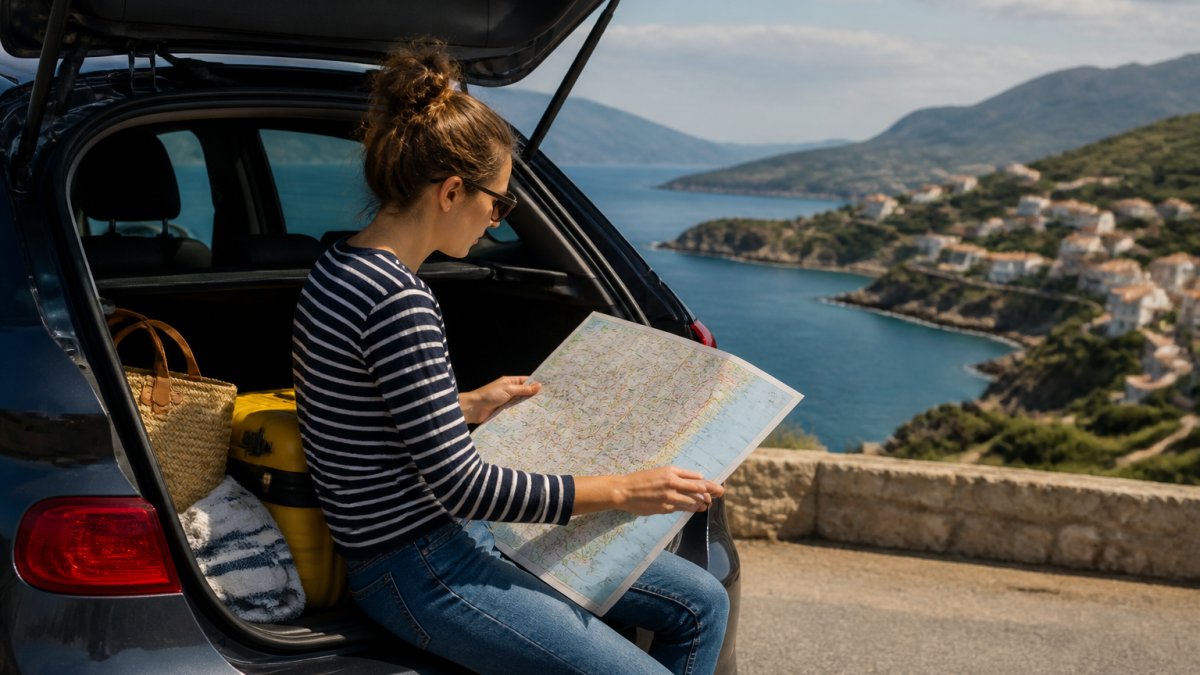
Navigation helps. Set your route before you move off, and let a passenger handle the map so you keep your eyes on the road.
What to Do After a Breakdown or Collision
Most equipment lists stop at what to carry. This section covers what to actually do, in order, because the first ten minutes after a breakdown or collision on a Spanish road are where the risk is highest and where UK drivers are least prepared. For the full walkthrough, see the step-by-step breakdown safety guide.
Step 1: Get the car off the carriageway
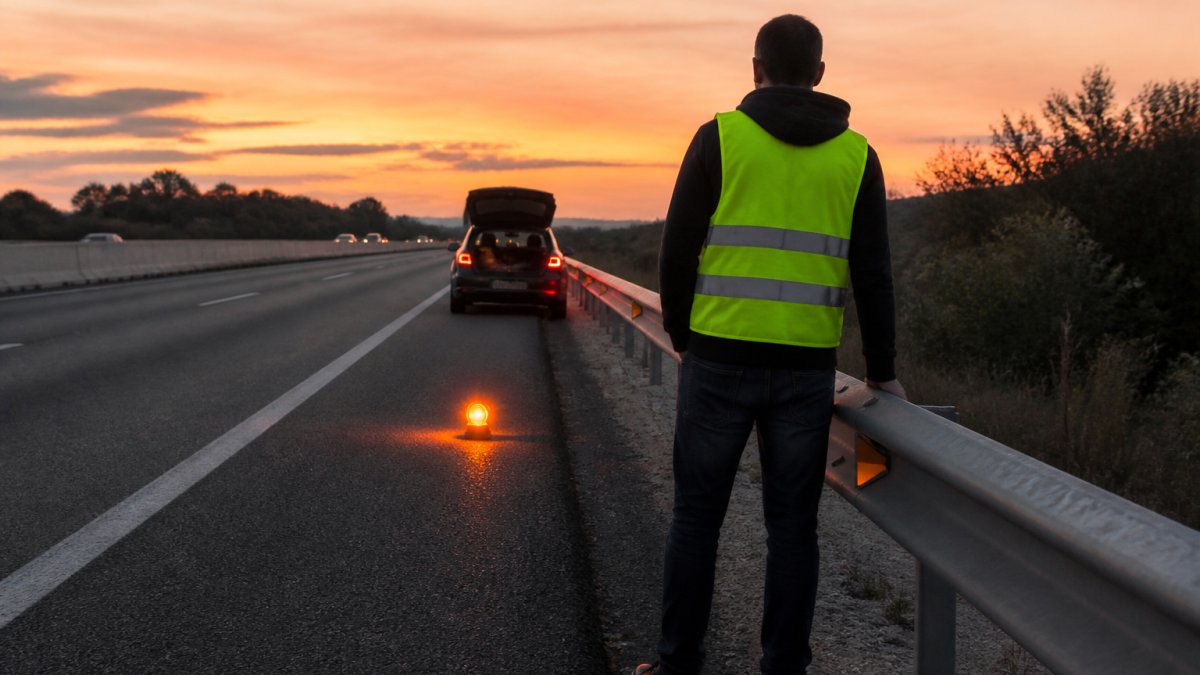
If the car will move, get it as far off the carriageway as you can, onto the hard shoulder on a motorway, or onto the verge on a normal road. Switch on your hazard lights immediately. If the car cannot move and you are in a live lane, do not stand behind it. Get everyone out on the side away from traffic and behind a barrier if there is one.
Step 2: Put the vest on before you open the door
This is the step UK drivers most often get wrong. The vest must be inside the cabin so you can put it on before you step out. Reaching into the boot at the roadside, with traffic passing, is exactly the situation the rule is designed to prevent. Put the vest on first, then open the door.
Step 3: Warn approaching traffic
Place your warning triangle where approaching drivers will see it in time to react. On a normal road that means well behind the vehicle, on the same side, and only if it is safe to walk there. On a motorway, do not walk along the carriageway to place a triangle; the risk of being struck outweighs the benefit. This is where a connected beacon earns its place: it warns traffic without you standing in a live lane.
Step 4: Move people to safety
Get passengers, and any pets, behind the barrier and well away from the carriageway. Keep children close. Do not stand between your car and oncoming traffic, and do not stand on the hard shoulder itself.
Step 5: Call for help
- Emergency: dial 112 if anyone is injured, if the carriageway is blocked, or if there is a fire risk. The 112 service operates across Spain and connects to the relevant emergency service.
- Breakdown: call your breakdown provider. Check before you travel that your cover extends to Spain, how many days it covers, and whether it includes recovery to a garage and repatriation of the vehicle. A UK policy that covers European driving for a set number of days may not include the same level of assistance abroad.
Step 6: Exchange details if another vehicle is involved
If another vehicle is involved, exchange names, addresses, vehicle registration numbers, insurer names and policy numbers. Note the time, the location and the road conditions. Photograph the scene, the vehicle positions and any damage before vehicles are moved, if it is safe to do so. Ask for the other driver’s insurance documentation and check that the details match the vehicle.
Step 7: Notify your insurer promptly
Report the incident to your insurer as soon as practicable, and within any deadline your policy sets. Keep copies of everything you exchange and every reference number you are given. If a report is required, ask your insurer whether they will handle it or whether you need to file it yourself.
Before you leave home, save your insurer’s claims line, your breakdown provider’s European assistance number and 112 in your phone. Do not rely on finding them at the roadside with a dying battery.
Building Your Pre-Departure Kit Before You Cross the Channel
Pack the kit once, check it every trip. Here is the checklist we would use:
- Driving licence, passport and V5C
- Insurance documents and breakdown cover details
- Warning triangle and high-visibility vests
- Headlamp converters fitted
- DGT 3.0 beacon if required
- Tyre pressure gauge and spare wheel
- First aid kit and torch
- Printed route and emergency numbers
Roadflash offers multi-award-winning DGT 3.0 compliant emergency beacons with GPS/geolocation and high-visibility lighting.
Frequently Asked Questions
What documents do I need to drive my UK car in Spain?
Carry your full UK driving licence, your passport, the original V5C registration certificate and proof of insurance cover. Confirm your policy extends to Spain and for the length of your trip.
Do I need a warning triangle or emergency beacon in Spain?
Check the current requirements with the DGT before you travel.
Does my UK car insurance cover me in Spain?
Ring your insurer before booking and ask whether your cover extends to Spain and for the length of your trip.
What should I check on my car before driving to Spain?
Run through tyres, fluids, lights, brakes and battery before you leave.
Breakdowns rarely happen at a convenient moment. They happen on a dark hard shoulder with traffic passing at speed. Get the right kit in the car before you leave, and you turn a frightening situation into a manageable one. Explore the Roadflash range of DGT 3.0 compliant beacons and high-visibility lighting, and add the right early warning system to your basket before your next crossing.
