
Roadside Safety Devices for Professional Drivers
Table of Contents
- Why Roadside Safety Devices Matter for Professional Drivers
- High-Visibility Hazard Lights for Maintenance and Roadside Operations
- Essential Emergency Roadside Kits and Contents
- Commercial Vehicle Breakdown Safety Protocols
- HSE Driving for Work Safety Requirements and Employer Duties
- Crash Avoidance and Vehicle-Mounted Safety Hardware
- Maintenance and Inspection Schedules for Safety Devices
- Digital Safety Tools and Mobile Connectivity
- Frequently Asked Questions
Last Updated: September 2, 2026
Why Roadside Safety Devices Matter for Professional Drivers
Professional drivers face unique hazards when vehicles break down on busy highways. A stationary vehicle becomes an obstacle in seconds, yet many drivers rely solely on hazard lights and reflective triangles, equipment that often fails to provide adequate warning to approaching traffic at speed. High-visibility apparel, warning beacons, and electronic systems work together to create multiple layers of hazard perception, giving approaching drivers the time and clarity needed to slow down or change lanes.
At Roadflash, we’ve developed early warning systems specifically designed for stationary vehicles on busy roads. Our multi-award-winning products combine high-visibility lighting, GPS-enabled beacons, and reflective gear to significantly increase hazard awareness and reduce collision risk during breakdowns.
This guide covers essential roadside safety devices every professional driver should understand: high-visibility hazard lights, traffic warning triangles, breakdown protocols, and vehicle-mounted crash avoidance systems. We’ll also explore legal requirements under HSE driving for work safety guidance and how modern digital tools are changing roadside response.
High-Visibility Hazard Lights for Maintenance and Roadside Operations
High-visibility hazard lights serve as the first line of defence when your vehicle is stationary on a roadside. Unlike standard vehicle hazard lights, dedicated high-visibility hazard lights for maintenance operations provide significantly greater visibility through LED technology and strategic placement.
LED warning beacons consume less power, operate reliably in extreme weather, and produce a more noticeable flash pattern that captures attention even in bright sunlight. Many professional drivers carry portable LED warning lights that can be deployed independently of the vehicle’s electrical system, critical if your vehicle has suffered electrical damage.
LED Warning Beacons and GPS-Enabled Systems
Modern LED warning beacons integrate location data directly into the beacon, allowing emergency services to pinpoint your exact position without requiring you to provide coordinates. This is particularly valuable on long stretches of motorway where landmarks are sparse.
Roadflash’s DGT 3.0 compliant emergency beacons with GPS/Geolocation represent the current standard for professional roadside safety. These devices combine high-intensity LED warning lights with real-time location tracking, ensuring emergency services can locate you precisely even if you’re injured or unable to communicate clearly.
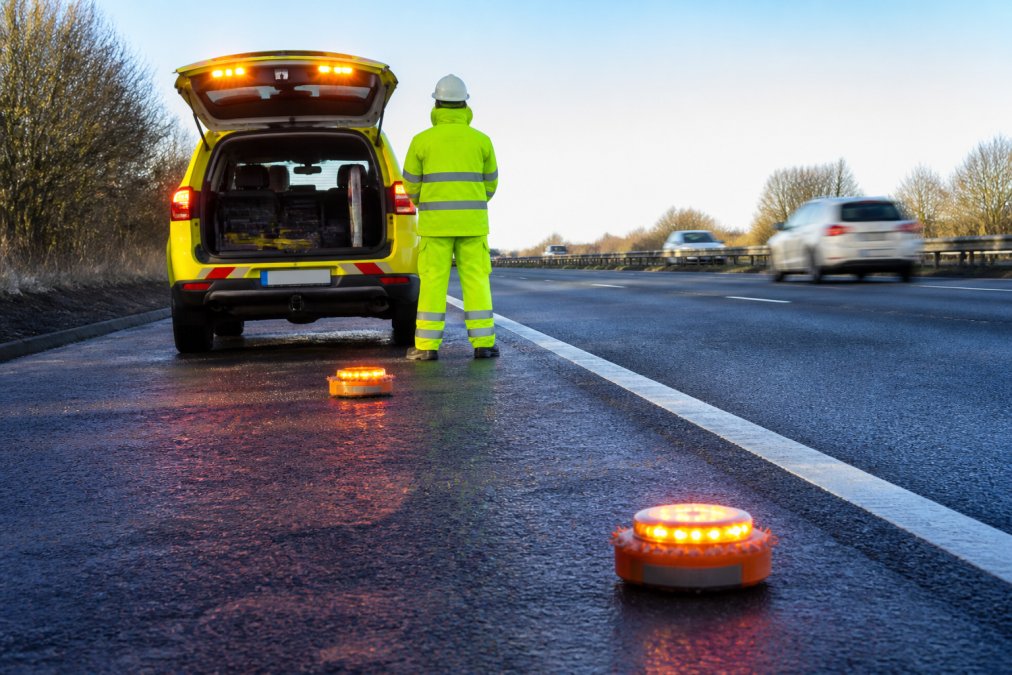
When selecting a beacon system, consider battery life, brightness (measured in lumens or candela), and weather resistance. Look for systems rated for continuous operation in rain, fog, and extreme cold.
Traffic Warning Triangles and Reflective Gear
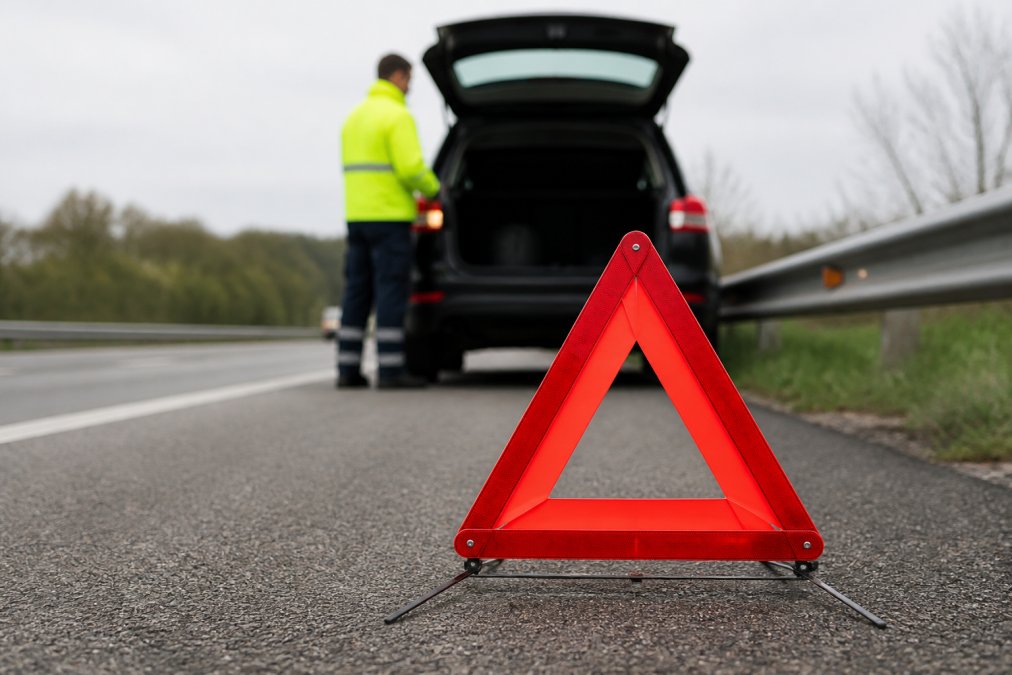
Traffic warning triangles remain a legal requirement and serve as a visual backup to electronic warning systems. The recommended placement distance for traffic warning triangles is 50 metres behind your vehicle on motorways (gov.uk). In poor visibility, increase this distance to 100 metres or more.
Reflective gear worn by the driver and passengers ensures visibility to approaching traffic, particularly in darkness or poor weather. High-visibility vests, jackets, and trousers with retroreflective material are practical necessities when standing near moving vehicles on busy roads.
Roadflash combines high-visibility apparel with electronic warning systems because each addresses different aspects of hazard perception. Layering visibility measures creates redundancy, if one system fails, others remain in place.
Essential Emergency Roadside Kits and Contents
A properly equipped emergency roadside kit should contain: high-visibility vests for all occupants, traffic warning triangles or electronic warning devices, a first aid kit, a torch with spare batteries, jump leads or a portable jump starter, basic hand tools, spare fuses, a fire extinguisher, and a reflective jacket.
The legal requirement under HSE guidance is that employers ensure drivers have access to appropriate safety equipment. For professional drivers, this means your employer should provide or reimburse the cost of a properly stocked emergency kit.
Storage matters as much as contents. Emergency kits should be stored in a location that’s easily accessible during a breakdown, not buried in the boot. A dedicated emergency kit bag, clearly marked and stored prominently, ensures you can deploy safety equipment within seconds of stopping.
Commercial Vehicle Breakdown Safety Protocols
When your commercial vehicle breaks down on a busy road, the sequence of actions you take in the first five minutes determines whether the situation remains under control or escalates into a collision.
The first priority is personal safety. If your vehicle has broken down in a live traffic lane, activate hazard lights immediately and exit only if it’s safe to do so. If you’re on a motorway and unable to move the vehicle, remain inside with your seatbelt fastened until you’ve assessed the traffic situation.
Once you’ve exited safely, deploy your high-visibility hazard warning devices: activate electronic warning beacons, place traffic warning triangles at the recommended distance, and ensure all occupants wear high-visibility apparel. Only after these steps should you contact roadside assistance.
Positioning and Deployment of Safety Equipment
Correct positioning of safety equipment can mean the difference between a safe breakdown and a collision. On motorways, position warning triangles at least 50 metres behind your vehicle. On dual carriageways and A-roads, position triangles at least 45 metres behind.
When deploying electronic warning beacons, place them on the roof or highest point of your vehicle to maximise visibility. If your beacon has GPS functionality, activate it immediately, this ensures emergency services receive your location data even if you’re unable to communicate clearly.
Stand well away from the vehicle and approaching traffic when deploying equipment. Never stand between your vehicle and oncoming traffic. The safest position is behind the vehicle, between it and the warning triangles, where you’re visible to approaching traffic but protected by your vehicle.
Psychological Safety and Driver Stress Management
Breakdowns are stressful events that can impair decision-making and increase the risk of unsafe actions. A driver who’s panicked, fatigued, or disoriented is more likely to make poor choices about positioning and equipment deployment.
Psychological safety during a breakdown means taking a moment to assess the situation and follow a predetermined protocol rather than reacting emotionally. Many professional drivers benefit from regular safety training that includes scenario-based breakdowns, practising the response sequence until it becomes automatic.
Stress management also means recognising when a situation exceeds your ability to manage safely. If you’re injured, extremely fatigued, or unable to safely deploy equipment, remain in your vehicle with hazard lights activated and wait for professional assistance.
Roadflash’s GPS-enabled beacons reduce stress by automating location transmission to emergency services. When you activate the beacon, you know help is being dispatched to your exact location, even if you’re unable to communicate.
HSE Driving for Work Safety Requirements and Employer Duties
The Health and Safety Executive (HSE) provides guidance on driving for work safety that applies to all employers whose staff drive as part of their role. This guidance establishes the employer’s duty of care and requirements for vehicle safety, driver training, and incident response.
Under HSE driving for work safety requirements, employers must ensure vehicles are maintained to a safe standard, drivers are competent and fit to drive, and appropriate safety equipment is provided and regularly inspected (hse.gov.uk). For professional drivers, this means your employer has a legal obligation to supply or reimburse the cost of high-visibility apparel, warning devices, and emergency kits.
Many employers conduct formal risk assessments for driving work, identifying hazards specific to their operations and implementing controls to reduce risk. The HSE also emphasises the importance of incident reporting and investigation to identify systemic issues that contributed to breakdowns or near-misses.
Crash Avoidance and Vehicle-Mounted Safety Hardware
Modern commercial vehicles increasingly incorporate electronic safety systems designed to prevent collisions or reduce their severity. These systems operate continuously while the vehicle is in motion, monitoring road conditions and intervening automatically if a collision risk is detected.
Autonomous emergency braking (AEB) systems detect obstacles ahead, including stationary vehicles and pedestrians, and apply the brakes automatically if the driver doesn’t respond in time. Electronic stability control (ESC) systems monitor wheel slip and vehicle stability, automatically adjusting engine power and brake pressure to prevent skids and loss of control.
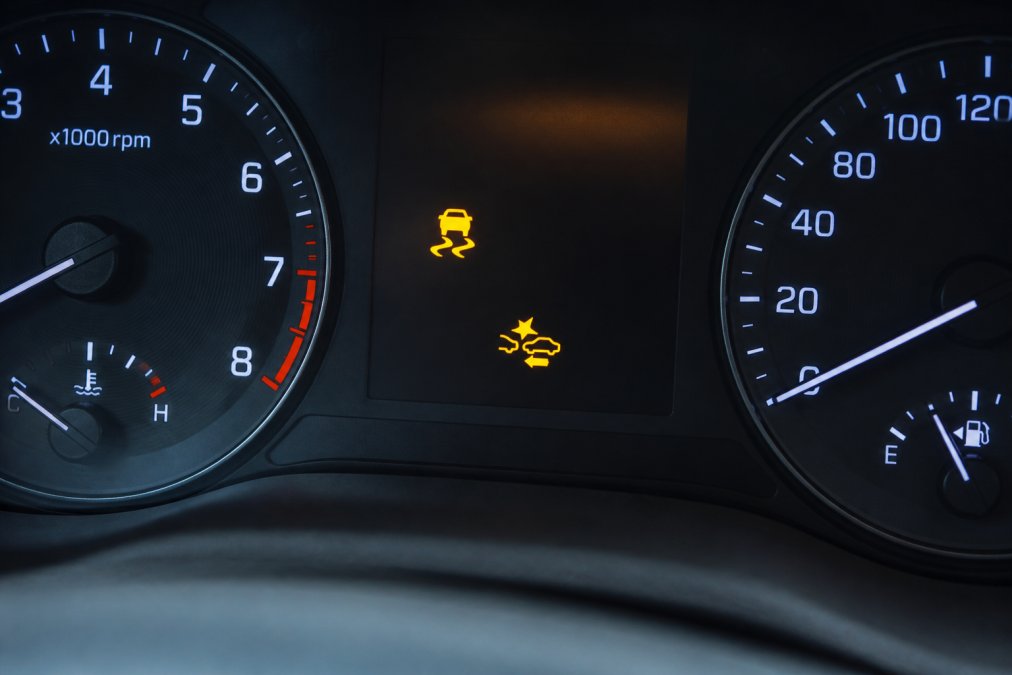
These systems significantly reduce the probability of serious accidents, particularly in heavy traffic or poor visibility where human reaction times are insufficient.
Autonomous Emergency Braking and Electronic Stability Control
Autonomous emergency braking uses radar, lidar, or camera systems to detect obstacles ahead (peer-reviewed research). When an obstacle is detected and a collision is likely, the system alerts the driver and applies the brakes if the driver doesn’t respond. Modern AEB systems can bring a vehicle to a complete stop in some scenarios.
Electronic stability control monitors the vehicle’s motion and compares it to the driver’s steering input. If the vehicle begins to skid, the system automatically adjusts brake pressure to individual wheels and may reduce engine power to restore control. This is particularly valuable in emergency manoeuvres on motorways.
Both systems are now standard on most commercial vehicles, though older vehicles may not have them. If you’re operating an older vehicle without these systems, the collision risk during a breakdown situation increases.
Maintenance and Inspection Schedules for Safety Devices
Safety devices only provide protection if they’re functional and properly maintained. A warning beacon with a failed battery or a first aid kit with expired medications provides false reassurance.
Establish a regular inspection schedule for all safety equipment. High-visibility apparel should be inspected for damage to reflective material; beacons and lights should be tested monthly; batteries should be checked and replaced on schedule; and first aid kits should be reviewed to ensure medications remain within expiration dates.
Many professional drivers maintain a simple checklist completed before each journey: checking that high-visibility vests are present and undamaged, testing beacon batteries, verifying warning triangles are in the vehicle, and confirming the first aid kit is complete.
Fleet operators should establish formal maintenance schedules for all safety equipment, with records maintained to demonstrate HSE compliance. This documentation also provides protection in the event of an incident.
Digital Safety Tools and Mobile Connectivity
The integration of digital tools into roadside safety has transformed how drivers respond to breakdowns and how emergency services locate stranded motorists. Mobile connectivity now enables real-time location sharing, instant communication with roadside assistance services, and automated incident reporting.
Many professional drivers carry mobile apps that integrate with their vehicle’s safety systems, providing alerts if the vehicle’s location changes unexpectedly and enabling one-touch activation of roadside assistance. These apps often include integration with GPS-enabled beacons, so that when you activate the beacon, your location is simultaneously transmitted to your employer, roadside assistance provider, and emergency services.
Digital safety tools also enable predictive maintenance, vehicle telematics systems monitor engine performance and battery health, alerting the driver to potential issues before they result in a breakdown.
The critical requirement for digital safety tools is connectivity. Mobile networks are generally reliable on UK motorways and major A-roads, but coverage can be patchy in rural areas. A professional driver should never rely solely on mobile connectivity for safety, physical warning devices must always be in place as a backup if digital systems fail.
Roadside breakdowns are stressful events that can quickly escalate into dangerous situations if safety equipment isn’t deployed correctly. The combination of high-visibility apparel, electronic warning beacons, traffic warning triangles, and crash avoidance systems creates multiple layers of protection, ensuring approaching drivers see your vehicle in time to slow down or change lanes. Roadflash’s DGT 3.0 compliant emergency beacons with GPS/Geolocation, combined with our high-visibility gear, provide professional drivers with industry-leading early warning capabilities. Add these roadside safety devices to your vehicle today and gain the peace of mind that comes from knowing you’re protected during any breakdown.
Frequently Asked Questions
Q: What are the legal requirements for roadside safety devices on commercial vehicles?
A: Commercial vehicles must comply with Health and Safety at Work etc. Act 1974 and the Management of Health and Safety at Work Regulations 1999. Employers have a duty of care to provide appropriate safety equipment including high-visibility apparel, warning triangles, and hazard warning devices. Specific requirements depend on vehicle type and operation; professional drivers should carry emergency kits and ensure all equipment meets current standards. Roadside safety devices like GPS-enabled beacons provide additional protection.
Q: How do high-visibility hazard lights for maintenance improve safety for stationary vehicles?
A: High-visibility hazard lights dramatically increase vehicle detection at night and during poor visibility. Unlike passive reflective triangles, active LED warning beacons with audible alarms alert approaching drivers much earlier, giving them more time to react. GPS-enabled systems add another layer by automatically notifying emergency services of your exact location. Active warning systems can reduce rear-end collisions significantly compared to triangles alone, making them essential for motorway breakdowns.
Q: What should be included in a professional driver’s breakdown emergency kit?
A: A comprehensive breakdown kit should contain: high-visibility clothing (jacket and trousers), warning triangles or electronic beacons, first aid supplies, resuscitation devices, audible alarms, torch with spare batteries, jump leads, basic tools, spare fuses, and a mobile phone with emergency numbers. For professional drivers, GPS-enabled beacons and digital safety tools are increasingly important. Keep the kit easily accessible in your vehicle and check contents regularly to ensure nothing has expired or deteriorated.
Q: How does HSE driving for work safety requirements affect what equipment I need?
A: The Health and Safety Executive (HSE) requires employers to conduct risk assessments for work-related driving and provide appropriate safety equipment and training. Professional drivers must understand hazard perception, maintain vehicles properly, and carry suitable emergency equipment. Compliance means having high-visibility apparel, warning devices, and first aid kits at minimum. However, exceeding these baseline requirements with advanced systems like GPS-enabled emergency beacons demonstrates a stronger duty of care and significantly improves incident management outcomes.
Q: Are GPS-enabled emergency beacons effective for roadside incident management?
A: Yes, GPS-enabled beacons are highly effective for incident management. They automatically transmit your exact location to emergency services, eliminating confusion about where you are on a motorway. This is particularly valuable if you’re injured, disoriented, or unable to provide clear directions. Combined with audible alarms and high-visibility lighting, GPS beacons ensure faster emergency response times and reduce the risk of secondary collisions. They’re especially valuable for professional drivers working alone on busy routes.
Q: How often should I inspect and maintain my roadside safety devices?
A: Inspect all safety equipment monthly: check LED beacons for battery charge and functionality, examine reflective gear for damage or fading, verify warning triangles are intact, and ensure first aid supplies haven’t expired. Test GPS functionality quarterly and replace batteries before they drop below recommended levels. Professional drivers should maintain a log of inspections. For fleet operators, establish a scheduled maintenance programme aligned with vehicle servicing. Damaged or degraded equipment should be replaced immediately to maintain effective hazard awareness and compliance.
Q: What makes roadside safety devices necessary if I don’t break down often?
A: Even infrequent motorway users face significant risk during breakdowns. A stationary vehicle on a busy highway is vulnerable to high-speed rear-end collisions, particularly at night or in poor weather. You cannot predict when a breakdown will occur, and when it does, you’ll be grateful for effective warning systems. Professional drivers and fleet operators use these devices routinely because the cost is minimal compared to the consequences of an accident. High-visibility hazard lights and emergency kits are insurance against the unexpected.
This article was written using GrandRanker