
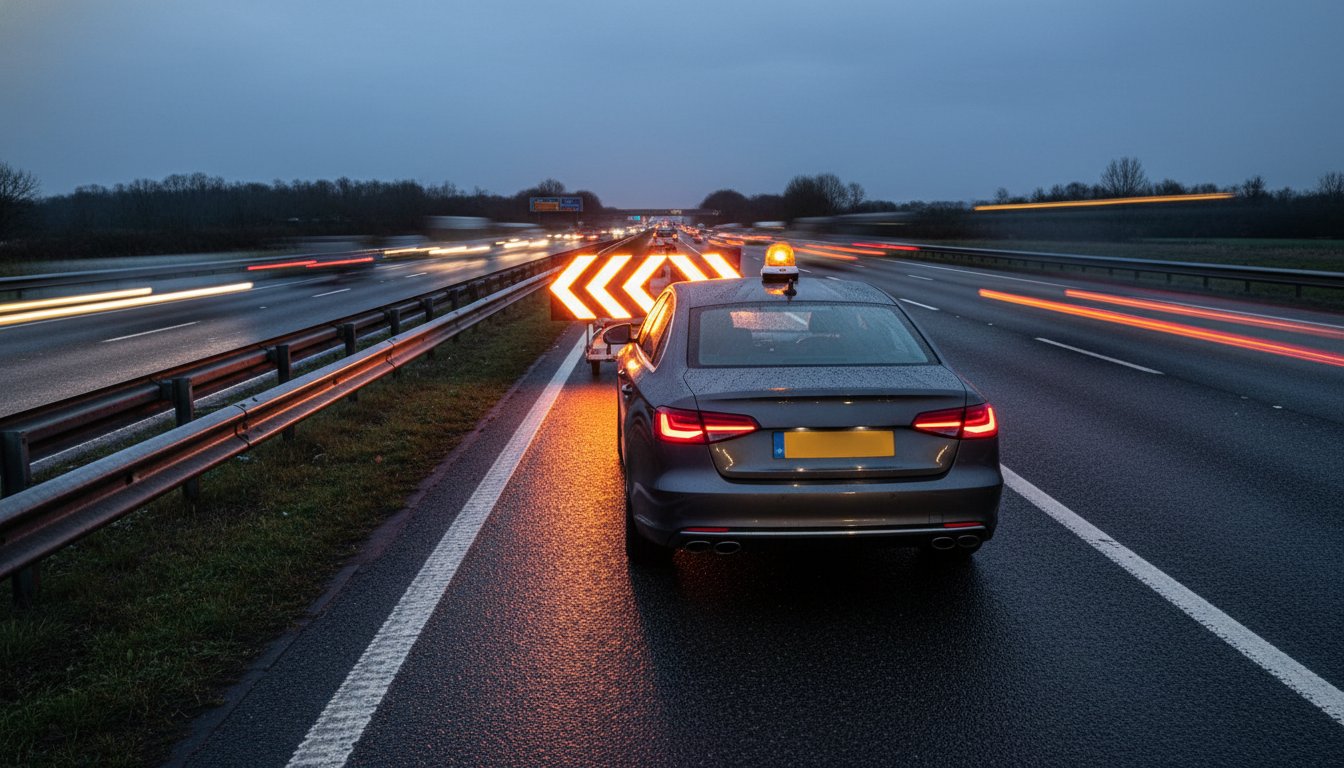
Roadside Assistance Safety Equipment: Professional Visibility Solutions for 2026
Did you know that roadside fatalities increased by nearly 77% over the last decade? This sobering reality proves that simply standing by your vehicle is no longer enough to ensure your survival on modern high-speed roads. You likely feel a profound sense of vulnerability during a breakdown, especially whilst waiting for help amongst fast-moving traffic. It’s a common fear that outdated, dim hazard lights won’t provide the warning that distracted drivers need to avoid a secondary collision.
Securing professional roadside assistance safety equipment is the only way to dictate driver behaviour and protect your passengers. You’ll learn how active visibility systems and professional-grade LED hardware are replacing traditional gear to save lives in 2026. This guide examines the essential inventory available at Roadflash, from V16 geolocation beacons to high-intensity folding arrow lights, ensuring you remain compliant with the latest safety standards. By shifting your focus to active conspicuity, you can transform a life-threatening risk into a managed and secure situation.
Key Takeaways
- Understand why passive reflectors are no longer sufficient for modern motorways and how active LED systems dictate driver behaviour from a safe distance.
- Explore a professional range of roadside assistance safety equipment at the Roadflash storefront to ensure your vehicle meets 2026 visibility standards.
- Learn why the Folding LED Arrow Light is the essential hardware for providing clear, high-impact directional signalling during an emergency.
- Discover how to organise a tiered safety system using beacons, wraps, and light-up cones to create a multi-layered barrier of light.
- Master professional deployment strategies to establish a secure safety corridor that protects passengers and recovery personnel in high-risk environments.
Beyond the Warning Triangle: Why Modern Roads Demand Active Safety Hardware
Active visibility represents a fundamental shift in how we approach vehicle breakdowns. It moves beyond passive reflection to high-intensity, powered LED systems that signal hazards from significantly greater distances than traditional gear. Whilst many drivers rely on professional roadside assistance services to manage a recovery, the initial moments of a breakdown are the most perilous. On modern high-speed roads, especially smart motorways where the hard shoulder may be a live lane, stationary vehicles require immediate, high-impact signalling to prevent secondary collisions.
The science of road safety confirms that the human eye reacts faster to the rhythmic pulse of flashing LED patterns than to static light. When travelling at 70mph, those extra milliseconds of recognition translate into hundreds of feet of braking distance. Transitioning to professional roadside assistance safety equipment is no longer a preference; it’s a necessity. Modern road safety hardware is designed to meet 2026 standards by commanding attention rather than simply requesting it.
The Limitations of Passive Reflectors in 2026
Traditional warning triangles are inherently flawed in adverse weather. Fog, heavy rain, or spray from passing lorries can render passive reflectors nearly invisible until it’s too late. There’s also the physical danger of deployment. Walking 50 metres behind a vehicle to place a triangle puts the driver at extreme risk. In a landscape where roadside fatalities have seen a sharp increase, relying on a piece of plastic that requires you to enter the line of fire is a gamble you shouldn’t take.
Mitigating Risk with High-Intensity LED Technology
High-intensity hardware, such as the Folding LED Arrow Light, provides clear directional guidance to passing traffic. This doesn’t just warn drivers of your presence; it tells them exactly where to go. Professional roadside assistance safety equipment also helps mitigate the ‘moth-to-flame’ effect, where distracted drivers inadvertently steer towards a stationary light source. By using sophisticated pulse patterns, these systems ensure maximum conspicuity whilst maintaining a safe environment for passengers and recovery staff alike.

Essential Roadside Assistance Equipment: A Survey of Professional Solutions
Accessing professional-grade hardware is the primary step in mitigating roadside risk. The Roadflash online storefront serves as a dedicated hub for this specialised inventory, providing a depth of variety that general retailers simply cannot match. Whilst basic consumer kits often provide only a single, dim beacon, this collection offers a comprehensive suite of roadside assistance safety equipment designed for high-stakes environments. From battery-powered units to vehicle-integrated systems, the focus remains on reliability and immediate impact.
The Folding LED Arrow Light stands as the gold standard for directional hazard awareness. It doesn’t just signal a danger; it dictates the flow of traffic by providing clear, rhythmic instructions to approaching drivers. This proactive approach is supplemented by the V16 Emergency Beacon DGT 3.0, which integrates geolocation technology to ensure your precise coordinates are available to recovery services. For 360-degree protection, Road Safety Traffic Cones with Light provide a vertical light source that remains visible even amongst the congestion of a multi-lane motorway.
Specialised Hardware for Diverse Road Hazards
Expanding the visual footprint of your vehicle is crucial in low-visibility conditions. Hazard Awareness Road Fans and Wraps offer high-impact visual warnings that attach directly to the vehicle or the road surface. When selecting your hardware, consider the IP ratings to ensure durability against the unpredictable British winter. Whilst a standard emergency supply kit provides a baseline for survival, professional-grade hardware ensures you aren’t just surviving the wait, but actively preventing an accident. You can browse the full collection online to find the right fit for your vehicle type.
Connected Safety: Geolocation and V16 Standards
As safety regulations evolve, understanding the V16 beacon UK equivalent is vital for drivers who travel internationally or desire the latest in smart connectivity. Geolocation-enabled beacons accelerate response times by transmitting data directly to emergency platforms. This technology removes the ambiguity of location descriptions, ensuring help arrives exactly where it’s needed without delay. Investing in roadside assistance safety equipment with integrated GPS ensures that your vehicle is not just seen, but digitally tracked for a faster recovery.
Optimising Vehicle Conspicuity: How to Organise Your Emergency Kit
High-speed roads require a tactical approach to roadside assistance safety equipment. Relying on a single device is a strategic error; instead, you should implement a tiered safety system. This multi-layered strategy begins with immediate roof-mounted beacons and extends to ground-level directional hardware. By combining a V16 geolocation beacon with Hazard Awareness Wraps and a Folding LED Arrow Light, you create a comprehensive visual barrier that protects your vehicle from every angle. This redundancy ensures that even if one light source is obscured by a passing lorry, others remain visible to approaching motorists.
Establishing a ‘safety corridor’ is essential for protecting passengers whilst they wait for recovery. Your deployment strategy should involve placing Road Safety Traffic Cones with Light in a tapering line that guides traffic away from your vehicle’s rear corner. Position your arrow light at the furthest point of this taper to provide the earliest possible directional warning. This method ensures that drivers aren’t just aware of a hazard but are actively steered into a safer lane well before they reach your stationary vehicle. It transforms the area around your car from a danger zone into a managed environment.
Accessibility determines your survival in the initial moments of a breakdown. You should keep mission-critical roadside assistance safety equipment within the vehicle cabin, such as in the glovebox or door pockets, rather than buried under luggage in the boot. This allows you to activate roof-mounted lights or Hazard Awareness Safety Lights without even exiting the vehicle. Reducing the time you spend standing in a live lane or on a narrow hard shoulder is the most effective way to lower the risk of a secondary collision.
Maintenance and Readiness for Emergency Hardware
Professional hardware requires a professional maintenance mindset. Regularly check the charge levels of your rechargeable LED systems to ensure they’re ready for immediate use during a midnight breakdown. Magnetic mounts and adhesive Hazard Awareness Wraps must be kept clean; dirt and grit can compromise their ability to secure firmly to the vehicle bodywork during high winds or heavy rain. A quick monthly inspection ensures your life-saving gear won’t fail when you need it most.
Direct Access to Advanced Safety Gear
Securing professional-grade protection requires sourcing hardware from specialists who understand the gravity of road safety. The Roadflash shop provides access to the latest hazard warning breakdown lights and integrated visibility solutions tailored for the UK’s unique road conditions. By choosing a UK-based specialist, you ensure your kit meets rigorous local standards and provides the reliability needed during a crisis. Fleet operators and private motorists alike can benefit from the sophisticated technology found in the full inventory.
Explore the full range of Roadflash safety equipment online to build a customised kit that prioritises your protection and the safety of your passengers.
Securing Your Future on the Road
The evolution of road safety in 2026 demands a shift from passive reflection to active, high-intensity signalling. Professional roadside assistance safety equipment transforms a stationary vehicle into a commanded environment, ensuring that distracted drivers have the time and direction needed to avoid a collision whilst you wait for help. By implementing a tiered safety system and maintaining a professional readiness mindset, you provide the highest level of protection for your passengers and yourself. Modern roads are unforgiving; your equipment shouldn’t be.
Roadflash is committed to this mission through specialist UK design and manufacture. Our advanced LED technology is engineered specifically for high-speed visibility, offering a comprehensive range that spans from V16 geolocation beacons to heavy-duty Folding Arrow Lights. Our mission is protection. Browse the full inventory of professional road safety hardware at Roadflash and equip your vehicle with the sophisticated tools required for the modern road. You can drive with the calm confidence that comes from being truly prepared.
Frequently Asked Questions
What is the most important piece of roadside assistance safety equipment for motorways?
The Folding LED Arrow Light is arguably the most critical piece of roadside assistance safety equipment because it provides active directional guidance. Unlike a static warning, it tells approaching drivers exactly which way to move, which is vital on multi-lane motorways. This proactive signalling reduces the risk of confusion and secondary collisions during the initial minutes of a breakdown.
Are LED arrow lights legal for private car owners in the UK?
Yes, LED arrow lights are legal for private car owners in the UK when used to warn other road users of a stationary hazard. You should only activate these devices whilst your vehicle is stopped on the hard shoulder or roadside. They shouldn’t be used as moving signals on the public highway; however, they’re essential tools for creating a secure safety zone during an emergency.
How does a V16 beacon with GPS differ from a standard hazard light?
A V16 beacon with GPS differs from standard hazard lights by offering a self-powered, 360-degree light source and integrated data connectivity. Whilst car hazard lights depend on the vehicle’s electrical system, a V16 beacon operates independently. It transmits your precise geolocation to emergency platforms, ensuring that help can find your exact position without the need for verbal descriptions.
Why should I choose an illuminated traffic cone over a standard one?
Illuminated traffic cones are superior because they provide their own light source rather than relying on external headlamps for reflection. In heavy rain or pitch-black conditions, a standard cone can be difficult to see until the driver is dangerously close. An LED-centred cone ensures 360-degree visibility from a significant distance, helping to establish a clear safety corridor around your vehicle.
Can Roadflash safety equipment be used for commercial fleets and private vehicles?
The professional roadside assistance safety equipment available at Roadflash is engineered for both commercial fleets and private vehicles. Whether you’re managing a group of service vans or looking to protect your family car, this hardware provides a standardised level of protection. The inventory includes versatile options like Hazard Awareness Wraps and beacons that fit any vehicle profile or size.
What are the benefits of the Folding LED Arrow Light in daytime conditions?
In daytime conditions, the primary benefit of the Folding LED Arrow Light is its ability to overcome sun glare and visual clutter. Passive reflective materials often struggle to stand out against a bright horizon or busy backgrounds. The high-intensity pulse of the LEDs ensures that your directional warning is seen early, giving high-speed traffic ample time to change lanes safely.