
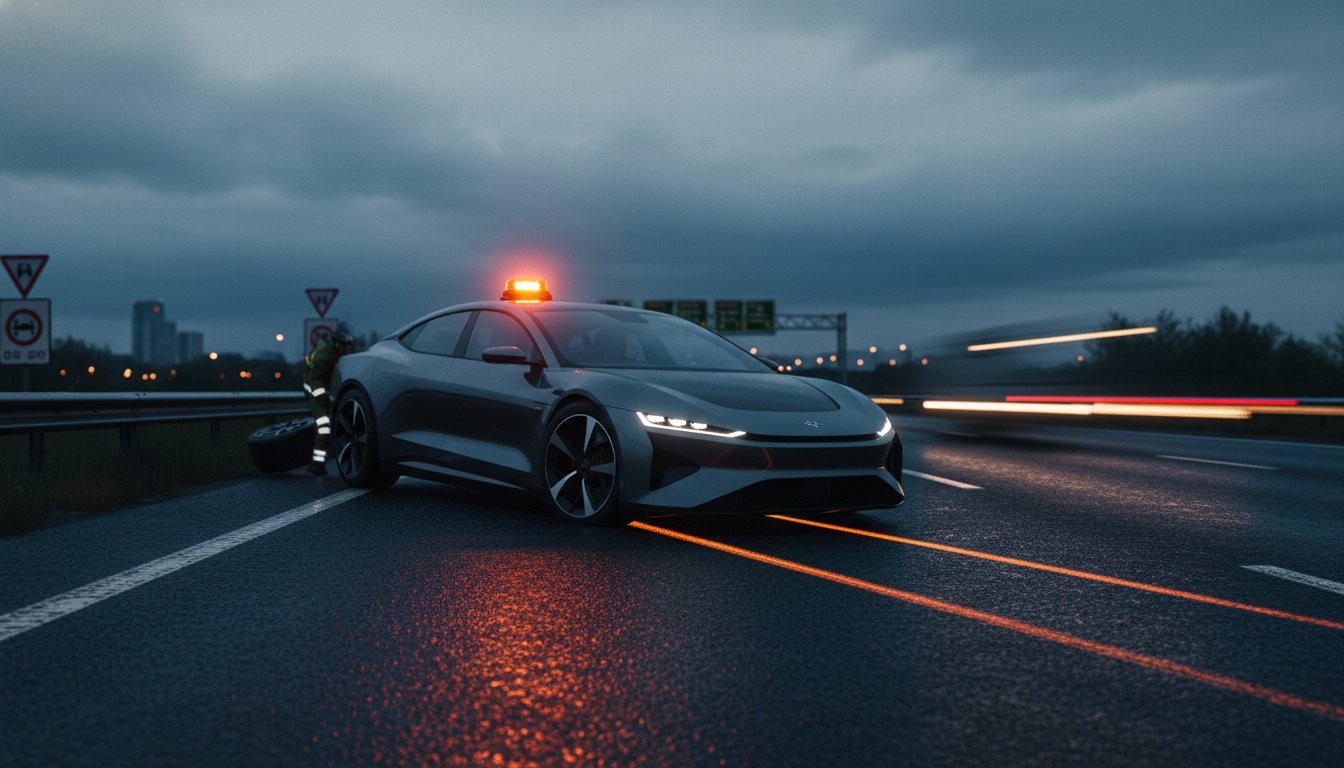
Roadflash: Debunking the Myths of Roadside Safety and Breakdown Visibility
What if the very safety equipment you rely on is actually increasing your risk during a breakdown? Placing a traditional warning triangle requires you to walk directly into the path of high-speed traffic, a move that offers little protection against a distracted driver or a lorry with limited visibility. It is natural to feel a sense of vulnerability whilst stranded on the hard shoulder, especially when you realise that standard hazard lights often disappear amongst the glare of a busy motorway. You will discover why 20th-century safety standards are failing today’s motorists and how Roadflash provides a sophisticated, engineering-led approach to roadside visibility that ensures you are seen from hundreds of metres away.
This article examines the transition from passive warnings to active hazard management. We will explore how modern hardware, such as the Folding LED Arrow Light and the V16 Emergency Beacon, delivers absolute peace of mind by meeting the most stringent UK and European safety requirements. From the rapid deployment of the Hazard Awareness Wrap to the precision of GPS-enabled beacons, you will learn how to secure your vehicle and protect your passengers with professional-grade technology.
Key Takeaways
- Understand why standard indicators fail to alert high-speed traffic and how to bridge the dangerous “conspicuity gap” during a breakdown.
- Discover the hidden risks of daytime visibility and how specialised materials can prevent accidents caused by intense midday glare.
- Learn why Roadflash engineering and high IP ratings are vital for hardware to withstand the rigours of the British climate and corrosive road salt.
- Explore the transition to connected safety and why GPS-enabled beacons are becoming the mandatory standard for modern European driving.
The Myth of the “Sufficient” Hazard Light: Why Standard Indicators Fail
Most drivers believe their factory-fitted hazard lights provide a safety net during a breakdown. This is a dangerous assumption. Car indicators are engineered primarily for urban environments where speeds are low and ambient lighting is typically high. On a motorway at 70mph, these small bulbs struggle to compete with the visual noise of a modern road. Drivers often fall victim to the “Conspicuity Gap”, a phenomenon where a motorist sees a light but fails to recognise it as a stationary hazard amongst a sea of moving traffic. Roadflash hardware is engineered to close this gap by providing the high lumen output required for high-speed recognition.
Lumen Output and Atmospheric Interference
Standard bulbs are easily muffled by heavy rain, thick fog, or the constant spray kicked up by lorries. Roadflash LEDs utilise specific colour temperatures to pierce through these atmospheric barriers whilst standard indicators become blurred and indistinct. Active conspicuity is the ability to trigger a driver’s braking response sooner. Unlike the passive nature of warning triangle regulations, which rely on external light to be seen, active LED technology ensures you are visible even on unlit stretches of road.
Directional Lighting vs. Omnidirectional Confusion
Standard hazards are omnidirectional. They signal that a problem exists but fail to tell passing traffic which way to move. This creates a moment of hesitation for approaching motorists, which is often fatal at high speeds. The Folding LED Arrow Light addresses this by providing clear, active instruction. It uses distinct flash patterns that differ significantly from standard vehicle relays, reducing the cognitive load on other drivers. By replacing omnidirectional confusion with directional certainty, you guide traffic safely away from your vehicle’s position.
- Recognition Speed: High-intensity LEDs are identified up to five times faster than standard filament bulbs in low-visibility conditions.
- Psychological Impact: Directional arrows trigger an instinctive lane-change response in passing drivers.
- Reliability: Professional-grade hardware maintains consistent output, unlike car batteries which may drain quickly when hazards are left on for extended periods.
Debunking the Safety of Warning Triangles on High-Speed Roads
The traditional red plastic triangle has long been regarded as an essential safety tool. However, on modern high-speed roads, relying on this 20th-century device is a dangerous gamble. Deploying a triangle requires a 45-metre walk along the hard shoulder, placing you in the direct path of oncoming traffic with your back turned to the hazard. This “Deployment Delay” exposes you to extreme risk for several minutes whilst you struggle with flimsy stands and reflective panels. It’s a high-stakes task that offers very little protection in return.
The Smart Motorway Reality
Smart motorways have fundamentally changed the safety landscape. In a “live lane” breakdown where no hard shoulder exists, exiting the vehicle to place a triangle is both illegal and suicidal. You need immediate, active protection that doesn’t require you to leave your vehicle’s side. The Hazard Warning Breakdown Light provides this instant visibility, allowing for 30-second activation that alerts other motorists before you even step onto the tarmac. This shift away from physical roadside deployment is becoming the cornerstone of modern safety policies, ensuring drivers stay protected within the vehicle’s footprint. For a structured approach to deploying your equipment effectively, understanding how to use an emergency breakdown warning light to maximise roadside safety is an essential skill for every motorist.
Mechanical Reliability and Stability
Traditional triangles are notorious for their lack of stability. The “vortex effect” created by a passing 44-tonne lorry frequently topples lightweight plastic gear, rendering your warning invisible within seconds. An AAA Foundation for Traffic Safety study confirms that the intensity and height of a warning signal are critical for driver recognition. By using magnetic mounting, Roadflash units remain secure on your vehicle’s roof at eye level for HGV drivers. This ensures your hazard signal stays active and visible, regardless of wind gusts or road conditions. For those seeking the ultimate in stability and visibility, exploring the full range of safety hardware is a vital step in vehicle preparation.
- Deployment Speed: Roadflash gear activates in under 30 seconds, compared to the several minutes required for a triangle.
- Stability: Magnetic bases resist the wind force of passing HGVs that easily flatten plastic stands.
- Visibility: Roof-mounted lights remain visible over the crests of hills, whereas ground-level triangles are often hidden.

Active vs. Passive Visibility: Why Daytime Hazards are Deadlier
Many motorists assume that danger only arrives after sunset. In reality, midday glare and heat haze create significant blind spots that make a stationary vehicle nearly invisible. Standard reflective gear often fails when the sun is at a direct angle, as it requires an external light source, such as a headlamp, to function. Roadflash addresses this through active visibility. By utilising high-conspicuity fluorescent materials in the Hazard Awareness Wrap, the vehicle remains visible from up to 300 metres even in intense sunlight.
Scientific roadside visibility research highlights that daytime safety requires a distinct technological approach. Whilst reflective materials work at night, fluorescent pigments are necessary to convert invisible UV light into visible colour during the day. This dual-layer protection ensures your vehicle doesn’t disappear against the backdrop of a shimmering motorway.
Combating Sun Glare and Heat Haze
Passive reflectors are ineffective without headlights to activate them. The technical challenge lies in creating a signal brighter than the ambient daylight. The Hazard Awareness Road Fan expands the visual footprint of the vehicle, breaking the silhouette of the car against the shimmering road surface. Roadflash LEDs are engineered with specific daytime pulse patterns that use high-intensity bursts to cut through midday glare, ensuring the light source isn’t washed out by the sun.
The Psychology of the Daytime Driver
During the day, drivers often operate on autopilot, scanning for movement rather than stationary hazards. This reduced alertness necessitates a disruptive visual signal to break their concentration and force a change in their visual scan. Internal testing indicates that the hardware significantly extends daytime recognition distances compared to standard vehicle lighting. This provides approaching motorists with the critical seconds needed to adjust their path safely. By delivering a clear, active warning, you move beyond the limitations of passive equipment that relies on the sun being at the correct angle to work.
- Fluorescent Technology: Essential for daytime visibility where standard reflectors fail to trigger.
- Active Pulse Patterns: High-intensity LED bursts designed to outshine ambient sunlight.
- Visual Footprint: Tools like the Road Fan create a larger, more recognisable hazard profile.
The Roadflash Engineering Advantage: Beyond Generic LED Lights
Cheap “emergency beacons” sourced from generic retailers often fail during mission-critical moments. Whilst they might appear functional in a controlled environment, they lack the robust construction needed to survive a breakdown on a freezing, salt-covered motorway. Roadflash hardware is developed through Nottingham-based R&D, ensuring every device is purpose-built for the realities of the British road network. This engineering focus prioritises reliability over low-cost manufacturing, providing a tool that works exactly when you need it most.
Resilience is defined by an IP rating that can withstand the corrosive combination of winter road salt and heavy spray. Standard retail lights often suffer from water ingress or battery discharge whilst stored in a vehicle boot for extended periods. Roadflash technology ensures that safety gear maintains its charge and structural integrity through months of dormancy and extreme temperature shifts. This level of reliability is what separates professional safety equipment from a generic consumer gadget.
Durability and Material Science
Hardware longevity depends on the use of automotive-grade polymers and high-strength, corrosion-resistant magnets. The hinge mechanism of the Folding LED Arrow Light represents a significant feat of specialised engineering, designed to resist the wear caused by constant vehicle vibrations. These materials ensure that the equipment doesn’t become brittle or fail after years of storage. It’s this commitment to material science that allows the gear to remain functional in the most demanding environments.
User-Centric Design for High-Stress Situations
Design must account for the psychological and physical stress of a roadside emergency. Every button and switch on Roadflash devices undergoes “Glove-Friendly” testing to ensure tactile feedback is clear, even when the user is wearing heavy winter clothing. Efficiency also dictates the form factor; folding designs maximise storage space without compromising on the size of the visual warning. It’s essential to invest in professional-grade safety equipment before an emergency occurs. You can View the full range of Roadflash professional safety hardware here.
Future-Proofing Your Vehicle with Roadflash Safety Systems
Modern road safety is undergoing a digital transformation. We’re moving beyond simple illumination toward “Connected Safety” systems that actively communicate with emergency services. Roadflash is at the forefront of this shift, providing hardware that doesn’t just warn passing drivers but also integrates with wider traffic management networks. This proactive approach is essential for the “Vision Zero” mission, which aims to eliminate road fatalities through superior engineering and connectivity. By adopting these systems now, you’re preparing for a future where vehicle-to-everything (V2X) communication becomes the standard for motorway survival.
The V16 GPS Beacon: What UK Drivers Must Know
For those driving in Europe, the regulatory landscape is changing rapidly. By 2026, GPS-enabled beacons like the V16 Emergency Beacon DGT 3.0 will become the mandatory standard in Spain and other EU jurisdictions, replacing traditional triangles entirely. Geolocation technology removes the ambiguity of a breakdown by providing an exact “pinned” location to recovery services, significantly reducing response times. This is why the Roadflash V16 is the preferred choice for international travellers who require hardware that meets both current and future legal requirements. It ensures that help finds you faster, even if you’re unable to describe your surroundings in a foreign country.
Building a Comprehensive Safety Kit
Relying on a single device is rarely sufficient for complex roadside scenarios. A “Layered Safety” approach involves combining different tools to manage various risks. For instance, using the Folding LED Arrow Light to direct traffic whilst the Hazard Awareness Road Fan increases your vehicle’s visual footprint creates a multi-dimensional warning zone. Fleet managers increasingly favour these solutions for standardised vehicle safety across large organisations. Implementing a uniform safety kit reduces employer liability and ensures that every driver has the same high level of protection. It’s about creating a predictable, safe environment in an unpredictable situation.
Secure your vehicle today with Roadflash award-winning safety systems.
Securing Your Future on the Road
Roadside safety is no longer a matter of passive reflection; it requires an active, engineering-led response to high-speed environments. You now understand that traditional methods like warning triangles and standard indicators don’t provide the visibility needed to protect you from modern motorway traffic. By shifting to professional-grade hardware, you eliminate the “conspicuity gap” and ensure your vehicle is recognised as a hazard from a safe distance, whether in midday glare or a midnight storm.
As the Road Safety Specialist of the Year 2025, Roadflash continues to set the benchmark for protective technology. Every product is designed and engineered in Nottingham, UK, ensuring it meets the rigorous demands of our climate and road network. This dedication to quality is why our systems are trusted by national fleet operators and emergency responders across the country. You don’t have to leave your safety to chance or outdated regulations.
Upgrade your roadside safety with Roadflash award-winning hardware.
Take the proactive step today to ensure that you and your passengers remain visible, protected, and prepared for whatever lies ahead on your journey.
Frequently Asked Questions
Is the Roadflash Folding LED Arrow Light legal for use on UK motorways?
The Folding LED Arrow Light is legal for use as a supplementary safety device to provide directional guidance to approaching traffic. Whilst standard hazard lights only indicate a problem, this hardware actively instructs motorists to move away from your vehicle’s position. It is engineered to meet professional standards and is frequently utilised by breakdown responders to manage high-speed traffic flows effectively.
How does the V16 Emergency Beacon GPS technology actually work during a breakdown?
The V16 Emergency Beacon DGT 3.0 uses integrated GPS to “pin” your exact location the moment it is activated. This information is transmitted to relevant traffic authorities, allowing them to update digital motorway signs and alert other connected vehicles in the vicinity. This automated process reduces the risk of human error during a high-stress situation and ensures recovery services can find you without delay.
Can I use Roadflash safety gear in heavy rain or snow?
Roadflash safety gear is specifically engineered to remain functional in the harshest British weather, including torrential rain and heavy snow. The internal electronics are protected by automotive-grade seals with high IP ratings that prevent water ingress and corrosion from road salt. This durability ensures that your visibility isn’t compromised when environmental conditions are at their worst and the risk of a collision is highest.
Why should I choose Roadflash over a cheaper LED beacon from an online marketplace?
Choosing Roadflash ensures that your safety equipment is a mission-critical tool rather than a generic gadget. Cheaper alternatives often fail to meet the required lumen output for motorway visibility and frequently suffer from rapid battery discharge whilst stored. Our hardware undergoes rigorous testing to guarantee it survives high-impact vibrations and maintains its charge through months of dormancy in your vehicle’s boot.
How long do the batteries last in the Hazard Awareness Safety Light?
The Hazard Awareness Safety Light is engineered for long-duration use during extended breakdown scenarios. Whilst specific runtimes depend on the chosen flash pattern, the high-capacity cells are optimised to provide consistent, high-intensity output for several hours. This prevents the signal from fading before recovery services arrive, ensuring your protection remains constant throughout the entire duration of the incident.
Is it mandatory to carry a V16 beacon if I am only driving within the UK?
It’s not currently a legal requirement to carry a V16 beacon for UK-only driving, but the technology offers a significant safety advantage over traditional methods. Whilst UK law still recognises the warning triangle, many motorists choose to upgrade for the active visibility and GPS capabilities. If you plan to drive in Spain, this hardware is becoming the mandatory standard for all vehicles by 2026.
How do I mount the Roadflash hardware if my vehicle has a non-metallic body?
If your vehicle has a non-metallic body, the Hazard Awareness Wrap provides a high-conspicuity alternative that adheres safely to any paint-friendly surface. For hardware like the Hazard Warning Breakdown Light, you can utilise the high-strength magnets on metallic hinges or roof rails. Alternatively, placing the units on the dashboard or rear parcel shelf ensures they remain visible to approaching traffic through the glass.
What makes the Roadflash Hazard Awareness Wrap different from standard reflective tape?
The Roadflash Hazard Awareness Wrap is a specialised safety tool that combines fluorescent pigments for daytime visibility with retro-reflective chevrons for night-time use. Standard reflective tape often fails during the day because it requires a direct light source to activate. This wrap is visible from up to 300 metres in all lighting conditions, providing a much larger visual footprint than a simple strip of tape.