
Benefits of Real Time Location Tracking for Drivers
Table of Contents
- 1. Why Real Time Tracking Has Become Essential for Drivers
- 2. GPS Fleet Tracking: Visibility That Changes Daily Operations
- 3. Driver Safety Tracking: Coaching, Incidents and Emergency Response
- 4. Theft Prevention and Geofence Alerts Against Unauthorised Use
- 5. How Far a GPS Tracker Range Really Reaches
- 6. Driver Tracking Privacy: Consent, Law and Responsible Monitoring
- 7. Measuring the Return: KPIs That Prove Tracking Pays
- Conclusion
- Frequently Asked Questions
Last Updated: October 17, 2026
1. Why Real Time Tracking Has Become Essential for Drivers
Real time location tracking is the practice of transmitting a vehicle’s live position, speed and status to a dashboard or app, second by second, rather than reconstructing the journey afterwards. For drivers, the benefits of real time location tracking for drivers change almost everything about how a journey is planned, protected and paid for.
At Roadflash, we build early warning systems for vehicles stopped on busy motorways, and location data sits at the heart of that work. A stationary car on a hard shoulder is one of the most dangerous places a driver can be, and knowing exactly where that car is, and getting that location to the right people fast, is what turns a breakdown into an inconvenience rather than a collision.
Below, we break down the practical benefits of real time location tracking for drivers, from route planning and fuel savings to theft recovery and safety coaching. We also cover the parts most guides skip: privacy law, tracker range limits and how to prove the investment pays.
2. GPS Fleet Tracking: Visibility That Changes Daily Operations
GPS fleet tracking gives managers and drivers a shared live map of every vehicle, and that single view reshapes daily decisions. Instead of phoning around for updates, dispatch sees where each vehicle is and reassigns work in minutes.
Route planning, congestion and delivery schedules
Live location data lets a driver or dispatcher reroute around congestion, road closures and incidents before the delay compounds. Delivery tracking improves too: customers get realistic arrival times, and schedule adherence becomes something you can measure rather than guess at. A common mistake is planning routes once in the morning and never revisiting them. The best operators adjust throughout the day as traffic conditions change.
Fuel consumption, idle time and vehicle utilisation
Idle time is where fuel costs quietly disappear. Tracking flags vehicles left running outside a depot or waiting far longer than a job requires, and that visibility alone tends to change behaviour. Fleet productivity improves when managers can see which vehicles are underused and rebalance work accordingly. Many businesses find that simply showing drivers their own idle figures reduces wasted fuel without any formal policy.
3. Driver Safety Tracking: Coaching, Incidents and Emergency Response
Driver safety tracking turns driving habits into data you can coach against, and it shortens the response time when something goes wrong. Harsh braking, rapid acceleration and speeding show up in trip reports, giving managers evidence for a conversation rather than a suspicion.
Behaviour monitoring without the blame game
The fastest way to kill adoption is to use tracking as a disciplinary tool. A better approach is to share performance data with drivers, celebrate improvement and coach the outliers privately. What most guides miss is that drivers who can see their own scores tend to self-correct before a manager ever needs to step in.
Breakdowns, accident locations and the GPS beacon link
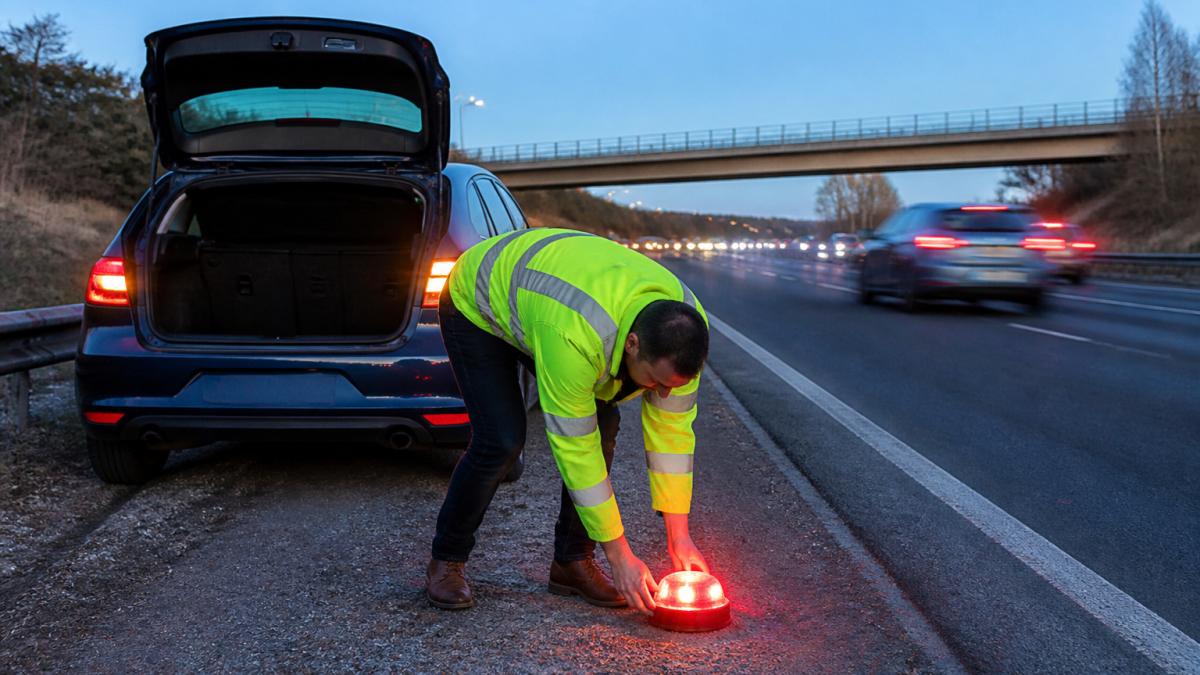
When a vehicle stops unexpectedly, live location data tells emergency services exactly where to find it, which matters most on unlit stretches where landmarks are scarce. This is where tracking and physical warning equipment work together. A GPS-enabled emergency beacon does two jobs at once: it marks the vehicle visibly for approaching traffic and reports its position, so the driver is seen and found.
If you break down on a smart motorway, get behind the barrier first, then activate your warning beacon. Location data helps responders find you, but visibility is what stops the next vehicle from hitting yours.
4. Theft Prevention and Geofence Alerts Against Unauthorised Use
Geofence alerts are virtual boundaries around a depot, customer site or permitted area, and they trigger a notification the moment a vehicle crosses one unexpectedly. That single feature covers two risks at once: theft prevention and unauthorised vehicle use.
Set time-of-use restrictions and you will know immediately if a van moves at 2am when no job is scheduled. Vehicle security improves because a stolen vehicle can be located live rather than traced hours later. Incident response gets faster, too, since the alert arrives while the vehicle is still moving. For drivers, the benefit is personal: a company car parked outside your home is protected by the same boundary.
5. How Far a GPS Tracker Range Really Reaches
GPS tracker range is not the limiting factor most drivers assume. A tracker receives satellite signals passively, so there is no fixed maximum distance between the vehicle and the person watching the map. The real constraint is the mobile network connection the device uses to send location updates.
That means coverage depends on signal, not distance. A vehicle can be tracked across the country and still drop offline in a tunnel, a deep car park or a remote valley. Good trackers store data locally and upload it once signal returns, so gaps fill in. When comparing devices, ask how they behave without signal rather than how far they claim to reach.
6. Driver Tracking Privacy: Consent, Law and Responsible Monitoring
Driver tracking privacy is governed in the UK by data protection law, and employers must handle location data lawfully and transparently. Under UK GDPR and the Data Protection Act 2018, location data about an identifiable person counts as personal data, which brings clear obligations.
What UK employers must get right
Monitoring must be necessary and proportionate, and staff should be told what is collected, why and for how long it is kept. Guidance from the Information Commissioner’s Office on monitoring at work sets out how to carry out a legitimate interest assessment and how to avoid excessive surveillance. Continuous out-of-hours tracking of a vehicle a driver takes home is a common flashpoint. The practical answer is to restrict monitoring to working time, publish a clear policy and consult drivers before switching systems on.
Rolling out tracking without telling drivers first is the mistake that ends in grievances. Announce the system, explain the purpose and confirm what is switched off outside working hours before the first device is fitted.
7. Measuring the Return: KPIs That Prove Tracking Pays
Proving the return comes down to a small set of measures tracked before and after rollout. Pick them in advance, record a baseline month, then compare.
| KPI | What it shows | How often to review |
|---|---|---|
| Idle time per vehicle | Fuel waste and poor scheduling | Weekly |
| On-time delivery rate | Customer service and schedule adherence | Weekly |
| Fuel cost per mile | Overall operational efficiency | Monthly |
| Speeding and harsh braking events | Driver behaviour and insurance risk | Monthly |
| Unauthorised movement alerts | Vehicle security and misuse | Monthly |
| Average response time to incidents | Emergency readiness | Quarterly |
Cost reduction rarely arrives from one headline number. It builds from small, repeated gains in idle time, route efficiency and insurance costs, and the table above is how you show it to a finance team.
Conclusion
The hardest part of tracking is not installing it, it is using the data fairly and consistently once it flows. Roadflash builds multi-award-winning early warning systems, including DGT 3.0 compliant emergency beacons with GPS and geolocation, so a stopped vehicle is both clearly seen and precisely located. Pair that with a clear monitoring policy and you protect drivers on the road and their privacy off it. Explore the Roadflash range to see how location-aware warning equipment fits your vehicles.
Frequently Asked Questions
How does real time location tracking actually work for drivers?
A GPS receiver in the vehicle or beacon calculates its position from satellite signals, then sends that location over a mobile network to a dashboard or app. Updates typically arrive every few seconds to a few minutes, depending on the device and data plan. That live location data feeds route planning, arrival times, geofence alerts and emergency response. For breakdown situations, a GPS-enabled warning beacon gives control rooms the vehicle’s exact position even if the driver is injured or disoriented, which shortens response time considerably.
How far away will a GPS tracker work?
GPS tracker range is not limited by distance from your phone or office. The receiver talks to satellites, so coverage depends on sky visibility, and the data travels over the mobile network. That means a vehicle in another county or abroad can still report its position. The real limits are tunnels, multi-storey car parks, dense urban canyons and areas with weak mobile signal, where updates may pause until coverage returns. Check that any device you buy uses a network with reliable coverage on your routes.
Can real time tracking improve driver safety without invading driver tracking privacy?
Yes, provided you follow the rules. Under UK GDPR and the Data Protection Act 2018, employers must have a lawful basis, tell drivers what is collected and why, and keep monitoring proportionate. Track vehicle location and journey data rather than continuous personal surveillance, avoid out-of-hours monitoring, and publish a clear policy. Done that way, driver safety tracking supports coaching on harsh braking or speeding, speeds up incident response and protects drivers accused of faults they did not commit.
What information can a fleet manager see with driver tracking?
A typical system shows live vehicle location, historical trip data, journey times, idle periods, geofence entries and exits, and alerts for unauthorised use or time-of-use restrictions. Some platforms add driver behaviour scores covering speeding, harsh acceleration and cornering. Use these to plan routes, cut fuel costs and manage schedules, not to micromanage individuals. Share the same dashboards with drivers so the data works as a coaching tool, and keep the focus on operational efficiency and safety rather than constant observation.