
Are V-16 Beacons Mandatory for Rental Cars in Spain?
Last Updated: October 29, 2026
Quick Summary
Yes, in most cases. Since 1 January 2026, vehicles registered in Spain must carry an approved V-16 beacon in place of warning triangles, so a Spanish-registered rental should have one. Foreign-registered cars driven into Spain should follow the same rule, so check the car before you travel.
- The vehicle’s registration decides the requirement, not the driver’s passport or the rental company’s base.
- The mandate took effect on 1 January 2026 and replaces warning triangles.
- Check at pickup that the beacon is present, approved, working and within reach of the driver.
- Photograph the beacon and its condition at collection to record any existing faults.
- Check current penalties and approval rules with official DGT guidance, since they can change.
Table of Contents
- What a V-16 Beacon Is and Why Spain Requires It
- Spain’s V-16 Mandate and the 1 January 2026 Effective Date
- Are Rental Cars Required to Carry a V-16 Beacon?
- Spain V-16 Beacon Rules for Tourists
- DGT-Approved Connected V-16 Beacons: Certification and Connectivity
- How to Use a V-16 Beacon Correctly
- V-16 Beacon for UK Cars in Spain: Penalties and Responsibility
- Booking Your Own V-16 Beacon Before You Travel
- Frequently Asked Questions
Are V-16 beacons mandatory for rental cars in Spain? Short answer: the rules changed on 1 January 2026, and most drivers now need to carry one. This guide sets out what the rules say, who they apply to, and what to do before you pick up keys.
What a V-16 Beacon Is and Why Spain Requires It
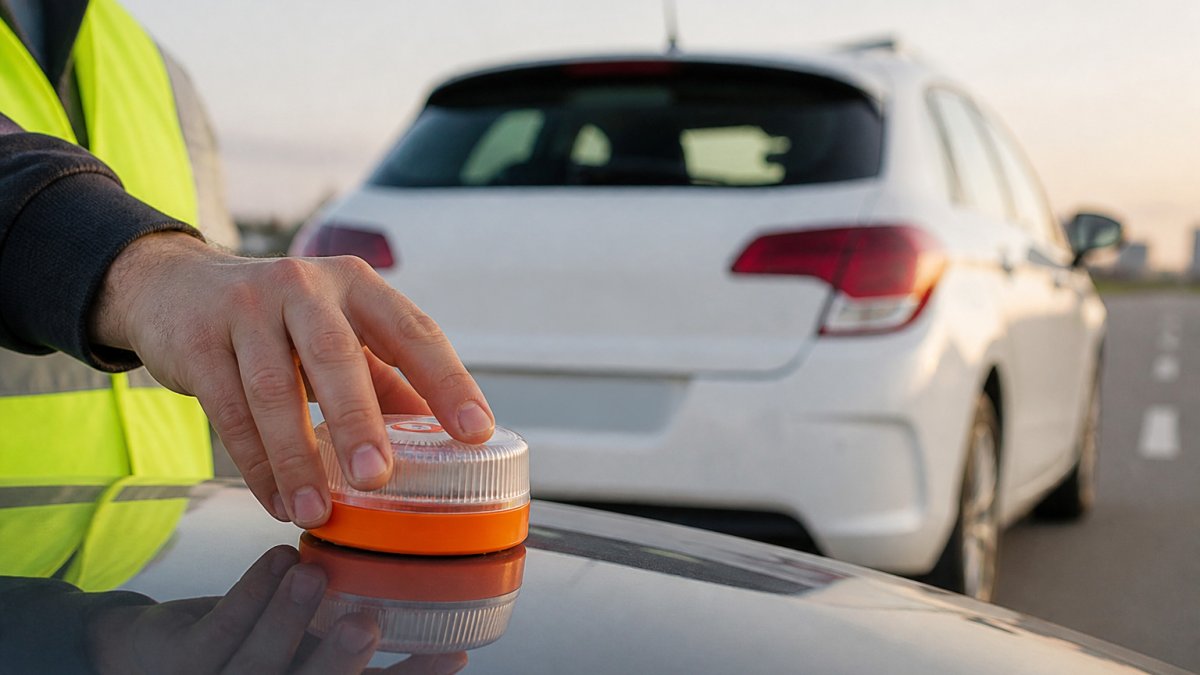
A V-16 beacon is an electronic hazard warning device that sits on the roof of a stationary vehicle. It flashes a bright amber light that drivers can see from a long way off, which gives approaching traffic time to react.
Spain introduced the rule to cut the risk of collisions at the roadside. Standing next to a broken-down car on a fast road is dangerous. A beacon lets you warn traffic without stepping into the lane.
- Placed on the roof, it signals hazards to vehicles behind
- It replaces the traditional warning triangle as the required device
- Connected versions can also send location data in an emergency
Spain’s V-16 Mandate and the 1 January 2026 Effective Date
The mandate took effect on 1 January 2026, and vehicles registered in Spain must carry an approved V-16 beacon in place of warning triangles.
Official guidance from the Dirección General de Tráfico (DGT) sets out the detail. Check the DGT official V-16 beacon guidance for current requirements, since rules around approval and enforcement can be updated.
Many drivers assume the change is only a Spanish concern. It affects anyone who drives in Spain, including visitors.
Are Rental Cars Required to Carry a V-16 Beacon?
The honest answer is that it depends on how the rental car is registered and where you are driving it, not simply on the word ‘rental’. Most top-ranking pages blur those scenarios together, which is why drivers come away unsure. Here is the breakdown by registration and rental scenario.
Scenario 1: You rent a Spanish-registered car in Spain
This is the clearest case. A Spanish-registered vehicle on Spanish roads must carry an approved V-16 beacon in place of the warning triangle. The rental company is supplying a vehicle that is meant to be legal on the road, so the beacon should be in the car when you collect it. Confirm it at the desk rather than assuming.
Scenario 2: You rent a foreign-registered car and drive it into Spain
A foreign-registered rental car, for example, one hired in another country and driven across the border, is still a vehicle on Spanish roads. Treat the beacon requirement as applying to the vehicle while it is in Spain. The practical problem is that the rental company may not have equipped it for Spanish rules, so check before you cross the border and buy your own approved beacon if the car does not have one.
Scenario 3: You are a visitor renting a locally registered car
If you hire a car that is registered in Spain, you are in Scenario 1 regardless of your own nationality or where you flew from. Your UK driving licence or home-country rules do not change what the vehicle must carry. The car’s registration does.
The registration of the vehicle decides the requirement, not the driver’s passport or the country the rental company is headquartered in. A Spanish-registered rental should have a beacon; a foreign-registered rental driven into Spain may not, so verify before you travel.
What to check at rental pickup
Spend two minutes at the desk and in the car park. A short checklist prevents most disputes later:
- Is the beacon present? Look in the glovebox, boot, and door pockets. Ask the desk to show you where it is kept.
- Is it an approved device? Check for the DGT approval marking or documentation. A generic amber beacon is not automatically compliant.
- Is it working? Switch it on briefly and confirm it flashes. If it is rechargeable, ask whether it is charged.
Take a photo of the beacon and its condition when you collect the car. If something is wrong, report it at the desk and keep a record. That photo is your evidence that the issue existed at pickup rather than after your rental.
Who is responsible if the beacon is missing or damaged?
The rental company’s obligation is to supply a vehicle that meets the equipment rules for where it is used. Your obligation as the driver is to use the equipment correctly and to report faults. If the beacon is missing at pickup, raise it before you drive away, that is the cleanest point to resolve it.
Spain V-16 Beacon Rules for Tourists
Visitors need to know two things: whether the car they hire should have a beacon, and what they must do if it does not. The answer depends mainly on where the vehicle is registered.
Rules by Vehicle Registration Country
The rules differ depending on the registration of the car, not just the country you are visiting from.
- Spanish-registered vehicles: must carry an approved V-16 beacon
- Foreign-registered vehicles, including UK-registered ones: should follow the same rule while driving in Spain
- Motorhomes and caravans: check the specific requirement for the vehicle type
A common mistake is assuming a UK-registered car is exempt because the rule is Spanish. Treat the rule as applying wherever you drive in Spain.
What to Check at Rental Pickup
Before you leave the rental desk, take a few minutes to check the car properly.
- Look for a V-16 beacon and confirm it is in the vehicle
- Check that the beacon is not damaged
- Ask how it is charged or powered
Take a photo of the beacon in the boot or glovebox. If there is a problem, you have a record of the condition when you collected the car.
DGT-Approved Connected V-16 Beacons: Certification and Connectivity
Not every beacon is equal. The DGT approves specific devices, so a beacon must be certified to meet Spanish requirements.
Roadflash offers DGT 3.0 compliant emergency beacons with GPS and geolocation. Connected beacons do send location data, so check how a device handles privacy before you buy. Check whether your beacon is DGT approved before relying on it in Spain.
- Confirm the device carries the relevant DGT approval
- Check whether it is connected or standalone
- Read how any location data is used and stored
How to Use a V-16 Beacon Correctly
Using the beacon properly makes the difference between a useful warning and a wasted device.
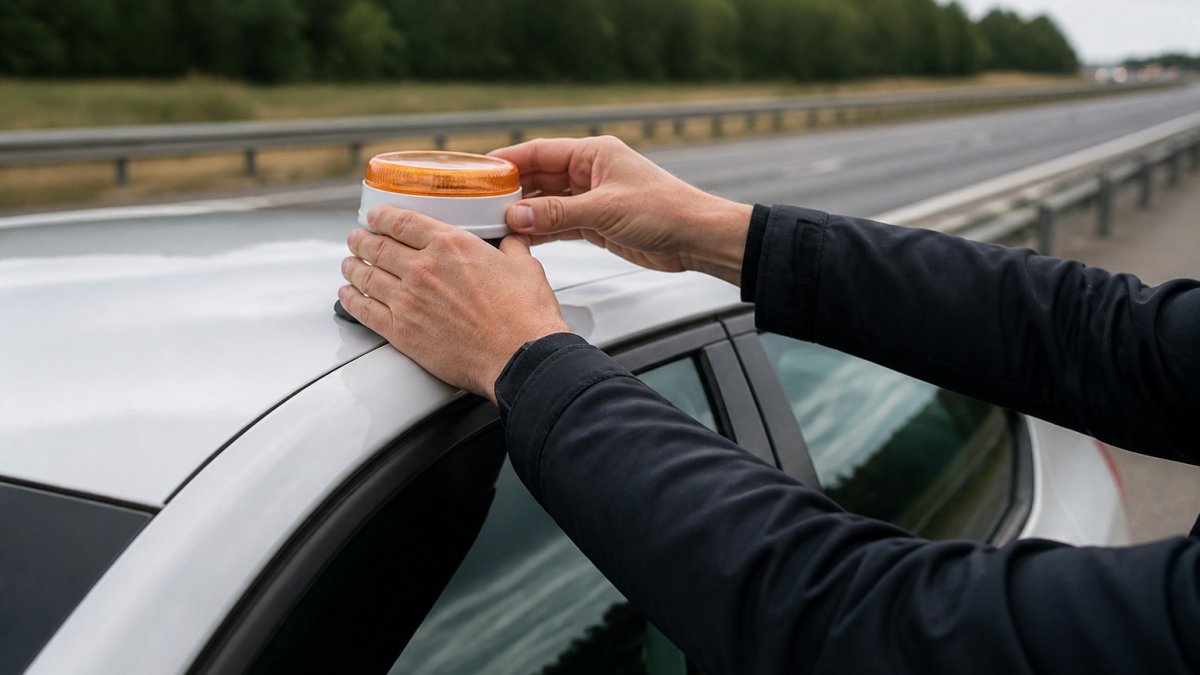
- Switch the car off and turn on your hazard lights
- Stand well away from the traffic, behind a barrier where possible
- Place the beacon on the roof, centred and firmly seated
Watch out: placing the beacon while standing in the live lane puts you at serious risk. Move to the verge first.
Using the beacon in the right order makes the warning effective and keeps you safe at the roadside:
| Step | What to do | Note |
|---|---|---|
| Stop and secure the car | Switch the car off and turn on hazard lights | Do this before anything else |
| Get to safety | Stand well away from traffic, behind a barrier if possible | Avoid standing in the live lane |
| Place the beacon | Position it on the roof, centred and firmly seated | Placing it from the lane is dangerous |
| Switch it on | Confirm the beacon is flashing | Check it is on before you step away |
V-16 Beacon for UK Cars in Spain: Penalties and Responsibility
Most competitors either skip penalties or repeat a single line about fines. The useful version separates three things: what the rule requires, how compliance is checked, and who carries the risk when something goes wrong.
What the rule requires of a UK-registered car in Spain
A UK-registered vehicle driving in Spain is a vehicle on Spanish roads. Treat the beacon requirement as applying while you are there. The practical difficulty is that a UK car will not have been supplied with a Spanish-approved beacon, so you need to source one before you travel or at the earliest opportunity after arrival.
How enforcement works in practice
Enforcement is handled by Spanish traffic authorities, principally the Dirección General de Tráfico (DGT). In practice, checks tend to happen at roadside stops, at accident or breakdown scenes, and during targeted campaigns rather than at every border crossing. Confirm the current enforcement position with the DGT official V-16 beacon guidance before you travel, because approval and enforcement details can be updated.
Penalties: what to expect and what to verify
Penalty levels and the exact classification of a missing or non-approved beacon can change, and secondary sources often quote outdated figures. Rather than rely on a number from a forum, check the current position with official guidance. What is consistent is the direction of travel: the beacon is treated as required safety equipment, so a missing or unapproved device can be treated as an equipment offence and can complicate insurance or liability discussions after a breakdown or collision.
Do not treat a fine as the main risk. The bigger practical risk is being stranded at the roadside without a compliant warning device, or having a claim questioned because the vehicle was not equipped as required. Carry an approved beacon and use it correctly.
Responsibility: rental company versus driver
There are two separate duties, and confusing them is the usual source of arguments:
- The rental company’s duty is to provide a vehicle equipped to the standard required where it is used. If you hire a Spanish-registered car, the beacon should be supplied and in working order.
- The driver’s duty is to use the equipment correctly, keep it accessible, and report faults. You cannot delegate that to the rental company once you are on the road.
If the beacon is missing at pickup, the cleanest fix is to raise it before you leave the rental compound. If it fails during the rental, contact the provider and follow their instructions, and keep a record of the call. If you are driving a UK-registered car into Spain, the equipment duty sits with you as the driver, so buy an approved beacon before you go rather than hoping to find one at a service station.
A short decision path for UK drivers
- Driving a Spanish-registered rental in Spain? Confirm the beacon is present, approved, working, and accessible at pickup.
- Driving a UK-registered car into Spain? Source an approved beacon before you travel and keep it in the car.
- Beacon missing or faulty at pickup? Report it at the desk, photograph the condition, and get the provider’s contact number.
- Beacon fails during the rental? Contact the provider, follow their instructions, and keep a record.
- Unsure about current penalties or approval? Check official guidance rather than older advice.
Booking Your Own V-16 Beacon Before You Travel
If you are not sure the rental car will carry one, bringing your own is a simple fix. A personal beacon means you are covered whatever the provider supplies.
Roadflash offers DGT 3.0 compliant emergency beacons with GPS and geolocation, designed for drivers who want clear hazard warning on the road. Check the product details, confirm the approval status, and add the beacon to your basket before your trip. Compare the best emergency beacons for car breakdowns before you choose one.
Frequently Asked Questions
Do UK cars need a V-16 beacon when driving in Spain?
Yes. Spain’s V-16 requirement applies to vehicles driven on Spanish roads regardless of registration country, so a UK-registered car needs a compliant V-16 beacon in the boot or cabin. The beacon must be a DGT-approved device. Check the current DGT guidance before travelling, as details of approval and enforcement can be updated.
Are V-16 beacons mandatory in rental cars?
Spain’s V-16 requirement applies to every vehicle on Spanish roads, including hire cars. Do not assume a beacon is in the car simply because the rental is in Spain. Confirm at pickup whether one is provided before driving away, and keep a record of any issue.
Who is responsible for supplying a V-16 beacon in a hire car?
The vehicle owner, which is normally the rental company, is expected to provide the beacon as part of the car’s equipment. The driver remains responsible for carrying and using it correctly during a breakdown or accident. If the beacon is missing, damaged or has a discharged battery, report it to the rental company straight away and do not drive off without resolving it. Keep photos or written confirmation of any issue.
Where should you place a V-16 beacon on a rental car?
Place the beacon on the roof of the vehicle, on the side facing traffic, so it is visible from behind at a distance. Use the magnetic base or mounting method supplied with the device and make sure it sits firmly on a clean metal surface. Activate it once the car is stopped and you are safe to exit. Keep it visible until the vehicle is moved or help arrives.
