
Roadside Safety Devices in Spain: Legal Requirements
Table of Contents
- Roadside Safety Devices in Spain: What Drivers Must Carry
- Spain V-16 Beacon Requirements and DGT 3.0 Compliance
- Warning Triangles Spain Rules: Current Status and Alternatives
- V-16 Beacon for Foreign-Registered Vehicles: What You Need to Know
- How to Use a V-16 Emergency Beacon During a Breakdown
- Reflective Safety Vests and High-Visibility Requirements
- Penalties for Non-Compliant or Missing Equipment
- Frequently Asked Questions
Last Updated: October 10, 2026
Roadside Safety Devices in Spain: What Drivers Must Carry
Roadside safety devices in Spain are legally required equipment that every motorist must carry while driving. These devices protect you and other road users during breakdowns, accidents, or emergencies on busy highways and motorways.
The legal framework for roadside safety devices has evolved significantly. Traditional warning triangles remain part of the requirement, but Spain now recognises advanced alternatives like V-16 emergency beacons that offer superior visibility and faster emergency response.
At Roadflash, we specialise in multi-award-winning early warning systems designed to prevent vehicle collisions, particularly for stationary vehicles on busy highways and motorways. Our DGT 3.0 compliant emergency beacons with GPS/Geolocation technology significantly increase hazard awareness and improve vehicle visibility at the side of roads, protecting drivers and passengers during breakdowns.
Spain V-16 Beacon Requirements and DGT 3.0 Compliance
The V-16 emergency beacon represents Spain’s modern approach to roadside safety. DGT 3.0 compliance means your beacon meets the latest Spanish traffic safety standards for connected warning devices. This certification ensures your equipment works reliably during emergencies and provides emergency services with accurate location data.
A V-16 beacon is a connected warning device that activates automatically or manually when your vehicle breaks down. Unlike traditional triangles, it transmits your vehicle’s location to emergency services and alerts other motorists through flashing light signals.
Why V-16 Beacons Outperform Traditional Warning Triangles
V-16 beacons offer advantages traditional warning triangles cannot match. They activate instantly without requiring you to exit your vehicle into traffic. The flashing light pattern is visible from much greater distances, even in poor visibility conditions.
A motorist experiencing a breakdown on a Spanish motorway faces real danger. Positioning a traditional triangle requires leaving your vehicle, walking into fast-moving traffic, and placing the device correctly. V-16 beacons eliminate this risk.
Warning Triangles Spain Rules: Current Status and Alternatives
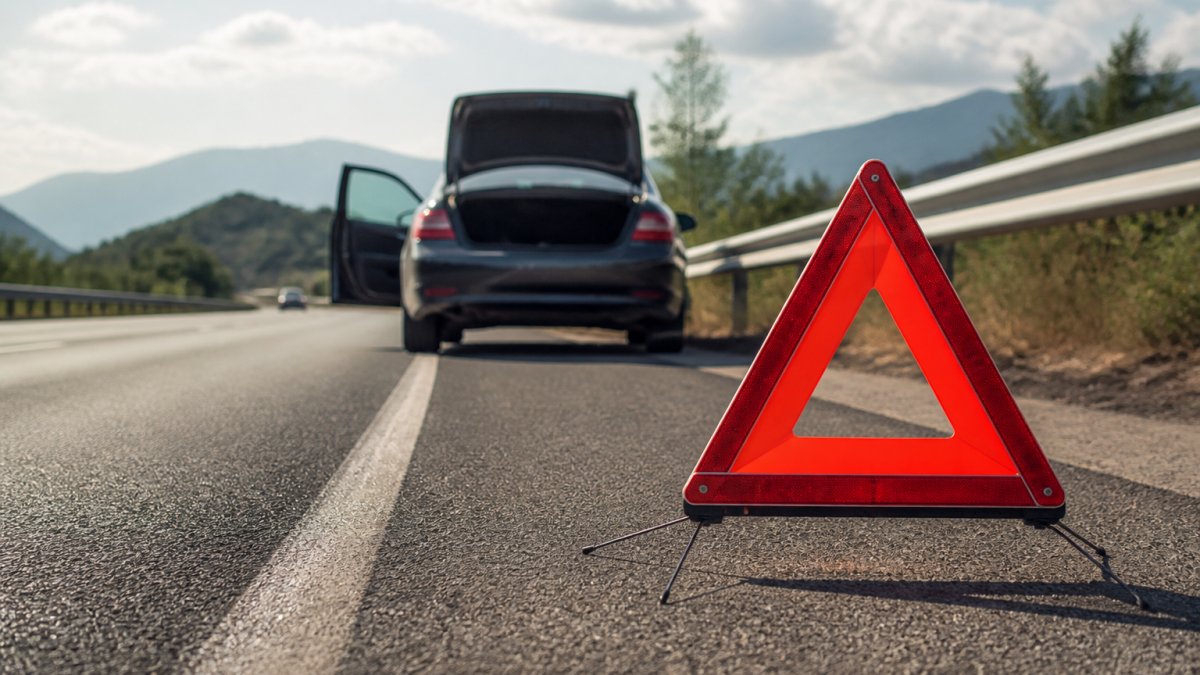
Warning triangles remain a legal requirement under Spanish traffic regulations (Código de la Circulación and DGT guidelines), though the regulatory landscape has evolved to permit V-16 emergency beacons as compliant alternatives. Current law mandates that all motor vehicles (except motorcycles and mopeds under 50cc) carry at least one warning triangle when travelling on roads outside built-up areas.
Placement and Distance Requirements by Road Type
The distance at which you must position your warning triangle depends on the road classification:
- Motorways and dual carriageways: 50 metres behind your vehicle, measured from the rear bumper to the triangle’s nearest edge.
- Other roads (national roads, regional roads, local roads): 30 metres behind your vehicle.
- Urban areas and built-up zones: Warning triangles are not required if your vehicle is stationary within a built-up area, though hazard lights must remain activated.
Triangles must be placed on the same side of the road as your vehicle and angled to face approaching traffic. On motorways with poor sightlines (bends, hills, fog), position the triangle further back if safe to do so. The triangle’s reflective surface must be clearly visible in daylight and artificial light; worn or damaged reflectors no longer meet legal standards and can result in fines.
Transition from Triangles to V-16 Beacons: Timeline and Current Status
Spain’s regulatory framework has not mandated a complete replacement of warning triangles with V-16 beacons. Instead, regulations now permit V-16 emergency beacons (specifically those meeting DGT 3.0 technical standards) as an alternative to traditional triangles. This dual-compliance approach means:
- Drivers may carry a traditional warning triangle alone and remain compliant.
- Drivers may carry a DGT 3.0 certified V-16 beacon alone and remain compliant.
- Drivers may carry both devices for redundancy (recommended for long journeys or high-risk routes).
There is no announced sunset date for warning triangle requirements. The regulatory shift reflects technological advancement and safety improvement rather than a phased elimination. Foreign-registered vehicles (including those from the UK) must comply with the same triangle or beacon requirement as Spanish-registered vehicles.
Vehicle-Type Variations
Warning triangle requirements vary by vehicle category:
- Passenger cars and light vans (up to 3.5 tonnes): One warning triangle required.
- Heavy goods vehicles and buses: Two warning triangles required (one for the vehicle, one for any trailer).
- Motorcycles and mopeds (under 50cc): Warning triangles are not required; hazard lights and high-visibility vests are the primary visibility measures.
- Rental vehicles: Must include a warning triangle in the vehicle’s standard equipment; rental companies are responsible for ensuring compliance.
Inspection and Maintenance Standards
Your warning triangle must meet EN 471 or EN ISO 20471 standards for reflective material. The triangle’s reflective surface should be checked regularly for:
- Cracks or delamination in the reflective coating.
- Fading or discolouration that reduces visibility.
- Damage to the frame or support legs.
If your triangle fails to meet these standards, it no longer satisfies legal requirements. Replacement triangles are inexpensive (typically €5-€15) and widely available at petrol stations, supermarkets, and online retailers across Spain. Carrying a spare triangle is not legally required but is a practical safeguard for longer journeys.
V-16 Beacon for Foreign-Registered Vehicles: What You Need to Know
Foreign-registered vehicles driving in Spain must comply with Spanish roadside safety requirements. If you’re driving a UK-registered car in Spain, you need either traditional warning triangles or a DGT 3.0 compliant V-16 beacon.
Your vehicle’s registration certificate and driving licence must be carried at all times. Spanish authorities conduct roadside checks and can issue fines for missing or non-compliant equipment.
Before driving to Spain, verify your beacon’s certification. Not all emergency beacons sold internationally meet DGT 3.0 standards. Roadflash beacons are specifically certified for Spanish compliance.
How to Use a V-16 Emergency Beacon During a Breakdown
Activating a V-16 beacon during a breakdown is straightforward and far safer than positioning traditional triangles. When your vehicle breaks down on a Spanish motorway, switch on your hazard lights immediately.

Placement and Activation Steps
Position your beacon on the road surface behind your vehicle, at the required distance (50 metres on motorways, 30 metres on other roads). The beacon’s flashing light should face approaching traffic. Activation takes seconds, press the button or use the connected app to initiate the light sequence.
Modern V-16 beacons activate automatically on impact during accidents, transmitting your location instantly. Manual activation is equally simple for breakdowns. The beacon’s GPS function sends your coordinates to emergency services and alerts nearby drivers through its distinctive flashing pattern.
Safety Positioning and Visibility
Never position yourself between your vehicle and the beacon. Stay inside your vehicle or stand well clear of the roadside. Your high-visibility vest should be worn when exiting the vehicle for any reason. The beacon’s light pattern is designed to be visible from 1,000 metres away, giving approaching drivers ample warning.
Check that your beacon is clearly visible and unobstructed. Dust, rain, or snow can reduce visibility. Wipe the light lens if necessary. Ensure the beacon remains activated until emergency services arrive or you can safely move your vehicle.
Reflective Safety Vests and High-Visibility Requirements
Spain requires all vehicle occupants to wear reflective safety vests when exiting the vehicle on a roadway. Each vest must meet CE marking standards for high-visibility clothing.
Vests must display retro-reflective material visible from all angles. Worn or faded vests no longer meet legal standards. Check your vests regularly and replace them if the reflective coating deteriorates. A single vest per occupant is the minimum; carrying spares is recommended for longer journeys or group travel.
Penalties for Non-Compliant or Missing Equipment
Spanish traffic authorities enforce roadside safety equipment requirements through the Dirección General de Tráfico (DGT) and regional traffic police. Penalties for non-compliance are significant and are applied consistently to both Spanish-registered and foreign-registered vehicles.
Fine Structure by Violation Type
The Spanish traffic fine system (Sistema de Sanciones por Infracciones de Tráfico) categorises equipment violations into three severity levels:
Serious violations (infracciones graves):
- Missing warning triangle(s): €80-€200 fine.
- Missing or non-compliant reflective safety vest(s): €80-€200 fine.
- Equipment stored in inaccessible location (e.g., boot, locked compartment): €80-€200 fine.
Very serious violations (infracciones muy graves):
- Repeated equipment violations within 12 months: €200-€500 fine and potential vehicle impoundment.
- Driving without any visible warning device (triangle or beacon) on a motorway: €200-€500 fine.
Aggravating circumstances:
- If your missing or non-compliant equipment contributes to an accident, fines increase and you may face liability for damages.
- Fines are doubled if the violation occurs in a high-risk area (motorway, dual carriageway, poor visibility zone).
Enforcement Procedures During Roadside Checks
Spanish traffic police conduct routine roadside checks (controles de tráfico) on motorways, national roads, and regional routes. During a check, officers will:
- Request your driving licence, vehicle registration certificate, and proof of insurance.
- Visually inspect your vehicle for required safety equipment.
- Check that warning triangles or beacons are accessible (not locked in the boot or inaccessible compartments).
- Verify that reflective safety vests are present and stored within the passenger cabin or easily accessible areas.
- Inspect the condition of reflective material on triangles or vests for wear, fading, or damage.
If equipment is missing or non-compliant, the officer will issue a fine on the spot (multa inmediata). You have the right to request a written explanation of the violation. Fines must be paid within 15 days to receive a 50% discount; payment after 15 days incurs the full penalty amount.
Treatment of Foreign-Registered Vehicles
Foreign drivers face identical enforcement as Spanish residents. If you are driving a UK-registered vehicle in Spain and lack required safety equipment, you will receive the same fine as a Spanish driver. However, there are important procedural differences:
- Immediate payment requirement: Spanish authorities may require foreign drivers to pay fines immediately or provide a deposit (typically €300-€600) to guarantee payment. Failure to pay can result in vehicle impoundment.
- Vehicle impoundment: If you cannot pay a fine on the spot, your vehicle may be impounded until payment is made or a court date is scheduled.
- Diplomatic notification: Serious violations may be reported to your home country’s driving authority, potentially affecting your driving record or insurance.
To avoid complications, ensure your vehicle is fully compliant before entering Spain. Carry proof of equipment compliance (purchase receipts for new triangles or beacon certification documents) in case of disputes.
Cumulative Penalties and Licence Points
While equipment violations do not directly result in licence point deductions (unlike speeding or drink-driving offences), accumulating multiple violations within 12 months can trigger:
- Enhanced fines for repeat offences.
- Vehicle impoundment for 24-72 hours.
- Mandatory attendance at a traffic safety course (curso de sensibilización y reeducación vial).
- Referral to a provincial traffic court (juzgado de lo penal) if violations are deemed reckless or contribute to accidents.
Cost-Benefit Analysis: Equipment Investment vs. Fines
A single warning triangle costs €5-€15. A single equipment fine (€80-€200) exceeds the cost of purchasing compliant equipment. For drivers making regular journeys to Spain, compliance is both a legal obligation and a financial safeguard.
Frequently Asked Questions
Is a V-16 beacon mandatory in Spain, or can drivers still use a warning triangle?
Spanish traffic regulations permit both V-16 beacons and warning triangles as valid roadside safety devices. However, V-16 beacons offer superior visibility and compliance with DGT 3.0 standards, making them the preferred choice for motorists on busy highways. Warning triangles remain legal but are less effective at alerting approaching drivers to a stationary vehicle, especially at night or in poor visibility.
Do foreign-registered vehicles need a V-16 beacon when driving in Spain?
Foreign-registered vehicles must comply with Spanish roadside safety equipment requirements when driving on Spanish roads. A V-16 beacon for foreign-registered vehicles provides the most reliable compliance with DGT 3.0 standards and Spanish traffic law. If your vehicle is registered outside Spain, carrying a DGT 3.0 compliant beacon ensures you meet legal obligations and maximises safety during a breakdown on motorways or highways.
What should I do first when I break down on a Spanish motorway?
When your vehicle breaks down, activate your hazard lights immediately, move to a safe location away from traffic, and put on a high-visibility vest. Position your V-16 emergency beacon at least 30 metres behind your vehicle to alert approaching drivers. Contact roadside assistance and remain in your vehicle or behind a safety barrier until help arrives. Never stand in the traffic lane.
What other equipment must drivers carry in Spain besides warning devices?
Spanish traffic law requires drivers to carry reflective safety vests (one per passenger), a warning triangle or V-16 beacon. Additionally, carry your driving licence, vehicle registration certificate, and proof of insurance at all times. High-visibility clothing must meet CE marking standards to ensure compliance.