
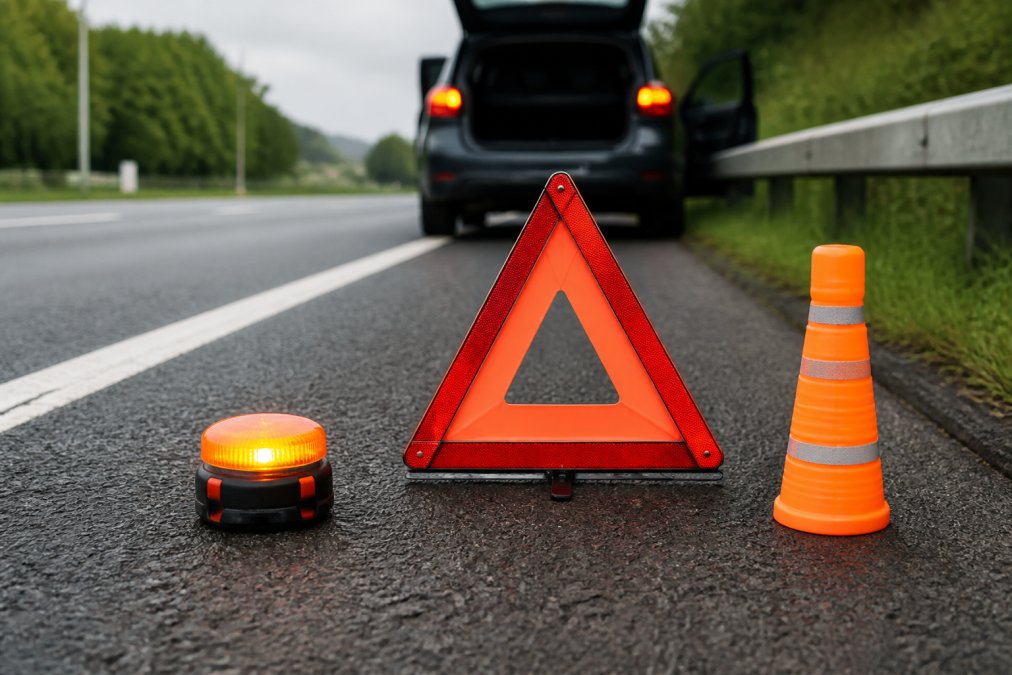
Modern Alternatives to Roadside Flares
Table of Contents
- Why Drivers Are Moving Away from Traditional Pyrotechnic Flares
- Best LED Road Safety Beacons 2026
- DGT 3.0 Compliant Emergency Beacons for Legal Compliance
- How to Use LED Roadside Warning Lights Effectively
- Reflective Triangles and Passive Safety Markers
- Cold Weather Battery Performance and Durability
- Safety, Environmental Impact, and Vehicle Emergency Kit Integration
- Frequently Asked Questions
Last Updated: September 18, 2026
Why Drivers Are Moving Away from Traditional Pyrotechnic Flares
Traditional pyrotechnic flares have been the standard roadside emergency signal for decades. Yet drivers are increasingly abandoning them for modern alternatives to roadside flares that offer better safety, reliability, and environmental benefits.
The problem with pyrotechnic flares is fundamental. They create an open flame in an unpredictable environment. On a busy motorway, that’s a genuine hazard. Drivers are stressed, visibility is poor, and placing a burning object on tarmac near moving traffic introduces unnecessary risk. Beyond safety, flares are single-use, produce toxic smoke, and create disposal headaches.
Modern LED beacons and reflective safety markers solve these problems directly. They eliminate fire risk entirely, work in any weather, and last for years. For motorists concerned about breakdown safety, the shift from flares to LED alternatives represents a fundamental upgrade in hazard warning technology.
Best LED Road Safety Beacons 2026
LED road safety beacons have become the dominant choice for drivers seeking alternatives to roadside flares. These devices provide high-visibility warning signals without the fire hazard or environmental impact of traditional pyrotechnic options.
Rechargeable vs. Battery-Powered Options
Rechargeable LED beacons eliminate the ongoing cost of battery replacement. Once charged, they’re ready for years of use. A rechargeable system makes sense if you drive regularly or maintain a fleet, the upfront investment pays for itself quickly through lower operating costs.
Battery-powered beacons offer simplicity and instant readiness. You buy them, they come with batteries installed, and you deploy them immediately during a breakdown. The trade-off is obvious: you’ll replace batteries periodically, and the environmental impact of disposable cells adds up over time.
For most motorists, rechargeable options represent better value long-term. Professional drivers and fleet operators almost always prefer rechargeable systems because the maths favour them decisively. For budget-conscious drivers, some LED road flares offer nine flash patterns and waterproof construction, though you’ll manage battery replacements yourself.
Visibility and Brightness Comparison
Visibility distance is where LED beacons outperform flares dramatically. A quality LED beacon produces consistent, directional light visible from up to a mile away in darkness. Pyrotechnic flares burn brightly but unpredictably, wind affects the flame, smoke obscures the light, and intensity fades as the fuel depletes.
Some LED road flares deliver high-intensity red LEDs with 360-degree visibility, making them exceptionally effective for stationary vehicles. Other options operate at professional-grade brightness with multiple light patterns, including SOS mode, ideal for emergency services and serious motorists who demand maximum conspicuity.
Daytime visibility matters equally. LED beacons with high lumen output remain visible in daylight, whereas flares become nearly invisible in bright sunlight. This is where alternatives to roadside flares gain a decisive advantage: they work equally well at 3 AM or 3 PM.
DGT 3.0 Compliant Emergency Beacons for Legal Compliance
Drivers in Spain face specific regulatory requirements. The DGT (Dirección General de Tráfico) mandates that emergency beacons meet strict standards for visibility, flash patterns, and performance. Roadflash specialises in DGT 3.0 compliant emergency beacons with GPS/Geolocation, meeting these requirements precisely.
Compliance isn’t optional, it’s a legal requirement for motorists on Spanish roads. Non-compliant warning devices can result in fines or confiscation. Roadflash’s multi-award-winning beacons satisfy DGT 3.0 specifications, ensuring your hazard warning system meets legal standards while providing GPS-enabled location tracking that helps emergency services locate you quickly during a genuine emergency.
How to Use LED Roadside Warning Lights Effectively
Deploying LED beacons correctly maximises their protective benefit. Proper placement, timing, and technique determine whether your warning system prevents accidents or merely signals a hazard.
Placement Strategy for Maximum Visibility
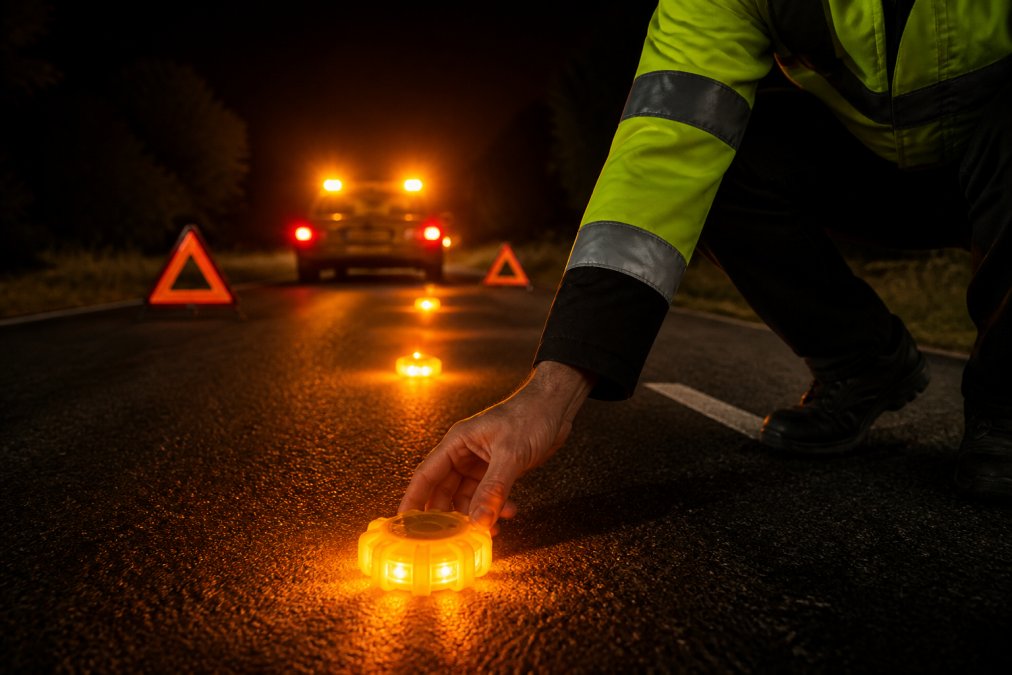
Distance matters critically. Place your first beacon 50-100 metres behind your stationary vehicle, depending on road speed and lighting conditions. On motorways, extend this distance, approaching drivers need maximum warning time. A second beacon placed 150-200 metres back provides additional safety margin.
Position beacons on the road surface rather than on the vehicle itself. Ground-level placement forces approaching drivers to acknowledge the hazard earlier. Magnetic bases on most modern LED beacons secure them firmly, preventing wind displacement.
Triangulation improves effectiveness. Use your hazard lights, LED beacons, and reflective triangles together as a layered warning system. The hazard lights alert drivers to a stationary vehicle. The LED beacons provide bright, directional warning. The reflective triangles ensure visibility if electronic systems fail. Roadflash’s multi-award-winning early warning systems combine these elements for maximum hazard awareness.
Deployment Speed and Storage Considerations
LED beacons deploy in seconds. Most models activate with a single button press, no striking, no flame, no risk. This speed matters during a genuine emergency when you’re stressed and visibility is poor.
Storage is straightforward. LED beacons are compact and durable. Battery-powered models require minimal maintenance. Rechargeable systems need occasional charging but eliminate battery waste.
Reflective Triangles and Passive Safety Markers
Reflective emergency triangles represent the simplest alternative to roadside flares. They require no power, no batteries, and no maintenance. A quality reflective triangle remains effective indefinitely.
The limitation is obvious: triangles depend entirely on vehicle headlights for visibility. In daylight or heavy rain, their effectiveness diminishes. They also demand manual placement, which means exiting your vehicle on a busy road, a genuine safety concern.
Most experienced motorists use triangles as a backup system, not a primary warning. Paired with LED beacons and hazard lights, triangles provide redundancy. If your electronics fail, the triangle still warns approaching traffic. For cost-conscious drivers, reflective triangles (£15) are essential kit. For comprehensive hazard warning, they’re part of a layered system rather than a standalone solution.
Cold Weather Battery Performance and Durability
Cold weather degrades battery performance dramatically, yet most roadside hazard articles ignore the mechanics entirely. Understanding how temperature affects your chosen system is critical for drivers in northern regions or those who travel during winter months.
Battery Chemistry and Temperature Performance
Lithium-ion cells (used in rechargeable beacons) retain approximately 80-90% of their rated capacity at 0°C, but this drops to 50-60% at -10°C. Standard alkaline batteries lose capacity more steeply: they deliver only 70% capacity at 0°C and 40% at -10°C. This matters directly. A beacon rated for 12 hours of continuous operation at room temperature may deliver only 5-6 hours in freezing conditions.
Lithium primary cells (non-rechargeable lithium batteries, distinct from lithium-ion) perform better in cold than alkaline.
Practical Cold Weather Deployment
Battery-powered alternatives work reliably in cold, but brightness visibly diminishes during extended deployment in freezing conditions. After 30 minutes of continuous operation at -5°C, expect 15-20% reduction in light output compared to the same beacon at 15°C. This is not a failure, the beacon still functions, but it reduces visibility distance from, say, 800 metres to 650 metres.
Choosing the Right System for Your Climate
For drivers in regions where temperatures regularly drop below -5°C:
- Rechargeable systems are the strongest choice. They maintain consistent brightness, eliminate battery replacement hassles, and are designed for cold-weather reliability. Charge them indoors before winter travel.
- Battery-powered beacons with lithium primary cells (not alkaline) offer a practical alternative if you prefer simplicity. Accept slightly reduced brightness in extreme cold, but gain the convenience of instant deployment without pre-charging.
For drivers in milder climates (southern England, Wales) where temperatures rarely fall below 0°C:
- Battery-powered beacons with alkaline cells provide adequate performance and lower upfront cost. Cold-weather performance is less critical if you’re unlikely to deploy them in freezing conditions.
Durability extends beyond temperature. Weather resistance ratings (IP codes) indicate water and dust protection. Most modern LED beacons carry IP65 or higher ratings, meaning they withstand heavy rain, salt spray, and road debris. Magnetic bases endure repeated attachment and removal without degradation. Crush-resistant housings survive accidental vehicle contact. However, check the manufacturer’s cold-weather specification sheet, not all beacons are tested at sub-zero temperatures, and unmarked products may underperform when you need them most.
Safety, Environmental Impact, and Vehicle Emergency Kit Integration
Pyrotechnic flares pose genuine hazards. The open flame creates fire risk near fuel tanks and on petrol-soaked tarmac. Toxic smoke exposure during placement affects drivers with respiratory conditions. Single-use disposal creates environmental waste.
| Option | Best For | Key Advantage | Cost Range |
|---|---|---|---|
| Rechargeable LED Beacons | Regular drivers, fleet operators | Long-term value, zero waste | £35-£75 |
| Battery-Powered LED Beacons | Budget-conscious drivers | Simple, ready-to-use | £20-£30 |
| Reflective Triangles | Backup systems, cost-sensitive users | No power required, permanent | £15 |
| Chemlight Sticks | Emergency backup lighting | Maintenance-free, waterproof | £5 |
Frequently Asked Questions
What can be used as a safe alternative to traditional road flares?
LED beacons, reflective triangles, and GPS-enabled emergency systems all provide safer alternatives to incendiary flares. LED options eliminate open flame and toxic smoke, making them suitable for use near fuel tanks and in confined spaces. Reflective triangles require no power but depend on vehicle headlights. GPS-enabled beacons automatically alert emergency services to your exact location, providing an additional safety layer during breakdowns. Your choice depends on whether you prioritise active illumination, passive reflection, or automated emergency response.
Are LED road safety beacons legal for use on motorways?
Yes, LED beacons are legal on motorways throughout the UK and comply with traffic safety regulations. Many LED alternatives to roadside flares exceed minimum visibility standards. If you operate in Spain or other European markets, ensure your beacons meet DGT 3.0 compliance standards, which specify brightness, flash patterns, and colour requirements. Always check local regulations before purchasing, as some jurisdictions have specific standards for emergency warning equipment. Roadflash beacons are certified for use across multiple markets and regions.
How do modern LED road flares compare to chemical light sticks?
LED road flares offer reusable, adjustable brightness with multiple flash patterns, while chemical light sticks are single-use and provide fixed illumination that fades over time. LED beacons deliver superior visibility at distance and work in daylight, whereas chemical sticks are better suited as emergency backup lighting. LED options require battery maintenance but last for years; chemical sticks need no maintenance but cannot be recharged. For primary roadside emergency signalling, LED beacons outperform chemical alternatives in visibility and reliability.
What should I consider when choosing between different LED beacon options?
Evaluate battery life, visibility range, deployment speed, and durability in cold weather. Rechargeable beacons offer long-term value but require charging between uses. Budget-friendly multi-packs provide good value but may need battery replacement. Professional-grade options deliver superior reliability in extreme conditions. Consider magnetic mounting, flash pattern variety, and whether you need GPS integration. For frequent motorway users, durability and cold weather performance are critical; occasional drivers may prioritise affordability and ease of storage.