
7 Ways to Ensure Vehicle Safety in Spain 2026
Table of Contents
- 1. Fit a DGT 3.0 Compliant V-16 Emergency Beacon
- Is a DGT 3.0 Beacon Mandatory in Spain?
- 2. Meet V-16 Emergency Light Requirements 2026
- 3. Carry the Correct Breakdown and Warning Equipment
- 4. Keep Your Vehicle’s ADAS and Safety Tech Maintained
- 5. Driving in Spain Checklist for UK Motorists
- 6. Arrange European Breakdown Cover Before You Travel
- 7. Maintain Your Vehicle to Pass the ITV Inspection
- Frequently Asked Questions
Last Updated: September 17, 2026
1. Fit a DGT 3.0 Compliant V-16 Emergency Beacon
The single most important upgrade for anyone planning to drive in Spain in 2026 is a DGT 3.0 compliant V-16 emergency beacon. It is the headline change in Spanish road safety law and sits at the centre of our guide to the 7 ways to ensure vehicle safety in Spain 2026.
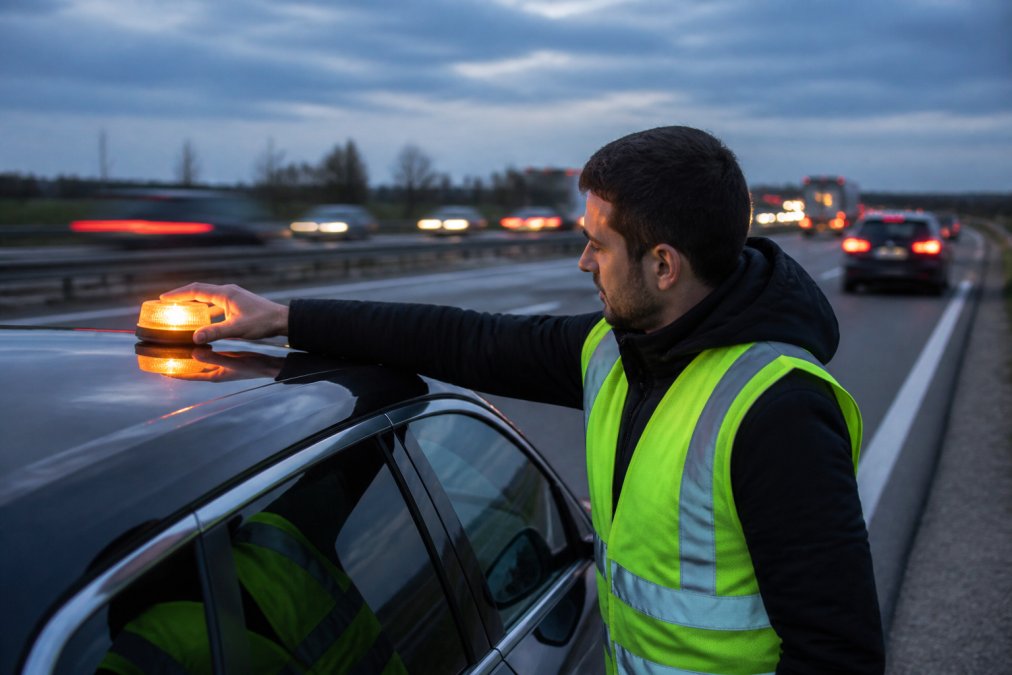
Do not assume any amber light qualifies. A beacon must be approved to the correct standard and, for the connected version, carry the right connectivity. An unapproved unit can fail a roadside check and still leave you exposed to a fine.
Is a DGT 3.0 Beacon Mandatory in Spain?
Yes. A DGT 3.0 connected beacon is mandatory for vehicles registered in Spain, enforced through 2026 as the warning triangle is phased out. It applies to passenger cars, vans and most vehicles that previously carried triangles.
| Driver type | Connected V-16 beacon required? | Warning triangle still needed? |
|---|---|---|
| Spanish-registered vehicle | Yes | No |
| UK-registered vehicle | No | Yes |
| Rental car collected in Spain | Usually fitted by the hire company | Check the glovebox |
2. Meet V-16 Emergency Light Requirements 2026
Meeting the V-16 emergency light requirements 2026 means buying a unit that carries the correct approval, works without your phone, and keeps signalling long enough to matter. The gap between a compliant beacon and a generic amber flasher is the difference between a legal warning device and an expensive ornament.
Connected vs non-connected: what the rules actually require
Two classes of V-16 beacon exist, and only one satisfies the connected requirement for vehicles registered in Spain.
- Non-connected V-16. A magnetic-base amber flashing light. It warns nearby drivers visually but broadcasts nothing. It does not report your position to the traffic authority.
- Connected V-16 (DGT 3.0). The same amber light, plus GPS/Geolocation and a mobile data link that sends an automatic alert, including your position, to the traffic authority’s platform. No app, no pairing, no driver input beyond switching it on.
Technical points to verify before you buy
- Approval. The unit must be approved to the relevant Spanish standard for V-16 signalling devices. Look for the approval marking on the body or packaging, not just a marketing claim on the listing.
- Amber flash. Steady or white lights do not qualify. The flash must be amber and visible at distance in daylight and rain.
- Magnetic base. It must grip a steel roof securely at motorway speed. Test the grip on your own roof before you rely on it.
- GPS/Geolocation. The connected unit determines its own position. It should not depend on your phone’s GPS.
- Connectivity. The alert must reach the traffic authority without an app. If the instructions tell you to download something and pair it, that is not the connected standard.
- Battery endurance. Check the stated signalling duration and whether the battery is replaceable or rechargeable.
Testing and battery maintenance
- Switch the unit on and confirm a clear amber flash.
- If it is connected, confirm the status indicator shows a live connection rather than a fault.
- Check the battery level if the unit reports one.
- Store it flat and uncrushed, a cracked housing or bent base is a common cause of failure.
Keep a note of the beacon’s approval marking and purchase date. If a roadside check questions the unit, being able to show it is an approved connected model resolves the issue quickly.
3. Carry the Correct Breakdown and Warning Equipment
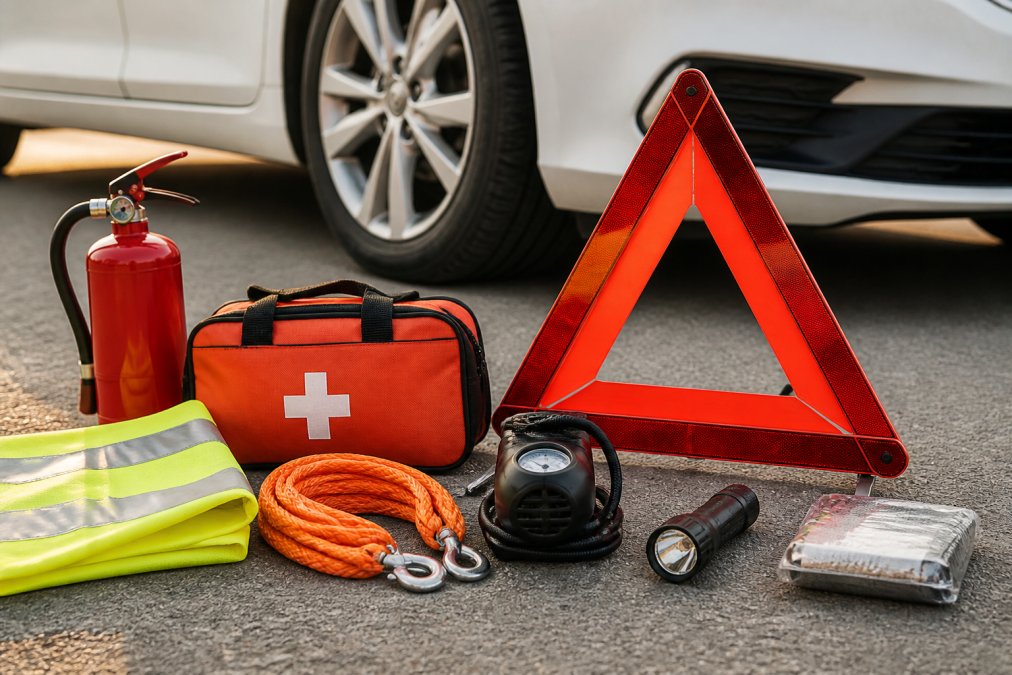
Correct kit is not optional, and the list is longer than most drivers expect. Beyond the beacon or triangle, Spanish rules expect a reflective high-visibility vest for each occupant, stored inside the cabin rather than the boot, plus a spare wheel or repair kit and the tools to change it.
A basic compliance kit should include:
- High-visibility vest for every occupant, kept in the cabin
- Warning triangle for foreign-registered vehicles
- A DGT-approved V-16 beacon if your vehicle requires one
- Spare wheel or tyre repair kit and a working jack
- A torch and a first-aid kit
4. Keep Your Vehicle’s ADAS and Safety Tech Maintained
Advanced driver assistance systems only help if they work. Modern cars rely on cameras, radar and sensors for emergency braking, lane keeping and blind-spot warnings, and these need clean sensors and current software to function.
What to do before a long drive:
- Clean the windscreen area around the camera and the front grille sensors
- Check that no warning lights are lit on the dashboard
- Book any software updates the manufacturer has released
- Have the alignment checked if the car pulls or the lane warning misbehaves
5. Driving in Spain Checklist for UK Motorists
A driving in Spain checklist for UK motorists saves you from the fines and arguments that come with missing paperwork. The essentials: your full UK driving licence, the vehicle’s V5C logbook, proof of insurance valid in Spain, and your passport.
Documents to carry
- Full UK photocard licence, plus your DVLA check code if hiring
- V5C registration document for your own vehicle
- Insurance certificate showing European cover
- Passport or national ID for each occupant
- European breakdown cover documents
- GB sticker or UK identifier on the number plate
Equipment to carry
- High-visibility vest for every occupant, kept in the cabin rather than the boot
- Warning triangle for foreign-registered vehicles (two if towing)
- A DGT 3.0 compliant V-16 beacon if your vehicle requires one
- Headlamp beam deflectors for right-hand-drive cars
- Spare wheel or tyre repair kit and a working jack
- Torch and first-aid kit
Rental car drivers: who is responsible for the beacon?
This question catches most visitors. When you collect a hire car in Spain, the vehicle is Spanish-registered, so the connected V-16 requirement applies to the car, and responsibility for a compliant beacon sits with the hire company, not you. Most major hire companies now fit one.
- Open the glovebox and confirm a beacon is present.
- Switch it on and confirm a clear amber flash.
- If it is a connected unit, confirm the status indicator shows a live connection.
- Ask the desk to note any missing or faulty beacon on your rental agreement before you drive away.
Placement and installation
Correct placement matters as much as having the device. The beacon goes on the roof, on a magnetic base, as close to the centre as the roof shape allows. Reach out of the window to place it rather than stepping onto the carriageway. Once it is on:
- Switch on your hazard lights.
- Put on your high-visibility vest before opening the door.
- Stay inside the vehicle if it is safe to do so, and exit on the side away from traffic only if you must.
The paperwork and equipment check takes ten minutes and prevents the most common roadside problem for UK visitors: a fine for missing equipment that was never in the car to begin with. For rental drivers, the beacon is the hire company’s responsibility, but confirming it works is yours.
6. Arrange European Breakdown Cover Before You Travel
European breakdown cover is the difference between a two-hour delay and a ruined trip. Without it, a motorway recovery can cost more than the holiday. With it, you get a local recovery partner, an English-speaking helpline and, if needed, vehicle repatriation.
| Provider | Starting price | Standout feature | Watch out for |
|---|---|---|---|
| RAC European Breakdown Cover | From £60/year | 24/7 English-speaking helpline | Cost varies with vehicle age |
| AA European Breakdown Cover | From £55/year | Includes legal support | Parts and labour not covered |
7. Maintain Your Vehicle to Pass the ITV Inspection
The ITV is Spain’s mandatory technical inspection, the local equivalent of the UK MOT. For residents with Spanish-registered cars, passing it is a legal requirement. For visitors, a valid MOT keeps your UK vehicle legal.
Common reasons vehicles fail:
- Worn brake pads or discs
- Blown or misaligned lights
- Emissions above the limit
- Cracked windscreen in the driver’s line of sight
- Worn tyres below the legal tread depth
Frequently Asked Questions
Is the DGT 3.0 beacon mandatory in Spain from 2026?
From 1 January 2026, all passenger cars and vans in Spain must carry a DGT 3.0 connected V-16 beacon. The traditional warning triangle is being phased out for breakdown signalling. The beacon must be approved by the DGT and feature GPS/geolocation and real-time connectivity to alert traffic authorities. Non-compliance can result in fines, so drivers should ensure their beacon meets the technical specifications before travelling.
What are the V-16 emergency light requirements for 2026?
A compliant V-16 emergency light must have a magnetic base for roof mounting, emit an amber flashing light visible from 360 degrees, and include DGT 3.0 connectivity for real-time traffic alerts. It must be approved by the Spanish traffic authority and carry the official certification mark. The device should be placed on the vehicle roof, not on the ground, and must be capable of transmitting the vehicle’s location to emergency services if activated.
Do UK-registered vehicles need to comply with Spanish safety regulations?
Yes. Any vehicle driven on Spanish roads, including UK-registered cars, must comply with Spanish traffic law. This includes having a warning triangle for temporary use until the deadline, and carrying a reflective vest and spare bulbs. UK motorists should also carry their V5C logbook, insurance certificate, and a valid UK driving licence. Non-compliance can lead to on-the-spot fines.
What should be on a driving in Spain checklist for UK motorists?
A driving in Spain checklist for UK motorists should include: a DGT 3.0 compliant V-16 beacon (if your vehicle requires one), a warning triangle, reflective vests for all occupants, spare bulbs, and a first-aid kit. Also carry your V5C, insurance, driving licence, and a European breakdown cover policy. Check headlamp beam deflectors, ensure your vehicle is ITV-compliant if registered in Spain, and familiarise yourself with local speed limits and LEZ rules.
How do V-16 emergency beacons improve road safety?
V-16 emergency beacons improve road safety by providing a high-visibility amber flashing light that can be seen from a distance, reducing the risk of collisions with stationary vehicles. Unlike warning triangles, they are placed on the vehicle roof, so drivers do not need to exit the car in dangerous traffic. DGT 3.0 connected beacons also send real-time location data to traffic authorities, speeding up emergency response and warning other drivers via navigation apps.