

Warnlight vs LED-GPS: Safety Comparison 2026
Table of Contents
- What are V16 warning lights and how do they differ from basic hazard systems?
- Best LED road safety beacons 2026: Key features compared
- DGT 3.0 compliant emergency beacons: Understanding legal requirements
- LED-GPS safety beacons vs traditional warning lights: The visibility advantage
- How to use emergency warning lights effectively on motorways
- GPS and IoT connectivity: Real-world impact on emergency response
- Battery life, durability and weatherproofing: What matters in a breakdown
- Making your choice: LED-GPS safety beacons for your situation
Last Updated: August 22, 2026
What are V16 warning lights and how do they differ from basic hazard systems?
V16 emergency beacons deliver 360-degree visibility with far greater light intensity than standard hazard lights, engineered specifically for roadside emergencies on busy motorways. A standard hazard light system relies on your vehicle’s electrical supply and is designed for close-range visibility. V16 warning lights produce a luminous signal visible up to 1 kilometre in all directions, even in poor weather or darkness, giving approaching drivers critical seconds to slow down (the CDC).
Modern V16 systems introduce connectivity that traditional hazard lights cannot provide. A GPS-enabled V16 beacon like the Roadflash V16 Emergency Beacon DGT 3.0 with GPS/Geolocation transmits your exact location to traffic authorities every 100 seconds. In Spain, DGT 3.0 compliance (effective from 1 January 2026) mandates that emergency beacons meet specific technical standards for light output, durability, and geolocation capability. Basic hazard systems don’t meet these requirements.
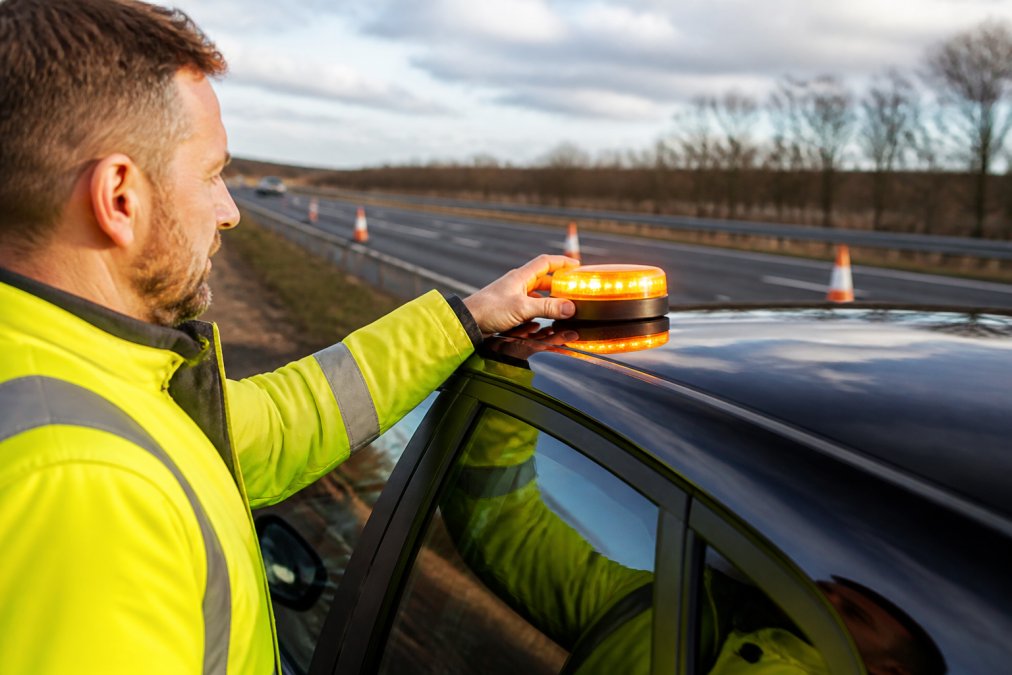
V16 warning lights offer 360-degree visibility up to 1 kilometre and, in modern variants, automatic geolocation reporting to traffic authorities. Standard hazard lights are passive, short-range, and provide no emergency service coordination.
Best LED road safety beacons 2026: Key features compared
Three features separate genuinely effective beacons from adequate ones: light intensity measured in candelas, battery longevity under real-world conditions, and mounting flexibility.
Light intensity determines visibility in critical conditions. Leading beacons in 2026 deliver 50-100+ candelas, ensuring the flashing pattern cuts through poor visibility (peer-reviewed research). Battery life is where many LED beacons fail in practice. Rechargeable systems using lithium-ion cells typically outperform disposable alternatives because you control the charging cycle. USB recharging adds convenience; you’re not hunting for replacement batteries on the motorway.
Mounting flexibility determines whether you’ll actually use the device. Magnetic bases work on any metal surface and require no tools. Durability ratings (IP waterproofing codes) reveal how a beacon handles motorway conditions. An IP67 rating means the device survives temporary immersion in water and resists dust, essential for devices that sit on vehicle roofs in all weather.
| Feature | Roadflash Hazard Warning Light | Roadflash V16 DGT 3.0 | OSRAM LEDguardian V16 IoT |
|---|---|---|---|
| Light Intensity | High (multiple modes) | 360° visibility to 1km | Enhanced visibility, all directions |
| Battery Type | Rechargeable lithium 750mAh | Integrated SIM, long-term connectivity | Built-in SIM card, years of service |
| Mounting Options | Magnetic base | Magnetic & suction | Magnetic base |
| Waterproofing | IP-rated for weather resistance | DGT 3.0 certified durability | strong design for durability |
| Geolocation | No | Yes (DGT 3.0 transmission) | Yes (IoT connectivity) |
| Best For | General breakdown visibility | Spain/EU travel, legal compliance | Advanced connectivity, European roads |
Choose a rechargeable beacon if you drive regularly. The upfront cost is offset by never needing to replace batteries and knowing your device is charged and ready when you need it.
DGT 3.0 compliant emergency beacons: Understanding legal requirements
DGT 3.0 compliance is mandatory for drivers in Spain or those regularly crossing Spanish borders. From 1 January 2026, the Spanish Dirección General de Tráfico (DGT) requires emergency beacons to meet specific technical and connectivity standards.
The DGT 3.0 standard mandates three core requirements: sufficient light intensity visible up to 1 kilometre in daylight and poor weather; geolocation data transmission sending GPS coordinates to the DGT cloud infrastructure every 100 seconds when activated; and ruggedised design to IP standards with integrated connectivity and no additional subscription required for a defined period.
When you break down on a motorway in Spain, activating your beacon transmits your exact location to traffic authorities and emergency services within seconds. Approaching drivers receive automated alerts about the hazard ahead. The Roadflash V16 Emergency Beacon DGT 3.0 with GPS/Geolocation meets these requirements fully, including an integrated SIM card with connectivity fees covered until at least 2038.
Devices without DGT 3.0 certification may incur fines if you’re stopped in Spain. More importantly, they don’t transmit your location to emergency services, leaving you vulnerable during a breakdown on a crowded motorway.
LED-GPS safety beacons vs traditional warning lights: The visibility advantage
The visibility advantage of LED-GPS beacons over traditional warning lights is transformative in critical scenarios. On a rain-soaked motorway at dusk, a traditional hazard light becomes nearly invisible beyond 50 metres. An LED-GPS beacon with 360-degree visibility and 1-kilometre range cuts through that chaos.
A vehicle travelling at 70 mph covers 31 metres per second (nhtsa.gov). At 100 metres away, a driver has roughly 3 seconds to react. Traditional lights may not be visible at that distance in poor conditions. A 1-kilometre-range beacon gives drivers 30+ seconds of warning, the difference between a controlled slowdown and a collision.
LED-GPS beacons introduce automatic alert transmission. When a Roadflash V16 beacon activates, it transmits geolocation data to traffic authorities, who can issue dynamic alerts to approaching drivers through variable message signs and navigation systems. The optical difference is measurable: LED-GPS beacons use focused optics with brightness of 50-100+ candelas versus traditional lights at typically 10-20 candelas, creating faster driver response.
How to use emergency warning lights effectively on motorways
Using an emergency warning light effectively on a motorway requires understanding both deployment and positioning.
Step 1: Activate immediately upon breakdown. The moment your vehicle becomes stationary, activate your beacon so emergency services and approaching drivers know about the hazard.
Step 2: Position the beacon on the highest visible point of your vehicle. This typically means the roof or rear wing, ensuring the 360-degree light pattern reaches approaching traffic without obstruction.
Step 3: Ensure the beacon has clear sight lines. If your vehicle is parked in a dip or behind a curve, position the beacon as high as possible.
Step 4: Stay inside your vehicle or behind the safety barrier. Do not stand in the traffic lane. Modern LED-GPS beacons eliminate this risk; they work from inside your vehicle or from a safe position.
Step 5: Keep the beacon activated until help arrives. A rechargeable beacon like the Roadflash Hazard Warning Breakdown Light delivers 9-50 hours depending on the flashing mode.
Step 6: Activate geolocation features if your beacon includes them. For a DGT 3.0 compliant beacon, geolocation transmission begins automatically upon activation.
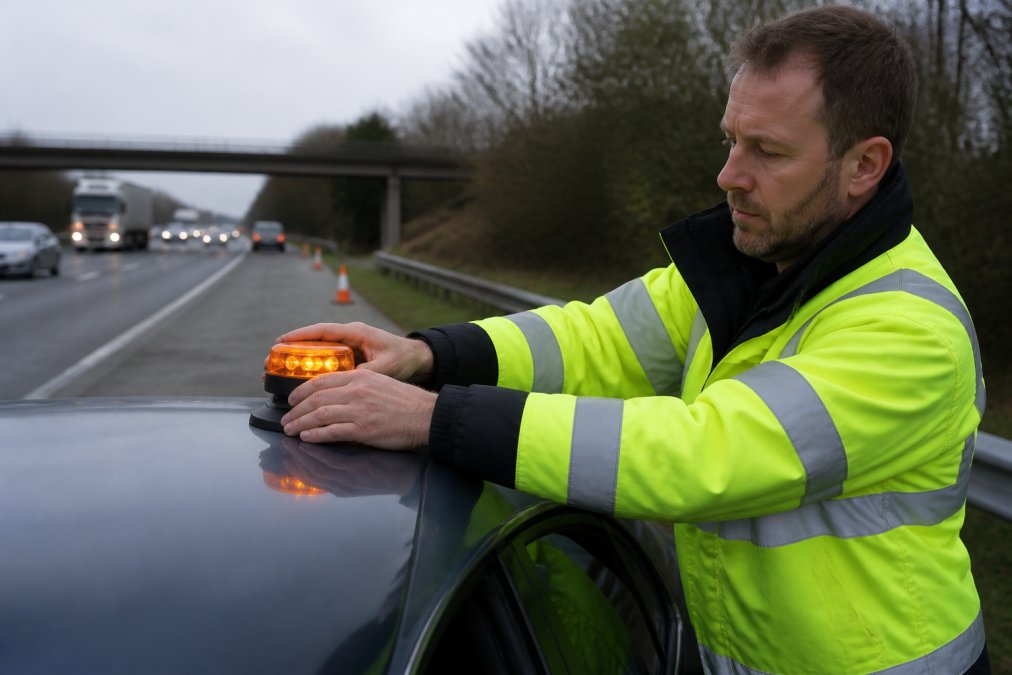
Test your beacon before a motorway journey. Ensure it’s charged, the magnetic mount is secure, and you understand the activation procedure.
GPS and IoT connectivity: Real-world impact on emergency response
GPS and IoT connectivity in modern emergency beacons fundamentally changes how emergency response works. Rather than relying on a driver’s ability to communicate their location while stressed or injured, the beacon communicates automatically.
When a Roadflash V16 Emergency Beacon with GPS/Geolocation activates, it transmits precise coordinates to the DGT cloud infrastructure every 100 seconds. Emergency services receive real-time location data without a phone call. This matters most when traditional communication fails: a dazed driver may not remember their location, a remote section may have weak mobile signal, or a driver may be unconscious. GPS transmission bypasses these barriers.
Emergency response data shows that automatic geolocation transmission reduces emergency service arrival time significantly. When responders know the exact location before dispatch, they route directly rather than searching. When approaching drivers receive alerts, they avoid secondary collisions.
One limitation: DGT 3.0 geolocation currently transmits to Spanish traffic centres. If you break down in France, your beacon’s GPS data doesn’t feed into French emergency systems. However, the beacon’s high-visibility light still functions, and you can call emergency services with your location. The geolocation benefit is most complete within Spain; the visibility benefit is universal.
Battery life, durability and weatherproofing: What matters in a breakdown
Battery life, durability, and weatherproofing determine whether your emergency beacon actually works when you need it. Rechargeable lithium-ion beacons typically outperform disposable alternatives because you control the charging cycle. A device sitting in your vehicle for years with old batteries is a liability; a device you charge monthly is reliable.
Weatherproofing is measured using IP (Ingress Protection) ratings. An IP67 rating means the device survives temporary immersion in water and resists dust. An IP54 rating offers splash resistance but may fail under heavy spray from passing vehicles. On a motorway, your beacon will face rain, spray, temperature extremes, and wind. IP67 is the minimum acceptable standard.
Durability extends beyond waterproofing. The lens must resist UV degradation. The mounting mechanism must survive repeated attachment and detachment. The flashing circuit must tolerate temperature swings from -10°C to +50°C without failure. The cost of durability is justified: a beacon that works for five years is cheaper per year than a beacon that fails after two years.
Making your choice: LED-GPS safety beacons for your situation
Choosing between beacon types depends on your driving patterns, regulatory environment, and risk tolerance.
Choose a GPS-enabled DGT 3.0 compliant beacon if: You drive regularly in Spain or cross Spanish borders, value automatic emergency service coordination, or want the highest visibility advantage combined with geolocation transmission. The Roadflash V16 Emergency Beacon DGT 3.0 with GPS/Geolocation is purpose-built for this scenario.
Choose a high-visibility LED beacon without GPS if: You drive primarily in the UK and don’t cross into Spain, want excellent visibility without the geolocation layer, or prefer a simpler device with fewer moving parts. The Roadflash Hazard Warning Breakdown Light delivers outstanding visibility and rechargeable convenience.
Avoid basic warning triangles or low-intensity LED beacons if: You drive motorways regularly, value rapid emergency response, or want to meet evolving European safety standards.
The decision hinges on three questions: Do you cross into Spain or other countries with DGT 3.0 requirements? How often do you drive motorways? How much is automatic emergency service coordination worth to you? Roadflash offers both options, with the Roadflash V16 Emergency Beacon DGT 3.0 with GPS/Geolocation representing the most advanced option.
Modern motorway safety demands more than your vehicle’s built-in hazard lights can provide. Whether you choose a high-visibility LED beacon or a GPS-enabled DGT 3.0 compliant system, the key is choosing a device engineered for real-world motorway conditions and actually using it. Roadflash’s multi-award-winning emergency beacons, including the V16 Emergency Beacon DGT 3.0 with GPS/Geolocation and the Hazard Warning Breakdown Light, deliver the visibility, durability, and emergency coordination that modern motorway safety requires. Get started with Roadflash and ensure that when you break down, emergency services know exactly where you are and approaching drivers see your hazard clearly.
=== FAQ ANSWERS (audit these too, same rules) ===
[1] Q: What is the difference between a standard warning light and a GPS-enabled LED-GPS safety beacon?
A: Standard warning lights emit a flashing signal to alert approaching drivers but do not transmit your location to emergency services. LED-GPS safety beacons combine high-visibility lighting with geolocation technology that automatically sends your exact coordinates to traffic authorities and emergency services. This dual functionality means help can find you faster, especially critical on motorways where breakdowns pose serious collision risks. The GPS element also reduces the time you spend exposed outside your vehicle.
[2] Q: Are DGT 3.0 compliant emergency beacons mandatory in the UK, or only in Spain?
A: DGT 3.0 compliance is currently a legal requirement in Spain under Dirección General de Tráfico regulations effective from January 2026. In the UK, there is no mandatory requirement for GPS-enabled beacons, though high-visibility warning lights remain essential. However, if you frequently travel to Spain or other EU countries adopting similar standards, a DGT 3.0 compliant beacon ensures you meet legal obligations across borders and benefit from enhanced safety features wherever you drive.
[3] Q: How does geolocation technology actually improve emergency response times for stranded motorists?
A: When you activate a GPS-enabled beacon, it transmits your vehicle’s precise location to traffic management centres every 100 seconds. This eliminates the need for you to describe your location or flag down passing vehicles, which is dangerous on motorways. Emergency services receive your coordinates directly, reducing response time by minutes. In poor visibility, fog, or at night, geolocation ensures rescuers find you even if your vehicle is difficult to spot, significantly improving safety outcomes during breakdowns.
[4] Q: Do LED-GPS beacons require an ongoing subscription, or is connectivity included?
A: This depends on the specific beacon model. Many modern LED-GPS safety beacons include integrated SIM cards with connectivity fees built in, often covering several years with no additional cost. Others may require separate subscription arrangements. Before purchasing, confirm whether connectivity is included in the purchase price or if ongoing charges apply. This affects your total cost of ownership and whether the beacon will function reliably when you need it most.
[5] Q: I drive motorways twice a week but rarely break down, is an LED-GPS beacon really necessary for occasional users?
A: Even infrequent motorway users face serious risk during a breakdown. A single stationary vehicle on a busy motorway can cause multi-vehicle collisions at high speed. An LED-GPS beacon dramatically increases your visibility and ensures emergency services can locate you quickly, whether you break down once a year or once a month. The cost is modest insurance against a potentially life-threatening situation. Professional drivers and occasional users benefit equally from the protection it provides.
Frequently Asked Questions
What is the difference between a standard warning light and a GPS-enabled LED-GPS safety beacon?
Standard warning lights emit a flashing signal to alert approaching drivers but do not transmit your location to emergency services. LED-GPS safety beacons combine high-visibility lighting with geolocation technology that automatically sends your exact coordinates to traffic authorities and emergency services. This dual functionality means help can find you faster, especially critical on motorways where breakdowns pose serious collision risks. The GPS element also reduces the time you spend exposed outside your vehicle.
Are DGT 3.0 compliant emergency beacons mandatory in the UK, or only in Spain?
DGT 3.0 compliance is currently a legal requirement in Spain under Dirección General de Tráfico regulations effective from January 2026. In the UK, there is no mandatory requirement for GPS-enabled beacons, though high-visibility warning lights remain essential. However, if you frequently travel to Spain or other EU countries adopting similar standards, a DGT 3.0 compliant beacon ensures you meet legal obligations across borders and benefit from enhanced safety features wherever you drive.
How does geolocation technology actually improve emergency response times for stranded motorists?
When you activate a GPS-enabled beacon, it transmits your vehicle's precise location to traffic management centres every 100 seconds. This eliminates the need for you to describe your location or flag down passing vehicles, which is dangerous on motorways. Emergency services receive your coordinates directly, reducing response time by minutes. In poor visibility, fog, or at night, geolocation ensures rescuers find you even if your vehicle is difficult to spot, significantly improving safety outcomes during breakdowns.
Do LED-GPS beacons require an ongoing subscription, or is connectivity included?
This depends on the specific beacon model. Many modern LED-GPS safety beacons include integrated SIM cards with connectivity fees built in, often covering several years with no additional cost. Others may require separate subscription arrangements. Before purchasing, confirm whether connectivity is included in the purchase price or if ongoing charges apply. This affects your total cost of ownership and whether the beacon will function reliably when you need it most.
I drive motorways twice a week but rarely break down, is an LED-GPS beacon really necessary for occasional users?
Even infrequent motorway users face serious risk during a breakdown. A single stationary vehicle on a busy motorway can cause multi-vehicle collisions at high speed. An LED-GPS beacon dramatically increases your visibility and ensures emergency services can locate you quickly, whether you break down once a year or once a month. The cost is modest insurance against a potentially life-threatening situation. Professional drivers and occasional users benefit equally from the protection it provides.
This article was written using GrandRanker