

GPS-Enabled Hazard Lights: Why Choose Them
Table of Contents
- Why GPS-Enabled Hazard Lights Matter for Motorway Safety
- How Does GPS Emergency Tracking Work in Hazard Beacons
- The Critical Difference: Standard Hazard Lights vs GPS-Enabled Beacons
- DGT 3.0 Compliant Emergency Beacons and Legal Requirements
- Best Practices for Motorway Breakdown Safety with Emergency Lighting
- Real-World Impact: How Geolocation Reduces Response Times
- Choosing GPS-Enabled Hazard Lights for Your Safety Needs
- Conclusion
Why GPS-Enabled Hazard Lights Matter for Motorway Safety
When your vehicle breaks down on a busy motorway, seconds matter. A stationary car becomes an invisible hazard to drivers approaching at high speed, particularly in poor visibility or darkness. Standard hazard lights flash at a frequency designed decades ago, visible only to vehicles close enough to react. GPS-enabled hazard lights combine visual warning with precise geolocation data that alerts emergency services and nearby drivers to your exact location before they can even see your vehicle.
GPS-enabled hazard lights create a multi-layer safety system: visual signalling combined with automated location broadcasting and emergency alert integration.
GPS-enabled beacons transmit your location continuously, not just when someone spots your vehicle. This means help is already being routed to you while you’re still assessing the situation after a breakdown.
How Does GPS Emergency Tracking Work in Hazard Beacons
GPS emergency tracking in modern hazard beacons operates on a principle of redundancy and speed. When you activate the beacon, it immediately locks onto satellite positioning data and begins broadcasting your coordinates through multiple channels simultaneously.
The system works in three stages. First, the beacon’s GPS module calculates your position with accuracy typically within 5-10 metres. Second, that location data transmits via cellular networks or dedicated emergency protocols to a monitoring centre or emergency services. Third, the beacon continues transmitting at intervals, updating your position if you move or conditions change.
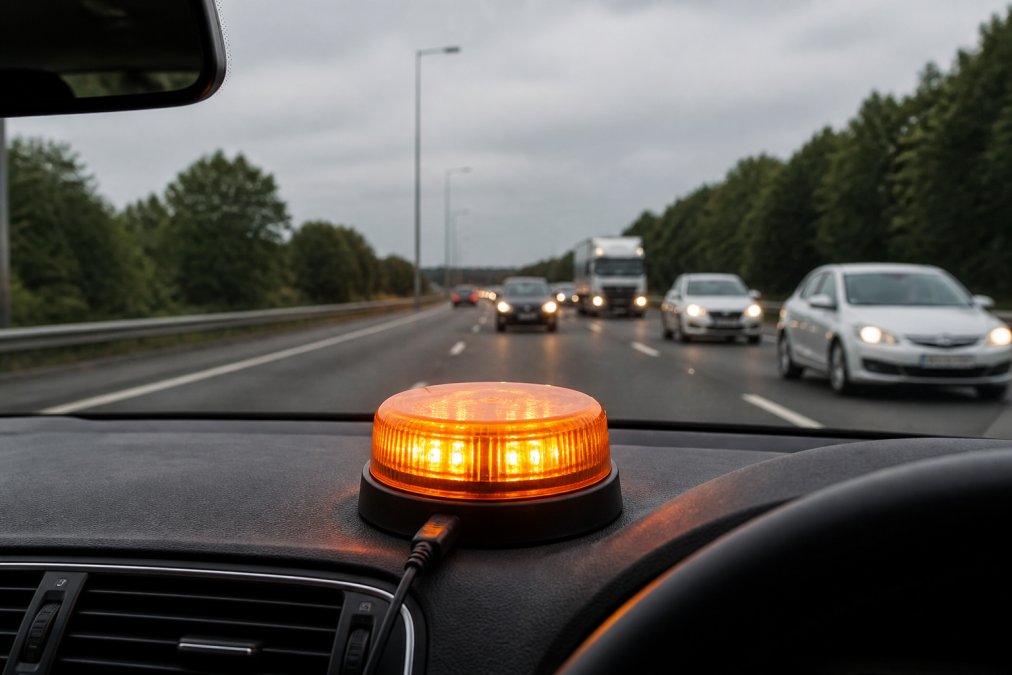
What makes this different from calling emergency services is the elimination of communication delay. When you’re disoriented, injured, or in shock after an incident, explaining your location accurately becomes difficult. GPS does that work automatically. The beacon’s geolocation data reaches responders instantly, without relying on your ability to describe where you are or your mobile phone signal.
Battery life must sustain continuous transmission; most quality beacons maintain 8-24 hours of operation on a single charge. Connectivity requires either cellular coverage or dedicated emergency frequency access. Roadflash’s DGT 3.0 compliant emergency beacons address these requirements through redundant power systems, multi-band transmission capabilities, and high-visibility LED arrays that work independently of electronic systems.
GPS emergency tracking eliminates the communication bottleneck that delays response times. Your location reaches responders automatically, without requiring you to communicate clearly during a stressful situation.
The Critical Difference: Standard Hazard Lights vs GPS-Enabled Beacons
Standard hazard lights fulfil a basic legal requirement: they warn approaching drivers that your vehicle is stationary or in distress. They flash at a standardised rate, visible from roughly 100-150 metres in daylight and somewhat less in darkness. They work without batteries, relying on your vehicle’s electrical system.
GPS-enabled hazard lights retain all these functions but add critical capabilities. They broadcast your exact position to emergency services, not just visual warning to other drivers. They work in zero visibility, fog, heavy rain, or darkness, because they don’t depend on approaching drivers seeing your light. They provide automated incident reporting and create a record of the incident, including time, location, and sometimes vehicle telemetry data.
Consider a practical scenario: your vehicle breaks down in heavy fog on a motorway at night. Standard hazard lights flash, but visibility extends only 30-40 metres. An approaching HGV driver at 60 mph has roughly two seconds to see your vehicle and brake. GPS-enabled beacons transmit your location to emergency services, alert nearby vehicles through connected-car networks where available, and provide recovery services with your exact coordinates. Emergency services already know where you are and are en route.
This difference becomes critical in high-speed environments. Motorways concentrate fast-moving vehicles in narrow lanes with limited stopping distance. A standard hazard light provides warning only to vehicles close enough that reaction becomes physically difficult. A GPS beacon provides information at distance, allowing emergency services to prepare and other road users to adjust speed before they reach your location.
DGT 3.0 Compliant Emergency Beacons and Legal Requirements
GPS-enabled hazard lights must navigate a complex regulatory landscape. For drivers operating in Spain or across European motorways, DGT 3.0 compliance becomes a legal requirement, not an optional feature.
DGT 3.0 (Dirección General de Tráfico 3.0) specifies strict standards for emergency beacons used on Spanish roads: minimum light intensity, flash frequency, colour specifications, mounting requirements, GPS accuracy thresholds, and approved transmission channels.
Compliance matters because non-compliant beacons can result in fines, confiscation of equipment, and potential liability if an incident occurs. Insurance claims may be denied if your safety equipment doesn’t meet applicable standards.
Roadflash’s emergency beacons are engineered to DGT 3.0 specifications, meeting light intensity requirements, regulated flash frequency, GPS data transmission through approved emergency networks, and secure mounting according to specification. Beyond DGT 3.0, UK regulations require that hazard lights function independently of your vehicle’s main electrical system during emergencies, meaning battery-powered beacons must maintain charge and functionality even if your vehicle’s battery is depleted.
Using non-compliant beacons in regulated jurisdictions can result in fines up to £1,000 and confiscation of equipment. More critically, if your beacon doesn’t meet legal standards and an incident occurs, your insurance may deny claims and liability may fall on you rather than approaching drivers.
Best Practices for Motorway Breakdown Safety with Emergency Lighting
Motorway breakdowns require a sequence of actions designed to move you and your vehicle out of the collision hazard zone as quickly as possible. GPS-enabled hazard lights form part of this sequence, but they work most effectively when combined with other safety practices.
First, activate your hazard lights immediately. If your vehicle has GPS-enabled beacons, activate those simultaneously; they begin transmitting your location to emergency services at this moment. Second, move yourself and passengers out of the vehicle and away from the traffic lane. Stand behind your vehicle or on the hard shoulder, never between your vehicle and approaching traffic. Third, contact emergency services if you have mobile signal. The GPS beacon has already transmitted your location automatically. Fourth, deploy a reflective warning triangle if you carry one and can do so safely, placed 45 metres behind your vehicle.
GPS-enabled beacons improve this sequence by removing the communication delay. Traditional breakdowns require you to call emergency services and explain your location. GPS beacons transmit your location automatically, allowing emergency services to dispatch resources while you’re still moving to safety.
Real-World Impact: How Geolocation Reduces Response Times
When emergency services receive a call with verbal location information, they must interpret that information, verify it against dispatch systems, and route resources. This process typically takes 3-5 minutes before a vehicle is even dispatched.
When emergency services receive GPS coordinates from a beacon, dispatch begins immediately. The location is precise, verified, and doesn’t require interpretation. Dispatch systems can plot exact coordinates on mapping software and route the nearest available resource instantly. This reduces pre-dispatch time from 3-5 minutes to 30-60 seconds.
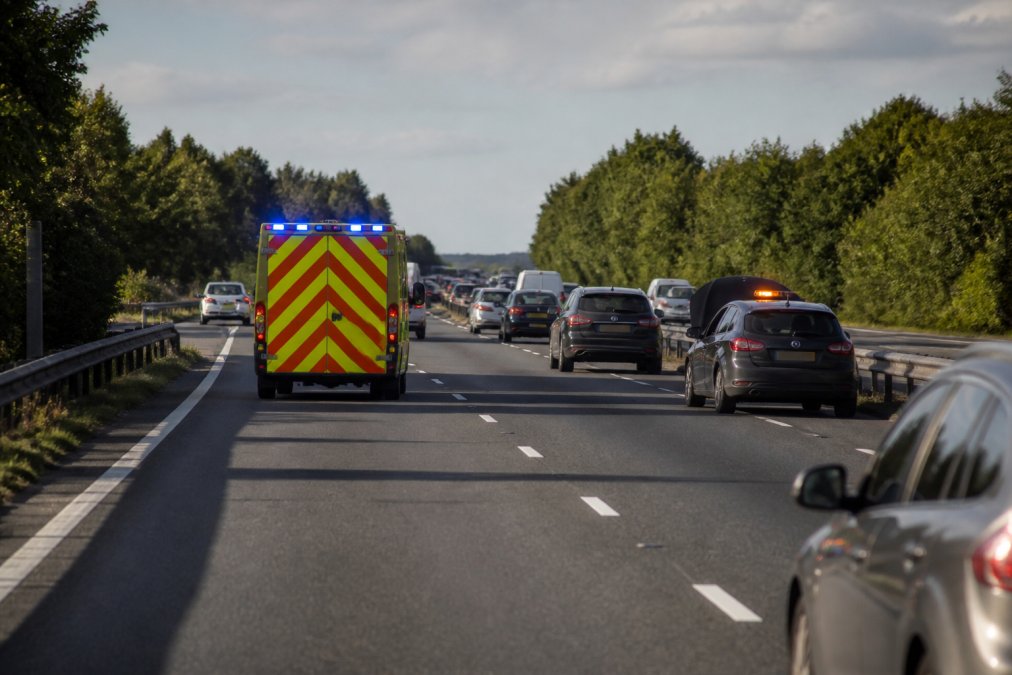
On a motorway where 15-20 vehicles pass any given point per minute at peak hours, a 3-5 minute dispatch delay creates a window where dozens of vehicles approach an unwarned hazard. A 30-60 second dispatch window reduces that exposure significantly. GPS-enabled beacons also transmit updated coordinates continuously, ensuring emergency services respond to the actual incident location, not where the breakdown occurred.
Choosing GPS-Enabled Hazard Lights for Your Safety Needs
Selecting GPS-enabled hazard lights requires evaluating factors specific to your driving patterns and risk profile. If you commute on motorways twice weekly or more, GPS-enabled beacons provide insurance against the statistical likelihood of experiencing a breakdown. If you drive professionally, fleet operations, or in high-traffic corridors during peak hours, GPS-enabled beacons reduce your exposure to secondary collisions.
If you travel alone, GPS-enabled beacons provide an additional safety layer. A single occupant may be injured, disoriented, or unable to communicate clearly after an incident. GPS beacons communicate your location automatically. If you travel routes with poor mobile signal coverage, GPS-enabled beacons become critical, transmitting through dedicated emergency frequencies that often have better coverage than commercial mobile networks.
Roadflash’s GPS-enabled beacons combine high-visibility LED arrays with strong GPS transmission and battery systems engineered for reliability in emergency situations. When evaluating GPS-enabled beacons, verify that the system meets legal requirements for your jurisdiction, that battery life sustains continuous operation for at least 12 hours, that GPS accuracy meets emergency services standards, and that the activation mechanism is intuitive enough to work under stress.
Frequent motorway commuters, professional drivers, fleet operators, and anyone who drives alone on high-speed roads. GPS-enabled beacons provide the greatest safety advantage in peak-hour traffic, poor visibility conditions, and areas with limited mobile signal coverage.
When a breakdown happens on a motorway, every second shapes the outcome. Standard hazard lights provide basic warning, but GPS-enabled beacons provide active protection. Roadflash’s multi-award-winning emergency beacons combine high-visibility LED arrays with precise geolocation and DGT 3.0 compliance, ensuring emergency services reach you quickly and other drivers have maximum warning. For motorists who value safety, GPS-enabled hazard lights are essential infrastructure. Add Roadflash GPS-enabled hazard lights to your vehicle and transform your breakdown from a high-risk situation into a managed incident with professional response.
Frequently Asked Questions
How do GPS-enabled hazard lights improve emergency response times?
GPS-enabled emergency beacons transmit your exact location to emergency services automatically when activated, eliminating the time spent describing your position or waiting for responders to locate you. This is especially critical on motorways where vehicles are spread across multiple lanes and visibility is limited. Real-time geolocation allows recovery teams and emergency services to reach you faster, reducing your exposure to high-speed traffic and improving overall safety during a breakdown.
What is the difference between standard hazard lights and GPS-enabled beacons?
Standard hazard lights alert nearby drivers to your presence but do not communicate your location to emergency services. GPS-enabled hazard lights combine visual signalling with automatic geolocation transmission, creating a dual-layer safety system. When activated, they broadcast your precise coordinates to emergency responders and roadside assistance networks, enabling faster recovery and medical response. This technology is particularly valuable on busy motorways where traditional visual signals alone may not be sufficient to prevent rear-end collisions.
Are GPS-enabled emergency beacons legal for use on motorways?
Yes, GPS-enabled emergency beacons are legal in the UK for use on motorways and highways. Many are designed to meet international safety standards, including DGT 3.0 compliance for those operating in Spain and other European jurisdictions. Always verify that the specific beacon you choose complies with current UK road safety regulations and your vehicle's specifications. Roadflash's products are engineered to meet these legal requirements while providing enhanced safety features beyond basic hazard light functionality.
Do GPS-enabled hazard lights require a subscription service?
This depends on the specific product and its features. Some GPS-enabled beacons operate independently with no ongoing subscription, while others may offer optional connected services for enhanced tracking or integration with roadside assistance networks. Check the product specifications carefully and contact Roadflash directly to understand what ongoing costs, if any, apply to your chosen beacon. Many drivers find that the improved safety and faster emergency response justify any additional investment.
This article was written using GrandRanker